
If one parent has sickle cell disease and the other is a sickle cell disease carrier, what percentage of their children may be sickle cell disease carriers?
- (a)25%
- (b)50%
- (c)75%
- (d)100%
Correct — B, 50%. Sickle cell disease is an autosomal recessive condition. A parent with the disease is SS (both copies of the β-globin gene carry the sickle allele) and a carrier — sickle cell trait — is AS. The affected parent can only pass on S; the carrier parent passes A or S with equal chance. The cross SS × AS therefore gives, on average, 50% AS children (carriers) and 50% SS children (disease). No child of this couple can be AA, i.e. completely free of the sickle allele.
- (a)25% — 25% is the affected (SS) share in a different cross — carrier × carrier (AS × AS), which gives 25% AA : 50% AS : 25% SS. It is not the carrier share when one parent is already SS.
- (c)75% — No two-parent cross of this type yields 75% carriers. 75% appears in AS × AS as the proportion of children who are NOT affected (AA plus AS) — a different quantity.
- (d)100% — All children would be carriers only if one parent were SS (diseased) and the other AA (fully normal). Here the second parent is AS, so half the children inherit S from both sides and have the disease rather than the trait.
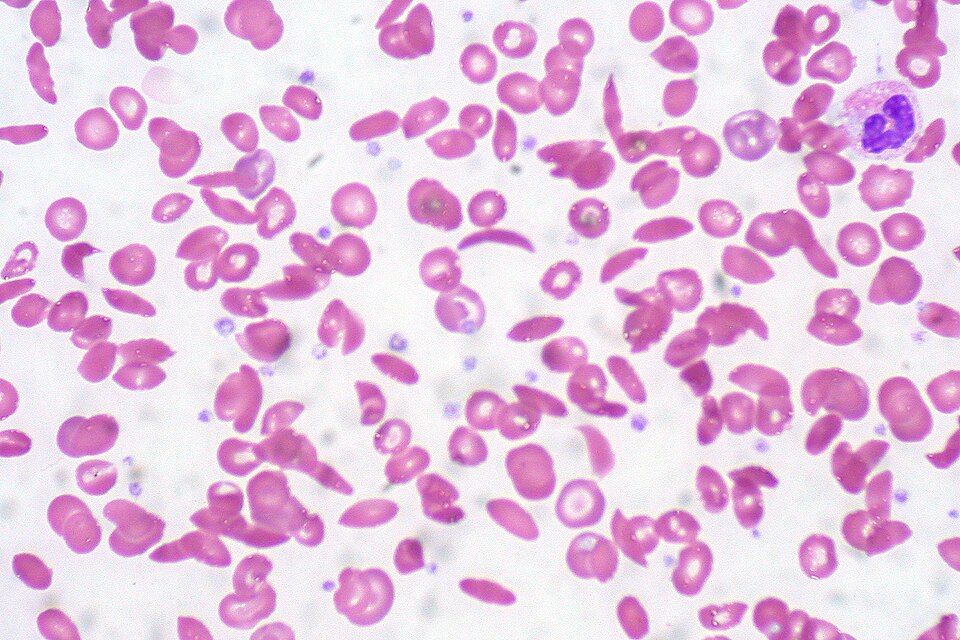
Sickle cell disease comes from a single point mutation in the HBB gene on chromosome 11: glutamic acid is replaced by valine at the sixth position of the β-globin chain, producing haemoglobin S. When deoxygenated, HbS polymerises and distorts red cells into a rigid sickle shape, causing haemolytic anaemia and painful vaso-occlusive crises. Inheritance is autosomal recessive — two copies (SS) give the disease, one copy (AS) gives sickle cell trait, which is usually symptom-free.
Solve it with a two-second Punnett square rather than memory. Write the gametes: affected parent SS gives S, S; carrier parent AS gives A, S. The four combinations are AS, SS, AS, SS — half carriers, half diseased. The tempting error is to reach for the familiar 1:2:1 (25:50:25) ratio, which belongs to the carrier × carrier cross, not this one.
- Autosomal recessive; mutation in the HBB (β-globin) gene — glutamic acid → valine at position 6, producing HbS
- SS (disease) × AS (carrier) → 50% carriers (AS) and 50% affected (SS); no unaffected AA child
- AS × AS → 25% AA : 50% AS (carrier) : 25% SS (disease) — the classic 1:2:1
- Carriers (sickle cell trait) are usually asymptomatic and carry partial protection against falciparum malaria
- India's National Sickle Cell Anaemia Elimination Mission was launched on 1 July 2023 from Shahdol, Madhya Pradesh, targeting elimination by 2047
- Applying the 25:50:25 ratio of a carrier × carrier cross to an affected × carrier cross
- Reading 'carrier' as 'affected' — the question asks for the AS share, not the SS share
- Treating sickle cell disease as sex-linked; it is autosomal, so sons and daughters are equally at risk
MPPSC alternates between a genetics cross like this one and the policy side (mission, launch year, target year), because sickle cell prevalence is high in MP's tribal districts. UPSC has tested the classification of the disease and its inheritance mode.
Which one of the following sets is correctly matched?
- (a) Diphtheria, Pneumonia and Leprosy: Hereditary
- (b) AIDS, Syphilis and Gonorrhoea: Bacterial
- (c) Colour blindness, Haemophilia and Sickle cell anaemia: Sex linked
- (d) Polio, Japanese B encephalitis and plague: Viral
AnswerNone of the options (a-d) is correct — notably (c) fails because sickle cell anaemia is autosomal, not sex-linked.
Same underlying idea — the mode of inheritance of sickle cell anaemia. UPSC tested that it is autosomal (not sex-linked); MPPSC 2026 makes you use that autosomal recessive logic in a cross.
By which year has "National Sickle Cell Anaemia Elimination Mission" fixed the target to eliminate sickle cell anaemia from India ?
- (a) 2032
- (b) 2037
- (c) 2042
- (d) 2047
Answer(d) 2047
MPPSC returns to sickle cell year after year — 2025 tested the elimination mission's target year, 2026 tests the genetics of transmission. Same disease, both halves of the syllabus.
- practice — not a real PYQ
If both parents carry sickle cell trait (both AS), what percentage of their children is expected to have sickle cell disease?
- (a)25%
- (b)50%
- (c)75%
- (d)100%
Answer(a) 25% — AS × AS gives 25% AA, 50% AS (carriers) and 25% SS (disease). - practice — not a real PYQ
People carrying the sickle cell trait (heterozygous AS) are known to have a survival advantage against which disease?
- (a)Tuberculosis
- (b)Malaria
- (c)Cholera
- (d)Kala-azar
Answer(b) Malaria — the trait gives partial protection against Plasmodium falciparum, which is why the allele persists in malaria-endemic populations.