
By which year has "National Sickle Cell Anaemia Elimination Mission" fixed the target to eliminate sickle cell anaemia from India ?
- (a)2032
- (b)2037
- (c)2042
- (d)2047
Correct — D, 2047. The National Sickle Cell Anaemia Elimination Mission, announced in the Union Budget 2023-24 and launched by the Prime Minister at Shahdol in Madhya Pradesh on 1 July 2023, fixes 2047 — India's hundredth year of independence — as the year by which sickle cell anaemia is to be eliminated as a public health problem. Its headline operational target is universal screening of 7 crore people aged 0-40 years in tribal-majority areas across 278 districts of 17 high-focus states, supported by awareness, counselling (including pre-marital genetic counselling) and treatment.
- (a)2032 — Not a target year in this mission or in any allied programme. India's nearer-term disease goals use other years — tuberculosis elimination, for instance, is set at 2025 — and none of them is 2032.
- (b)2037 — A decade short of the actual deadline and not a milestone in any Government of India health document on sickle cell disease.
- (c)2042 — The closest of the wrong options, but still not the number. The mission's horizon is deliberately pegged to the 2047 independence centenary, not to a round figure near it.
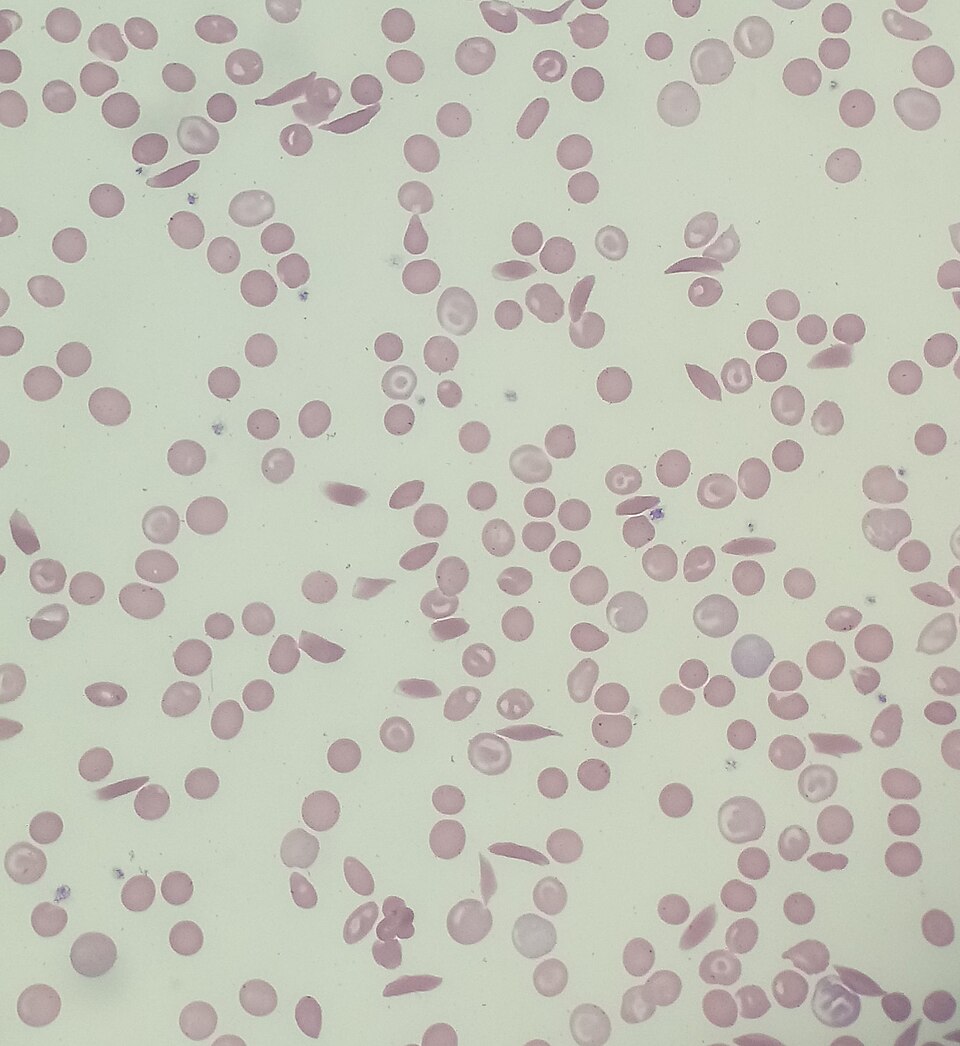
Sickle cell disease is an inherited, autosomal recessive haemoglobin disorder. A single point mutation in the beta-globin gene produces haemoglobin S, which polymerises when oxygen levels fall and deforms red blood cells into a rigid sickle shape. Those cells break down early, causing chronic anaemia, and jam small blood vessels, causing painful vaso-occlusive crises and cumulative organ damage. In India the disease is concentrated among tribal populations of central, western and eastern India — which is why the mission is run jointly by the Ministry of Health and Family Welfare, through the National Health Mission, and the Ministry of Tribal Affairs.
Two signals make this answer recoverable even if the exact figure is not memorised. First, every long-horizon Indian mission announced since 2022 is pegged to 2047, the independence centenary — the 'Amrit Kaal' framing. Second, this is not a nutritional anaemia programme: it is a genetic-disease elimination programme, and eliminating an inherited condition needs a generational timescale of screening and counselling, which rules out a target only seven or ten years away.
- Announced in the Union Budget 2023-24; launched by the Prime Minister at Shahdol, Madhya Pradesh, on 1 July 2023
- Goal: eliminate sickle cell anaemia as a public health problem by 2047, India's centenary of independence
- Operational target: screening 7 crore people aged 0-40 years in 278 districts of 17 high-focus states — Madhya Pradesh, Gujarat, Maharashtra, Chhattisgarh, Jharkhand, Odisha, Rajasthan and others
- Three pillars: health promotion (awareness), prevention (screening, pre-marital genetic counselling) and holistic management and treatment
- The disease: an inherited haemoglobinopathy caused by haemoglobin S from a point mutation in the beta-globin gene; carriers of the sickle cell trait get partial protection against falciparum malaria
- Confusing the launch year (2023) with the target year (2047)
- Treating sickle cell anaemia as a nutritional deficiency — it is genetic, so iron supplementation is not the remedy
- Mixing up sickle cell trait (one copy of the gene, usually symptom-free carrier) with sickle cell disease (two copies)
MPPSC asks the target year, the launch place or the states covered — Madhya Pradesh angles are favoured because the mission was launched from Shahdol; UPSC asks the underlying biology or how the programme is designed.
Consider the following statements in the context of interventions being undertaken under Anaemia Mukt Bharat Strategy : 1. It provides prophylactic calcium supplementation for pre-school children, adolescents and pregnant women. 2. It runs a campaign for delayed cord clamping at the time of child-birth. 3. It provides for periodic deworming to children and adolescents. 4. It addresses non-nutritional causes of anaemia in endemic pockets with special focus on malaria, hemoglobinopathies and fluorosis. How many of the statements given above are correct?
- (a) Only one
- (b) Only two
- (c) Only three
- (d) All four
Answer(c) Only three
The same policy field — a national mission built around anaemia, whose design explicitly reaches beyond diet to non-nutritional causes including haemoglobinopathies, the family sickle cell disease belongs to.
- practice — not a real PYQ
The National Sickle Cell Anaemia Elimination Mission was launched in July 2023 from which city?
- (a)Ranchi
- (b)Shahdol
- (c)Nagpur
- (d)Bhubaneswar
Answer(b) Shahdol, Madhya Pradesh — a tribal-majority district in one of the mission's high-focus states. - practice — not a real PYQ
Sickle cell anaemia in humans is caused by:
- (a)A dietary deficiency of iron
- (b)A point mutation in the beta-globin gene of haemoglobin
- (c)A parasite transmitted by the Anopheles mosquito
- (d)Autoimmune destruction of platelets
Answer(b) A point mutation in the beta-globin gene — it produces haemoglobin S, which distorts red cells into a sickle shape.