
Which of the following rivers had the ancient name Askini?
- (a)Beas
- (b)Chenab
- (c)Jhelum
- (d)Ravi
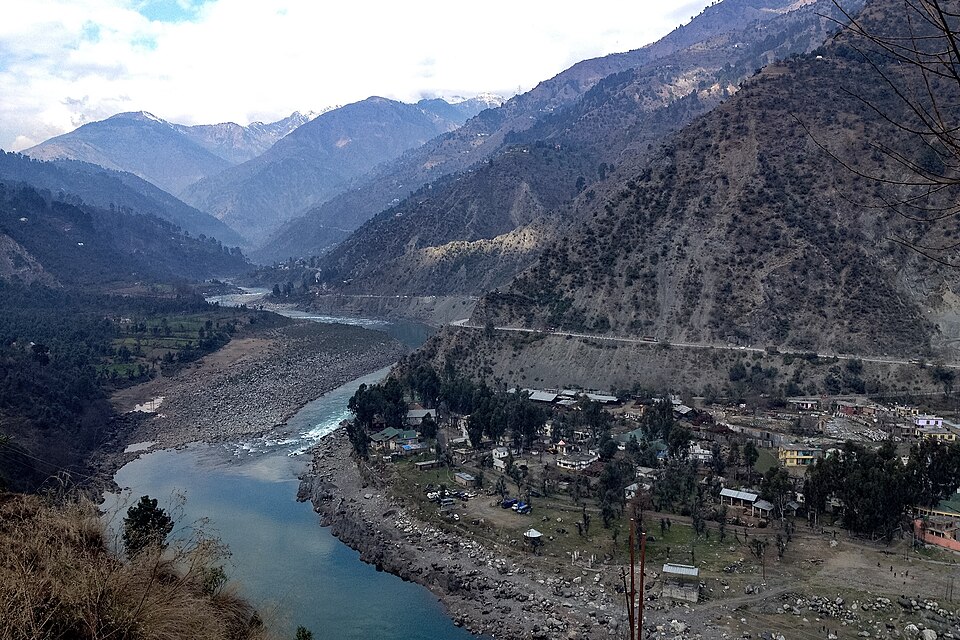
Correct — B, Chenab. In the Rigveda the Chenab is called Asikni (Askini), literally 'the dark one', and the Greeks who came with Alexander rendered the same name as Acesines. The river is born in Himachal Pradesh's Lahaul as two streams, the Chandra and the Bhaga, which meet at Tandi to form the Chandrabhaga — the Chenab — before flowing through the Jammu region into Pakistan. It is the largest of the five Punjab rivers by volume, and the Jhelum, Ravi and Satluj all deliver their water to the Indus through it.
- (a)Beas — The Beas is the Vedic Vipasa (Greek Hyphasis) — the river at which Alexander's army refused to march further east. Not Asikni.
- (c)Jhelum — The Jhelum is the Vedic Vitasta (Greek Hydaspes). This is the standard trap in this question — 'Asikni' is paired with the Jhelum far more often than with the Chenab in students' notes, but Vitasta is the Jhelum and Asikni is the Chenab.
- (d)Ravi — The Ravi is the Vedic Parushni, later Iravati (Greek Hydraotes) — the river on whose banks the Dasarajna, the Battle of Ten Kings, was fought.
Rigvedic geography is built around rivers, and the Nadistuti Sukta (Rigveda 10.75) actually lists them in order from east to west. Each of the five Punjab rivers therefore carries three names a student must be able to switch between: the Vedic name, the Greek name from Alexander's campaign, and the modern name. Askini/Asikni ('dark') is the Chenab, and the Greek Acesines is simply that word passed through Greek ears.
This is a pure recall question with one built-in trap: Asikni and Vitasta both sound 'Kashmiri', so the Jhelum feels like a safe answer. The reliable fix is to memorise the full mapping as one block rather than one pair at a time — the moment you can recite Vitasta–Jhelum, you stop assigning Asikni to it.
- Asikni (Askini) = Chenab; the name means 'dark/black', and the Greek form was Acesines
- Vitasta = Jhelum (Hydaspes); Parushni/Iravati = Ravi (Hydraotes); Vipasa = Beas (Hyphasis); Shutudri = Sutlej
- The Chenab is formed by the union of the Chandra and Bhaga streams at Tandi in Lahaul, Himachal Pradesh — hence the name Chandrabhaga
- The Nadistuti Sukta (Rigveda 10.75) is the hymn that lists these rivers in sequence
- Under the Indus Waters Treaty (1960) the Chenab is one of the three 'western rivers' allotted to Pakistan, with India permitted run-of-the-river use (Salal, Baglihar, Dulhasti projects)
- Pairing Asikni with the Jhelum — Vitasta is the Jhelum
- Treating Chandrabhaga as a river separate from the Chenab; they are the same river
- Confusing Iravati (the Ravi) with the Irrawaddy of Myanmar
Almost always a one-liner ('the ancient name of river X was') or a List-I/List-II match of Vedic to modern river names, sometimes flipped so the Vedic name is the option. Learn the mapping in both directions.
The river most mentioned in early Vedic literature is
- (a) Sindhu
- (b) Sutudri
- (c) Sarasvati
- (d) Ganga
Answer(a) Sindhu
Same concept — Vedic river nomenclature; its options are themselves Vedic hydronyms (Sutudri = Satluj), the mapping this MPPSC question tests through Asikni.
- practice — not a real PYQ
In the Rigveda, the river known as Vitasta is identified today as the:
- (a)Chenab
- (b)Jhelum
- (c)Ravi
- (d)Beas
Answer(b) Jhelum — Vedic Vitasta, called Hydaspes by the Greeks. - practice — not a real PYQ
The Dasarajna (Battle of Ten Kings) described in the Rigveda was fought on the banks of which river?
- (a)Parushni (Ravi)
- (b)Asikni (Chenab)
- (c)Vipasa (Beas)
- (d)Sindhu (Indus)
Answer(a) Parushni — the modern Ravi, where Sudas of the Bharatas defeated a confederacy of ten tribes.