
Which cave of Bagh (District Dhar) is called 'Rang Mahal' ?
- (a)Second
- (b)Third
- (c)Fourth
- (d)Eighth
Correct — C, the fourth cave. Cave 4 of the Bagh group is popularly called 'Rang Mahal' — literally the palace of colour — because it preserved the richest surviving painted plaster of the whole complex. The Bagh caves are Buddhist rock-cut viharas on the Baghini river in Dhar district, and their murals are, along with Ajanta's, the best-known example of Gupta-period painting in India; Cave 4 is the one that carries that reputation, which is why it earned the name.
- (a)Second — Cave 2 is the large vihara popularly called 'Pandav Gufa' (Gomai) in local usage — a monastic hall with cells, not the painted 'Rang Mahal'.
- (b)Third — Cave 3 goes by the local name 'Hathkhana'. It is part of the same group but is not the cave the painting-derived name attaches to.
- (d)Eighth — Only a handful of the nine numbered Bagh caves survive in visitable condition, and the outer ones are plain or badly collapsed. The eighth is not the painted hall the name 'Rang Mahal' belongs to.
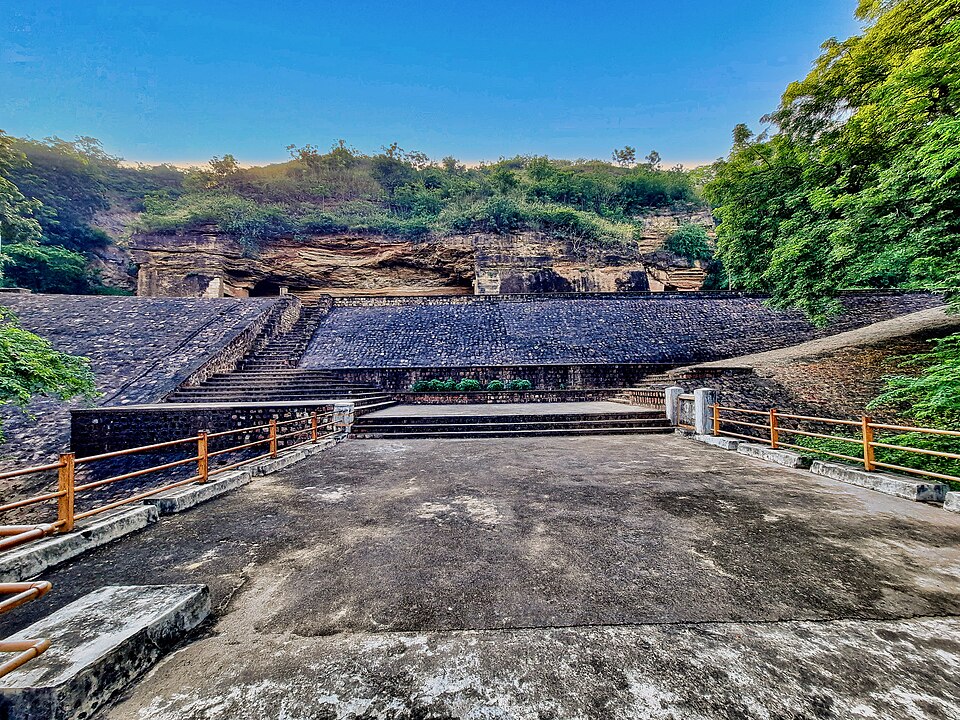
Bagh is a group of rock-cut Buddhist caves excavated into a sandstone hill above the Baghini river near Bagh town in Dhar district, Madhya Pradesh, generally dated to about the 5th-6th century CE. They are viharas — monastic residences with cells around a pillared hall and a stupa shrine at the rear — and their fame rests on mural painting done on a lime-plaster ground, in the same tradition and roughly the same period as Ajanta. The individual caves carry popular names rather than only numbers, and Cave 4's name, Rang Mahal, comes straight from the colour on its walls.
MPPSC has a recurring soft spot for Bagh, because it lets the commission ask an art-history question that is also an MP-geography question. Expect three kinds of framing: the district (Dhar), the religion (Buddhist), and the cave names. The trick with this question is that 'Rang' means colour — the cave with the paintings — so if you remember that the painted cave is the fourth, both the number and the reason stay attached.
- Bagh caves — rock-cut Buddhist caves on the Baghini river, near Bagh town, Dhar district, Madhya Pradesh
- Dated broadly to the 5th-6th century CE; their murals, with Ajanta's, are the principal surviving examples of Gupta-period painting
- Nine caves are numbered but only about five survive in reasonable condition
- Popular cave names: Cave 2 'Pandav Gufa' (Gomai), Cave 3 'Hathkhana', Cave 4 'Rang Mahal'
- The murals are painted on a lime-plaster ground and have deteriorated badly; portions were detached for conservation and are kept in museum custody
- Confusing the Bagh caves (paintings, Dhar district) with Bagh print (the block-printed textile craft of the same town)
- Attributing the Padmapani painting to Bagh — it belongs to Ajanta
- Assuming Bagh is Jain or Brahmanical; the caves are Buddhist viharas
MPPSC asks the district, the cave name or the religion of Bagh; UPSC asks it as 'the other surviving example of Gupta painting besides Ajanta' or hides Bagh among options in an Ajanta question.
There are only two known examples of cave paintings of the Gupta period in ancient India. One of these is paintings of Ajanta caves. Where is the other surviving example of Gupta paintings?
- (a) Bagh caves
- (b) Ellora caves
- (c) Lomas Rishi cave
- (d) Nasik caves
Answer(a) Bagh caves
The same subject from the national angle — Bagh as the twin of Ajanta for Gupta-period mural painting, which is precisely why its fourth cave is called Rang Mahal.
The painting of Bodhisattva Padmapani is one of the most famous and oft-illustrated paintings at
- (a) Ajanta
- (b) Badami
- (c) Bagh
- (d) Ellora
Answer(a) Ajanta
Tests the Ajanta–Bagh discrimination inside the same mural tradition — the exact confusion this MPPSC question rewards you for having sorted out.
- practice — not a real PYQ
The Bagh caves, famous for their murals, are situated in which district of Madhya Pradesh?
- (a)Dhar
- (b)Dewas
- (c)Damoh
- (d)Datia
Answer(a) Dhar — the caves are cut into a hillside above the Baghini river near Bagh town in Dhar district. - practice — not a real PYQ
The Bagh caves of Madhya Pradesh belong to which religious tradition?
- (a)Jain
- (b)Buddhist
- (c)Shaiva
- (d)Vaishnava
Answer(b) Buddhist — they are viharas (monastic halls with cells) with a stupa shrine, in the same tradition as Ajanta.