
In which Upanishad is the famous dialogue of Yagnavalkya and Gargi mentioned ?
- (a)Brihadaranyaka Upanishad
- (b)Taittiriya Upanishad
- (c)Aitareya Upanishad
- (d)Prashnopanishad
Correct — A, Brihadaranyaka Upanishad. The exchange in which Gargi Vachaknavi twice cross-examines the sage Yajnavalkya — ending with her question about what everything above the sky and below the earth is 'woven, warp and woof' upon, and Yajnavalkya's answer of Akshara, the imperishable — occurs in the third chapter of the Brihadaranyaka Upanishad, set in the assembly of King Janaka of Videha. The same text also carries Yajnavalkya's dialogue with his wife Maitreyi.
- (b)Taittiriya Upanishad — Belongs to the Krishna Yajurveda and is known for the five-sheath (panchakosha) doctrine and the convocation address 'Satyam vada, dharmam chara' — it contains no Gargi dialogue.
- (c)Aitareya Upanishad — Attached to the Rigveda (part of the Aitareya Aranyaka); famous for the mahavakya 'Prajnanam Brahma' and an account of creation — not for the Yajnavalkya-Gargi debate.
- (d)Prashnopanishad — Belongs to the Atharvaveda and is built around six questions put to the sage Pippalada by six disciples. It is a question-and-answer text, which makes it tempting — but the questioners are not Gargi and the respondent is not Yajnavalkya.
The Upanishads form the concluding, philosophical layer of Vedic literature (hence 'Vedanta'), and each is attached to a particular Veda. The Brihadaranyaka — literally 'the great forest book' — forms the closing portion of the Shatapatha Brahmana of the Shukla Yajurveda and is among the oldest and longest of the principal Upanishads. It is largely dialogue: Yajnavalkya with Gargi, Yajnavalkya with Maitreyi, and the brahmodya, the philosophical contest held at King Janaka's court.
Both MPPSC and UPSC test 'which text contains which idea or person'. The efficient way to prepare is one hook per Upanishad: Brihadaranyaka = Yajnavalkya, Gargi, Maitreyi, 'Aham Brahmasmi' and 'Asato ma sadgamaya'; Chandogya = 'Tat Tvam Asi' and the Uddalaka-Shvetaketu dialogue; Mundaka = 'Satyameva Jayate'; Katha = Nachiketa and Yama; Prashna = Pippalada's six questions.
- The Yajnavalkya-Gargi dialogue appears in the third chapter of the Brihadaranyaka Upanishad, at the court of King Janaka of Videha.
- The Brihadaranyaka belongs to the Shukla Yajurveda and forms the last part of the Shatapatha Brahmana.
- Its famous lines include the mahavakya 'Aham Brahmasmi' and the prayer 'Asato ma sadgamaya, tamaso ma jyotirgamaya, mrityor ma amritam gamaya'.
- Gargi Vachaknavi and Maitreyi are the best-known women thinkers of the Upanishadic age.
- Mahavakya map: Prajnanam Brahma (Aitareya, Rigveda), Aham Brahmasmi (Brihadaranyaka, Yajurveda), Tat Tvam Asi (Chandogya, Samaveda), Ayam Atma Brahma (Mandukya, Atharvaveda).
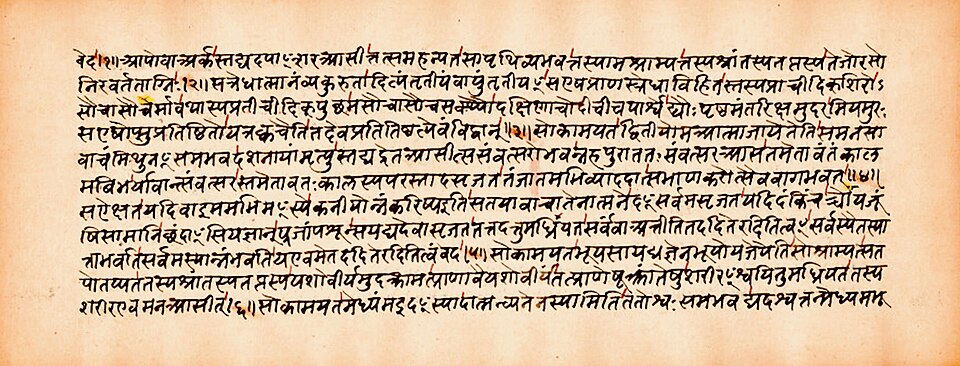
- Mixing up the Yajnavalkya-Gargi dialogue (Brihadaranyaka) with the Uddalaka-Shvetaketu dialogue (Chandogya)
- Attaching the Brihadaranyaka to the Rigveda — it belongs to the Shukla Yajurveda
- Assuming any question-and-answer Upanishad must be the Prashna
Standard 'in which text does X appear' or 'match the Upanishad with its Veda/mahavakya' — UPSC has asked the source of 'Satyameva Jayate' (Mundaka) and MPPSC has asked which Veda calls Sabha and Samiti twin institutions.
The national motto of India, ‘Satyameva Jayate’ inscribed below the Emblem of India is taken from
- (a) Katha Upanishad
- (b) Chandogya Upanishad
- (c) Aitareya Upanishad
- (d) Mundaka Upanishad
Answer(d) Mundaka Upanishad
Exactly the same skill — pinning a famous passage to the correct Upanishad, with the other principal Upanishads offered as distractors.
Who among the following was a Brahmavadini who composed some hymns of the Vedas?
- (a) Lopamudra
- (b) Gargi
- (c) Leelavati
- (d) Savitri
Answer(a) Lopamudra
Same cluster — women scholars of the Vedic age; note the distinction UPSC tested, that Gargi debates in the Brihadaranyaka Upanishad while Lopamudra is credited with composing Rigvedic hymns.
Consider the following statements: 1. There are no parables in Upanishads. 2. Upanishads were composed earlier than the Puranas. Which of the statements given above is/are correct?
- (a) 1 only
- (b) 2 only
- (c) Both 1 and 2
- (d) Neither 1 nor 2
Answer(b) 2 only
Same body of literature — the Upanishads' character and date; statement 1 is false precisely because of dialogue-parables like the Yajnavalkya-Gargi and Nachiketa episodes.
In which Veda have the Sabha and Samiti been declared as twin institutions?
- (a) Rigveda
- (b) Samaveda
- (c) Atharvaveda
- (d) Yajurveda
Answer(c) Atharvaveda
The identical MPPSC pattern one year earlier — locate a well-known idea in the correct Vedic text, with the other texts of the corpus as distractors.
- practice — not a real PYQ
The mahavakya 'Aham Brahmasmi' occurs in which Upanishad?
- (a)Chandogya Upanishad
- (b)Brihadaranyaka Upanishad
- (c)Mandukya Upanishad
- (d)Katha Upanishad
Answer(b) Brihadaranyaka Upanishad — of the Shukla Yajurveda. - practice — not a real PYQ
The dialogue in which sage Pippalada answers six questions put by six disciples forms the core of which Upanishad?
- (a)Prashna Upanishad
- (b)Kena Upanishad
- (c)Isha Upanishad
- (d)Mundaka Upanishad
Answer(a) Prashna Upanishad — attached to the Atharvaveda.