
Which of the following atomic power stations had the highest installed capacity in India in the year 2024 ?
- (a)Kakrapar
- (b)Kaiga
- (c)Kalpakkam
- (d)Kudankulam
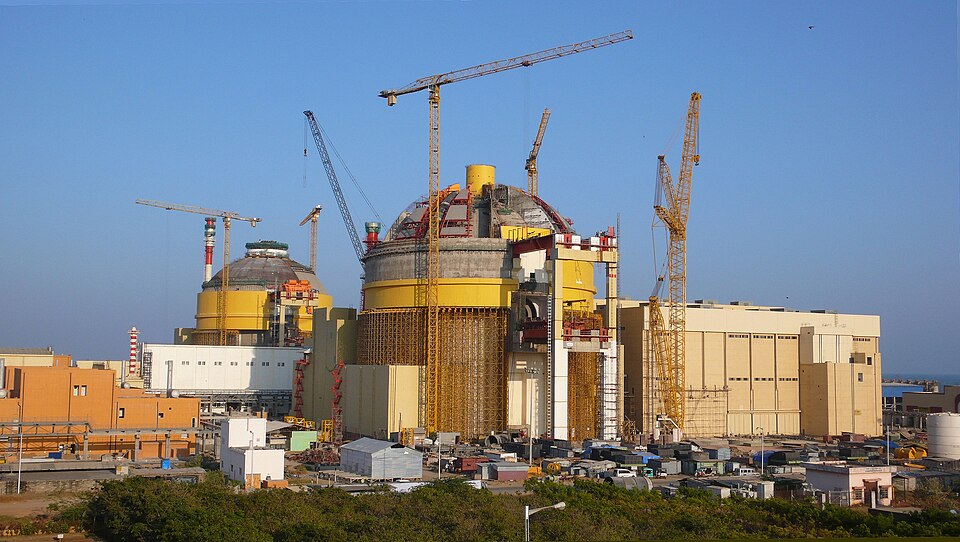
Correct — D, Kudankulam. The Kudankulam Nuclear Power Plant in Tirunelveli district, Tamil Nadu, has two operating Russian-supplied VVER-1000 pressurised water reactors of 1,000 MW each — 2,000 MW, the largest installed capacity at any single nuclear station in India in 2024. Four further 1,000 MW units are under construction at the same site, which will eventually take it to 6,000 MW.
- (a)Kakrapar — Second largest in 2024 at 1,840 MW — two 220 MW PHWRs plus India's first two indigenous 700 MWe PHWRs (KAPS-3 commercial from June 2023, KAPS-4 from March 2024). Still short of Kudankulam's 2,000 MW.
- (b)Kaiga — Four 220 MW PHWRs in Uttara Kannada district, Karnataka — 880 MW in all. Kaiga is celebrated for Unit-1's world record of 962 days of continuous operation, not for size.
- (c)Kalpakkam — The Madras Atomic Power Station has two 220 MW PHWRs — 440 MW, the smallest of the four. Kalpakkam matters for the fast-breeder programme (the PFBR), not for installed capacity.
India's commercial nuclear fleet is operated by NPCIL and is dominated by indigenous pressurised heavy water reactors (PHWRs) of 220 MW and, more recently, 700 MWe. The only large light-water reactors are the Russian VVER-1000 units at Kudankulam, built under a 1988 Indo-Soviet agreement. Because each Kudankulam unit is 1,000 MW, that station leads on installed capacity even though other sites have more reactors. In 2024 India's total nuclear capacity was about 8.2 GW from 24 reactors — under 3% of the country's electricity generation.
The trap is to equate 'oldest' or 'most units' with 'largest'. Tarapur has four units but only 1,400 MW; Kaiga has four units but 880 MW. Do the arithmetic — number of units multiplied by unit size. Kudankulam's 2 x 1,000 MW beats every other station until Kudankulam 3-6 come online and lift it further.
- Kudankulam (Tirunelveli district, Tamil Nadu): two VVER-1000 units of 1,000 MW each, built with Russian collaboration — India's largest nuclear station by installed capacity.
- Kakrapar-3 (2023) and Kakrapar-4 (2024) are India's first indigenous 700 MWe PHWRs, taking Kakrapar in Gujarat to 1,840 MW.
- Kaiga (Karnataka) is 4 x 220 MW = 880 MW; the Madras station at Kalpakkam (Tamil Nadu) is 2 x 220 MW = 440 MW.
- Kalpakkam also hosts the 500 MWe Prototype Fast Breeder Reactor (PFBR) built by BHAVINI — the gateway to Stage II of India's three-stage nuclear programme.
- All commercial nuclear plants are run by NPCIL; total nuclear capacity was about 8.2 GW in 2024, under 3% of India's electricity generation.
- Assuming Tarapur is the largest because it is the oldest and has four units (1,400 MW)
- Treating 'number of reactors' as 'installed capacity' — Kaiga has four units but only 880 MW
- Counting Kalpakkam's PFBR (500 MWe, Stage II) as operating commercial capacity
Usually as 'match the atomic power plant with its state' or 'which is the largest/first' — memorise site, state, reactor type and unit size for the seven operating NPCIL stations.
In India, why are some nuclear reactors kept under “IAEA Safeguards” while others are not?
- (a) Some use uranium and others use thorium
- (b) Some use imported uranium and others use domestic supplies
- (c) Some are operated by foreign enterprises and others are operated by domestic enterprises
- (d) Some are State-owned and others are privately-owned
Answer(b) Some use imported uranium and others use domestic supplies
Same subject — how India's nuclear stations differ from one another: Kudankulam's Russian-supplied VVER units run on imported fuel, which is exactly why they sit under IAEA safeguards while indigenous PHWRs need not.
- practice — not a real PYQ
India's first indigenously designed 700 MWe pressurised heavy water reactor was commissioned at:
- (a)Kaiga
- (b)Kakrapar
- (c)Narora
- (d)Rawatbhata
Answer(b) Kakrapar, Gujarat — KAPS-3 began commercial operation in 2023, followed by KAPS-4. - practice — not a real PYQ
The Prototype Fast Breeder Reactor (PFBR), central to Stage II of India's nuclear programme, is located at:
- (a)Tarapur
- (b)Kalpakkam
- (c)Kudankulam
- (d)Rawatbhata
Answer(b) Kalpakkam, Tamil Nadu — the 500 MWe PFBR is built and operated by BHAVINI.