UPSC Current Affairs

15 topicsGS-1: 4GS-2: 5GS-3: 6
0/15 done
GS-2Polity

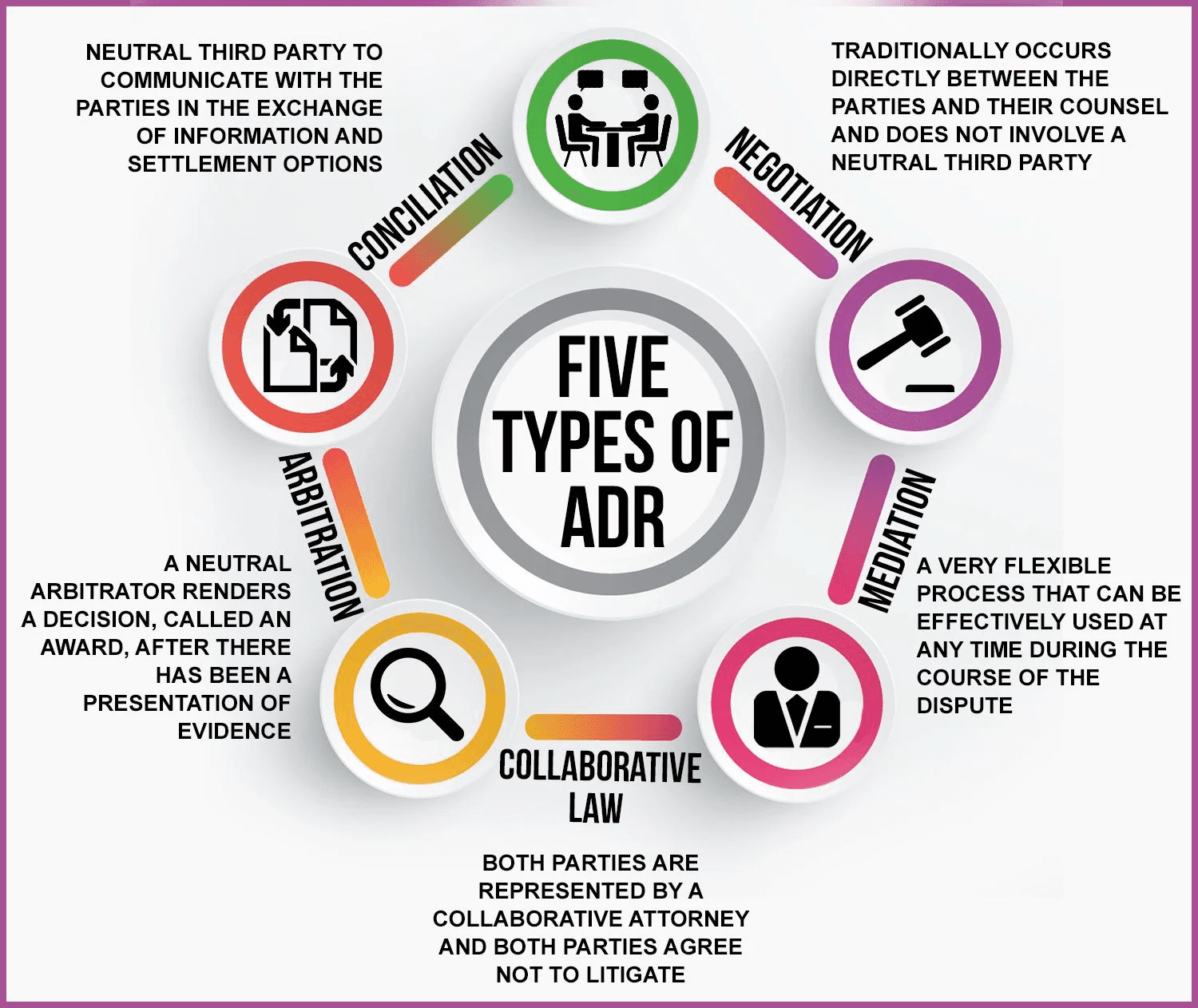
1.Arbitration Council of India Delay (ADR Regulation)

The Hindu
Illustration for Arbitration Council of India Delay (ADR Regulation)

What & Where

Arbitration Council of India (ACI): statutory regulator of institutional arbitration under Part IA, Arbitration & Conciliation Act 1996.

Core processes: grading institutions, accrediting arbitrators, maintaining award-depository, promoting ADR (arbitration, mediation, conciliation).

Territorial reach: pan-India; headquarters yet to be notified by Union Government.

Quick Facts for MCQs

Composition & Appointment

  • Membership: eminent practitioners, academicians, ex-officio govt reps besides Chair.
  • Tenure & conditions: determined by Central Govt rules framed under the Act.
  • Independence concern: dominance of govt appointees when State is biggest litigant.

Mandate & Powers

  • Grading: objective evaluation of arbitral institutions for quality, fee structure, infrastructure.
  • Accreditation: individual arbitrator certification, potential exclusion of foreign professionals.
  • Repository: national database of arbitral awards to aid precedent consistency.

Regulatory Challenges

  • Unlimited accreditation risk: quality dilution, administrative overload unlike single-hub models of Singapore/Hong Kong.
  • Exclusionary stance: foreign lawyer bar may deter global parties choosing India seat.
  • Delay fears: absence of ACI hampers uniform standards six years after legal provision.

Draft 2024 Bill Changes

  • Deadline control: institutions may extend award date, cut fees for tribunal-caused delay.
  • Interim relief shift: courts’ Section 9 power limited; emergency arbitrators gain primacy.
  • New Section 9-A: interim measures allowed post-commencement, pre-tribunal constitution.

Key Data Points

FeatureData-Point
Enabling amendmentArbitration & Conciliation (Amendment) Act 2019
Act locationPart IA, Sections 43A–43M
Chairperson appointing bodyCentral Govt + consultation with CJI
Eligible Chair profilesex-SC Judge / ex-HC CJ-Judge / eminent arbitration practitioner
Parent committeeJustice B.N. Srikrishna Committee 2017
Distinct fromIndian Council of Arbitration (ICA, 1965, non-governmental)
Draft 2024 Bill focusRevised “arbitral institution”, emergency arbitrator powers, deadline control
Typical dispute scopeCommercial, civil, international conflicts outside regular courts
GS-2Polity

2.National Voters’ Day 2026 Highlights (Election Commission)

PIB

What & Where

National Voters’ Day (NVD); annual observance on 25 Jan to commemorate Election Commission of India (ECI) set-up under Article 324.

Held country-wide; President hosts central ceremony, ECI drives mass enrolment & awareness activities.

2026 focus: Theme “My India, My Vote”, tagline “Citizen at the Heart of Indian Democracy”.

Quick Facts for MCQs

Tech & Schemes

  • e-EPIC digital, non-editable voter ID downloadable to mobiles.
  • ECINET single portal integrating 40+ ECI apps for voters, parties, officials.
  • cVIGIL geo-tagged MCC violation reporting; mandatory action within 100 minutes.

Legal & Policy

  • Article 324 vests superintendence, direction, control of elections in ECI.
  • SC 2013 directive triggered nationwide VVPAT deployment with EVMs.
  • Special Intensive Revision 2025 purged duplicates, deceased to ensure clean rolls.

International Examples

  • India International Conference on Democracy & Election Management 2026 adopted Delhi Declaration.
  • Declaration pillars: clean rolls, free-fair polls, research, tech sharing, IIIDEM training.

Key Data Points

FeatureData-Point
ECI establishment date25 Jan 1950
Constitutional provisionArticle 324
NVD first celebrated2011
NVD 2026 themeMy India, My Vote
NVD 2026 taglineCitizen at the Heart of Indian Democracy
e-EPIC launch year2021
cVIGIL disposal limit100 minutes
Full EVM rollout1998 State polls
VVPAT mandated bySC 2013 (Subramanian Swamy v ECI)
ECINET unveiled2026
Special Intensive Revision2025; 51 crore electors, 12 States/UTs
Year of Accessible Elections2018
Best Practices Awards 2026Bihar, Kerala, TN, Odisha, Gujarat, Meghalaya, Mizoram, UP, Jharkhand, Delhi

Related UPSC Prelims PYQs

CDS_GK, GEO_GS 2022PYQ 1

The use of ‘Electors Photo Identity Cards (EPIC)’ by the Election Commission of India was started in which one of the following years ?

CDS_GK, GEO_GS 2022PYQ 2

Article 324 of the Constitution of India provides for the establishment of which one of the following institutions in India?

GS-3Economy

3.Economic Survey 2026 Overview (Economic Survey)

LiveMint

What & Where

Flagship annual review document of Ministry of Finance, tabled in Parliament before Union Budget

Assesses Indian economy’s last 12 months; projects next fiscal outlook

Core geography: India; presented in New Delhi

Quick Facts for MCQs

Origin & Evolution

  • Inception 1950-51; served as Budget chapter
  • 1964 separation enabled independent economic appraisal
  • Current practice places Survey 2-3 days ahead of Budget for context

Institutional Setup

  • Preparation handled by Economics Division, DEA
  • Authorship guided by Chief Economic Advisor V Anantha Nageswaran (2026)
  • Release requires Union Finance Minister’s formal approval

Coverage & Structure

  • Part A analyses macroeconomic developments and next-year outlook
  • Part B offers data-heavy focus on health, education, climate, employment
  • Tracks sectoral performance: agriculture, industry, services, infrastructure

Utility & Impact

  • Policy blueprint; past surveys signalled reforms like 2017-18 gender focus “Pink Survey”
  • Market barometer for investors assessing stability and opportunities
  • Academic reference for data-driven research and policymaking

Key Data Points

FeatureData-Point
First presentation1950-51 (within Budget)
De-linked year1964, shifted a day before Budget
2026 schedule29 Jan 2026; Budget on 1 Feb
Preparing bodyEconomics Division, Dept. of Economic Affairs
Supervising postChief Economic Advisor
Final clearanceUnion Finance Minister
Document partsPart A Macro; Part B Sectoral
Key macro metricsGDP, CPI/WPI inflation, fiscal deficit, trade balance

Related UPSC Prelims PYQs

GS1 1998PYQ 1

Economic Survey in India is published officially, every year by the

GS1 2010PYQ 2

Which one of the following is responsible for the preparation and presentation of Union Budget to the Parliament?

GS-3Infrastructure

4.Smart Fishing Harbour, Mayabunder (Fisheries Infrastructure)

News on air
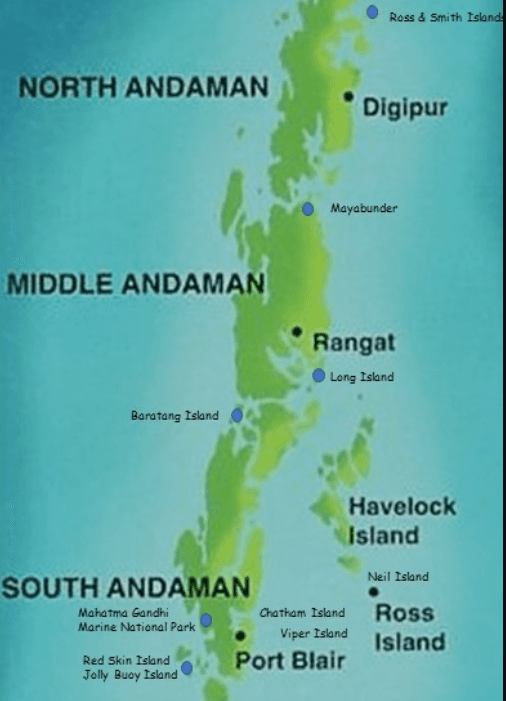
Illustration for Smart Fishing Harbour, Mayabunder (Fisheries Infrastructure)

What & Where

Smart & Integrated Fishing Harbour sanctioned at Mayabunder; handles 9,900 t fish/yr via tech-driven ecosystem.

Mayabunder town, North & Middle Andaman district; ~242 km by road, 136 km by sea from Port Blair.

Site within seismically active, biodiverse zone flanked by Karmatang turtle beach, Interview wildlife island, Avis coral isle.

Quick Facts for MCQs

Tech & Schemes

  • IoT-enabled sensors track catch, vessel, cold-chain in real time.
  • Integrated harbour clubs landing, auction, cold storage, renewable modules.

Environmental Impact

  • Anti-IUU systems deter illegal, unreported, unregulated fishing in Andaman waters.
  • Renewable power & low-waste handling cut carbon load, fish spoilage.
  • Proximity to turtle nesting zones necessitates controlled lighting, noise.

Economic Angle

  • Harbour augments seafood exports, local jobs, maritime tourism in northern Andaman.
  • Year-round safe berthing slashes weather-related downtime for 430 vessels.
  • Efficient supply chain minimises post-harvest loss on 9,900 t annual landings.

Key Data Points

FeatureData-Point
Sanctioning bodyUnion Department of Fisheries
Island groupAndaman & Nicobar Islands
District HQNorth & Middle Andaman
Road distance to Port Blair~242 km (Andaman Trunk Road)
Sea distance to Port Blair~136 km
Annual fish capacity9,900 tonnes
Berthing capacity430 fishing vessels
Core techIoT-based digital traceability
Green focusEnergy-efficient, eco-friendly post-harvest
Anti-IUU measureReal-time monitoring & data logs
Key turtle site nearbyKarmatang Beach
Largest wildlife isle nearbyInterview Island

Related UPSC Prelims PYQs

ESE_GS 2026PYQ 1

What is the name of the national digital framework launched at India Maritime Week 2025 to make Indian ports data-driven and AI-enabled?

GS-3Misc

5.Daily Current Affairs, 28 Jan 2026 (Current Affairs Digest)

ABP
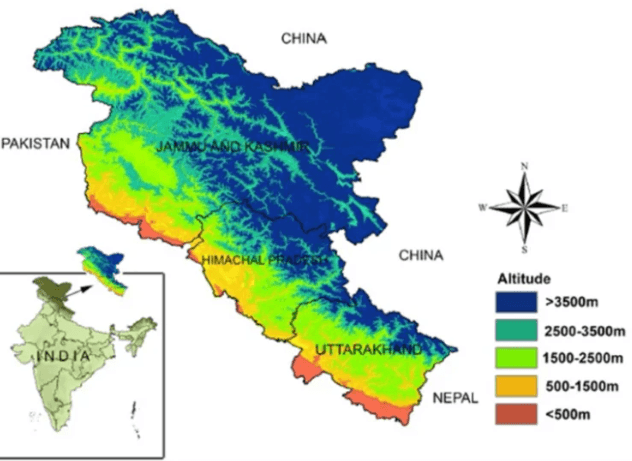
Illustration for Daily Current Affairs, 28 Jan 2026 (Current Affairs Digest)

What & Where

Avalanche: rapid downslope slide of snow-ice-debris when gravitational pull exceeds snowpack strength.

Types: slab, loose-snow, powder (dust cloud), wet, and ice/rock/debris variants.

Core geography: 30°–45° Himalayan slopes; Sonamarg, Pir Panjal & Zanskar ranges form India’s high-incidence belt.

Quick Facts for MCQs

Risk Factors

  • Heavy-snowfall: ≥ 1 m in 24 h overloads snowpack; rapid temp rise or rain adds lubrication.
  • Weak-layer snowpack: buried hoar or crust beneath cohesive slab acts as glide plane.
  • External triggers: earthquakes, ski traffic, loud machinery, even artillery blasts.

Tech & Schemes

  • Monitoring: IoT-linked AWS, satellite feeds, Doppler radar scan slopes every three seconds.
  • Infrastructure: Atal & upcoming Zojila tunnels engineered with avalanche galleries, snow sheds.
  • Forecasting: Daily bulletins issued by DGRE to BRO, Army & hill states via Snow Messaging System.

Legal & Policy

  • Zonation: NDMA mandates hazard maps for land-use clearance and developmental planning.
  • Structural control: snow nets, catch fences in start zones; deflection mounds in run-out corridors.
  • Community prep: local guides trained in beacon-probe-shovel rescue; school drills institutionalised.

Environmental & Economic Impact

  • Transport: frequent blockades on NH-44, Kashmir valley airstrips, harming perishables supply.
  • Ecosystem: slides uproot alpine forests, re-route streams, deposit nutrient-poor debris fans.
  • Tourism loss: resort closures, insurance hikes, cancelled winter-sports events dent regional GDP.

Key Data Points

FeatureData-Point
Max powder avalanche speed≈ 300 km h⁻¹
Ideal trigger slope30°–45° inclination
Snow–Met observatories72 sites
Automated Weather Stations100 + units
1st Avalanche RadarNorth Sikkim, 2021
Nodal R&D bodyDGRE (ex-SASE)
NDMA early-warning target≥ 24 h lead time

Related UPSC Prelims PYQs

CDS_GK, NDA_GAT 2022PYQ 1

Consider the following features about a geographical phenomenon:

CDS_GK, NDA_GAT 2021PYQ 2

An avalanche is a type of which one of the following disasters?

GS-1History

6.Buddhist Diamond Triangle UNESCO Listing (Buddhist Sites)

Times of India
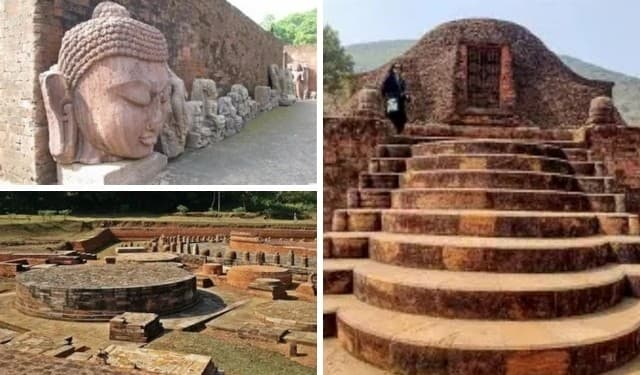
Illustration for Buddhist Diamond Triangle UNESCO Listing (Buddhist Sites)

What & Where

Serial cultural nomination of Lalitgiri, Udayagiri, Ratnagiri—“Buddhist Diamond Triangle”—in Jajpur & Cuttack, Odisha.

Captures 1,500-year continuum of Theravada → Mahayana → Vajrayana Buddhism.

Recently accepted on UNESCO World Heritage Tentative List.

Quick Facts for MCQs

Chronology & Schools

  • Continuum: Theravada origins, Mahayana maturity, Vajrayana zenith documented on same landscape.
  • Temporal span: 2nd BCE–13th CE evidencing uninterrupted monastic activity.
  • Offers rare layered narrative of doctrinal evolution in eastern India.

Site-wise Distinctions

  • Lalitgiri: Relic stupa, apsidal chaityagriha, “Sri Chandraditya Vihara” inscription.
  • Udayagiri: Largest complex, two-storey monastery, high Mahayana artistry.
  • Ratnagiri: Tantric iconography, female donors, syncretic stupas unique globally.

UNESCO & Protection

  • Tentative listing mandatory precursor to full World Heritage nomination & ICOMOS evaluation.
  • Serial approach packages three sites under one Outstanding Universal Value dossier.
  • Status expected to boost conservation funds, heritage tourism along Odisha’s Buddhist circuit.

Key Data Points

FeatureData-Point
UNESCO statusTentative List (World Heritage Centre)
Odisha districtsJajpur & Cuttack
Oldest complexLalitgiri, 2nd–3rd BCE
Lalitgiri relicsGold-silver-stone caskets in main stupa
Chaityagriha typeEast-facing apsidal, first in Odisha (Lalitgiri)
Udayagiri hallmarkDouble-storeyed monastery, Madhavapura Mahavihara
Udayagiri iconsColossal Avalokiteswara & Pancha Dhyani Buddhas
Ratnagiri focusVajrayana sculptures—Tara, Vajrapani, Jambhala
Female patronageQueen Karpurashri at Ratnagiri
Architectural fusionRatnagiri stupas blend Buddhist & Brahmanical motifs

Related UPSC Prelims PYQs

GS1 2009PYQ 1

Recently, which one of the following was included in the UNESCO's World Heritage list ?

GS-1History

7.Early Telugu Inscription Discovery (Telugu Epigraphy)

The Hindu

What & Where

Early-8th-century CE Telugu inscription found at Pitikayagulla, Nandyal district, Andhra Pradesh.

Text in early Telugu script records construction of a new embankment (nava katta) by sculptor Pranimilli Achari.

Part of Renadu epigraphic corpus, evidencing Telugu’s shift from Prakrit influence to an autonomous administrative language.

Quick Facts for MCQs

Linguistic Evolution

  • Proto-Dravidian split ~5000 yrs ago; Telugu distinct by c.10th century BCE.
  • Genetic proximity nearer Central Dravidian; cultural ties strong with Tamil, Kannada.
  • Inscription illustrates Telugu’s administrative use replacing earlier Prakrit vocabulary.

Epigraphic Record

  • Earliest Telugu epigraphy: 575 CE Renati Chola stones at Kalamalla & Erragudipadu.
  • Pitikayagulla find broadens Renadu corpus into early 8th century.
  • Record omits ruling king; focuses on public-works attribution and donor names.

Legal & Policy

  • 8th Schedule listing enables official use, UPSC optional, constitutional safeguards.
  • Classical Language status (2008) provides dedicated funding for research & higher studies.
  • Speaker base ≈130 million across Andhra Pradesh, Telangana, diaspora communities.

Key Data Points

FeatureData-Point
Inscription dateEarly 8th century CE
Village & districtPitikayagulla, Nandyal (A.P.)
Mentioned projectNew embankment (nava katta)
Named artisanPranimilli Achari
Epigraphic regionRenadu
First dated Telugu inscription575 CE, Renati Cholas
Telugu speakers≈130 million
Constitutional status8th Schedule language
Classical tag year2008 (GoI)
Proto-Dravidian split~5000 years ago
GS-1Environment

8.Sonamarg Avalanche Impact (Avalanche Hazard)

ABP
Illustration for Sonamarg Avalanche Impact (Avalanche Hazard)

What & Where

Avalanche = gravity-driven, rapid downslope slide of snow/ice/debris after snowpack strength fails.

Himalayan hotspots: Sonamarg (J&K), North Sikkim, Himachal & Uttarakhand; riskiest on 30–45° slopes.

Key types: slab (most lethal), loose-snow sluff, powder (dust cloud ≈ 300 km/h), wet-snow, ice/rock/debris.

Quick Facts for MCQs

Causes & Triggers

  • Steep 30–45° slopes, convex terrain amplify shear stress.
  • Heavy, rapid snowfall or rain-on-snow lubricates weak layers.
  • Earthquakes, skiers, machinery vibrations frequently tip unstable slabs.

Impacts

  • Fatalities from suffocation, trauma, hypothermia within minutes.
  • NH-44 blockade, flight cancellations illustrate transport & economic paralysis.
  • Forests uprooted, valley morphology altered, long-term ecosystem loss.

Tech & Schemes

  • DGRE’s 72 observatories + 100 AWS feed real-time stability models.
  • North Sikkim X-band radar detects, maps slide path up to 2 km range.
  • Avalanche-resistant Atal & upcoming Zojila tunnels secure year-round Himalayan connectivity.

Key Data Points

FeatureData-Point
Most-dangerous slope angle30° – 45°
Max speed (powder avalanche)≈ 300 km h⁻¹
Rapid snowfall overload~1 m in 24 h
Lead time NDMA early warning≥ 24 h
Snow-Met observatories (DGRE)72
Automated Weather Stations100 +
Avalanche radar locationNorth Sikkim
Radar trigger-to-alert time3 seconds
Institution leading researchDGRE (ex-SASE)
All-weather avalanche tunnelsAtal, planned Zojila

Related UPSC Prelims PYQs

CDS_GK, NDA_GAT 2022PYQ 1

Consider the following features about a geographical phenomenon:

CDS_GK, NDA_GAT 2021PYQ 2

An avalanche is a type of which one of the following disasters?

GS-1Mapping

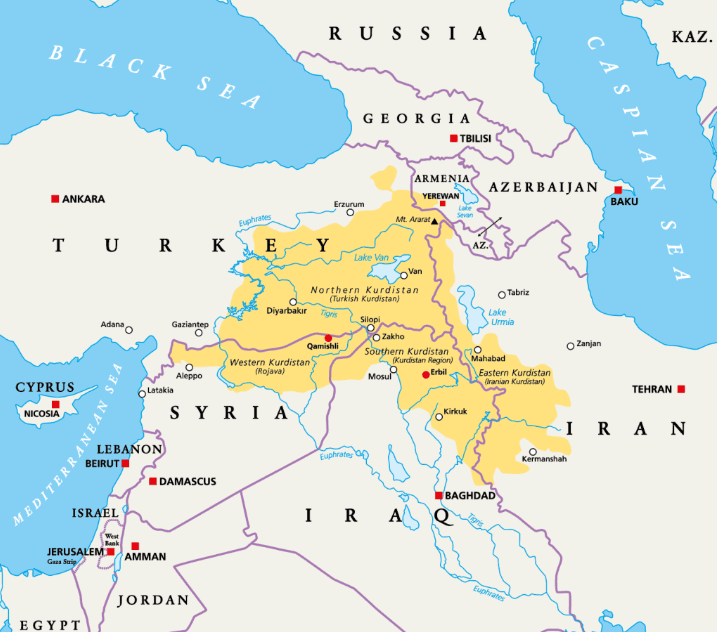
9.Rojava Region Mapping (Syrian Kurd Region)

The Hindu
Illustration for Rojava Region Mapping (Syrian Kurd Region)

What & Where

Rojava; de facto autonomous region in NE Syria; governed by Democratic Autonomous Administration of North & East Syria (DAANES).

Ideology; democratic confederalism stressing local self-rule, gender parity, ethnic pluralism; unrecognised internationally.

Geography; spans Hasakah, Raqqa, Deir ez-Zor, Kobane-Aleppo belt along Euphrates; oil- and gas-rich crossroads near Türkiye & Iraq.

Quick Facts for MCQs

History Timeline

  • 2014-15; YPG, aided by US airpower, defeats ISIS at Kobane.
  • 2016-23; successive charters culminate in DAANES governance framework.
  • 2024-26; Assad collapse, interim Damascus recaptures ≈80 % Rojava territory.

Governance Dispute

  • Autonomy demand; Kurds insist on retained legislative, security powers within federal Syria.
  • Centralisation push; Damascus seeks unitary state, individual integration of SDF fighters.
  • Ceasefire; 14-point draft yet unresolved on troop deployment in core Kurdish zones.

External Actors

  • Türkiye; labels YPG as PKK extension, opposes any Kurdish self-rule at its border.
  • United States; formerly SDF ally against ISIS, now tilting toward Damascus vs Iran-Russia.
  • ISIS threat; renewed clashes enable prison breaks, jihadist resurgence risks.

Security Dimension

  • Force balance; SDF still controls pockets around Hasakah oil fields, Kobane urban core.
  • Integration issue; Damascus demands full Syrian Arab Army presence in Rojava cities.
  • Border pressure; Turkish artillery and drone strikes target SDF positions to prevent entrenchment.

Key Data Points

FeatureData-Point
Official nameDemocratic Autonomous Administration of North & East Syria
Foundational exit of Syrian troops2012
Flagship militiaPeople’s Protection Units (YPG)
Multi-ethnic allianceSyrian Democratic Forces (SDF) – formed 2015
Key riversEuphrates & tributaries
Neighbouring statesTürkiye (N), Iraq-Kurdistan (E)
Core Kurdish citiesKobane, Qamishli
Major resourcesOil, natural gas fields of eastern Syria
GS-3Environment

10.State of Finance for Nature 2026 (Environmental Finance)

Down to Earth

What & Where

UNEP “State of Finance for Nature 2026” maps global money destroying vs conserving ecosystems

Nature-based Solutions (NbS): protect, sustainably manage, restore ecosystems to address climate, food, disaster challenges

India spotlight: high subsidy–driven nature loss, needs Nature Transition X-Curve and private capital mobilisation

Quick Facts for MCQs

Financial Imbalance

  • Subsidies: fossil fuel, unsustainable agriculture, water dominate Environmentally Harmful Subsidies
  • Market distortion: environmental destruction cheaper than conservation, deters green investments
  • Private finance dwarfs public in destructive sectors energy, utilities, basic materials

India-Specific Issues

  • Subsidy paradox: fertiliser and free power overpower MoEFCC or organic-farming outlays
  • Implementation gap: Centre signs pacts, land-water action with revenue-hungry States
  • Green taxonomy void enables greenwashing, blocks genuine NbS capital inflow

Scaling NbS

  • Instrument mix: green bonds, sustainability-linked loans, biodiversity credits, first-loss guarantees needed
  • Data push: adopt TNFD-aligned, standard biodiversity metrics like Mean Species Abundance
  • Pricing tools: carbon or nature-liability taxes to internalise externalities, shift capital flows

International Targets

  • UNFCCC: keep warming below 2 °C, prefer 1.5 °C
  • CBD: conserve 30 % land & seas, restore 30 % degraded ecosystems by 2030
  • UNCCD: restore 1.5 billion ha degraded land by 2030

Key Data Points

FeatureData-Point
Destructive : protective finance ratio30 : 1 (2023)
Global nature-negative flows 2023USD 7.3 trillion
Private share in harmful flowsUSD 4.9 trillion (≈67 %)
Govt Environmentally Harmful SubsidiesUSD 2.4 trillion / yr
Total NbS investment 2023USD 220 billion
Public share in NbS finance90 %
NbS annual need by 2030USD 571 billion (2.5× jump)
Rise in biodiversity & landscape spend 2022-2311 %
Rio Convention land restoration target1.5 billion ha by 2030

Related UPSC Prelims PYQs

CAPF_GAI, GS1 2025PYQ 1

The Union Budget for which of the following years announced the issue of Sovereign Green Bonds to reduce the carbon intensity of the economy?

CAPF_GAI, GS1 2025PYQ 2

Which organization has enacted the Nature Restoration Law (NRL) to tackle climate change and biodiversity loss?

GS-3SpeciesQuick Bite

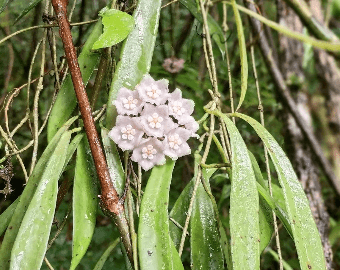
11.New Plant Species Hoya nagaensis (New Plant Species)

The Hindu
Illustration for New Plant Species Hoya nagaensis (New Plant Species)

What & Where

Species: Hoya nagaensis, waxy-flowered angiosperm, newly described by Nagaland University taxonomists

Location: Kavünhou Community Reserved Forest, Phek district, Eastern Himalayan biodiversity zone, Nagaland

Habitat: High-altitude temperate forest; currently known from a single, community-managed site

Quick Facts for MCQs

Biodiversity Significance

  • Hotspot affirmation; new species adds to Eastern Himalaya undocumented flora tally
  • Endemism highlighted; single-site occurrence stresses micro-range speciation processes
  • Global taxonomy enriched; informs phylogenetic studies within Hoya genus

Conservation Model

  • Community stewardship; indigenous management safeguarded intact forest enabling discovery
  • Reserved Forest status; local rules restrict extraction, favouring habitat integrity
  • Study advocates scaling community-led conservation for rare plant protection

Taxonomic Highlights

  • Distinctive traits; unique leaf morphology and floral structures separate it from congeners
  • Diagnostic characters documented; herbarium specimens, molecular data archived for reference
  • Scientific naming follows ICN rules; epithet ‘nagaensis’ honours Nagaland origin

Key Data Points

FeatureData-Point
GenusHoya (ornamental, waxy flowers)
FamilyApocynaceae
Elevation zoneHigh-altitude temperate forest
Exact siteKavünhou Community Reserved Forest, Phek, Nagaland
Biogeographic regionEastern Himalaya hotspot
Known distributionOnly one population, extremely restricted
IUCN assessmentProvisionally Critically Endangered
Discovering bodyNagaland University researchers
Journal of descriptionKew Bulletin
GS-2Polity

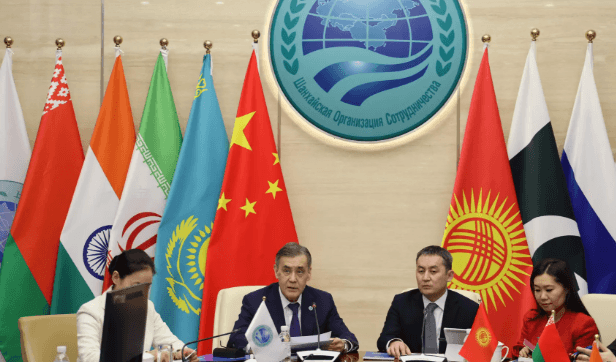
12.SCO National Coordinators Meet Beijing (SCO Council)

SCO
Illustration for SCO National Coordinators Meet Beijing (SCO Council)

What & Where

Council of National Coordinators (CNC): SCO’s chief coordination body linking Secretariat/RATS with 10 member states.

First 2026 CNC meet convened in Beijing under Kyrgyz chair to shape upcoming CHS & CHG agendas.

SCO: Eurasian inter-governmental organisation spanning ~42 % world population; Secretariat headquarters in Beijing.

Quick Facts for MCQs

Coordination Functions

  • Groundwork: CNC prepares CHS and CHG meetings, harmonises multilateral cooperation.
  • Implementation: CNC monitors execution of earlier summit decisions.
  • Chairing: Kyrgyz Republic leading 2026 CNC cycle.

Membership & Geography

  • Eurasian span: Members stretch from Belarus to China covering Central, South, West Asia.
  • Population weight: Bloc represents ~42 % global populace.
  • Economic size: Accounts for >23 % world nominal GDP.

Security Dimension

  • RATS mandate: Counter Terrorism, Separatism, Extremism—Three Evils.
  • Meetings: CNC outcomes feed into CHS decisions on regional security cooperation.
  • Trust-building: Shanghai Spirit stresses mutual trust, equality, civilisation respect, common development.

Key Data Points

FeatureData-Point
SCO founding date15 Jun 2001
Predecessor groupingShanghai Five (1996)
Secretariat locationBeijing, China
Second permanent bodyRATS, Tashkent
Official languagesRussian; Chinese
Current members10
Latest entrantBelarus – 2024
Indian entry year2017
Share of world population≈42 %
Share of global nominal GDP>23 %

Related UPSC Prelims PYQs

CDS_GK, GS1 2024PYQ 1

Consider the following statements about the Shanghai Cooperation Organisation (SCO):

CDS_GK, GS1 2007PYQ 2

Consider the following statements:

GS-2Economy

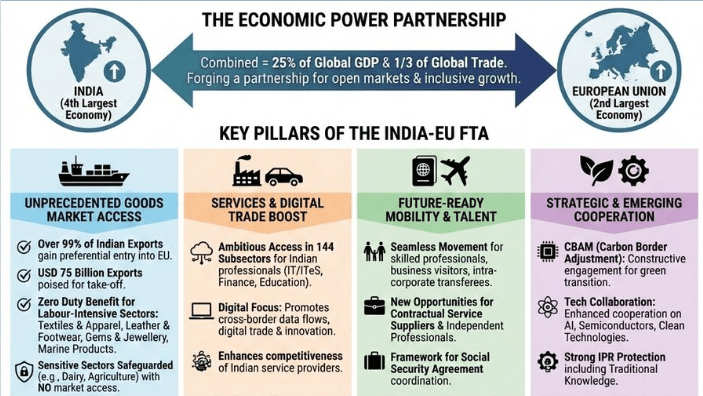
13.India-EU Free Trade Agreement (Bilateral FTA)

Times of India
Illustration for India-EU Free Trade Agreement (Bilateral FTA)

What & Where

India–EU FTA: comprehensive goods-services pact; EU becomes India’s 22nd FTA partner.

Scope: tariff cuts, professional mobility, SPS/TBT cooperation, IPR, digital trade.

Geography: India + 27-member European Union (single market, customs union, Schengen core).

Quick Facts for MCQs

Market Access

  • Preferential coverage 99.5 % of Indian exports, deepest ever arrangement for India
  • EU farm access: cereals, dairy, poultry excluded, wines & autos on staggered schedule
  • MSME rules: self-certification Statements of Origin, special flexibilities for shrimp, downstream aluminium

Regulatory Barriers

  • CBAM imposes carbon levy, could nullify tariff gains on metals
  • EUDR demands geotagged traceability for coffee, rubber, wood imports post-2020
  • Corporate Sustainability Due Diligence mandates full value-chain audits from 2027

Strategic Significance

  • Combined bloc equals 25 % world GDP, one-third global trade
  • Supports EU’s China-plus-one diversification; aligns with India’s manufacturing push
  • TTC & IMEC corridors embed supply-chain resilience in Indo-Pacific context

India’s Safeguards

  • Protected lists: dairy, cereals, soymeal, select agri to shield farmers
  • Gradual tariff cuts on automobiles, spirits to cushion domestic industry
  • Balanced IPR: TRIPS-compliant while preserving generic pharma & Traditional Knowledge Library

Key Data Points

FeatureData-Point
EU tariff lines opened97 % (covers 99.5 % of India’s export value)
Indian tariff lines opened92.1 % (covers 97.5 % of EU export value)
Zero-duty gain sectorsTextiles, apparel, leather, marine, gems & jewellery, toys, sports goods
Current EU duty on these sectors4 – 26 % to be reduced to 0
Services subsectors committed by EU144
Services subsectors opened by India102
EU goods trade with India FY 24USD 135 billion
EU investment stock in IndiaUSD 117 billion+
CBAM start year2026 (20–35 % equivalent tax on steel/aluminium)
FTA next stepsLegal scrubbing → translation → ratification by 27 parliaments + EP

Related UPSC Prelims PYQs

CAPF_GAI, CDS_GK 2024PYQ 1

If India enters into Free Trade Agreements (FTAs) with other nations, then the growth of exports of India would depend upon which of the following?

CAPF_GAI, CDS_GK 2024PYQ 2

Which of the following is NOT one of the pillars of India’s ‘Foreign Trade Policy-2023’?

GS-2PolityQuick Bite

14.UK-Mauritius Chagos Deal (Chagos Sovereignty)

BL

What & Where

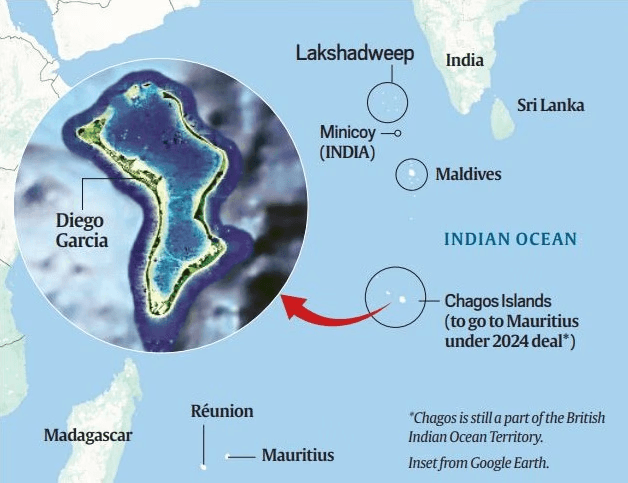
Chagos Archipelago – 58-island British Indian Ocean Territory of coral atolls in central Indian Ocean.

Location – ~500 km south of Maldives; Diego Garcia biggest atoll at 7° S latitude.

Status – Detached from Mauritius in 1965; UK now to return sovereignty but retain Diego Garcia on 99-yr lease.

Quick Facts for MCQs

Colonial History

  • 1715: France colonised Mauritius & Chagos; ceded both to Britain under 1814 Treaty of Paris.
  • 1965: UK carved out BIOT, compensating Mauritius £3 million.
  • Detachment criticised as late-colonial manoeuvre, sowing sovereignty dispute.

Military & Strategic

  • 1966: UK-US pact granted American forces BIOT access; Diego Garcia hub by 1986.
  • Base launched operations in Gulf War, Iraq, Afghanistan, post-9/11, anchoring Indo-Pacific reach.
  • 99-year lease secures uninterrupted Anglo-American footprint despite sovereignty shift.

Legal & Policy

  • 2019: ICJ ruled UK’s 1965 detachment unlawful; UNGA endorsed withdrawal.
  • 2024: UK accepted transfer to Mauritius while leasing Diego Garcia.
  • US President publicly criticised UK negotiating approach, exposing allied friction.

Key Data Points

FeatureData-Point
No. of islands58
Largest islandDiego Garcia
Distance from Maldives≈500 km south
Latitude Diego Garcia7° S
Colonial transfer to UKTreaty of Paris 1814
Detachment creating BIOT1965
Grant paid to Mauritius£3 million
UK-US military pact1966
Base fully operational1986
ICJ advisory opinion2019
Sovereignty deal year2024
Lease period agreed99 years

Related UPSC Prelims PYQs

GS1 2002PYQ 1

In the map given below, four islands of Indian Ocean region, i.e. A) Seychelles, B) Chagos, C) Mauritius and D) Socatra are marked as 1, 2, 3 and 4. Match them and select the correct answer from the codes given below.

GS-3SecurityQuick Bite

15.Indian Navy Training Squadron Thailand (Naval Diplomacy)

PIB

What & Where

Mission: Indian Navy’s First Training Squadron (1TS) deployment to Southeast Asia for sea training and outreach

Location: Phuket Deep Sea Port, Thailand; gateway to Andaman Sea & eastern Indian Ocean

Context: Part of 2026 ASEAN–India Year of Maritime Cooperation, advancing Act East & MAHASAGAR vision

Quick Facts for MCQs

Security Dimension

  • Emphasis: Enhances interoperable skills, situational awareness across Bay of Bengal and eastern IOR waters
  • Deterrence: Visible presence underlines India’s commitment to regional maritime security architecture
  • Assurance: Friendly port call promotes collective sea-lane safety against piracy, trafficking threats

Diplomatic Context

  • Symbolism: Port call inaugurates ASEAN–India maritime cooperation theme year
  • Leadership: Deployment preludes India assuming IONS chairmanship, expanding multilateral naval dialogues
  • Soft-power: Training interactions showcase Indian Navy capability as security provider and capacity builder

Exercises & Partnerships

  • PASSEX: Seamanship manoeuvres, communication drills executed with Royal Thai Navy units
  • CORPAT: Semi-annual coordinated patrol since 2005 covering 1,500 km common maritime boundary
  • SITMEX: Trilateral exercise initiated 2019, alternates among member ports to hone humanitarian assistance & interdiction skills

Key Data Points

FeatureData-Point
Squadron nameFirst Training Squadron (1TS)
Constituent shipsINS Tir, INS Shardul, INS Sujata, ICGS Sarathi
Port visitedPhuket Deep Sea Port, Thailand
Key on-site drillPassage Exercise (PASSEX)
Existing bilateral drillsEx Ayutthaya, Indo-Thai CORPAT
Trilateral exerciseSITMEX (India–Thailand–Singapore)
2026 tag lineASEAN–India Year of Maritime Cooperation
IONS chair hand-overFrom Thailand to India, Feb 2026
Strategic doctrineMAHASAGAR: Mutual & Holistic Advancement for Security and Growth Across Regions
Policy linkageAct East & maritime diplomacy focus

Related UPSC Prelims PYQs

CAPF_GAI, ESE_GS 2022PYQ 1

Which one of the following countries did the Indian Navy participate in the U.S. Navy-led Southeast Asia Cooperation and Training (SEACAT) military exercise, to demonstrate its maritime manoeuvres?

CAPF_GAI, ESE_GS 2023PYQ 2

Which one of the following Indian Naval Ships has recently concluded a 17,000-nm trans-ocean intercontinental voyage?

Ready to practice?

Test your knowledge with our UPSC test series.

Start Free Trial