UPSC Current Affairs

14 topicsGS-1: 4GS-2: 5GS-3: 5
0/14 done
GS-2Editorial

1.International Data Privacy Day Observance (Data Protection)

PIB

What & Where

International Data Privacy Day – 28 Jan, global observance on responsible data practices

Convention 108 – 1981 Council of Europe treaty on automated personal data protection

Digital Personal Data Protection Act 2023 – India’s first comprehensive privacy law covering all digital personal data

Quick Facts for MCQs

Legal & Policy

  • Provision; DPDP permits state exemptions without independent oversight, raising Article 21 imbalance
  • Amendment; IT Intermediary Rules 2021 → 2025 impose time-bound grievance redressal on platforms
  • Update; Convention 108 modernised 2018 demanding breach reporting, AI safeguards

Institutional Mechanisms

  • Platform; I4C coordinates cybercrime response, focuses on women, children offences
  • Tool; Cyber Swachhta Kendra offers free botnet cleaning, daily malware alerts
  • Hotline; 1930 enables real-time blocking via CFCFRMS for digital financial frauds

Security Dimension

  • Threat; surge in phishing, ransomware, identity theft targeting UPI, online banking users
  • Gap; cybersecurity skill shortages undermine enforcement against AI-enabled fraud, deepfakes
  • Measure; CyTrain 2019 and Cyber Commando Programme 2024 upskill law-enforcement cyber workforce

Gaps & Challenges

  • Independence; Executive-controlled Board risks biased enforcement against largest data fiduciary – government
  • Remedy; Penalties accrue to state, no automatic victim compensation; court route onerous
  • Public-data loophole; AI training on scraped personal info weakens consent, amplifies deepfake misuse

Key Data Points

FeatureData-Point
Day commemorated28 January each year
Designating bodyCouncil of Europe (2006)
India global digital rank3rd largest digital economy
Broadband subscribers101.7 crore (2024)
Average data priceUSD 0.10 per GB
SC case recognising privacyK.S. Puttaswamy 2017
Core law before DPDPIT Act 2000
Cyber nodal agencyCERT-In
Regulator under DPDPData Protection Board of India
Cybercrime complaints 20241.91 million

Related UPSC Prelims PYQs

GS1 2019PYQ 1

Which of the following adopted a law on data protection and privacy for its citizens known as ‘General Data Protection Regulation’ in April 2016 and started implementation of it from 25th May, 2018?


GS-2Polity

2.Governor’s Address and Article 176 Debate (Judiciary)

The Hindu

What & Where

Article 176, Governor’s address opens first legislative session each year, ceremonial executive duty

2026 incidents: walkout Tamil Nadu, paragraph omission Kerala, sparked discretion debate

Applies to all States, unicameral or bicameral, reflecting Westminster convention

Quick Facts for MCQs

Constitutional Limits

  • Principle: Aid-and-advice binds Governor except constitutionally specified discretion
  • Address content drafted by Council, Governor cannot edit autonomously
  • Deviation viewed as erosion of federal neutrality

Judicial Guidance

  • Shamsher Singh: Governor constitutional head, no personal discretion in executive matters
  • Nabam Rebia: discretionary domain narrowly defined, cannot destabilise elected govt
  • 2024 TN verdict: stalling address violates constitutional scheme

Commission Insights

  • Sarkaria: Governor not Centre agent, acts as federal lynchpin
  • Punchhi: avoid extra roles like University Chancellor to maintain neutrality
  • Both urge strict adherence to established conventions, reduce political frictions

Suggested Reforms

  • Codification: declaratory Supreme Court guidelines making address mandatory, zero discretion
  • Training: structured orientation for Governors on conventions, landmark rulings
  • Deadlines: written objections within fixed timeframe, silence implies concurrence

Key Data Points

FeatureData-Point
Governor’s annual address article176
Governor oath article159
Aid-and-advice article163
Power to address/send messages article175
Shamsher Singh case year1974
Nabam Rebia case year2016
State of TN v Governor year2024
Sarkaria Commission report year1988
Punchhi Commission report year2007
2026 walkout StatesTamil Nadu, Kerala

Related UPSC Prelims PYQs

GEO_GS, GS1 2021PYQ 1

Which one of the following is NOT the ordinance making power of Governor?

GEO_GS, GS1 2019PYQ 2

With reference to the Legislative Assembly of a State in India, consider the following statements:

GS-1HistoryQuick Bite

3.Lala Lajpat Rai 161st Anniversary (Freedom Fighter)

PIB

What & Where

Freedom-fighter nicknamed Punjab Kesari; part of extremist Lal-Bal-Pal leadership.

Born 28 Jan 1865, Dhudike village (now Moga district), Punjab; educated Government College, Lahore.

Died 17 Nov 1928, Lahore, after police lathi-charge during anti-Simon Commission march.

Quick Facts for MCQs

Early Life & Influences

  • Education Law, Government College Lahore; excelled in legal advocacy.
  • Inspiration Arya Samaj reformism, nationalist awakening.
  • Networking Formed early connections with Tilak, Pal, other nationalists.

Freedom Struggle Role

  • Leadership Extremist camp within INC, demanding Swaraj.
  • Mobilisation Organised Punjab protests, mass rallies, nationwide tours.
  • International Visited USA 1914–17, founded Indian Home Rule League of America.

Literary & Institutional Contributions

  • Writing Authored nationalist, economic critique works influencing public opinion.
  • Banking Co-founded Punjab National Bank to fund indigenous enterprise.
  • Education Helped establish Lahore National College, servant to Arya Samaj schools.

Demise & Legacy

  • Martyrdom Death amplified anti-British sentiment; slogan “Simon go back” gained force.
  • Commemoration Birth anniversary observed as tribute across India.
  • Influence Inspired subsequent revolutionaries like Bhagat Singh, HSRA cadres.

Key Data Points

FeatureData-Point
Full nameLala Lajpat Rai
Birthdate28 January 1865
BirthplaceDhudike, Punjab (then British India)
Popular epithetPunjab Kesari (Lion of Punjab)
Ideological mentorSwami Dayananda Saraswati, Arya Samaj
Extremist trioLal-Bal-Pal (with Tilak & Pal)
Key protestSimon Commission, Lahore, 30 Oct 1928
Cause of deathInjuries from colonial police lathi-charge
Bank co-foundedPunjab National Bank, 1894
Select booksYoung India; England’s Debt to India; India’s Will to Freedom
Anniversary 2026161st birth anniversary

Related UPSC Prelims PYQs

GS1 1995PYQ 1

100. Which one of the following pairs is not correctly matched?

GS1 2018PYQ 2

He wrote biographies of Mazzini, Garibaldi, Shivaji and Shrikrishna; stayed in America for some time; and was also elected to the Central Assembly. He was

GS-1HistoryQuick Bite

4.Lakkundi Excavations Aid UNESCO Bid (Lakkundi Heritage)

The Hindu

What & Where

Lakkundi (Lokkigundi) heritage village, Gadag district, Karnataka; famed for hundred wells and temples.

Neolithic artefacts near Kote Veerabhadreshwar Temple spur bid for UNESCO World Heritage status.

Landscape holds 11th–12th c inscriptions, Kalyana Chalukya shrines and ornate stepwells.

Quick Facts for MCQs

Historical Timeline

  • Prosperity marked in 11th–12th c inscriptions; likened to Indra’s Amaravati.
  • Mint (tankashale) operated during medieval zenith.
  • Became Hoysala capital under Veeraballala, 1192 AD.

Cultural Legacy

  • Jain resurgence under Attimabbe; numerous basadis, wells erected.
  • Lingayat reform era hosted sharanas Ajaganna, Muktayakka.
  • State award commemorates Attimabbe’s philanthropy.

Architecture & Hydrology

  • Thirteen Chalukyan temples show intricate dravida-nagara fusion.
  • Stepwells exemplify advanced medieval water engineering.
  • Latest digs uncover deeper Neolithic substratum.

Conservation Status

  • INTACH-Karnataka finalising UNESCO Tentative List dossier.
  • Neolithic finds enhance Outstanding Universal Value claim.
  • Heritage push dovetails with tourism strategy.

Key Data Points

FeatureData-Point
StateKarnataka
Distance from Gadag12 km
Earlier nameLokkigundi
NicknameVillage of 100 wells & temples
Key dynastiesChalukyas, Yadavas, Hoysalas
Hoysala capital year1192 AD (Veeraballala)
Surviving temples13
Architectural styleKalyana Chalukya
Celebrated Jain patronQueen Attimabbe
State awardDaana Chintamani Attimabbe Prashasti
Reformist sharanasAjaganna, Muktayakka
Archaeological layerNeolithic
WHS dossier byKarnataka + INTACH

Related UPSC Prelims PYQs

GEO_GS 2024PYQ 1

Which one among the following temples, constructed by Queen Loka Mahadevi in Pattadakal, is a UNESCO World Heritage site?

GS-1Environment

5.River Delta Land-Subsidence Study (Delta Subsidence)

Down to Earth

What & Where

Delta; sediment-built fan at river mouth, fertile and < 1 m elevation.

Study; 40 world deltas, 29 nations, 236 million people, 2014–23 satellite subsidence data.

India; Ganga-Brahmaputra, Brahmani, Mahanadi, Godavari, Cauvery, Kabani identified as high-risk.

Quick Facts for MCQs

Key Findings

  • Subsidence; median rate outpaces eustatic rise, amplifying flood frequency.
  • Cities; Kolkata, Dhaka, Shanghai record urban subsidence matching or exceeding rural tracts.
  • Hotspots; Ganga-Brahmaputra, Nile, Mekong, Yangtze, Amazon, Irrawaddy, Mississippi dominate loss.

Indian Hotspots

  • Brahmani; fastest national sink, groundwater stress plus sediment starvation.
  • Mahanadi; compounded by dams, land-use change, high population density.
  • Cauvery; severe aquifer drawdown driving irreversible sediment compaction.

Drivers of Subsidence

  • Groundwater; extraction lowers pore pressure, causes clay collapse.
  • Sediment cutoff; upstream dams, embankments reduce replenishment.
  • Land-use; urban load and drainage alteration accelerate compaction.

Social Concerns

  • Indigenous/rural residents; many live below 1 m, face relocation hurdles.
  • Future; unmanaged pumping risks escalating flood, land loss, displacement by mid-century.

Key Data Points

FeatureData-Point
Global mean sea-level rise4 mm yr⁻¹
Deltas sinking >3 mm yr⁻¹>50 % of 40 sampled
Total delta area subsiding35 % worldwide
Share of subsidence in 7 mega-deltas57 % (≈265,000 km²)
Brahmani delta subsiding area77 % >5 mm yr⁻¹
Mahanadi delta subsiding area69 % >5 mm yr⁻¹
Deltas with >90 % area sinking~50 %; includes Ganga-Brahmaputra
Prime driverUnsustainable groundwater withdrawal
Delta megacity exampleKolkata sinking ≥ surrounding delta
Delta land share vs people1 % land hosts 6 % world population

Related UPSC Prelims PYQs

GEO_GS 2025PYQ 1

Which one among the following rivers is a tributary of river Hooghly?

GEO_GS 2021PYQ 2

Which one among the following river basins has the highest level of ground water utilisation?

GS-1Mapping

6.Sela Lake and Sela Pass, Arunachal (High-Altitude Pass)

Indian Express

What & Where

Sela Lake: high-altitude (> 13,000 ft) glacial lake on N side of Sela Pass, Tawang district, Arunachal Pradesh, eastern Himalayas.

Formed by meltwater trapped in bedrock/moraine depression; drains to Nuranang → Tawang River.

Sela Pass: adjoining motorable mountain pass linking Tawang plateau with Assam plains, gateway near India–China LAC.

Quick Facts for MCQs

Geographical Features

  • Alpine zone; periglacial climate limits tree growth, fosters moraine-rimmed waterbody.
  • Lake–river system feeds Brahmaputra basin via Tawang–Kameng sub-catchment.

Cultural Significance

  • Monpa rituals include offerings at lake during lunar festivals.
  • Buddhist lore lists it among 108 sacred Tawang lakes.

Security Dimension

  • Pass enabled troop movement in 1962; still critical for LAC deployment logistics.
  • Sela Tunnel shortens Tezpur–Tawang route by 10 km, ensures year-round supply chain.

Key Data Points

FeatureData-Point
Lake typeGlacial (meltwater origin)
Lake altitude> 13,000 ft (≈ 4,000 m)
Immediate riverNuranang, tributary of Tawang River
Local nickname“Paradise Lake”
Sacred traditionTibetan Buddhism; revered by Monpa
Surrounding floraSparse alpine vegetation; yak summer pasture
Pass altitude rankAmong India’s highest motorable passes
Pass upkeep agencyBorder Roads Organisation (BRO)
Key tunnelSela Tunnel; Tezpur–Tawang all-weather link
War memorial nearbyJaswant Singh War Memorial (1962 Sino-Indian War)

Related UPSC Prelims PYQs

GS1 2007PYQ 1

Which one of the following Himalayan passes was reopened in the middle of the year 2006 to facilitate trade between India and China?

GS-3Editorial

7.World Bank Air-Pollution Report IGP-HF (Air Pollution Report)

Indian Express

What & Where

“A Breath of Change”: 2025 World Bank solutions book on air pollution in Indo-Gangetic Plains–Himalayan Foothills (IGP-HF) airshed.

Covers 13 jurisdictions across Bangladesh, Bhutan, India, Nepal, Pakistan; seeks WHO interim target 35 µg/m³ PM₂.₅ by 2035.

Roadmap organised under “4 Is” — Information, Incentives, Institutions, Infrastructure — for transboundary cooperation.

Quick Facts for MCQs

Health Impact

  • Premature deaths about one million yearly across airshed.
  • Average life expectancy cut by over three years from chronic PM₂.₅ exposure.
  • Hazardous pollution affects 81 % of public-school children.

Economic Angle

  • Pollution drains roughly 10 % of regional GDP via healthcare and productivity losses.
  • MSMEs, farmers face high upfront clean-tech costs; truck retrofit ≥180 % per-capita income.
  • Subsidy reform and emissions trading proposed to unlock private capital.

Drivers & Geography

  • Himalayan wall plus winter inversions trap pollutants over flat plains.
  • North-westerlies transport smoke; Pakistani Punjab may supply 30 % PM to Indian Punjab.
  • Long-range SO₂, NH₃ form secondary aerosols, pushing cross-border share beyond 50 %.

Policy & Instruments

  • Kathmandu Roadmap 2022 and Thimphu Outcome 2024 endorse regional “35 by 35” aspiration.
  • World Bank’s 4 Is: expand monitoring, redirect subsidies, clarify legislation, build clean infrastructure.
  • Tools include GeoAI hotspot mapping, Surat PM-ETS, Nepal Green Tax, EV grids, Happy Seeder support.

Key Data Points

FeatureData-Point
People breathing most-polluted air≈1 billion in IGP-HF
Annual premature deaths≈1 million
GDP loss due to pollution≈10 % each year
Life expectancy drop>3 years
Public-school students above 35 µg/m³81 %
Ambient PM₂.₅ from outside boundary>50 % in many areas
Cross-border share in Nepal Terai68 %
Pak Punjab addition to Indian Punjab PMup to 30 %
PM₂.₅ vs WHO guideline8–20 times higher
Regional goal“35 by 35” (35 µg/m³ by 2035)

Related UPSC Prelims PYQs

GEO_GS 2020PYQ 1

Which of the following particulate matters (size based) are notified pollutants in National Ambient Air Quality Standards (NAAQS)?

GEO_GS 2022PYQ 2

Which of the following major parameters are considered while deriving the Air Quality Index (AQI) of an area in India?

GS-3Environment

8.Sunabeda Wildlife Sanctuary, Odisha (Wildlife Sanctuary)

Times of India

What & Where

Sanctuary & proposed Tiger Reserve in Nuapada district, western Odisha, Deccan Peninsular biogeographic zone

Forms ecological bridge between Odisha and Chhattisgarh; borders Udanti-Sitanadi sanctuaries

High-altitude grass plateau with deep canyons; primary catchment of Jonk River, tributary of Mahanadi

Quick Facts for MCQs

Biodiversity

  • Leopards thriving post-conflict with camera traps indicating 70+ population
  • Rare Hard-ground Barasingha and Nilgai find ideal habitat here
  • Over 200 bird species; highlights include Forest Owlet, Banded Bay Cuckoo

Physical Geography

  • Plateau rises sharply creating deep valleys and gorges enhancing micro-habitats
  • Eleven perennial waterfalls boost eco-tourism potential
  • Source streams Sunder and Indra originate within sanctuary

Security Dimension

  • Maoist insurgency curtailed; sanctuary tagged Maoist-free January 2026
  • Improved security enabled systematic wildlife monitoring and eco-tourism revival
  • Conflict-to-conservation shift projected to aid proposed Tiger Reserve notification

Key Data Points

FeatureData-Point
Year notified1983
Sanctuary area~600 sq km
Proposed reserve area956 sq km
StateOdisha
DistrictNuapada
Bordering PAsSitanadi & Udanti (Chhattisgarh)
Biogeographic zoneDeccan Peninsula
Dominant forest typeDry Deciduous Tropical
Signature treesBija, Teak, Sissoo, Sandalwood
Key terrainGrass-covered plateau, canyons, gorges
Major river catchmentJonk River
Notable waterfalls11
Flagship faunaLeopard, Hard-ground Barasingha, Nilgai
Corridor importanceWild Water Buffalo Odisha↔Chhattisgarh
Bird diversity>200 species; includes Forest Owlet
Security statusDeclared Maoist-free Jan 2026
Recent leopard estimate70+ individuals

Related UPSC Prelims PYQs

GS1 2017PYQ 1

Recently there was a proposal to translocate some of the lions from their natural habitat in Gujarat to which one of the following sites?

GS1 2011PYQ 2

Two important rivers – one with its source in Jharkhand (and known by a different name in Odisha), and another, with its source in Odisha – merge at a place only a short distance from the coast of Bay of Bengal before flowing into the sea. This is an important site of wildlife and biodiversity and a protected area. Which one of the following could be this?

GS-3Environment

9.Solid Waste Management Rules 2026 (Waste Management Rules)

PIB
Illustration for Solid Waste Management Rules 2026 (Waste Management Rules)

What & Where

MoEFCC-notified Solid Waste Management Rules, 2026 under Environment (Protection) Act, operative pan-India from 1 Apr 2026.

Mandate four-stream segregation, on-site wet-waste treatment, digital end-to-end tracking, Polluter Pays compensation.

Include tailored clauses for hilly areas and islands within Indian territory.

Quick Facts for MCQs

Legal & Policy

  • Notification: Gazette 2026, enforceable under Sec-3 of Environment Act.
  • Obligation: Bulk Waste Generators must register and obtain EBWGR certificates or face compensation.
  • Penalty: Unregistered operation, forged reports trigger CPCB environmental compensation.

Tech & Schemes

  • Portal: Mandatory digital registration, audit, tracking from generator to disposal eliminating paper forms.
  • RDF: Industries, especially cement, must co-process 15 % refuse-derived fuel over six years.
  • Biomining: Time-bound legacy dumpsite remediation with quarterly progress uploads.

Economic Angle

  • Fees: Higher landfill charges for unsegregated waste incentivise source segregation.
  • Compensation: Polluter Pays framework internalises cost of improper disposal.
  • Tourism: Mandatory waste user fees funds high-altitude waste management.

Key Data Points

FeatureData-Point
Implementation date1 April 2026
Parent legislationEnvironment (Protection) Act 1986
Superseded rulesSWM Rules 2016
Segregation streams4 – Wet, Dry, Sanitary, Special Care
Bulk Waste Generator area≥ 20,000 sqm
BWG waste threshold≥ 100 kg/day
BWG share in total waste~30 %
RDF obligation on industry15 % solid fuel within 6 years
Compensation authorityCPCB
Digital compliance toolCentralised online waste-tracking portal

Related UPSC Prelims PYQs

GEO_GS, GS1 2019PYQ 1

As per the Solid Waste Management Rules, 2016 in India, which one of the following statements is correct?

GEO_GS, GS1 2023PYQ 2

According to the Solid Waste Management Rules, 2016, the responsibility of waste generators has been fixed for segregation of waste in which of the following streams?

GS-3Defense & Security

10.V-BAT Vertical-Takeoff Military Drones (Autonomous Drone)

The Print
Illustration for V-BAT Vertical-Takeoff Military Drones (Autonomous Drone)

What & Where

Definition: V-BAT is a Group-3 VTOL unmanned aircraft using a ducted-fan for vertical launch then fixed-wing cruise.

Geography: Procured by Indian Army; manufacturing hub planned in Hyderabad; operable from Himalaya ridges to Indian Ocean decks.

Process: Integrates Hivemind AI for GPS-denied, autonomous ISR missions tailored by Indian engineers.

Quick Facts for MCQs

Security Dimension

  • Emergency: Selected under fast-track procurement to plug immediate surveillance gaps.
  • Resilience: Operates if GPS/comms jammed; auto reroutes when hit by electronic warfare.
  • Swarm: Multiple V-BATs can autonomously coordinate one mission.

Tech & Schemes

  • Hivemind: Allows sense-plan-act without human control.
  • SDK: Empowers Indian coders to script border-specific behaviours.
  • VTOL-design: No runway, catapult or net; fits ship decks, rooftops, forward posts.

Industrial & Make in India

  • JSW-facility: Aims to make India global V-BAT production/maintenance centre.
  • Tech-transfer: Agreement covers manufacturing know-how, not just finished units.
  • Export-ready: Hyderabad line envisioned to serve domestic and overseas orders.

Key Data Points

FeatureData-Point
Original OEMShield AI, USA
Indian partnerJSW Defence
Hub investmentUSD 90 million, Hyderabad
CategoryGroup 3 VTOL UAS
Take-off space12 × 12 ft clearing
Endurance> 12 hours continuous
Engine fuelHeavy-fuel (mil-grade)
Core softwareHivemind Autonomy SDK
Main rolePersistent ISR in high-threat zones
PayloadHD ISR sensors + targeting suite
GS-3Security

11.National IED Data Management System (IED Database)

The Hindu

What & Where

NIDMS = India’s first centralised digital repository of all Improvised Explosive Device (IED) incidents since 1999.

Secure, real-time, two-way platform built by NSG; accessible to NIA, ATS, State Police, CAPFs and allied agencies.

National coverage; integrates with ICJS-2 ecosystem to pool criminal-justice data under ‘One Nation-One Repository’.

Quick Facts for MCQs

Tech & Schemes

  • Real-time sharing accelerates evidence-based investigation and prosecution across jurisdictions.
  • AI integration builds national security grid linking multiple criminal-justice databases.
  • ‘One Data-One Entry’ architecture minimises duplication, enhances searchability.

Security Dimension

  • Centralised IED intelligence improves pattern analysis, threat anticipation, preventive deployments.
  • Platform treats IED data as national security asset, enabling cross-agency situational awareness.
  • Supports counter-terror operations by providing historical device signatures and modus operandi.

Organisational Structure

  • NSG comprises Special Action Group (combat) and Special Ranger Groups (support).
  • Five operational hubs + forthcoming Ayodhya hub ensure rapid regional response.
  • NBDC within NSG remains sole national clearing-house for bombing incident analytics.

Key Data Points

FeatureData-Point
Launch date29 Jan 2026
Inaugurated byUnion Home Minister
Developed byNational Security Guard (NSG)
Earliest blast dataYear 1999
Core purposeCollection, collation, dissemination of IED data
Access agenciesNIA, ATS, State Police, CAPFs
Tech toolsAI analytics, real-time sharing
Integrated platformICJS-2 (CCTNS, e-Prisons, NAFIS, e-Forensics)
Guiding mottoOne Nation – One Data Repository
NSG raised1986 (post-1984 Cabinet decision)
NSG doctrineSwift strike & immediate withdrawal
NSG componentsSAG (Army) + SRG (CAPFs/State Police)
Existing hubsMumbai, Chennai, Kolkata, Hyderabad, Ahmedabad
Upcoming hubAyodhya
Bomb data nodal bodyNational Bomb Data Centre (NBDC)

Related UPSC Prelims PYQs

ESE_GS 2024PYQ 1

Which one of the following Institutions launched Centre of Data for Public Good (CDPG) for multidisciplinary research, bringing together experts from academia, industry, and Government to harness the power of data to benefit the public?

GS-2Scheme

12.Next-Gen Aadhaar Mobile App (Digital ID)

ITV

What & Where

New Aadhaar App: next-generation mobile platform for Aadhaar services, launched January 2026

Designed & operated by UIDAI under MeitY, usable across India

Offers privacy-first, consent-based data sharing, offline ID verification, at-home updates

Quick Facts for MCQs

Tech & Schemes

  • Offline-verification: QR scan gives digitally signed ID without internet
  • Face-authentication: enables in-app mobile number & address update from home
  • One-family-one-app: manage five Aadhaar profiles on one smartphone

User Convenience

  • Data-sharing choice: send only required fields; Aadhaar number masked
  • Photocopy elimination: eases hotel, airport ID checks
  • Home-based updates: fewer Aadhaar Seva Kendra visits; 15-day turnaround

Security Dimension

  • Biometric-lock: single-click disables fingerprint & iris use until unlocked
  • Password-protected share: limited-field ZIP file for service providers
  • Resident-centric consent: privacy-first architecture reduces data exposure

Legal & Policy

  • DPDP-Act compliance: data minimization and consent controls embedded
  • UIDAI oversight: statutory authority governs design, rollout under Aadhaar Act
  • Fee-based service: ₹75 cap set for self-mobile number update

Key Data Points

FeatureData-Point
LaunchJan 2026
DeveloperUIDAI
Mobile update methodFace authentication
Update fee₹75
Data reflect time≤15 days
Offline verificationInternet not required
Max profiles/device5
Biometric lockOne-click toggle
Compliance lawDPDP Act
Misuse curbNo photocopy sharing
GS-2Scheme

13.PANCHAM AI Chatbot for Panchayats (AI Chatbot Governance)

ITV
Illustration for PANCHAM AI Chatbot for Panchayats (AI Chatbot Governance)

What & Where

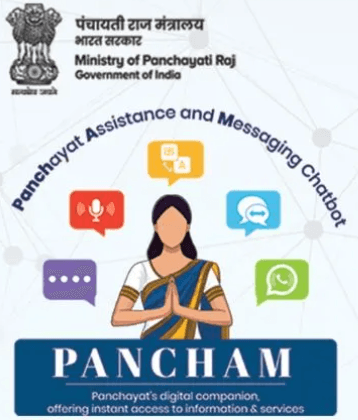
WhatsApp-based AI chatbot, PANCHAM, acts as digital companion for Panchayati Raj Institutions

Developed by Ministry of Panchayati Raj; UNICEF as knowledge partner

Covers rural India, linking 30 lakh+ elected Panchayat representatives with Central Government

Quick Facts for MCQs

Tech & Schemes

  • Integration BHASHINI enables multilingual chat and voice replies
  • Real-time guidance on geo-tagging Panchayat Bhawans and fund utilisation
  • WhatsApp interface removes need for heavy apps or new log-ins

Governance Impact

  • Direct connectivity curbs middlemen, enhancing grant transparency
  • Instant feedback loop lets field issues reach Union policymakers swiftly
  • Information saturation aims 100 % awareness of welfare schemes at village level

Capacity Building

  • Bite-sized videos upskill representatives on accounting, leadership, inclusion
  • Voice support bridges literacy gaps across rural users
  • Equal data access empowers women and youth leaders in decision-making

Key Data Points

FeatureData-Point
Full formPanchayat Assistance and Messaging Chatbot
Launch timingEve of India’s 77th Republic Day
Nodal MinistryMinistry of Panchayati Raj
Knowledge partnerUNICEF
Primary platformWhatsApp (QR code/official number)
Language engineBHASHINI, 22 official languages
Voice functionTwo-way voice notes supported
Key usersSarpanches, ward members, women Pradhans
Scheme info coverede-GramSwaraj, SVAMITVA, RGSA FAQs
Training modules30–50 second videos on leadership, finance, social justice

Related UPSC Prelims PYQs

CDS_GK 2024PYQ 1

Which one of the following is an ‘end-to-end secure mobile ecosystem’ developed recently by the Indian Army?

GS-2Scheme

14.Sampoornata Abhiyan 2.0 Saturation Drive (Aspirational Districts)

News on Air
Illustration for Sampoornata Abhiyan 2.0 Saturation Drive (Aspirational Districts)

What & Where

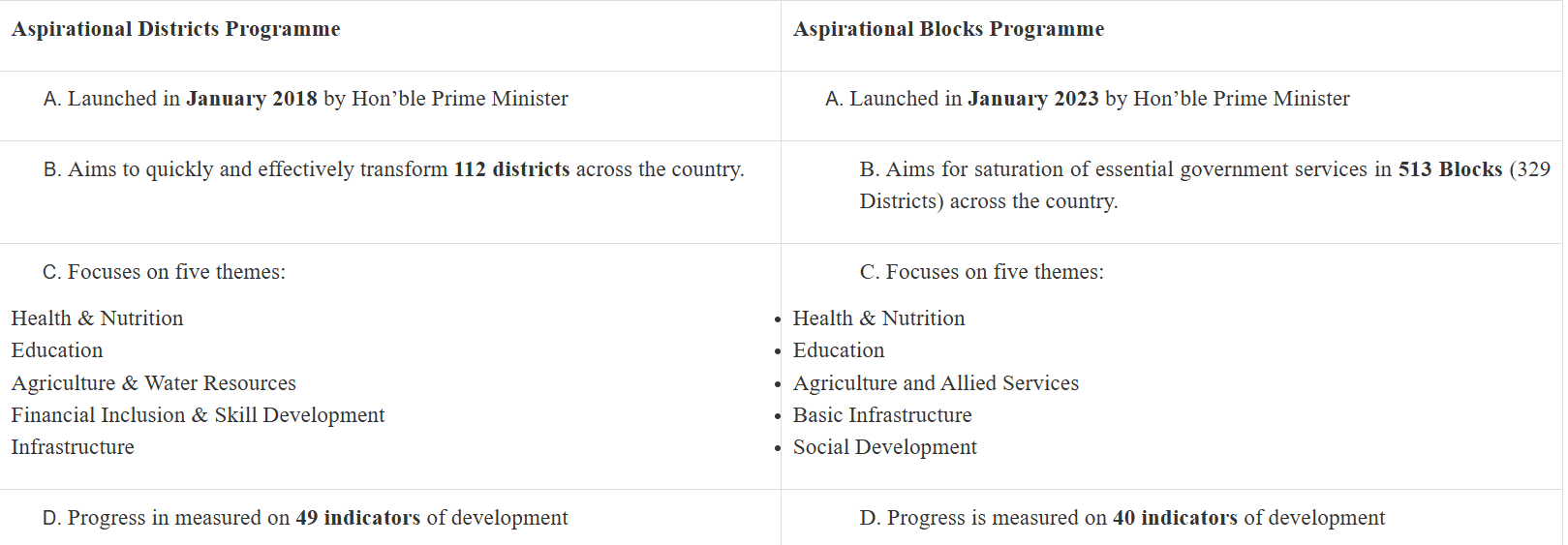
Mission-mode campaign by NITI Aayog to attain 100 % coverage on select social-sector indicators.

Operational area: 112 Aspirational Districts and 513 Aspirational Blocks across India.

Core sectors: health, nutrition, education, WASH facilities, livestock vaccination.

Quick Facts for MCQs

Timeline & Coverage

  • Timeline: 90-day sprint ending on Dr Ambedkar’s birth anniversary to enhance symbolic commitment.
  • Coverage: Focuses exclusively on India’s most underserved administrative units identified under Aspirational programmes.
  • Competition: Monthly ranking of blocks and districts to spur peer accountability.

Key Indicators

  • Health: Newborns weighed at birth, TB notification rates, VHSND/UHSND regularity.
  • Nutrition & WASH: Supplementary nutrition uptake, girls’ toilets in schools, functional Anganwadi toilets and safe water.
  • Livestock: Foot-and-Mouth Disease vaccination aiming universal bovine coverage.

Implementation Mechanics

  • Planning: Each unit prepares micro-roadmap to reach saturation by April 2026.
  • Monitoring: District officers conduct frequent field visits; real-time data dashboards flag bottlenecks.
  • Behaviour-change: Nukkad Nataks, Gram Sabhas and IEC drives mobilise community participation for last-mile uptake.

Significance & Impact

  • Outcome shift: Moves focus from scheme roll-out to measurable saturation of critical services.
  • Data-driven: Monthly validation tightens feedback loops between Centre, States and field level.
  • Inclusivity: Directly benefits populations at bottom of socio-economic pyramid in backward geographies.

Key Data Points

FeatureData-Point
Launch authorityNITI Aayog CEO B.V.R. Subrahmanyam
Start date28 Jan 2026
End date14 Apr 2026 (Ambedkar Jayanti)
Campaign duration3 months
Target districts112 Aspirational Districts
Target blocks513 Aspirational Blocks
KPIs tracked6 (Block) + 5 (District)

Related UPSC Prelims PYQs

CDS_GK, NDA_GAT 2025PYQ 1

Under which one of the following initiatives does the NITI Aayog support interested States to establish a State Institution for Transformation (SIT)?

CDS_GK, NDA_GAT 2025PYQ 2

Social Mobilisation and Institution Development (SM&ID) is one of the major components of:

Ready to practice?

Test your knowledge with our UPSC test series.

Start Free Trial