UPSC Current Affairs

14 topicsGS-1: 1GS-2: 5GS-3: 8
0/14 done
GS-2Polity

1.Notification for Census 2027 First Phase (Census 2027)

Business Standard

What & Where

Census of India 2027 – 16th national headcount, 8th post-Independence, conducted under Census Act 1948.

Two phases: Houselisting & Housing Census (Apr–Sep 2026); Population Enumeration (Feb 2027) with separate Ladakh, snow-bound schedule.

Executed pan-India by Office of Registrar General & Census Commissioner, Ministry of Home Affairs.

Quick Facts for MCQs

Legal & Policy

  • Statutory mandate: Census Act 1948; Rules 1990 empower enumerators, ensure confidentiality, prescribe penalties
  • Data guides reservations, Finance Commission transfers, constituency delimitation, SDG tracking
  • Central steering by MHA; state directorates provide enumerators, logistics

Tech & Schemes

  • Mobile app uploads encrypted schedules, removing manual paper flow
  • CMMS dashboards enable real-time progress tracking, exception alerts, supervisor oversight
  • CaaS supplies API-ready, machine-readable micro-datasets for ministries, academia

Historical Background

  • 1872 non-synchronous first count; 1881 first synchronous all-India census
  • 1951 first post-Independence enumeration; 2021 round deferred to 2027 after pandemic
  • Last caste-wise enumeration occurred in 1931 British census

Social Concerns

  • Electronic caste data expected to sharpen OBC, SC/ST welfare targeting
  • Self-enumeration may improve participation of urban migrants, digitally literate households
  • Privacy safeguards crucial amid granular, geo-tagged household information

Key Data Points

FeatureData-Point
Overall serial number16th Census
Post-Independence count8th
Legal basisCensus Act 1948 & Rules 1990
HLHC timelineApr–Sep 2026
PE timelineFeb 2027
Data capture modeAndroid & iOS mobile app
Self-enumeration window15 days before field visit
First caste count after1931 Census
Monitoring platformCensus Management & Monitoring System
Geo-tagging toolGIS-based House Listing Block Creator
Clean-data initiativeCensus-as-a-Service
Admin ministryMinistry of Home Affairs

Related UPSC Prelims PYQs

CDS_GK, GS1 2024PYQ 1

Consider the following statements with reference to Census in India:

CDS_GK, GS1 1997PYQ 2

In the Presidential election in India, every elected member of the Legislative Assembly of a State shall have as many votes as there are multiples of one thousand in the quotient obtained by dividing the population of the State by the total number of the elected members of the Assembly. As at present (1997) the expression "population" here means the population as ascertained by the
GS-2Polity

2.Directorate General of Mines Safety (Statutory Body)

PIB

What & Where

Statutory regulator for mine safety under Ministry of Labour & Employment

Established 1902; HQ Dhanbad (Jharkhand); covers coal, metalliferous, oil mines nationwide

Vision First Safety; pursues risk-free working conditions and worker welfare

Quick Facts for MCQs

Legal & Policy

  • Enforcement scope includes Mines Act 1952 and allied mining, electricity regulations
  • Constitutional backing via Entry 55 empowering Central regulation of mines, minerals, oilfields
  • Scientific & Technical Institution status since 1987 ensures expert cadre and laboratory support

Core Functions

  • Inspection audits approvals standardise safety norms across all mining operations
  • Accident investigation prescribes preventive and corrective measures reducing future hazards
  • Safety culture promotion through training, awareness, modern technology adoption

Worker Welfare & Significance

  • Protection of lives and livelihoods in high-risk sector vital to national growth
  • Occupational health monitoring tackles diseases, exposure risks via dedicated medical cadre
  • Alignment with First Safety vision strengthens humane labour standards and social security

Key Data Points

FeatureData-Point
Parent ministryLabour & Employment
Statute enforcedMines Act 1952
Year established1902
Head officeDhanbad, Jharkhand
Constitutional entryEntry 55, Union List
S&T institution tag1987
CoverageCoal, metalliferous, oil mines
Current milestone125th Foundation Day 2026

Related UPSC Prelims PYQs

GEO_GS 2021PYQ 1

The Headquarters of Coal India Limited (CIL), a ‘Maha Ratna’ PSU under the Ministry of Coal, is located at:

GS-2Polity

3.BIS 79th Foundation Day Highlights (Standardisation Body)

PIB

What & Where

Bureau of Indian Standards (BIS): National Standards Body under Dept. of Consumer Affairs ensuring standardisation, certification, hallmarking.

Originated as Indian Standards Institution on 6 Jan 1947; statutory identity via BIS Act 2016.

Oversees processes: product standards formulation, quality marking (ISI, HUID), conformity assessment.

Quick Facts for MCQs

Legal & Policy

  • BIS Act 2016 grants statutory backing for standards, certification, hallmarking.
  • Standards National Action Plan 2022-27 steers sustainability, emerging tech, climate goals.
  • Marking fee concessions incentivise MSME compliance.

Schemes & Programmes

  • SHINE: spreads quality literacy, empowers women producers.
  • BIS–SAKSHAM: honours high-impact contributors yearly.
  • Silver HUID Scheme boosts traceability, consumer protection.

Digital Tools

  • BIS Standardisation Portal integrates drafting, review, expert collaboration digitally.
  • End-to-end online workflows reduce compliance friction for industry.

Global Alignment

  • 94 % standards harmonised with ISO/IEC, enhancing export acceptability.

Key Data Points

FeatureData-Point
Foundation Day6 January; 79th observed in 2026
Parent MinistryConsumer Affairs, Food & Public Distribution
Statutory ActBIS Act, 2016
Vision Tagline“Made in India” → “Trusted by India & World”
Fee ConcessionMarking: 80% Micro, 50% Small, 20% Medium units
Silver HallmarkingHUID mandatory; silver hallmarking itself voluntary
Digital PortalBIS Standardisation Portal (end-to-end workflow)
Women OutreachSHINE Scheme through SHGs/NGOs
Merit AwardsBIS–SAKSHAM annual recognition
Intl. Harmonisation94 % Indian standards aligned with ISO/IEC

Related UPSC Prelims PYQs

ESE_GS 2024PYQ 1

To increase transparency and consumer awareness and handle customer complaints, a 'Centralised Receipt and Processing Centre' and an 'Integrated Ombudsman Scheme' have been set up. These two schemes are related to which one of the following institutions?

GS-3Economy

4.India Commercial Bio-Bitumen Production (Green Infrastructure)

TBL

What & Where

Bio-bitumen: binder from rice-straw pyrolysis, blended 20–30 % with petroleum bitumen for asphalt

Process hub: CSIR-IIP Dehradun (bio-oil) + CSIR-CRRI New Delhi (road validation)

Geography: First commercial production & 100 m trial on Jorabat–Shillong Expressway, Meghalaya, India

Quick Facts for MCQs

Tech & Schemes

  • Pyrolysis: heats pellets anaerobically yielding bio-oil, gases, bio-char
  • Blending: refined bio-oil mixed into bitumen then laid as hot-mix asphalt
  • Validation: product meets national highway standards after multi-parameter lab tests

Environmental Impact

  • Pollution cut: utilises crop residue, reduces open-field burning smoke
  • Carbon footprint: lower lifecycle emissions than 100 % fossil bitumen
  • Waste valorisation: converts agri-waste into high-value road material

Economic Angle

  • Import substitution: domestic bio-bitumen can offset expensive crude-derived bitumen
  • Cost saving: longer pavement life decreases maintenance expenditure
  • Rural income: straw procurement creates additional revenue stream for farmers

Key Data Points

FeatureData-Point
Fossil bitumen displaced20–30 %
Main feedstockRice straw pellets
Core technologyOxygen-free pyrolysis
Lead agenciesCSIR, CSIR-CRRI, CSIR-IIP
Field trial length100 m stretch
Highway testedNH-40 Jorabat–Shillong
Key performance testsRutting, cracking, moisture, rheology
Potential import savings₹25,000–30,000 crore/yr
Added service lifeLonger vs conventional asphalt
Emission benefitCuts stubble burning & lifecycle CO₂

Related UPSC Prelims PYQs

GS1 2011PYQ 1

In the Union Budget 2011-12, a full exemption from the basic customs duty was extended to the bio-based asphalt (bioasphalt). What is the importance of this material?

GS-3Economy

5.India Shifts from GDP to NDP (National Accounts)

Times of India

What & Where

GDP: gross monetary value of final goods & services produced within India; measured as nominal or inflation-adjusted real output.

NDP: GDP minus depreciation of fixed capital plus natural-resource depletion; slated to replace GDP as headline metric from 2029-30.

SNA 2025: upcoming UN accounting framework guiding India’s shift; reclassifies RBI output as non-market and embeds natural-capital accounts.

Quick Facts for MCQs

Economic Metrics

  • NDP corrects GDP by deducting capital wear and natural depletion; offers net, sustainability-aware income.
  • Potential GDP gauges maximum inflation-neutral output; vital for policy calibration.
  • Base-year shift to 2022-23 improves price, sectoral relevance for future series.

Sectoral Growth

  • Services dominate expansion; finance, real-estate, public administration forecast 9.9 % growth.
  • Manufacturing with construction targeted at 7 %; utilities modest at 2.1 %.
  • Domestic demand resilient; consumption up 7 %, fixed investment 7.8 %.

Global Standards

  • SNA 2025 supersedes SNA 2008; stresses sustainability, distributional and household-production accounts.
  • Natural capital depletion recorded as production cost; renewables recognised as assets.
  • RBI output tagged non-market; bank regulatory fees redefined as transfers.

Key Data Points

FeatureData-Point
FY 2025-26 real GDP growth7.4 %
Nominal GDP growth FY 2025-268.0 %
Real GVA growth FY 2025-267.3 %
Finance-Real Estate-Public services growth9.9 %
Trade-Hotels-Transport growth7.5 %
Manufacturing + Construction growth7.0 %
Agriculture & Allied growth3.1 %
GFCF growth7.8 %
PFCE growth7.0 %
New GDP base year2022-23 (release Feb 2027)
GDP→NDP adoption year2029-30
India nominal GDP 2025USD 4.18 trn; 4th largest

Related UPSC Prelims PYQs

CAPF_GAI, NDA_GAT 2023PYQ 1

Suppose an Indian citizen makes an investment abroad and earns a positive return on her investment. Which of the following is correct?

CAPF_GAI, NDA_GAT 2025PYQ 2

S1. Liberalisation and globalisation freed India's economy from the low GDP trap that had impeded India's progress

GS-3Infrastructure

6.Indian Railways Broad Gauge Electrification Drive (Railway Electrification)

PIB
Illustration for Indian Railways Broad Gauge Electrification Drive (Railway Electrification)

What & Where

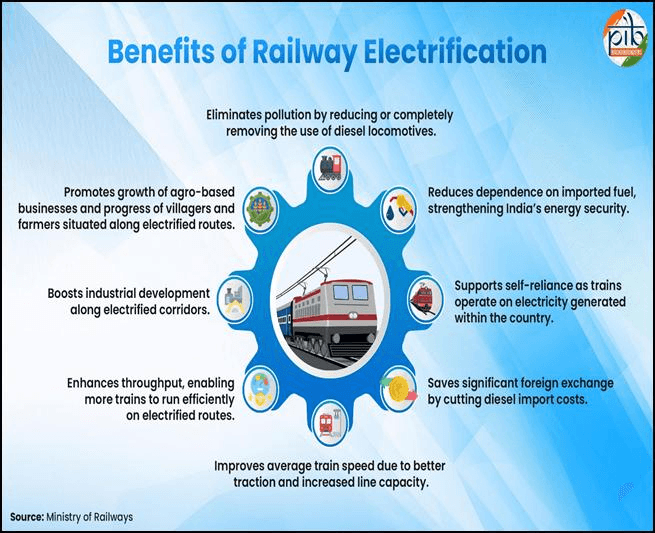
Broad-Gauge electrification; track gauge 1.676 m; migrating diesel traction to 25 kV AC network

Coverage spans 70,001 Route Kilometres; 99.2 % electrified as of Nov 2025; gaps remain in five states

First electric train 1925 Bombay Victoria Terminus–Kurla; foundation for energy-efficient rail mobility

Quick Facts for MCQs

Historical Milestones

  • 1925 Bombay Victoria Terminus–Kurla inaugurated electric traction in India
  • Electrified share grew 24 % in 2000 to >96 % by 2024

Acceleration Metrics

  • Pace jumped from 1.42 km/day (2004-14) to >15 km/day (2019-25)
  • 99.2 % target met; only 0.8 % network pending across five states

Economic & Environmental

  • Electric traction roughly 70 % more economical; slashes diesel import bill and operating costs
  • Electrification plus 898 MW solar cuts carbon, installed on 2,626 stations

International Snapshot

  • Switzerland 100 % electrified; China 82 %, Spain 67 %, UK 39 %
  • India trails only Switzerland on percentage coverage among major networks

Key Data Points

FeatureData-Point
Broad Gauge length70,001 RKMs
Electrified length69,427 RKMs
Electrification share99.2 % (Nov 2025)
States/UTs 100 % electrified25
Residual statesRajasthan, Tamil Nadu, Karnataka, Assam, Goa
Remaining non-electrified574 RKMs
Average pace 2019-25>15 km/day
Cost advantageElectric ~70 % cheaper
Solar capacity898 MW (Nov 2025)
GS-1Mapping

7.Australian State Victoria Mapping (Australian Geography)

Business Standard

What & Where

Victoria – second-most populous state, occupies southeastern tip of mainland Australia.

Sits between temperate coast (Tasman Sea, Southern Ocean) and semi-arid inland bordering NSW & South Australia.

Core relief includes Great Dividing Range, alpine plateaus, volcanic western plains, riverine north.

Quick Facts for MCQs

Physical Geography

  • Great Dividing Range creates alpine snowfields and shelters inland basins.
  • Western Victoria dotted with basaltic lava flows and dormant volcanic cones.
  • Plains: semi-arid Mallee versus fertile, yet fire-prone Gippsland.

Climate & Hazards

  • Heatwave > 40 °C triggered catastrophic bushfire alert across state.
  • Coastal temperate belt moderates cities; interior dryness heightens fire susceptibility.
  • Alpine zones losing snow cover under accelerated warming.

Economic Angle

  • Manufacturing, finance, education dominate Melbourne-centric economy.
  • Gippsland Basin yields significant national oil & natural-gas output.
  • Irrigated farming along Murray-Loddon sustains horticulture, viticulture exports.

Biodiversity

  • Habitats span alpine heath, temperate eucalypt forests, coastal wetlands.
  • Climate change escalating bushfire frequency, threatening endemic flora-fauna.
  • Land managers focusing on fuel-load reduction in Gippsland, Mallee regions.

Key Data Points

FeatureData-Point
CapitalMelbourne on Port Phillip Bay
Population rank2nd after New South Wales
Northern boundaryMurray River
Major mountain chainGreat Dividing Range
Highest peakMount Bogong
Key plainsMallee (NW), Gippsland (SE)
Hydrocarbon basinGippsland Basin oil & gas
Current fire ratingCatastrophic (≥ 40 °C)

Related UPSC Prelims PYQs

CDS_GK, GEO_GS 2022PYQ 1

Which one of the following cities is situated to the East of Great Dividing Range?

CDS_GK, GEO_GS 2025PYQ 2

Consider the following statements with regard to Australia:

GS-3Environment

8.Review of India’s Climate Targets Progress (Climate Targets)

The Hindu
Illustration for Review of India’s Climate Targets Progress (Climate Targets)

What & Where

Paris Agreement NDCs; India aligns climate action with Common but Differentiated Responsibilities

Core targets: emissions-intensity cut, 50 % non-fossil capacity, 500 GW RE, 2.5–3 Bt forest sink, net-zero 2070

Geography India; coal-heavy power belt, nationwide CAMPA-funded afforestation

Quick Facts for MCQs

Target Progress

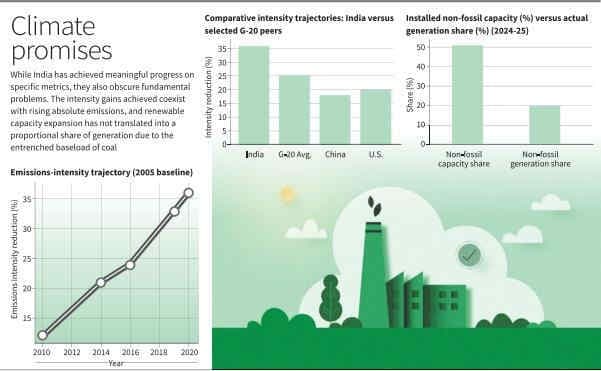
  • Emissions-intensity cut achieved 10 yrs early; absolute emissions still rising
  • Non-fossil capacity milestone met; 500 GW RE by 2030 termed technically feasible
  • Forest sink numerically on track; heavy reliance on fast-growing plantations

Roadblocks

  • Coal dominance persists; > 70 % electricity output, new plants risk carbon lock-in
  • Storage & grid gaps; 42 % transmission shortfall FY25, sub-GWh BESS undermines RE
  • CAMPA funds under-used; plantation bias raises ecological fragility of sinks

Strategic Pillars

  • Grid & storage push; execute National Transmission Plan, scale 74 GW BESS + 50 GW pumped hydro
  • Coal transition; retire old units, repurpose mines for solar/pumped storage ensuring just transition
  • Industrial decarbonisation; SIGHT incentives to deliver 5 MMT green hydrogen for steel, fertiliser, refining

Key Data Points

FeatureData-Point
Base year for intensity target2005
Intensity cut achieved by 2020≈ 36 %
Updated intensity pledge (2022)45 % cut by 2030
Non-fossil share in installed capacity> 50 % (mid-2025)
Renewable share in actual generation≈ 22 %
Solar capacity jump3 GW (2014) → 110 GW (2025)
Coal capacity operating≈ 219 GW
Coal capacity addition planned≈ 80 GW by 2031-32
India’s absolute GHG 2024≈ 3.35 Gt CO₂e
Operational BESS< 0.3 GWh
BESS target74 GW by 2032
Forest sink pledge2.5–3 Bt CO₂e by 2030
Green Hydrogen Mission outlay₹ 19,744 crore
Green H₂ production target5 MMT / yr by 2030

Related UPSC Prelims PYQs

CAPF_GAI, GEO_GS 2025PYQ 1

India’s key climate targets include

CAPF_GAI, GEO_GS 2020PYQ 2

India has committed to reduce emission intensity of its GDP from 2005 levels by 33-35 per cent by the year:

GS-3S&T

9.EX Hydrae White Dwarf System Study (Space Astronomy)

Times of India

What & Where

White dwarf system: dense, Earth-sized stellar remnant accreting matter from a binary companion.

EX Hydrae: intermediate-polar white dwarf ~200 ly away in constellation Hydra, now probed by NASA’s IXPE.

IXPE mission: low-Earth-orbit observatory measuring X-ray polarisation to map internal accretion structures.

Quick Facts for MCQs

Tech & Schemes

  • IXPE carries three identical telescopes with polarimeters using gas pixel detectors.
  • Data allow geometry reconstruction impossible with conventional X-ray photometry/spectroscopy.
  • First polarimetric study of any intermediate-polar system, expanding IXPE’s target catalogue beyond pulsars & blazars.

Physical Characteristics

  • Density: Sun-like mass compressed into ~1% Sun’s radius, supported by electron degeneracy pressure.
  • Accreting gas heats to tens of millions K, emitting hard X-rays.
  • Magnetic field moderate; disrupts inner disk, guiding plasma onto magnetic poles.

Accretion Dynamics

  • Polarisation angle reveals accretion columns rising thousands km above surface before shock cooling.
  • Reflected X-rays off white-dwarf crust confirm partial column occultation geometry.
  • Findings test models of magnetically-channelled accretion and extreme-matter radiative transfer.

Key Data Points

FeatureData-Point
MissionImaging X-ray Polarization Explorer (IXPE)
AgencyNASA
Observation methodX-ray polarimetry, not brightness alone
Target objectEX Hydrae binary
ConstellationHydra
Distance from Earth≈ 200 light-years
System subtypeIntermediate polar (magnetic cataclysmic variable)
New detectionHot gas column height & surface X-ray reflection
White-dwarf size~Earth radius
White-dwarf mass capChandrasekhar limit ≈ 1.4 M☉
GS-3S&T

10.EOS-N1 Anvesha Earth Observation Satellite (Earth Observation)

IT
Illustration for EOS-N1 Anvesha Earth Observation Satellite (Earth Observation)

What & Where

Satellite EOS-N1 ‘Anvesha’: advanced hyperspectral Earth-observation platform for strategic and civilian remote sensing

Launch details: January 2026, PSLV-C62, Satish Dhawan Space Centre Sriharikota

Capability: captures hundreds of spectral bands enabling precise material, surface and change detection

Quick Facts for MCQs

Security Dimension

  • DRDO-aligned asset provides border monitoring, terrain analysis, threat detection
  • Reduces foreign dependence for reconnaissance data, boosts national security autonomy
  • Supports rapid surveillance updates aiding operational planning

Agriculture & Environment

  • Crop health, soil moisture, yield estimation via spectral analytics
  • Land-use, infrastructure, disaster preparedness mapping for planners and responders
  • Ecosystem change, pollution dispersion, climate impact tracking

Tech Features

  • Hyperspectral sensors distinguish minerals, vegetation, man-made objects beyond multispectral capability
  • High spatial and spectral resolution enhances situation awareness for diverse sectors
  • Places India among few nations with indigenous hyperspectral satellite capability

Key Data Points

FeatureData-Point
Full nameEarth Observation Satellite-N1
CodenameAnvesha
Launch vehiclePSLV-C62
Planned launchJanuary 2026
Launch siteSriharikota (SDSC SHAR)
Co-passenger payloads18
Imaging modeHyperspectral, hundreds of bands
Key usersDefence, agriculture, urban planners, environmental agencies

Related UPSC Prelims PYQs

CAPF_GAI, ESE_GS 2023PYQ 1

NISAR satellite is manufactured jointly by Indian Space Research Organisation and:

CAPF_GAI, ESE_GS 2026PYQ 2

Which space organization launched the PUNCH Space Mission?

GS-2Polity

11.India-Bangladesh Ganga Water Treaty Renewal (Water Treaty)

Times of India
Illustration for India-Bangladesh Ganga Water Treaty Renewal (Water Treaty)

What & Where

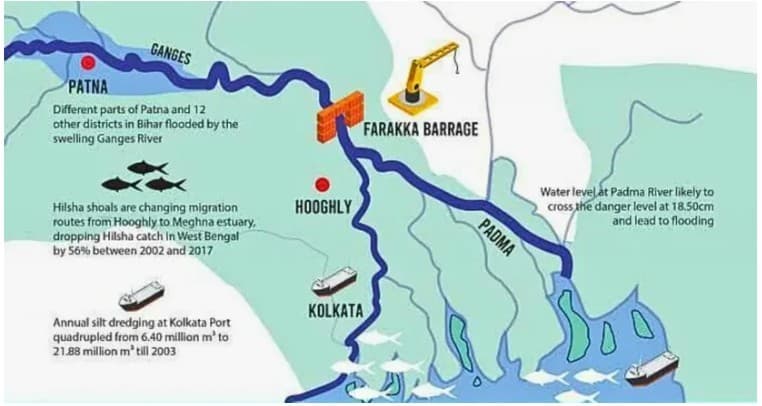
Treaty; 30-year accord allocating Ganga dry-season flows at Farakka Barrage between India and Bangladesh

Geography; Farakka Barrage (Murshidabad, WB) to Hardinge Bridge (Bangladesh) on Ganga/Padma main stem

Renewal; pact signed 12 Dec 1996 expires Dec 2026, renegotiation visits by Union Jal Shakti officials begun

Quick Facts for MCQs

Legal & Policy

  • Provision; review every five years, treaty extendable by mutual notification
  • Principle; equity, fairness, no harm underpin wording, cited as bilateral model
  • Status; automatic lapse avoided if renewed before Dec 2026 under Article XII

Institutional Mechanism

  • Joint Committee; records daily flows at Farakka & Hardinge, submits annual report
  • Consultation; immediate meeting mandated once discharge drops below 50,000 cusecs
  • Data-sharing; hydrological statistics exchanged routinely for transparency

Economic Angle

  • Navigation; assured freshwater maintains National Waterway-1 viability up to Haldia
  • Industry; Farakka & Sagardighi thermal plants rely on regulated releases
  • Port; salinity control aids Kolkata–Haldia port operations and dredging cost reduction

Historical Context

  • Precursor; interim accords signed 1977, 1982, 1985 due to protracted post-1950 disputes
  • Milestone; 1996 treaty ended water-sharing deadlock, boosted broader India-Bangladesh ties

Key Data Points

FeatureData-Point
Signing date12 December 1996
Validity30 years, renewable by consent
River stretchGanga between Farakka Barrage & Bangladesh border
Dry-season window1 January – 31 May
Allocation unitTen-day block schedule
Historical flow base1949-1988 average discharge data
Emergency trigger< 50,000 cusecs in any 10-day block
India’s upstream use cap≤ 200 cusecs between Farakka & border
Monitoring bodyJoint Committee, equal representation
Review intervalEvery 5 years or earlier

Related UPSC Prelims PYQs

GS1 2001PYQ 1

Mekong Ganga Cooperation Project is

GS-3Security

12.NATGRID Surveillance Expansion Debate (NATGRID)

The Hindu

What & Where

NATGRID; India-wide secure middleware linking 21 public-private databases for authorised intelligence queries

Processes: real-time data pull, AI entity resolution (GANDIVA), tiered query sensitivity

Geography: Bengaluru data centre; access now extended to all States/UTs up to Superintendent-of-Police rank

Quick Facts for MCQs

Legal & Policy

  • Statutory-gap; functions without dedicated law, raising proportionality concerns post-Puttaswamy judgment
  • DPDP Act 2023 exempts security agencies; citizens lack correction, grievance, deletion rights
  • Proposed oversight: Standing Committee on Intelligence, judicial warrants for “highly sensitive” data pulls

Technology & Schemes

  • AI GANDIVA matches KYC, vehicle and licence data, shrinking suspect linkage from days to minutes
  • Tiered access model: non-sensitive, sensitive, highly sensitive with audit logs for each query
  • Integration pipeline: NPR → NATGRID → CCTNS enabling family-tree verification against live FIR database

Security Dimension

  • Eliminates information silos; supports counter-terrorism, organised crime, terror-financing probes in real time
  • Centre–State intelligence coordination improved via direct SP-level access, shifting from episodic to continuous support
  • Function-creep risk; expansion into routine financial, civil offences may normalise mass surveillance

Social Concerns

  • Algorithmic bias; 15 % facial-ID false positives disproportionately affect marginalised demographics
  • Population-scale data linkage raises privacy, autonomy fears; lack of sunset and minimisation norms
  • Automated errors without human-in-loop can trigger wrongful detentions, reputational harm

Key Data Points

FeatureData-Point
Trigger event26/11 Mumbai attacks (2008)
Operational modeExecutive order; no parent Act
Linked dataset categories21 (travel, telecom, banking, identity etc.)
NPR linkage size≈119 crore resident records
Monthly query load~45,000 queries
AI module nameGANDIVA
CCTNS reach14,000+ police stations
State police access ceilingSuperintendent of Police
False-positive rate (facial)~15 %
Governing ministryUnion Home Ministry
GS-3Security

13.Akash-NG Surface-to-Air Missile Induction (Air Defence)

Indian Express

What & Where

Akash-NG = indigenous next-generation surface-to-air missile by DRDO for IAF layered air-defence, 70 km intercept

User Evaluation Trials held 2023-24 at Integrated Test Range, Chandipur (Odisha) clearing Acceptance of Necessity for induction

Production partners : Bharat Dynamics Ltd (missile) & Bharat Electronics Ltd (radar/C2); 96 % indigenous content

Quick Facts for MCQs

Tech & Schemes

  • Advancement : Replaces ramjet with lighter solid motor enabling longer reach and faster response
  • Atmanirbhar : 96 % local components plus fully indigenous radars, C2 and seeker
  • IGMDP : Continues P-A-T-N-A legacy aimed at missile self-reliance

Security Dimension

  • Layered-defence : Fills medium-range gap between QR-SAMs and S-400, counters drones, cruise missiles, fighters
  • Multi-target : Single battery can engage several threats simultaneously in low-altitude to high-altitude zones
  • Readiness : Canister storage gives longer shelf life and rapid shoot-and-scoot survivability

Export Potential

  • Demand : Armenia, Philippines, Vietnam, Egypt, Brazil expressed interest in export variant
  • Policy : Separate configuration offered abroad to protect domestic combat edge
  • Revenue : Missile exports align with USD 5 bn defence-export target by 2025

Key Data Points

FeatureData-Point
Max range60–70 km
Max altitude>20 km
SpeedMach 2.5
PropulsionDual-pulse solid motor
Warhead weight~60 kg
Missile weight350 kg (earlier Akash 700 kg)
GuidanceIndigenous RF seeker + command guidance
Kill probability≈90 %
Container typeCanisterised sealed launcher
MobilityTruck-mounted, 360° coverage
ECCMBuilt-in electronic counter-counter measures
Trial phaseUser Evaluation Trials completed Jan 2026
IGMDP lineageSuccessor to Akash (1980s-2014)
Export clearanceDec 2020 GoI approval

Related UPSC Prelims PYQs

ESE_GS, GS1 2003PYQ 1

With reference to Indian defence, which one of the following statements is correct?

ESE_GS, GS1 2024PYQ 2

Ministry of Defence signed contract with which one of the following organizations for Upgraded Super Rapid Gun Mount (SRGM) and other equipment for around 3000 crores?

GS-2Scheme

14.Ayush Export Promotion Council Milestones (AYUSH Exports)

PIB

What & Where

Nodal Export Promotion Council for AYUSH products and services, branded AYUSHEXCIL

Launched at Global AYUSH Investment & Innovation Summit, Gandhinagar, 2022 by Prime Minister

Operates nationwide with Ministry of AYUSH support and Commerce & Industry consultation

Quick Facts for MCQs

Functions & Services

  • Exporter capacity building, regulatory facilitation, B2B meetings, overseas outreach led by Council
  • International exhibitions and seminars organised to widen AYUSH market access

Product & Service Coverage

  • Supervises medicinal products, herbal formulations, traditional healthcare services across six AYUSH systems plus yoga
  • Anchors Ayush Quality Mark certification strengthening global credibility

Global Trade Dimension

  • AYUSH annexes secured in India–Oman CEPA and India–New Zealand FTA for formal recognition
  • Rising demand mirrored in USD 688.89 mn exports during 2024-25

Key Data Points

FeatureData-Point
Establishment anniversary4 Jan 2026 (4th)
Launch year2022
Launch venueGandhinagar Summit
Parent ministriesAYUSH; Commerce
Quality schemeAyush Quality Mark
Export growth 2024-256.11 %
Exports 2023-24USD 649.2 mn
Exports 2024-25USD 688.89 mn
Recognised in FTAsOman CEPA; NZ FTA
Sector coverageAyurveda, Yoga, Unani, Siddha, Sowa-Rigpa, Homoeopathy

Ready to practice?

Test your knowledge with our UPSC test series.

Start Free Trial