UPSC Current Affairs

15 topicsGS-1: 3GS-2: 2GS-3: 10
0/15 done
GS-2Polity

1.Right vs Freedom of Voting (Representation of People Act)

The Hindu

What & Where

Right to Vote: statutory entitlement under Representation of the People Act, 1951; eligibility defined by RPA 1950/51.

Freedom of Voting: speech-expression facet under Article 19(1)(a); exists only when an actual poll occurs.

Uncontested Election: Section 53(2) RPA 1951 lets Returning Officer declare winners without poll, disabling NOTA choice.

Quick Facts for MCQs

Legal & Policy

  • Section 53(2): equal candidates = seats; poll skipped; declaration through Forms 21/21B.
  • Rule 11, 1961 Rules: outlines paperwork and timeline for such uncontested declarations.
  • Section 79(b): NOTA excluded from “candidate”, hence cannot demand election when lone nominee.

Judicial Interpretation

  • PUCL 2003: casting vote equals speech; freedom of voting under Article 19 invoked only at polling.
  • Ponnuswami 1952 & Jyoti Basu 1982: right to vote purely statutory, Court upholds legislature’s limits.
  • Raj Bala 2015 hinted constitutional status, but prevailing jurisprudence still treats it statutory.

Election Statistics

  • Uncontested victories: 9 of 20 General Elections; frequency sharply declined post-1991.
  • ECI affidavit: multi-party competition makes uncontested seats “rare aberrations” of modern polls.
  • NOTA: introduced 2013; records dissent but lacks independent candidacy or seat-blocking power.

Key Data Points

FeatureData-Point
Constitutional article on adult franchiseArticle 326
Voting age lowered by61st Amendment Act, 1988
Present voting age18 years
Form for uncontested Lok Sabha winForm 21
Form for uncontested by-electionForm 21B
Total uncontested LS seats 1951-20249
Last uncontested LS seat year1991
Case recognising ballot as expressionPUCL v Union 2003
Provision defining “candidate”Section 79(b), RPA 1951
Rule enabling uncontested declarationRule 11, Conduct of Elections Rules 1961

Related UPSC Prelims PYQs

CDS_GK, GS1 2017PYQ 1

Right to vote and to be elected in India is a

CDS_GK, GS1 2023PYQ 2

सुभाष शर्मा बनाम भारत संघ (1991) के मामले में उच्चतम न्यायालय के ऐतिहासिक निर्णय में निम्नलिखित में से भारत के संविधान के किस मूल सिद्धान्त के बारे में उल्लेख किया गया ?
GS-3Editorial

2.G20 Report on Wealth Inequality (Wealth Inequality)

Economic Times

What & Where

Global inequality = skewed income/wealth distribution among persons, nations, regions.

Measured chiefly by Gini coefficient (0 = equality; 1 = max gap) and wealth-share ratios.

Starkest divide: rich regions vs. Sub-Saharan Africa; India-China growth only partly narrows gap.

Quick Facts for MCQs

Economic Angle

  • Concentration: richest 1% divert capital to finance, dampening productive investment and consumption.
  • Wage-lag: real wages for less-skilled suppressed by trade patterns, deregulated labor markets, IMF austerity.
  • Poverty-trap: inequality wastes human capital, slowing long-term inclusive growth.

Social Concerns

  • Health: 1.3 billion pushed into poverty by out-of-pocket medical spending, raising morbidity.
  • Nutrition: Additional 335 million regularly skip meals post-2019, escalating hunger, malnutrition.
  • Democracy: High-inequality polities seven times likelier to see democratic backsliding via elite capture.

Legal & Policy

  • Taxation: report urges progressive income, wealth, inheritance, global minimum corporate tax.
  • Governance: proposes International Panel on Inequality akin to IPCC for monitoring, advice.
  • Trade/IP: advocates IP waivers, antitrust, debt relief, SDR reallocation, stronger unions, minimum wages.

Key Data Points

FeatureData-Point
Richest 1% wealth capture (2000-24)41% of new global wealth
Bottom 50% wealth share (same period)1%
Nations with Gini > 0.483% (cover 90% populace)
Sub-Saharan Africa Gini0.61
India Gini 202225.5 (moderately low)
India: richest 1% gain 2000-2362% rise in share
Global food-insecure people 20232.3 billion (1 in 4)
Extra people skipping meals since 2019335 million

Related UPSC Prelims PYQs

CAPF_GAI, GEO_GS 2023PYQ 1

निम्नलिखित में से भारत की G20 प्राथमिकताएँ क्या हैं?

CAPF_GAI, GEO_GS 2020PYQ 2

The ‘head count ratio’ relates to which one of the following?

GS-3Economy

3.EEZ Fisheries Sustainability Rules (Deep-Sea Fishing)

Economic Times
Illustration for EEZ Fisheries Sustainability Rules (Deep-Sea Fishing)

What & Where

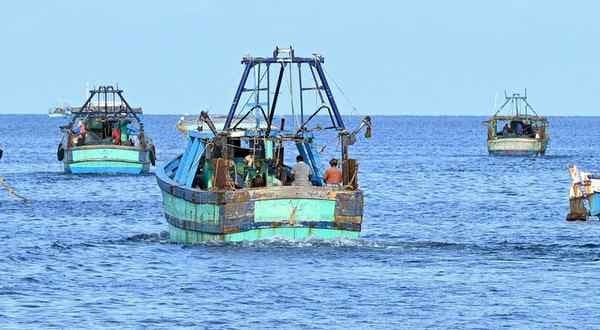
Regulatory Rules for Sustainable Harnessing of Fisheries govern deep-sea fishing inside India’s Exclusive Economic Zone (EEZ, 2.02 mn sq km).

Focus on responsible resource use via digital monitoring, cooperative-led vessel operations, traceability and biodiversity safeguards.

Key geographies: Mainland coast plus island EEZ; Andaman-Nicobar & Lakshadweep together hold 49 % of EEZ area.

Quick Facts for MCQs

Legal & Policy

  • Recognition: EEZ-caught fish treated as Indian-origin under customs rules for export accounting.
  • Management: Mandatory Fisheries Management Plans prescribe minimum legal sizes & seasonal controls.
  • Compliance: Aadhar/QR-coded Fisher ID cards integral to enforcement checks.

Tech & Digital

  • ReALCRaft: Single platform for vessel licence, catch log, health certificate, eco-labelling.
  • Monitoring: Real-time vessel tracking through transponders; data visible to Coast Guard & state agencies.
  • RBI e-monitoring: Transshipment proceeds, fuel payments and landings digitally audited mid-sea.

Livelihood & Economy

  • Capacity: Training, international exposure visits planned for small-scale fishers’ upskilling.
  • Diversification: Incentives for sea-cage mariculture and seaweed farming to ease coastal fishing pressure.
  • Export boost: Traceable, eco-labelled seafood expected to open premium markets and raise forex earnings.

Key Data Points

FeatureData-Point
Implementing ministryFisheries, Animal Husbandry & Dairying
Beneficiary priorityFishermen Cooperative Societies & FFPOs
Digital permitFree Access Pass on ReALCRaft portal
ExemptionNon-mechanised traditional crafts from Access Pass
Mid-sea transshipmentMother-and-Child vessels; RBI-monitored
Harmful gears bannedLED fishing, pair trawling, bull trawling
Safety linkageNABHMITRA app + compulsory transponders
Traceability partnersMPEDA & Export Inspection Council
Credit windowsPM Matsya Sampada Yojana, FIDF
IUU deterrenceNational Action Framework inside Indian waters

Related UPSC Prelims PYQs

CDS_GK, ESE_GS 2026PYQ 1

Which institution released the report titled “India’s Blue Economy: Strategy for Harnessing Deep-Sea and Offshore Fisheries”?

CDS_GK, ESE_GS 2024PYQ 2

Which of the following statements is not correct?

GS-3Economy

4.Demonetisation Impact on Money Supply (Currency in Circulation)

Indian Express
Illustration for Demonetisation Impact on Money Supply (Currency in Circulation)

What & Where

Demonetisation: India’s 8 Nov 2016 withdrawal of ₹500 & ₹1 000 notes to curb black money, fakes, boost digitisation.

Currency with public: Currency in circulation minus banks’ cash; mirror of cash held by households/firms in India.

2025 scene: Absolute cash doubled, yet cash-GDP ratio < 2016 because of robust growth & digital payment surge.

Quick Facts for MCQs

Legal & Policy

  • Provision: Centre can demonetise on RBI Board advice under Sec 26(2), RBI Act 1934.
  • Judiciary: Vivek Narayan Sharma v UoI (2023) held action proportionate; dissent 1.
  • Continuity: ₹2 000 note introduced 2016, withdrawn 2023, still legal tender.

Economic Angle

  • Absolute cash ↑, but GDP faster → ratio fall; still above US 7.96 %, China 9.5 %, Eurozone 8-10 %, Japan 9-11 %.
  • SMEs, demand, GDP hit (~1.5 %) during 2016 shock.
  • Cash preference persists due to large informal sector.

Digital Payments

  • Catalyst: 2016 cash crunch triggered rapid e-payment adoption.
  • Penetration: Tier-2/3 cities drive UPI to 185.9 bn txn FY25.
  • Growth: 49 % CAGR in UPI volume FY23-25.

Money Supply

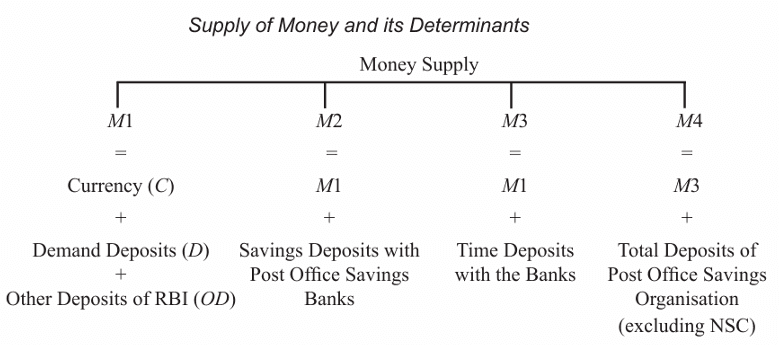
  • M1: Currency + demand deposits + RBI other deposits (narrow money).
  • M3: M1 + bank time deposits; RBI’s key target variable.
  • M4: Broadest; M3 + all post-office deposits.

Key Data Points

FeatureData-Point
Currency with public (Nov 2016)₹17.97 lakh cr
Currency with public (Oct 2025)₹37.29 lakh cr
Share of scrapped notes (2016)86 % of CIC
CIC-to-GDP ratio (2016)12.1 %
CIC-to-GDP ratio (2025)11.11 %
RBI Act clause usedSec 26(2)
SC verdict on move2023; 4:1 upheld
GDP dip estimate~1.5 %
UPI volume (FY25)185.9 billion
UPI CAGR (FY23-25)49 %

Related UPSC Prelims PYQs

CAPF_GAI, GS1 2023PYQ 1

यदि RBI द्वारा आरक्षित नकदी निधि अनुपात घटाया जाता है, तो अर्थव्यवस्था में मुद्रा की आपूर्ति:

CAPF_GAI, GS1 2020PYQ 2

यदि आप अपने बैंक के माँग जमा खाते (Demand Deposit Account) से ₹ 1,00,000 की नगद राशि निकालते हैं, तो अर्थव्यवस्था में तात्कालिक रूप से मुद्रा की समग्र पूर्ति पर इसका क्या प्रभाव पड़ेगा ?

GS-1History

5.Janjatiya Gaurav Varsh 2025 (Tribal Freedom Fighters)

PIB

What & Where

Nationwide, year-long Janjatiya Gaurav Varsh 2025 celebrates 150th birth of Bhagwan Birsa Munda and 150 years of “Vande Mataram”.

Nodal stewardship by Ministry of Tribal Affairs; activities span Jharkhand, Odisha, Gujarat, Nagaland, Ladakh and other States/UTs.

Signature Janjati Gaurav Yatra travels Ambaji & Umargam (Gujarat) to Statue of Unity, symbolising tribal unity with national pride.

Quick Facts for MCQs

Cultural & Heritage

  • Exhibitions, art shows, folk performances highlight tribal heroes’ role in freedom struggle.
  • Yatra and state-level festivals integrate traditional rites with modern staging.
  • Statue of Unity endpoint reinforces unity narrative through tribal iconography.

Education & Youth

  • Competitions, museum visits, heritage quizzes inject tribal history into school curricula.
  • EMRS hubs host workshops on reading, tribal scripts, storytelling.
  • Sports meets promote physical engagement alongside cultural learning.

Inclusion & Empowerment

  • Digital banking, Aadhaar seeding, e-commerce sessions target tribal economic uplift.
  • Skill camps emphasise entrepreneurship in crafts, forest produce.
  • Gender-sensitive programmes ensure women’s equal participation in all events.

Key Data Points

FeatureData-Point
Nodal ministryMinistry of Tribal Affairs
Celebration windowCalendar year 2025
Main honoureeBhagwan Birsa Munda (Dharti Aaba)
Additional milestone150 years of “Vande Mataram”
Key marchJanjati Gaurav Yatra: Ambaji & Umargam → Statue of Unity
Major partnersTRIs, State Govts, EMRS, cultural bodies
Vision sloganSabka Saath, Sabka Vikas, Sabka Vishwas, Sabka Prayas
Core componentsCultural events, educational drives, community empowerment
Mass activityNationwide singing of “Vande Mataram”
Literacy focusDigital & financial modules in EMRS
GS-1Mapping

6.Angola Geographical Overview (African Geography)

IT

What & Where

Resource-rich nation in southwestern Africa, independent from Portugal since 1975

Borders Republic of Congo, DRC, Zambia, Namibia; western frontage on Atlantic Ocean

Terrain climbs from narrow coastal plain to 1,000–2,000 m plateau; highest Mount Moco 2,620 m

Quick Facts for MCQs

Topography & Geology

  • Plateau: central plateau dominates interior, lateritic soils, eroded escarpments
  • HighestPeak: Mount Moco 2,620 m near Huambo province
  • CoastalPlain: narrow lowland transitions abruptly to highlands

Rivers & Drainage

  • WestFlow: Cuanza and Cuango drain directly to Atlantic
  • SouthFlow: Cunene river basin straddles Angola-Namibia border
  • EastFlow: headwaters supply Zambezi and Okavango inland systems

Natural Resources

  • Hydrocarbons: offshore deep-water blocks drive majority of export revenue
  • Diamonds: Lunda Norte & Sul host rich alluvial and kimberlite pipes
  • Metals: iron, copper, gold reserves remain underdeveloped

Diplomatic Angle

  • IndiaEngagement: first Indian Presidential visit signals elevated ties
  • Agenda: cooperation in oil, diamonds, trade logistics, digital tech

Key Data Points

FeatureData-Point
CapitalLuanda
Independence Year1975
Colonial PowerPortugal
Highest PointMount Moco 2,620 m
Avg Plateau Elevation1,000–2,000 m
Major RiversCuanza, Cunene, Cuango
Ocean CoastlineAtlantic
Neighbouring StatesRep. of Congo, DRC, Zambia, Namibia
Key MineralsOil, diamonds
GS-3Environment

7.Tiger Reserve Relocation Policy (Tiger Conservation)

The Hindu

What & Where

National framework (2025) on relocation & co-existence in tiger reserves, issued by Ministry of Tribal Affairs.

Covers all Indian tiger reserves; guides treatment of Scheduled Tribes & Other Traditional Forest Dwellers.

Aims to reconcile tiger conservation mandates with Forest Rights Act, 2006 safeguards.

Quick Facts for MCQs

Legal & Policy

  • Affirmative-State-Duty reiterated; rights curtailed only on demonstrable ecological necessity.
  • FRA & Wildlife Protection Act compliance made explicit relocation pre-condition.
  • Consent-based relocation aligns with constitutional Schedule V safeguards.

Governance Tools

  • NDCCI ensures transparent tracking of compensation, timelines, outcomes.
  • Third-party audits provide yearly rights-compliance verification.
  • Joint MoTA-MoEFCC framework sets procedural standards and accountability.

Tribal Rights & Participation

  • Gram-Sabha-centric decision making empowers local institutions.
  • Co-management roles envisaged for resident communities within tiger reserves.
  • Access to basic amenities guaranteed for those choosing in situ co-existence.

Key Data Points

FeatureData-Point
Nodal ministryMinistry of Tribal Affairs (MoTA)
Collaborating ministryMinistry of Environment, Forests & Climate Change
Regulatory authority referencedNational Tiger Conservation Authority
Core law referencedForest Rights Act, 2006
Relocation principleLast-resort, post-settlement of rights
Consent mandateFree, prior, informed consent of every Gram Sabha & household
Co-existence clauseCommunities may remain inside reserves with State support
Monitoring toolNational Database on Conservation–Community Interface (NDCCI)
Compliance checkAnnual third-party audits
Oversight body proposedNational Framework for Community-Centred Conservation & Relocation

Related UPSC Prelims PYQs

CAPF_GAI, GS1 2022PYQ 1

Which one of the following statements is not true with regard to tribal welfare?

CAPF_GAI, GS1 2018PYQ 2

Consider the following statements:

GS-3Environment

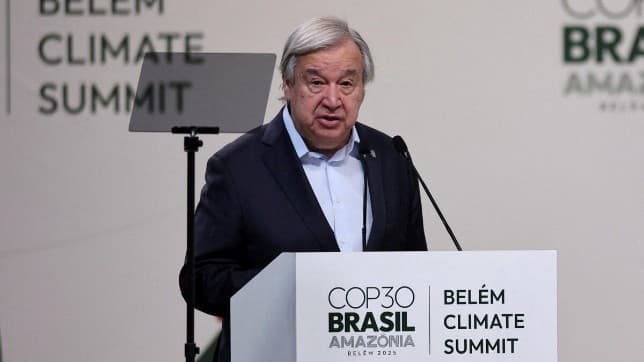
8.COP30 UN Climate Summit (UNFCCC COP30)

DH
Illustration for COP30 UN Climate Summit (UNFCCC COP30)

What & Where

COP30; 30th UNFCCC Conference; annual Paris-Agreement review & target-setting meet.

Venue Belém, Pará, Brazil; first Amazonian city to host a COP.

Branded “Implementation COP”; aims measurable actions under CBDR-RC principle.

Quick Facts for MCQs

Climate Finance

  • NCQG ups floor from USD 100 bn to 300 bn yearly by 2035.
  • Roadmap targets predictable, concessional flows for developing economies.
  • TFFF rewards nations preserving tropical forests via blended finance.

Adaptation Targets

  • GGA to set quantifiable, time-bound resilience benchmarks.
  • Stocktake to spotlight gaps directing finance & tech support.
  • Metrics likely include early-warning coverage, ecosystem restoration.

Equity & Just Transitions

  • CBDR-RC central to burden-sharing, tech transfer, capacity-building talks.
  • Emphasis on fair energy, industry, transport shifts in Global South.
  • Integrated agenda links carbon cuts with forest, ocean, soil health.

Key Data Points

FeatureData-Point
COP edition30th
Scheduled year2025
Host cityBelém
Host countryBrazil
Landmark10 yrs since Paris Agreement
First Global StocktakeOutcomes due at COP30
NCQG finance level≈ USD 300 bn / yr by 2035
Long-term finance vision≈ USD 1 trn / yr mobilised
Key roadmapBaku-to-Belém Climate Finance Roadmap
New fund ideaTropical Forests Forever Facility
Core adaptation toolGlobal Goal on Adaptation
Guiding equity normCBDR-RC

Related UPSC Prelims PYQs

CAPF_GAI, GEO_GS 2024PYQ 1

Which one among the following statements with regard to the United Nations Climate Change Conference (COP28) is NOT correct?

CAPF_GAI, GEO_GS 2026PYQ 2

The United Nations Framework Convention on Climate Change (UNFCCC) was first signed during

GS-3EnvironmentQuick Bite

9.Gogabil Lake Ramsar Site (Ramsar Wetland)

Times of India

What & Where

Gogabil Lake: ox-bow, permanent wetland in Trans-Gangetic plains, Katihar; bordered by Mahananda (NE) & Ganga (S).

Listed 2025 as Bihar’s 6th Ramsar site; state now third-highest Ramsar count after Tamil Nadu & Uttar Pradesh.

First Community Reserve & 15th Protected Area of Bihar; critical wintering node on Central Asian Flyway.

Quick Facts for MCQs

Biodiversity

  • Hosts Red-crested & Common Pochards, Bar-headed/Greylag Geese, Northern Pintail, Ruddy Shelduck congregations.
  • Supports endangered Black-bellied Tern, Ferruginous Duck, Painted & Lesser Adjutant Storks, Darter, Black-headed Ibis.
  • Recognised Important Bird Area for large, multi-species waterbird gatherings.

Threats

  • Fertiliser & pesticide runoff from catchment heavily contaminate wetland.
  • Biological resource over-extraction: intensive fishing, grazing, plant harvesting.
  • Seasonal shrinkage amplifies pollutant concentration, stressing fauna.

Socio-economic Use

  • Irrigation water abstraction vital for surrounding agriculture.
  • Extensive fishing, navigation, cattle wading underpin local livelihoods.
  • Recreation potential adds ancillary income opportunities.

Key Data Points

FeatureData-Point
Ramsar Convention1971
India’s Ramsar statusMost in Asia; 3rd worldwide
World leadersUK 176, Mexico 144 sites
Bihar Ramsar tally6 sites (2025)
Wetland typeOx-bow, permanent
IBA tagYes, high avian diversity
Key endangered birdsBlack-bellied Tern, Lesser Adjutant, River Tern
Major rivers nearbyMahananda, Ganga
Protected Area number15th PA of Bihar
Community Reserve rank1st in Bihar

Related UPSC Prelims PYQs

CAPF_GAI, GEO_GS 2025PYQ 1

Which one of the following pairs of Ramsar Sites and States is not correctly matched?

CAPF_GAI, GEO_GS 2023PYQ 2

Consider the following statements about Ramsar Wetland sites in India:

GS-3S&T

10.Odd Radio Circles Phenomenon (Radio Astronomy)

The Hindu
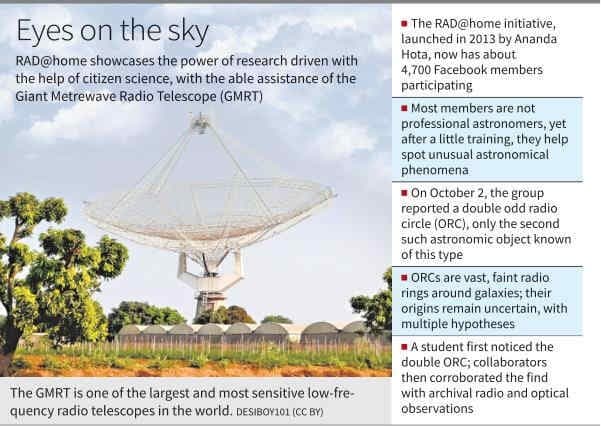
Illustration for Odd Radio Circles Phenomenon (Radio Astronomy)

What & Where

Odd Radio Circles (ORCs): gigantic, faint radio-emission rings encircling some distant galaxies.

First spotted 2019 via Australia’s ASKAP; latest twin ORC found in LOFAR data by Indian citizen scientists.

Located millions of light-years across intergalactic space; visible only at radio wavelengths.

Quick Facts for MCQs

Astronomical Characteristics

  • Radio-only detection indicates non-thermal synchrotron emission from relativistic electrons.
  • Edge brightness suggests outward-moving shock fronts compressing intergalactic magnetic fields.
  • Central host galaxy present in some cases, absent in others, complicating origin models.

Discovery & Instruments

  • LOFAR’s low-frequency sensitivity (≤240 MHz) ideal for faint, diffuse structures.
  • Follow-up with GMRT aids spectral index mapping, age, and energy estimates.
  • Citizen-science data mining complements professional survey pipelines, boosting rare-object finds.

Indian Contribution

  • RAD@home: free, online, pan-India learning programme training 5000+ volunteers in radio-image analysis.
  • Twin ORC discovery marks first Indian-led identification of this phenomenon.
  • Highlights domestic capacity ahead of SKA participation and upgraded GMRT utilisation.

Scientific Significance

  • Provides laboratory for studying galaxy-scale feedback and intergalactic medium physics.
  • Constraints on black-hole merger rates vital for gravitational-wave astronomy synergies.
  • Guides design of next-gen surveys (SKA, ngVLA) focused on low-surface-brightness cosmology.

Key Data Points

FeatureData-Point
Discovery year2019
First instrumentAustralian Square Kilometre Array Pathfinder (ASKAP)
Latest detectionLOFAR (Low-Frequency Array), Europe
Indian telescope used laterGiant Metrewave Radio Telescope (GMRT), Pune
Visibility rangeRadio frequencies only; no optical/X-ray/IR counterpart
Typical sizeUp to several million light-years diameter
MorphologyCircular, edge-brightened plasma rings
Rarest formTwin/double ORC; only 2 known so far
Probable originShockwaves from black-hole mergers or powerful galactic outflows
Lead Indian groupRAD@home network led by Prof. Ananda Hota
GS-3S&T

11.India's Nutritional Transformation Debate (Functional Foods)

The Hindu

What & Where

Functional foods = fortified staples (vitamin rice, omega-3 milk, probiotic yogurt) targeting disease prevention.

Smart proteins = plant-based, fermentation-derived or cultivated meat/dairy made via biotechnology.

India focus: >70 startups, DBT-BIRAC funding, IIRR zinc rice & ICRISAT iron millet under BioE3 nutrition push.

Quick Facts for MCQs

Tech & Schemes

  • Biofortification: IIRR zinc rice, ICRISAT iron millet combat micronutrient gaps.
  • DBT-BIRAC backs cultivated & fermentation proteins; FSSAI to frame novel-food norms.

Health Indicators

  • NFHS data show hidden hunger persists despite grain sufficiency.
  • Protein deficit heightens vulnerability to infections, chronic disorders.

Economic Angle

  • Malnutrition drains ₹1 lakh cr ($12 bn) annually in lost productivity.
  • Functional foods & smart proteins open high-skill biotech and agri-processing jobs.

International Examples

  • Singapore okayed cultivated chicken in 2020, pioneering regulatory acceptance.
  • EU “Farm to Fork” funds sustainable protein to aid carbon-neutral goal.

Key Data Points

FeatureData-Point
Child stunting (NFHS-5)35 %
Women anaemic (NFHS-5)57 %
Avg. Indian protein intake47 g/day
ICMR norm60 g/day
Indian functional food market$25 bn by 2030
Global smart-protein market$85–240 bn by 2030
Livestock share of GHG5 % worldwide
Alt-protein startups in India70 +
Products already launched377
CCMB cultivated-meat grant₹4.5 crore (DBT)

Related UPSC Prelims PYQs

GS1 2023PYQ 1

‘पोषण मुक्त भारत अभियान’ के अंतर्गत की जा रही व्यवस्थाओं के संबंध में, निम्नलिखित कथनों पर विचार कीजिए :

GS1 2017PYQ 2

Which of the following are the objectives of ‘National Nutrition Mission’?

GS-3S&T

12.Generative AI Data Privacy (Generative AI)

Indian Express
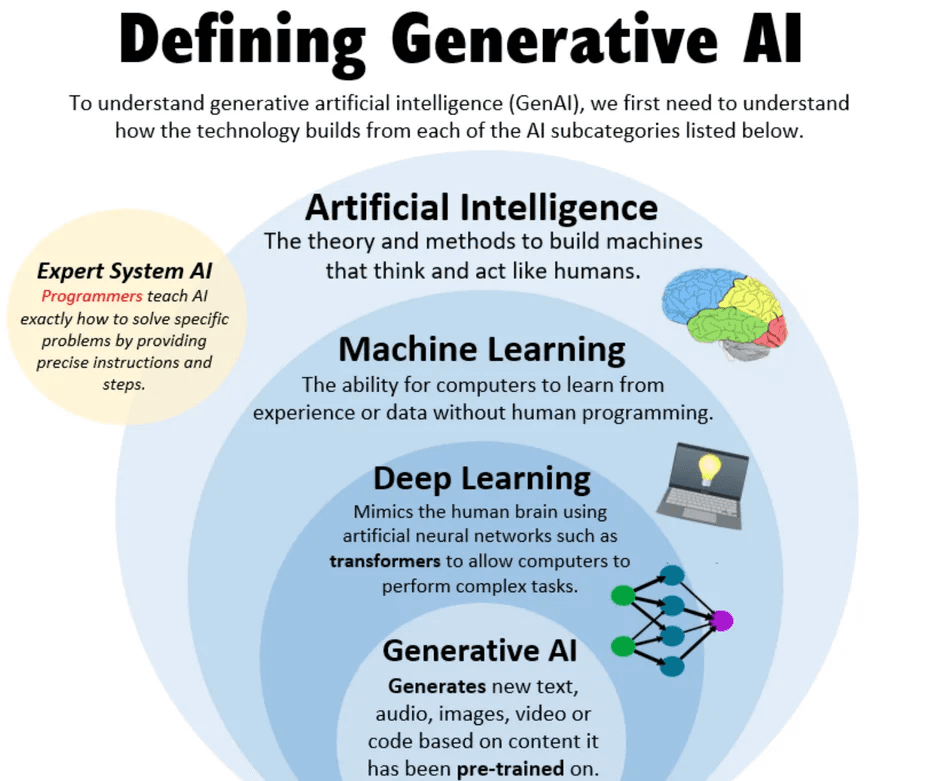
Illustration for Generative AI Data Privacy (Generative AI)

What & Where

Generative AI: systems creating original text, images, code, audio or video using Transformer-based Large Language Models.

Key tools: ChatGPT, Gemini, DALL-E, Midjourney, GitHub Copilot, Suno, Runway Gen-2.

Geography: India scrutinising GenAI in governance for data-privacy, inference and sovereignty reasons.

Quick Facts for MCQs

Security Dimension

  • Inference risk: foreign LLM queries may reveal policy timelines, strategic intent, system gaps.
  • Restriction: Finance Ministry bans ChatGPT, DeepSeek on official devices to secure confidential data.
  • Mitigation: Officials shifting to Zoho Mail and Zoho Office; air-gapped systems encouraged.

Legal & Policy

  • Framework: MeitY panel proposes India-specific AI Risk Assessment and whole-of-government guidelines.
  • Localisation: Mandatory domestic data storage and training aligned with DPDP Act 2023.
  • SOP plan: Unified ban on foreign GenAI in sensitive tasks; secure prompt-sanitisation gateways.

Tech & Schemes

  • India AI Mission: funds compute, datasets, 12 home-grown LLMs for governance use.
  • Synthetic data: proposal for national fabric generating diverse, privacy-preserving Indian datasets.
  • Niche LLMs: focus on domain models like Nyaya-Shastra for legal texts over mega-model rivalry.

Key Data Points

FeatureData-Point
Inference riskModel can deduce user roles, priorities from prompts
India AI Mission budget₹10,372 crore
Indigenous LLM target12 large + smaller domain models
First governance-focused LLMSarvam, due end-2026
Data law anchorDPDP Act, 2023
AI governance subcommitteeUnder MeitY
Ministry barring ChatGPT useFinance Ministry

Related UPSC Prelims PYQs

ESE_GS 2026PYQ 1

Which Ministry released the India AI Governance Guidelines in 2025?

GS-3Security

13.Exercise Malabar 2025 (Naval Exercise)

DC
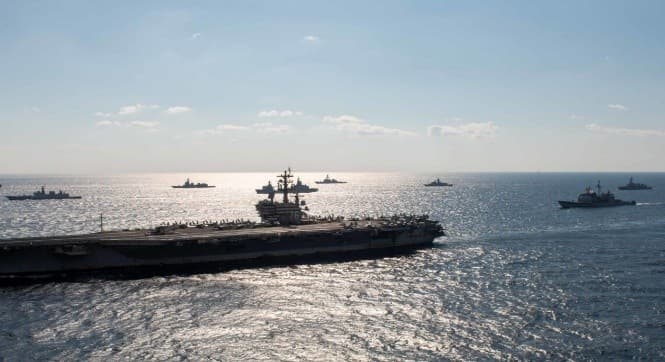
Illustration for Exercise Malabar 2025 (Naval Exercise)

What & Where

Exercise Malabar = Quad navies’ flagship drill for interoperability and maritime security across Indo-Pacific waters

Began 1992 as India–US bilateral; now permanent four-nation format (India, USA, Japan, Australia)

Malabar 2025 staged off Guam, Northern/Western Pacific U.S. territory; INS Sahyadri sails from India

Quick Facts for MCQs

Historical Evolution

  • Progression: basic coordination ➔ advanced joint operations over three decades
  • Hosting: rotates among Quad members, sharing security responsibility
  • Expansion: bilateral ➔ trilateral (2007 intermittent) ➔ permanent Quad by 2020

Operational Features

  • Harbour phase: planning meets, comms alignment, cross-deck visits, cultural exchanges
  • Sea phase: ASW, surface gunnery, aviation cross-deck, integrated fleet manoeuvres
  • Focus: maritime domain awareness, joint logistics, rapid coordinated response

Indigenous Capability

  • INS Sahyadri: indigenously designed Shivalik-class stealth frigate, showcases Aatmanirbhar Bharat
  • Demonstrates Indian self-reliance in frontline naval platforms and combat systems

Security Dimension

  • Quad navies signal commitment to regional stability amid Indo-Pacific strategic flux
  • Emphasises freedom of navigation, rule-based order, collective deterrence against emerging threats

Key Data Points

FeatureData-Point
Launch year1992
Original formatIndia-USA bilateral
Japan became permanent2015
Australia joined2020
Quad statusIndia, USA, Japan, Australia
2025 hostGuam (U.S. island territory)
Indian participantINS Sahyadri stealth frigate
Exercise phasesHarbour & Sea
Key sea drillsASW, fleet manoeuvres, gunnery, air defence
Core objectiveFree, open, rules-based Indo-Pacific

Related UPSC Prelims PYQs

ESE_GS, NDA_GAT 2024PYQ 1

Which one among the following Joint Military Exercises was NOT conducted between India and USA?

ESE_GS, NDA_GAT 2022PYQ 2

Which one of the following countries did the Indian Navy participate in the U.S. Navy-led Southeast Asia Cooperation and Training (SEACAT) military exercise, to demonstrate its maritime manoeuvres?

GS-2Infrastructure

14.National Urban Conclave 2025 (Urban Governance)

PIB

What & Where

National Urban Conclave 2025, New Delhi; flagship meet to operationalise Viksit Bharat 2047 urban vision.

Central theme Sustainable Urban Development & Governance; six new missions, funds, digital tools unveiled.

Scope All Indian ULBs, with focused modules for legacy dumpsites and fragile hill-Himalayan cities.

Quick Facts for MCQs

Tech & Schemes

  • DRAP speeds dumpsite remediation; aims Lakshya Zero Dumpsites by FY 26.
  • IIRS Sankalan offers geotagged, real-time urban survey capability.
  • UiWIN one-stop digital window for private, MDB, PPP urban investments.

Financials

  • Incentive Rs 550 / tonne boosts ULB legacy-waste bioremediation economics.
  • Rs 1,000 crore hill-Himalayan fund strengthens high-altitude SWM systems.
  • UiWIN channels World Bank, ADB, private equity into green urban infra.

Institutional Framework

  • KMU at NIUA drives SBM-Urban training, knowledge, M&E.
  • New Habitat-Housing Policy Centre supports affordable housing data, capacity.
  • MoHUA steers all initiatives, ensuring cross-scheme convergence.

Key Data Points

FeatureData-Point
Conclave venueNew Delhi
Event year2025
ThemeSustainable Urban Development & Governance
Vision alignedViksit Bharat 2047
DRAP goal yearSeptember 2026
Legacy waste targeted~8.8 crore MT
Centre support rateRs 550 per tonne
Hill & Himalayan Cities FundRs 1,000 crore
UiWIN lead agencyHUDCO
KMU host organisationNIUA (under MoHUA)
IIRS SankalanGIS-based survey mobile app

Related UPSC Prelims PYQs

CDS_GK 2025PYQ 1

Social Mobilisation and Institution Development (SM&ID) is one of the major components of:

CDS_GK 2023PYQ 2

Which one of the following is the venue of the UN 2023 Water Conference?

GS-1Editorial

15.Civil Services Gender Gap (Gender Representation)

Indian Express
Illustration for Civil Services Gender Gap (Gender Representation)

What & Where

UPSC Civil Services Examination: national gateway to IAS/IPS/IFS cadres.

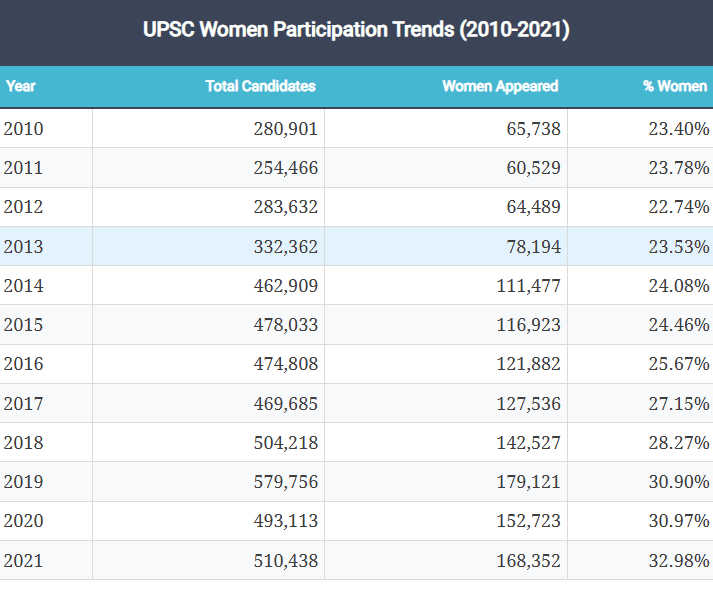
Three stages: Prelims → Mains → Personality Test; data analysed for 2010-2021.

Lens on gender participation across India, including legally recognised third gender.

Quick Facts for MCQs

Social Constraints

  • Patriarchy: 60% women cite family/societal pressure (CSDS 2023).
  • Early-marriage norms shorten preparation horizon; drives high drop-outs.
  • Safety fears deter relocation to Delhi, other exam hubs.

Institutional & Policy Gaps

  • UPSC lacks gender-specific hostels, counselling, mentorship structures.
  • Coaching centres seldom offer secure accommodation; inclusivity limited.
  • No mandated gender-disaggregated annual diversity report yet.

Emerging Positive Trends

  • Female candidature up 9.5 percentage points since 2010.
  • Visible officers—IAS Ira Singhal, IPS Rema Rajeshwari—inspire Tier-II/III entrants.
  • Schemes: PM-DAKSH, Mission Karmayogi include women’s capacity-building modules.

Governance Benefits

  • Higher female bureaucracy → better health/education outcomes (UNDP 2023).
  • NCAER 2022: women officers statistically lower rent-seeking behaviour.
  • Symbolic leaders (e.g., Smita Sabharwal) normalise women’s authority in public office.

Way Forward

  • Launch Women-in-Administration Fellowships for coaching, mentorship, scholarships.
  • Institutionalise crèches, flexible postings, sabbaticals within services.
  • Expand state-run district coaching centres and safe hostels for aspirants.

Key Data Points

FeatureData-Point
Female share, Prelims 201023.4%
Female share, Prelims 202132.98%
Women in 2021 final merit201; 15.66%
Transgender candidates 20214; none advanced
Third-gender option introducedUPSC forms 2016
Women quitting by age 2740% (Vision IAS 2024)
Avg. classroom coaching cost₹2–3 lakh per year
Rural female education spend gap30% below men (NSO 2022)
India rank, mobility freedom127 / 146 (WEF 2024)
Institutes with women’s hostels15% only

Related UPSC Prelims PYQs

CDS_GK 2025PYQ 1

आधुनिक भारत में सफल महिलाओं के संदर्भ में, निम्नलिखित कथनों पर विचार कीजिए:

CDS_GK 2025PYQ 2

राष्ट्रीय महिला आयोग के बारे में निम्नलिखित में से कौन-से कथन सही हैं?

Ready to practice?

Test your knowledge with our UPSC test series.

Start Free Trial