UPSC Current Affairs

13 topicsGS-1: 2GS-2: 4GS-3: 7
0/13 done
GS-2Polity

1.Tribunals Reforms Act 2021 Overview (Tribunal Reforms)

NDTV

What & Where

Legislation; streamlines India’s tribunal system, replacing Tribunals Reforms Ordinance 2021

Process; abolishes select appellate tribunals and shifts jurisdiction to High Courts

Scope; nationwide, appointments routed through Union Government and CJI-led committee

Quick Facts for MCQs

Legal & Policy

  • SupremeCourt; censured Union for repeated adjournments in validity challenge
  • SeparationOfPowers; Act reinstates clauses struck in Madras Bar Association 2021 judgment
  • JudicialIndependence; four-year terms contrary to earlier SC directives

Administrative Design

  • Appointments; Centre selects after CJI-panel recommendation, retains reappointment discretion
  • Transition; abolished-tribunal members demit office instantly, pending cases migrate to High Courts
  • AmendmentPower; Union can alter tribunal list without parliamentary approval

Governance Concerns

  • ExecutiveDominance; extensive control over tenure threatens functional autonomy
  • AgeBarrier; 50-year threshold sidelines younger advocates and academics
  • EfficiencyClaim; promised delay reduction debated amid concerns of central influence

Key Data Points

FeatureData-Point
Enactment date13 Aug 2021
Ordinance replacedTribunals Reforms Ordinance 2021
Chairperson tenure4 yrs / till 70 yrs
Member tenure4 yrs / till 67 yrs
Minimum appointment age50 years
Appointment bodySearch-cum-Selection Committee chaired by CJI/nominee
Key tribunals abolishedFCAT, IPAB, Airport Appellate Tribunal
Schedule amendment powerCentral Govt via notification
GS-3Economy

2.India Diversifies Export Markets Globally (Export Diversification)

Economic Times
Illustration for India Diversifies Export Markets Globally (Export Diversification)

What & Where

Export diversification: broadening product range & destination markets, reducing partner-concentration risk.

Current shift: lowering US dependence, boosting Africa–Middle East–SE Asia share via FTAs and supply-chain realignments.

Core new geographies: UAE, Iran, China, Vietnam, Thailand, Africa, EU alongside traditional US market.

Quick Facts for MCQs

Market Trends

  • Africa–Middle East–SE Asia increasingly absorb pharma, textiles, engineering, machinery demand.
  • Marine exports +60 % to China, Vietnam, Thailand; tea gains UAE, Iraq, Germany traction.
  • China-plus-one strategy positions India as reliable supply-chain alternative.

Policy Measures

  • Foreign Trade Policy-2023 & MAI incentivise new-market outreach, ease logistics barriers.
  • PLI schemes boost export competitiveness in electronics, textiles, pharma manufacturing.
  • Commerce Ministry mapped 40 high-import nations covering 75 % global textile-apparel demand.

Product Basket

  • Engineering goods exports exceed USD 100 bn annually since 2021-22.
  • Computer hardware shipments doubled to USD 1.4 bn; pharmaceuticals reach 200 countries.
  • Spices, coffee, tea, rice lead farm exports; Iran drives recent basmati surge.

Key Data Points

FeatureData-Point
Merchandise export growth (Apr–Aug 2025)+6.7 % to USD 36.38 bn
US-bound exports fallUSD 8.8 bn → 5.5 bn
US tariff range 202510 % – 50 %
Duty-free export decline–47 % (USD 3.4 bn → 1.8 bn)
Marine export rise+60 % to China/Vietnam/Thailand
Basmati rice to IranSix-fold jump
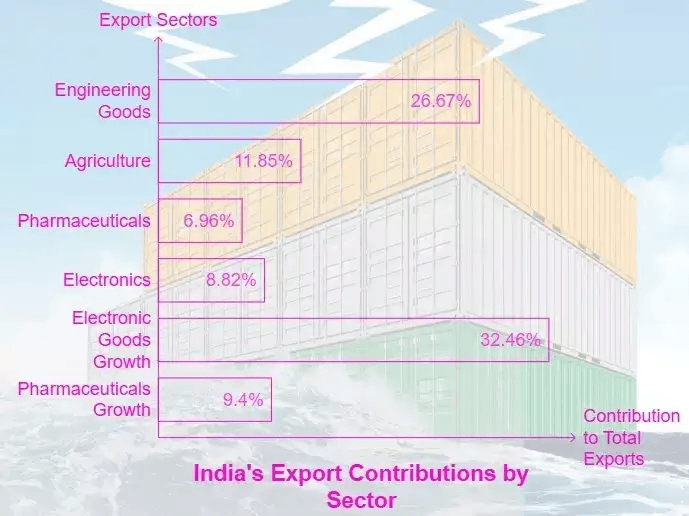
Engineering goods share FY2526.67 % (USD 116.67 bn)
Agriculture share FY2511.85 % (USD 51.86 bn)

Related UPSC Prelims PYQs

CAPF_GAI, CDS_GK 2024PYQ 1

If India enters into Free Trade Agreements (FTAs) with other nations, then the growth of exports of India would depend upon which of the following?

CAPF_GAI, CDS_GK 2024PYQ 2

Which of the following is NOT one of the pillars of India’s ‘Foreign Trade Policy-2023’?

GS-1Editorial

3.Indian Philosophies on Environmental Ethics (Environmental Ethics)

Times of India
Illustration for Indian Philosophies on Environmental Ethics (Environmental Ethics)

What & Where

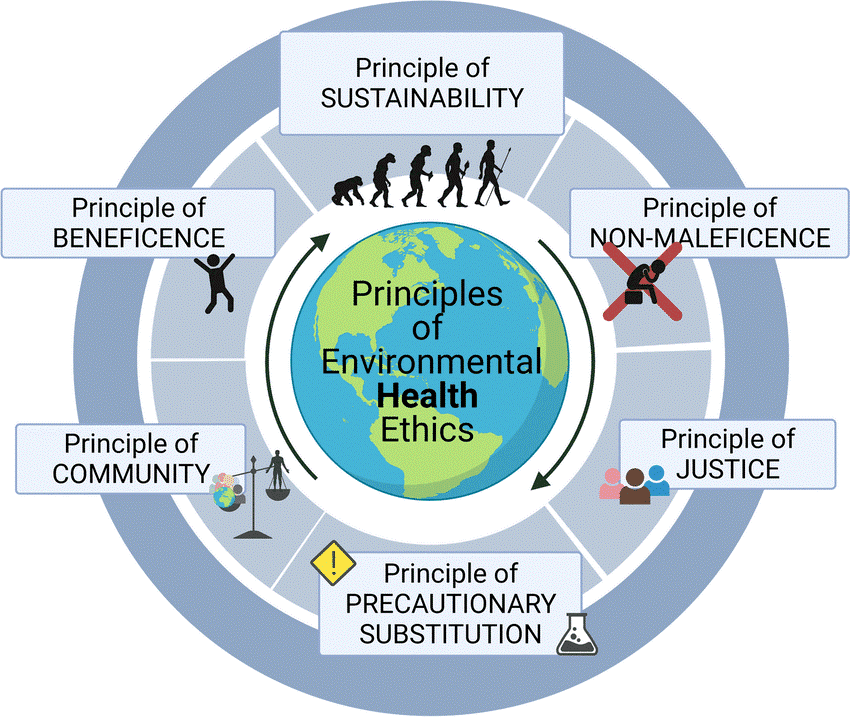
Definition: Nature seen as conscious extension; protecting Earth equates to fulfilling Dharma.

Key strands: Vedic, Ayurveda, Jain, Buddhist, Sikh ideas using Panchabhuta, Ahimsa, interdependence.

Geography: Practices span Indian subcontinent—sacred groves, rivers, seasonal agriculture embed ethics.

Quick Facts for MCQs

Indian Philosophies

  • Vedic thought: Earth as mother, humans children; stewardship mandated by hymns.
  • Ayurveda: Soil, water, air purity governs doshas; ecosystem imbalance mirrors human illness.
  • Jainism: Ahimsa plus Aparigraha prohibit violence or excess toward earth, air, water.

Western Approaches

  • Deep Ecology: Arne Næss urges ecocentrism; influences global rewilding, wilderness laws.
  • Utilitarianism: Mill’s greatest-good calculus shapes climate cost-benefit, subsidy designs.
  • Ecofeminism: Vandana Shiva parallels nature’s exploitation with patriarchy; advocates care ethics.

Challenges

  • Commodification: Sacred ethics reduced to eco-labels, diluting intrinsic reverence.
  • Urban alienation: Disconnection from seasons and soil weakens ecological conscience.
  • Policy gap: Compliance without moral education hampers collective Kartavya toward environment.

Tech & Schemes

  • Integration: Jal Jeevan, Namami Gange framed via Panchabhuta harmony and Ayurveda balance.
  • Innovation: AI, GIS, satellite tools proposed for safeguarding sacred groves, water systems.

Key Data Points

FeatureData-Point
Pancha MahabhutasEarth Water Fire Air Space
Vedic ecology hymn“Mata Bhumih Putro Aham Prithivyah”
Buddhist key ideaPratītyasamutpāda interdependence
Sikh ecological verse“Pavan Guru, Pani Pita, Mata Dharat Mahat”
Jain principleAhimsa + Aparigraha toward elements
Deep Ecology authorArne Næss
Ecofeminism voicesVandana Shiva; Val Plumwood
Indian scheme linkageJal Jeevan; Namami Gange

Related UPSC Prelims PYQs

CDS_GK, GS1 2023PYQ 1

“Souls are not only the property of animal and plant life, but also of rocks, running water and many other natural objects not looked on as living by other religious sects.”

CDS_GK, GS1 2023PYQ 2

The theme of India’s G20 Presidency ‘Vasudhaiva Kutumbakam’ or ‘One Earth-One Family-One Future’ is drawn from the

GS-1History

4.Vande Mataram 150th Anniversary Celebrations (Vande Mataram Anniversary)

PIB

What & Where

National initiative (2025-26) marking 150 yrs of song “Vande Mataram”; launched by PM in New Delhi, 7 Nov 2025

Song penned by Bankimchandra Chatterji on Akshaya Navami, 7 Nov 1875; set in novel Anandamath

Core geography: origin Bengal; freedom-struggle echo pan-India; later inspired 1948 Gulbarga (Karnataka) resistance

Quick Facts for MCQs

Freedom Struggle

  • Slogan unified diverse faiths, languages against colonial rule
  • Echoed in rallies, prisons, gallows despite British ban
  • Aurobindo termed it mantra of awakening; Gandhi saw vision of undivided India

Constitutional & Symbolic Status

  • Constituent Assembly granted equal status with Jana Gana Mana, 24 Jan 1950
  • Embodies civilizational ideal of Bharat: moral strength, knowledge, courage
  • Blends spiritual devotion with modern national identity

Regional Movements

  • Gulbarga 1948 marches led by Sharanabasappa, Qadeer Dargah chanting Vande Mataram
  • Nizam police opened fire; movement still spread across Hyderabad-Karnataka
  • Pledges submitted to Sardar Patel, aiding region’s integration into Indian Union

Key Data Points

FeatureData-Point
AuthorBankimchandra Chatterji
Date composed7 Nov 1875 (Akshaya Navami)
First publicationBangadarshan journal, as part of Anandamath
First public singingRabindranath Tagore, Calcutta Congress 1896
Key refrainSujalam Sufalam Malayaja Sheetalam
Constituent Assembly decision1950: equal honour with National Anthem
Swadeshi Andolan linkMain rallying cry during 1905 anti-Partition movement
British stanceBanned for revolutionary content
150-yr celebration spanNov 2025 – Nov 2026
Regional echo9 Nov 1948 Gulbarga Vande Mataram movement

Related UPSC Prelims PYQs

GS1 2003PYQ 1

Which one of the following statements is correct?

GS1 2007PYQ 2

The song ‘Amar Sonar Bangla’, written during the Swadeshi Movement of India, inspired the Liberation Struggle of Bangladesh and was adopted as the National Anthem of Bangladesh. Who wrote this song?

GS-3Environment

5.Tropical Forests Forever Facility Initiative (Forest Finance)

New Indian Express

What & Where

Facility: blended-finance trust fund paying tropical nations for verified forest protection.

Process: invests USD 25 bn public “junior” + USD 100 bn private “senior”; uses returns for annual payouts.

Geography: Global South-led, proposed by Brazil; formal launch slated COP30, Belém (Amazon, Brazil).

Quick Facts for MCQs

Finance & Funding

  • Blended-finance: public funds absorb first loss, attracting lower-risk private capital.
  • Perpetual endowment: investment income, not principal, funds conservation, avoiding aid-dependency.
  • Results-based payouts: linked to verified zero-deforestation and degradation metrics.

Governance & Equity

  • South-led design counters North-South finance imbalance, aligns with climate justice.
  • Observer status: India welcomes mechanism, may influence governance without immediate liability.
  • CBDR-RC anchoring ensures differentiated yet collective responsibilities.

Ecological Significance

  • Recognises tropical forests as global public goods for carbon, biodiversity, hydrological regulation.
  • Objective: make standing forests economically superior to timber extraction.
  • Supports UNFCCC goals, advances nature-based solutions.

Timeline & Diplomacy

  • 2023 announcement, 2024 structuring, 2025 formal adoption at COP30.
  • Partner supporters include Germany, France, UAE, Norway, UK, signalling broad donor confidence.

Key Data Points

FeatureData-Point
AcronymTFFF
First mootedCOP28, Dubai 2023
Formal launchCOP30, Belém 2025
Lead proponentBrazil
Other core nationsColombia, Ghana, Indonesia, Malaysia, DRC
Initial public capitalUSD 25 billion
Target private leverageUSD 100 billion
Expected yearly returns~USD 4 billion for conservation
Payment styleResults-based, predictable
Financial modelEndowment / trust using blended finance
Guiding principleCBDR-RC
India’s role (2025)Joined as Observer
GS-3Environment

6.Khangchendzonga Park IUCN Good Rating (World Heritage Outlook)

News on Air
Illustration for Khangchendzonga Park IUCN Good Rating (World Heritage Outlook)

What & Where

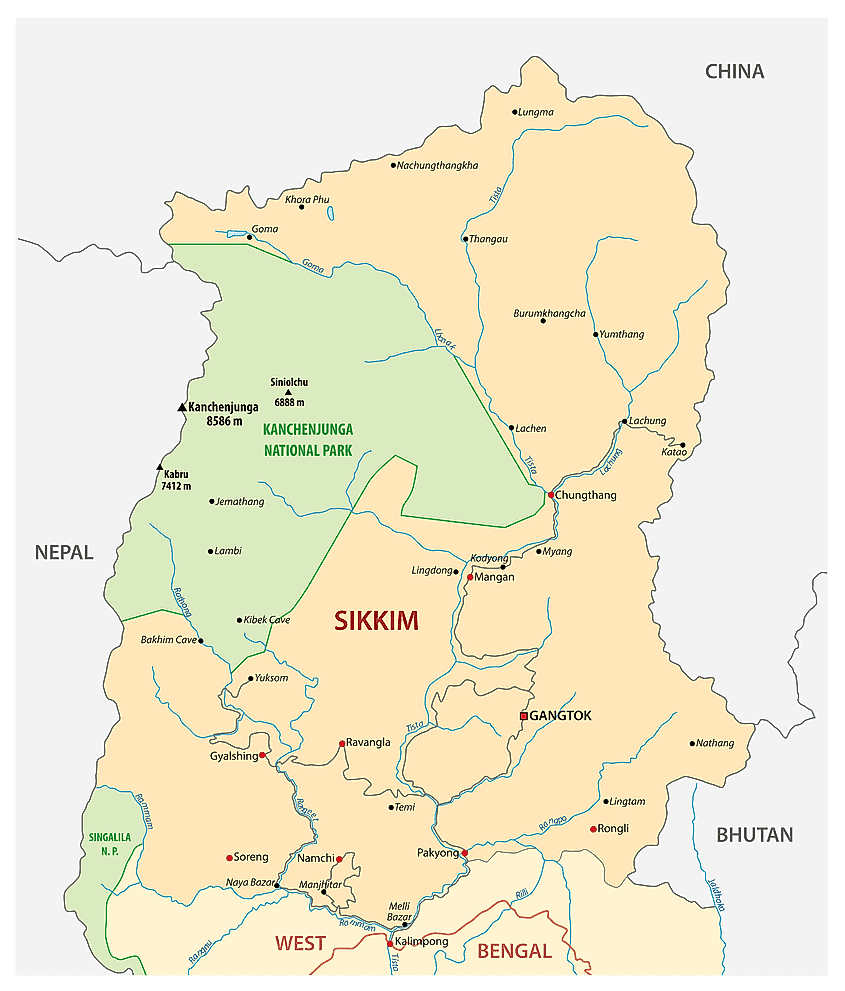
Khangchendzonga National Park, India’s first UNESCO mixed World Heritage Site (2016), lies in North & West Sikkim on India-Nepal border

Only Indian natural site rated “Good” in IUCN World Heritage Outlook 2025, signaling positive conservation status

Spans 1,784 sq km from 1,300 m subtropical forests to 8,586 m Mt Khangchendzonga snowfields

Quick Facts for MCQs

Global Assessment

  • IUCN Outlook evaluates 252 natural World Heritage Sites for biodiversity health, management quality, climate resilience
  • Rating tiers: Good, Good with Some Concerns, Significant Concern, Critical
  • Khangchendzonga stands as sole Indian site in Good category 2025 review

Conservation & Management

  • Community stewardship blends Lepcha, Bhutia cultural practices with park regulations
  • Zonation uses core park, buffer reserve, transition villages to limit human pressure
  • Glacier and alpine species monitoring informs climate adaptation actions

Biodiversity Highlights

  • Flagship mammals include snow leopard, red panda, clouded leopard, blue sheep, Himalayan tahr
  • Vegetation gradient from subtropical oak to alpine meadow drives exceptional species turnover
  • Avifauna exceeds 550 species; notable Satyr tragopan, Himalayan monal, Impeyan pheasant

Cultural & Spiritual Landscape

  • Sacred landscape Mayel Lyang (Lepcha) and Tibetan beyul ensures traditional protection codes
  • State ecotourism policy honours no-climb rule on summit, trekking permits regulated
  • Intangible heritage central to UNESCO mixed inscription rationale

Key Data Points

FeatureData-Point
Year declared National Park1977
UNESCO inscription typeMixed (Natural + Cultural), 2016
IUCN Outlook 2025 ratingGood
Park area1,784 sq km
Share of Sikkim’s land≈40 %
Highest pointMt Khangchendzonga 8,586 m
Glaciers counted≈280
Glacial lakes70+ (incl. Tso Lhamo)
Recorded bird species>550
Flagship predatorsSnow leopard, clouded leopard

Related UPSC Prelims PYQs

ESE_GS, GS1 2015PYQ 1

Which one of the following National Parks has a climate that varies from tropical to subtropical, temperate and arctic?

ESE_GS, GS1 2022PYQ 2

Which one of the following national parks has become the first national park in India to be equipped with satellite phones?

GS-3EnvironmentQuick Bite

7.Mussels Used as Pollution Bioindicators (Bioindicator Species)

The Hindu
Illustration for Mussels Used as Pollution Bioindicators (Bioindicator Species)

What & Where

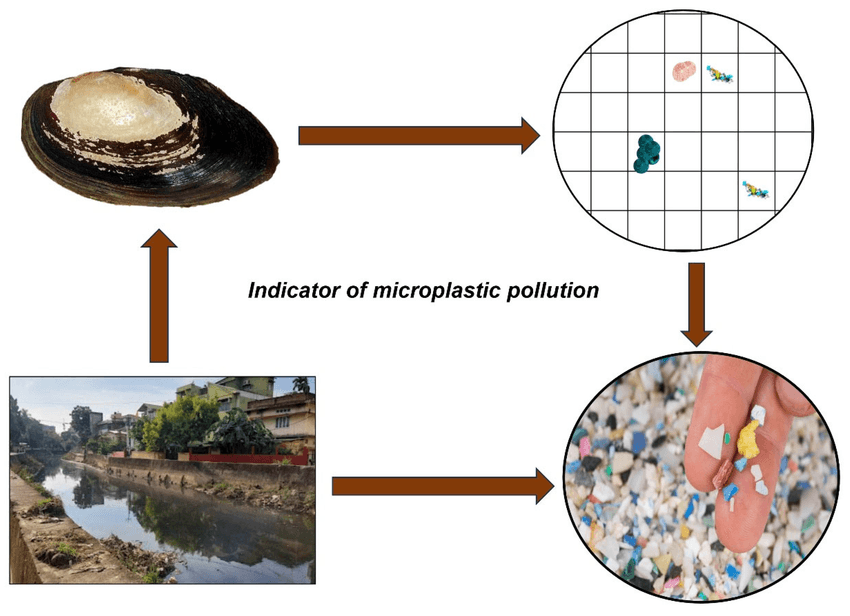
Mussels = bivalve mollusks with two hinged shells; sessile, filter-feeding invertebrates

Habitat spans marine family Mytilidae & freshwater family Unionidae; global, denser in cooler seas

Study site : Saronic Gulf, Greece—mussels deployed as bioindicators for microplastic & chemical pollution

Quick Facts for MCQs

Biological Traits

  • Shell-bearing, two-valve morphology offers protection & substrate attachment
  • High filtration rates concentrate dissolved & particulate pollutants in soft tissues
  • Longevity allows time-integrated record of water quality

Monitoring Utility

  • Cost-effective, passive samplers eliminating need for complex instruments
  • Comparable data across sites due to wide taxonomic uniformity
  • Indicators cover chemical, heavy metal, microplastic, biological hazards

Geographical Context

  • Saronic Gulf forms part of the Aegean Sea near Athens, high maritime traffic
  • Region faces urban runoff, port activities, tourism driven pollution
  • Mediterranean inclusion aids transboundary marine monitoring initiatives

Key Data Points

FeatureData-Point
Taxonomic classBivalvia
Marine familyMytilidae
Freshwater familyUnionidae
Feeding modeFilter-feeding (suspension)
Key trait for monitoringBioaccumulation of contaminants
Pollutants detectedHeavy metals, microplastics, chemicals
MobilitySessile (fixed)
Geographic exampleSaronic Gulf, Greece
Biodiversity roleKeystone in coastal ecosystems
DistributionWorldwide, esp. temperate & cooler seas
GS-3S&T

8.India AI Governance Guidelines Framework (AI Governance)

STV
Illustration for India AI Governance Guidelines Framework (AI Governance)

What & Where

Guideline: India AI Governance Guidelines, national framework drafted for MeitY to steer safe, trusted AI use.

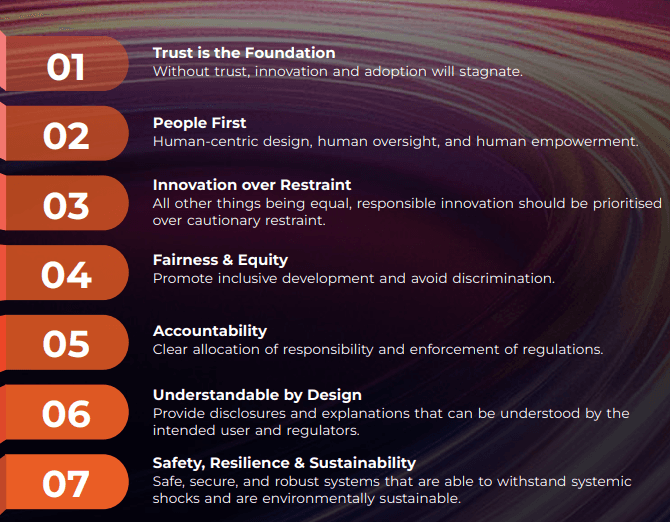
Process: Four-part blueprint anchored in Seven Sutras principles, Six Pillars enablement, phased action plan.

Geography: Applicable across India, aligning AI rollout with Viksit Bharat 2047 vision.

Quick Facts for MCQs

Principles & Pillars

  • Principles: Trust, People First, Innovation over Restraint, Fairness & Equity, Accountability, Understandable by Design, Safety & Sustainability.
  • Pillars: Infrastructure, Capacity Building, Policy & Regulation, Risk Mitigation, Accountability, Institutions.

Institutional Setup

  • Bodies: AIGG policy apex, TPEC advisory, AISI handles testing, standards, safety R & D.
  • Governance: Graded liability, transparency reports, auditor oversight embedded into institutional mandates.

Regulatory Tools

  • Approach: Use IT Act, DPDP, copyright tweaks instead of omnibus AI Act.
  • Measures: Watermarking, provenance, human-in-loop, DEPA-style consent enforce responsible training and deployment.
  • Action plan: Short, medium, long-term steps include sandboxes, standard codification, incident reporting system.

Capacity & Infrastructure

  • Compute: AIKosh, subsidised GPUs, MSME toolkits expand access.
  • Data: Representative multilingual datasets mandated for inclusive, bias-checked models.
  • Skilling: National programmes train regulators, LEAs, frontline deployers for compliance ease.

Challenges

  • Coherence: Align liability across AI value chain, close DPDP interface gaps.
  • Authentication: Watermarking helps yet remains spoof-prone, demands complementary forensic tech.
  • Disclosure: Need incentives so firms willingly report AI incidents without litigation fear.

Key Data Points

FeatureData-Point
Drafting ministryMeitY
Committee set-upJuly 2025
Guideline partsFour
Core principlesSeven Sutras
Enablement pillarsSix
Flagship institutionAI Safety Institute (AISI)
Apex bodyAI Governance Group (AIGG)
Target horizonViksit Bharat 2047
Regulatory stanceSector-led, amend existing laws
Risk toolIndia-specific taxonomy + incident database

Related UPSC Prelims PYQs

ESE_GS 2026PYQ 1

Which Ministry released the India AI Governance Guidelines in 2025?

ESE_GS 2021PYQ 2

Which one of the following frameworks is developed to assess the value of the increasing investments made on e-governance projects in terms of service orientation, technology architecture, replicability and sustainability in various states across the country ?

GS-3S&T

9.India Demonstrates 500-km Quantum Key Distribution (Quantum Communication)

PIB
Illustration for India Demonstrates 500-km Quantum Key Distribution (Quantum Communication)

What & Where

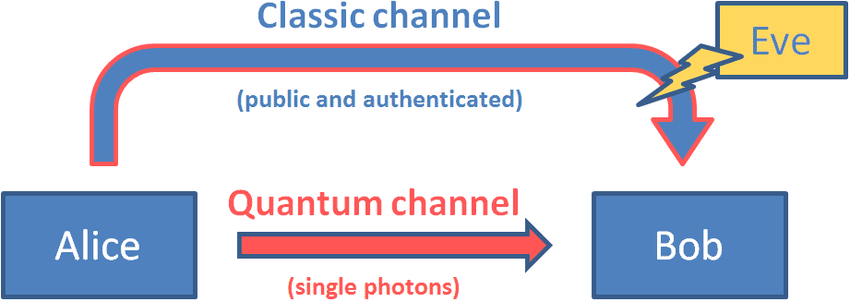
Quantum Key Distribution (QKD) = encryption-key exchange exploiting quantum laws; any eavesdropping disturbs photons, revealing intrusion.

India’s first 500 km QKD network deployed on existing optical-fibre by Bengaluru-based startup QNu Labs.

Project backed by National Quantum Mission (NQM), strengthening domestic quantum-secure communication.

Quick Facts for MCQs

Tech & Schemes

  • National Quantum Mission funds indigenisation of QKD, quantum sensors, computing & materials.
  • Demonstration shows retrofit on legacy fibre; no new trenches/cables required.
  • Indigenous hardware/software bolsters Atmanirbhar Bharat push in advanced tech.

Security Dimension

  • Quantum laws, not algorithmic complexity, underpin encryption; immune to future quantum-computer attacks.
  • “Harvest now, decrypt later” threat neutralised; stolen ciphertext stays unusable.
  • Real-time intrusion detection enables dynamic key refresh, enhancing cyber defence posture.

Economic Angle

  • Domestic QKD capability lowers import reliance and spurs deep-tech startups.
  • Secure digital infrastructure enhances investor confidence in fintech, e-governance.
  • High-skill job creation expected in photonics, cryogenics, and quantum software.

Scientific Principle

  • No-Cloning: unknown quantum state cannot be perfectly copied, blocking undetected key replication.
  • Observer Effect: measurement collapses photon superposition, creating detectable error rates.

Key Data Points

FeatureData-Point
Demonstrating entityQNu Labs (startup)
Supporting programmeNational Quantum Mission
Link length achieved500 km
Transmission mediumConventional optical fibre
Key carriersPhotonic qubits
Core security lawsNo-Cloning Theorem, Observer Effect
Security levelInformation-theoretic (quantum computer–proof)
Detects eavesdropperYes; disturbed photon states signal intrusion
Key action if compromisedDiscard and rerun protocol
Priority sectorsGovernment, military, finance, critical infra

Related UPSC Prelims PYQs

GS1 2022PYQ 1

"क्यूबिट (qubit)" शब्द का उल्लेख निम्नलिखित में कौन-से एक प्रसंग में होता है ?

GS-3S&T

10.Immunology Research Landscape in India (Immunology R&D)

The Hindu

What & Where

Discipline Immunology: science of immune organs, cells, molecules defending body from pathogens and abnormal self.

Key processes: pathogen recognition, neutralisation, peripheral immune tolerance, vaccine-induced memory, autoimmune dysregulation.

Core geography: Indian hubs AIIMS-Delhi, IISc-Bengaluru, NII-Delhi spearhead national immunology teaching and research.

Quick Facts for MCQs

Health Burden

  • Dual load: persistent infectious diseases plus rising NCDs demand vaccines and immune-based cancer or autoimmune therapies.
  • Population diversity offers unique cohorts for tuberculosis, dengue, allergy and cancer immunogenomics.

Institutional Support

  • Agencies: DBT, ICMR, DST finance projects; BIRAC links academia-industry; National Biopharma Mission targets affordable biologics.
  • Education: only select institutes provide in-depth immunology, causing workforce shortage.

Research Challenges

  • Funding gaps: preference for quick, low-risk studies hampers long-term immune investigations.
  • Infrastructure lack: scarce BSL-3 labs, expensive equipment, limited stable faculty trigger brain drain.
  • Regulation maze: overlapping ICMR-DBT-CDSCO clearances delay trials, raising compliance costs.

Action Agenda

  • Curriculum upgrade: NMC to integrate flow cytometry, ELISA practicals; set Regional Immunology Teaching Labs nationwide.
  • Infrastructure push: create Regional Immunology Research Centres and biobanks for large-scale immunogenetic mapping.
  • PPP stimulus: BIRAC Translational Immunology Grants to produce low-cost vaccines, biosimilars, point-of-care diagnostics.

Key Data Points

FeatureData-Point
Nobel 2025 topicPeripheral immune tolerance
CAR-T therapy price₹30–40 lakh per dose
National Vaccine Policy2011
Mission COVID Suraksha launch2020
Typical research grant span3–5 years
Suggested immunology funding share15–20 % of life-science budget
Premier Indian instituteNational Institute of Immunology

Related UPSC Prelims PYQs

CDS_GK 2020PYQ 1

Which one of the following Indian institutes was approved by the Drugs Controller General of India for conducting human trials of the Oxford-AstraZeneca Covid-19 vaccine candidate?

GS-2Editorial

11.Kazakhstan To Join Abraham Accords (Abraham Accords Expansion)

Indian Express

What & Where

Accord: US-brokered Abraham Accords (2020) normalise Israel ties with Muslim-majority nations

Mechanism: Each participant signs individual normalisation agreement with Israel under common framework

Geography: West Asia, North Africa, now Central Asia via Kazakhstan inclusion

Quick Facts for MCQs

Signatories & Timeline

  • Timeline2020: UAE, Bahrain first; Morocco joined after US Western Sahara recognition
  • Timeline2021: Sudan acceded post US terror-list delisting
  • Timeline2025: Kazakhstan first Central Asian Muslim republic to sign

Strategic Significance

  • Diplomacy: Arab states increasingly decouple stance from Palestine question
  • Economy: Accords unlock trade, tech, tourism, investment corridors with Israel
  • Security: Framework boosts US-led alignment countering Iranian influence

India Angle

  • Balancing: India sustains simultaneous strategic engagement with Israel and Gulf partners
  • Platform: I2U2 leverages accord partners for energy, food security, space projects
  • Logistics: Improved West Asian connectivity can lower freight costs for Indian exports

Key Data Points

FeatureData-Point
Launch year2020
BrokerUnited States
First signatory under accordsUnited Arab Emirates
Other 2020 signatoriesBahrain, Morocco
2021 entrantSudan
2025 entrant announcedKazakhstan
India-linked groupingI2U2 (India, Israel, UAE, US)
I2U2 focus sectorsEnergy, water, health, transport, food, space

Related UPSC Prelims PYQs

CAPF_GAI, CDS_GK 2022PYQ 1

Recently, with which one of the following countries did India sign the 'Comprehensive Economic Partnership Agreement'?

CAPF_GAI, CDS_GK 2022PYQ 2

हाल ही में बने देशों के समूह में, जिसे आमतौर पर ‘रखप्यू ग्रुप’ के रूप में जाना जाता है, भारत के अतिरिक्त निम्नलिखित में से कौन-सा अन्य सदस्य है?

GS-2Environment

12.Bangladesh Accedes to UN Water Convention (UN Water Convention)

Down to Earth
Illustration for Bangladesh Accedes to UN Water Convention (UN Water Convention)

What & Where

UN Water Convention: legally binding framework for equitable, sustainable transboundary water management

Adopted Helsinki 1992; under UNECE; open to all UN members since 2016

Covers rivers, lakes, aquifers crossing national borders worldwide

Quick Facts for MCQs

Legal & Policy

  • Cooperation mandate requires basin treaties and joint bodies for shared monitoring
  • Obligation to prevent significant transboundary harm, share data, conduct consultations
  • Dispute settlement options include negotiation, inquiry commissions, arbitration, ICJ

Regional Diplomacy

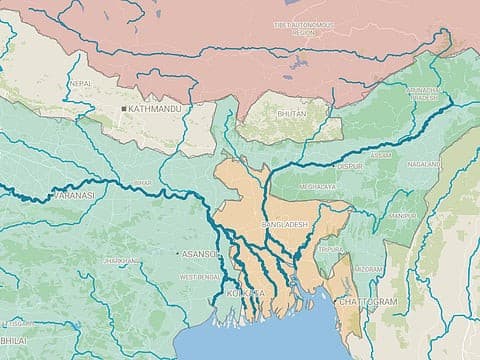
  • Bangladesh accession internationalises Teesta, Ganga talks, creating legal leverage
  • Convention facilitates donor, UN support for cooperative South Asian basin projects
  • Rules-based platform could reduce unilateral water infrastructure tensions

India Context

  • India preference bilateral mechanisms cites sovereignty, flexibility concerns
  • Non-membership shields from third-party adjudication over Indus, Brahmaputra basins
  • Could face normative pressure as regional neighbours sign up

Global Expansion

  • Seven non-European states joined 2018-22, signalling universality
  • African members using framework for Lake Chad, Niger, Okavango basins
  • UN 2023 Water Conference urged 30 new accessions by 2030

Key Data Points

FeatureData-Point
Formal nameProtection & Use of Transboundary Watercourses & International Lakes
Adoption year/place1992, Helsinki
Entered into force1996
Administering bodyUNECE Secretariat
Global accession opened1 March 2016
First South Asian memberBangladesh, accession effective 2025
India statusNon-party; prefers bilateral treaties
Key principleEquitable and reasonable use
Linked SDG target6.5 Integrated Water Resources Management
GS-2Environment

13.First BIMReN Marine Research Conference (BIMReN Conference)

DD News

What & Where

Definition: Biennial BIMSTEC-India Marine Research Network Conference promotes joint marine research and blue economy cooperation

Venue: First edition held 4–6 Nov 2025, Kochi, focusing on Bay of Bengal maritime geography

Stakeholders: Brings scientists, policymakers, 25 institutions from seven BIMSTEC nations

Quick Facts for MCQs

Institutional Collaboration

  • Twinning grants link institutes for collaborative Bay research
  • Split-site PhD fellowships ensure cross-country supervision and fieldwork
  • Data-sharing framework harmonises ocean observation protocols regionwide

Strategic Significance

  • MAHASAGAR vision integrates security growth ecology in Indo-Pacific
  • Conference boosts India’s marine science diplomacy credentials
  • Supports regional blue economy governance and policy coherence

Research Focus

  • Ecosystem health monitoring targets coral mangrove seagrass resilience
  • Sustainable fisheries work covers stock assessment tech-enabled value chains
  • Ocean observation deploys buoys satellites for climate and disaster insight

Key Data Points

FeatureData-Point
FrequencyBiennial
Inaugural conference dates4–6 Nov 2025
Host cityKochi, India
Parent frameworkBIMSTEC
Initial announcementColombo BIMSTEC Summit 2022 by Indian PM
Official launch2024 by MEA, India
Member countries7 BIMSTEC nations
Linked institutions25 research bodies
Scientists engaged50+ researchers
Key focus pillarsEcosystem health, sustainable fisheries, ocean observation, marine tech innovation
Strategic alignmentNeighbourhood First, Act East, Indo-Pacific, MAHASAGAR

Related UPSC Prelims PYQs

ESE_GS, GS1 2025PYQ 1

BIMSTEC के संदर्भ में, निम्नलिखित कथनों पर विचार कीजिए :

ESE_GS, GS1 2026PYQ 2

Which institution released the report titled “India’s Blue Economy: Strategy for Harnessing Deep-Sea and Offshore Fisheries”?

Ready to practice?

Test your knowledge with our UPSC test series.

Start Free Trial