UPSC Current Affairs

13 topicsGS-1: 2GS-2: 2GS-3: 9
0/13 done
GS-2Polity

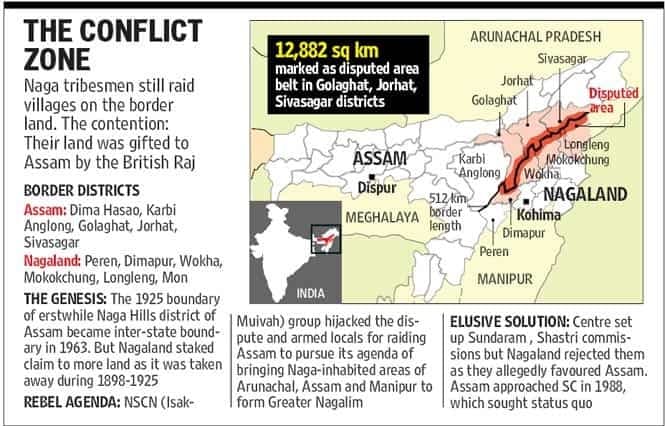
1.Assam–Nagaland Border Dispute (Interstate Boundary)

The Hindu
Illustration for Assam–Nagaland Border Dispute (Interstate Boundary)

What & Where

Dispute: Nagaland claims tracts inside Assam’s Golaghat, Jorhat, Sivasagar, Karbi Anglong districts

Core zone: 512 km Disputed Area Belt of reserved forests along the inter-state boundary

Fresh flare-up: Minority village in B Sector, Golaghat torched by alleged Naga miscreants

Quick Facts for MCQs

Historical Background

  • 1826 Yandabo treaty began British administrative redraws without Naga consent
  • 1866 Naga Hills District created; multiple 1875-1925 notifications shifted boundaries
  • 1947 Naga independence declaration; 1957 Naga Hills-Tuensang Area Act preceded 1963 statehood

Commissions & Agreements

  • Sundaram Commission 1972 produced four Interim Agreements maintaining status quo
  • Shastri 1985, J K Pillai 1997, Variava & Chatterjee 2006 failed to secure permanent demarcation
  • 16-Point Agreement 1960 cited by Nagaland for ancestral territory restoration

Disputed Area Belt

  • Composition: Reserved Forests like Rengma, Diphu, Doyang, Intanki
  • Governance: Both states barred from new settlements under status-quo pacts yet violations persistent
  • Assam asserts legal boundary fixed at 1963 state creation

Security Dimension

  • CRPF operates as neutral federal battalion under Union Ministry of Home Affairs
  • Periodic skirmishes involve armed village councils, forest revenue staff, civilian militias
  • August 2023 incident: ≈100 houses burnt, heightening inter-state tension

Key Data Points

FeatureData-Point
Inter-state boundary length512.1 km
Disputed Area Belt spanReserved forests across 4 Assam districts
Neutral security forceCRPF deployed since 1979
Claimed Assam land loss≈60,000 ha encroached (Assam claim)
Nagaland statehood formalisedNagaland State Act 1962; effective 1963
Key colonial triggerTreaty of Yandabo 1826
Latest violence locationB Sector, Golaghat district

Related UPSC Prelims PYQs

CDS_GK, NDA_GAT 2025PYQ 1

असम राज्य क्रमशः कितने अन्य देशों और भारतीय राज्यों से सीमा साझा करता है ?

CDS_GK, NDA_GAT 2024PYQ 2

Which of the following State/s is/are common to Bru-Reang Agreement, NLFT (SD) Agreement and Tripartite Agreement with TIPRA?
GS-3Economy

2.Presumptive Taxation Regime Proposal (Tax Regime)

PIB

What & Where

Presumptive taxation: optional regime taxing foreign firms on fixed profit percentage of Indian gross receipts.

Concept floated in NITI Aayog’s first Tax Policy Working Paper 2025 for nationwide adoption.

Sector-wide coverage: EPC, marketing, diverse services, digital/e-commerce income sourced from India.

Quick Facts for MCQs

Legal & Policy

  • Codification: Domestic law to align PE & profit attribution with OECD norms.
  • Safe-harbour: Opt-in blocks separate PE litigation, remains DTAA-compliant.
  • Retrospective legacy: Vodafone-type anxieties eased by forward-looking optional scheme.

Economic Angle

  • Revenue protection: Ensures minimum tax even from low-profit, asset-light models.
  • FDI boost: Certainty and reduced ambiguity lift investor confidence, aiding Make in India.
  • Litigation savings: Shorter disputes cut costs for exchequer and taxpayers alike.

Administrative Ease

  • Simplification: No transfer-pricing audit or elaborate books for presumptive filers.
  • Capacity building: Proposal stresses officer training for uniform enforcement.
  • APA/MAP expansion: Early dispute resolution mechanisms encouraged.

Digital Economy

  • High-profit platforms: 30 % deemed margin reflects user-generated value.
  • Certainty: Addresses SEP, equalisation levy concerns via safe-harbour.
  • Treaty harmony: Optional nature preserves bilateral tax benefits.

Key Data Points

FeatureData-Point
Working Paper year2025
Nature of regimeOptional, rebuttable presumptive tax
Deemed profit rate: EPC10 % of gross receipts
Deemed profit rate: Marketing15 % of gross receipts
Deemed profit rate: Services20 % of gross receipts
Deemed profit rate: Digital/e-commerce30 % of gross receipts
Existing presumptive sections44B, 44BB, 44BBA, 44AD, 44ADA
Average PE dispute duration> 10 years (e.g., Hyatt International)

Related UPSC Prelims PYQs

GS1 2018PYQ 1

अवासी इकाइयों द्वारा दी जा रही ऑनलाइन विज्ञापन सेवाओं पर भारत द्वारा 6% ‘समतुल्य कर’ (Equalisation Levy) लगाए जाने के निर्णय के सन्दर्भ में निम्नलिखित कथनों पर विचार कीजिए:

GS1 2016PYQ 2

The term 'Base Erosion and Profit Shifting' is sometimes seen in the news in the context of

GS-3Economy

3.Stablecoin Overview (Stablecoins)

FT
Illustration for Stablecoin Overview (Stablecoins)

What & Where

Stablecoin: cryptocurrency pegged to external asset (USD, metals, baskets) for near-constant purchasing power

Types: Fully-reserved coins backed 1:1 by liquid assets; Algorithmic coins using supply-changing smart contracts

Geography: Highlighted by India’s Finance Minister as impending global monetary tool requiring policy readiness

Quick Facts for MCQs

Legal & Policy

  • FinanceMinister: Countries must engage with stablecoins to avoid exclusion from future payment rails
  • RegulatoryPriority: Reserve transparency, redemption rights, systemic-risk mitigation

Economic Angle

  • Remittance: Stablecoins cut fees and time versus SWIFT corridors
  • SafeHarbor: Traders park value during broader crypto swings
  • Commerce: Price stability supports routine purchases within digital ecosystems

Technology Features

  • SmartContracts: Algorithmically adjust supply to maintain peg
  • On-chainSettlement: Instant clearing without traditional intermediaries
  • Interoperability: Digital fiat bridges banks, fintech, and decentralised apps

Key Data Points

FeatureData-Point
Typical peg1 coin ≈ 1 USD
Main categoriesFully-reserved, Algorithmic
Reserve assetsCash, bank deposits, short-term T-bills
Algorithmic leverMint-burn via smart contracts
Key advantageLow volatility versus Bitcoin
Core use-caseFast, cheap cross-border payments
Settlement speedNear-real-time on blockchain
ProgrammabilityIntegrates with DeFi & automated finance
GS-3Infrastructure

4.Highway QR Code Signboards (Highway QR Boards)

DD News

What & Where

Digital Project Information Sign Boards with embedded QR codes along National Highways in India

Give commuters instant project, safety, facility data via smartphone scan

Installed at toll plazas, rest areas, truck lay-byes, project start / end points nationwide

Quick Facts for MCQs

Governance & Transparency

  • Initiative aligns with citizen centric governance under GS II syllabus
  • QR access enables audit trail for project timelines and expenditures
  • Visibility of responsible officials promotes accountability to commuters

Road Safety

  • Quick scan connects users to 1033 helpline and Highway Patrol for emergencies
  • Real time map of hospitals and police stations shortens response time
  • Information boards placed at strategic accident prone spots like toll plazas and rest areas

Digital Infrastructure

  • Uses low cost QR tech not dependent on continuous power or network at board
  • Integrates with smartphones ensuring high penetration and ease of updates
  • Model can scale to other transport corridors railways airports

Key Data Points

FeatureData-Point
Nodal agencyNational Highways Authority of India
TechnologyStatic sign board plus printed QR code
Primary objectiveTransparency in construction and maintenance
Safety linkEmergency helpline 1033 displayed
Location spotsToll plazas, wayside amenities, truck lay-byes, start–end chainage
User infoHighway number, chainage, length, timelines
Contact listHighway Patrol, Toll Manager, Project Manager, Resident Engineer, NHAI office
Facility updatesHospitals, toilets, petrol pumps, police, repair shops, e-charging

Related UPSC Prelims PYQs

CDS_GK, NDA_GAT 2023PYQ 1

भारतीय राष्ट्रीय राजमार्ग प्राधिकरण (NHAI) के बारे में निम्नलिखित में से कौन-सा कथन सही नहीं है?

CDS_GK, NDA_GAT 2025PYQ 2

S1: National highways connect one state with another and are of national importance.

GS-1Environment

5.Cyclone Shakhti Formation (Arabian Sea Cyclone)

Down to Earth
Illustration for Cyclone Shakhti Formation (Arabian Sea Cyclone)

What & Where

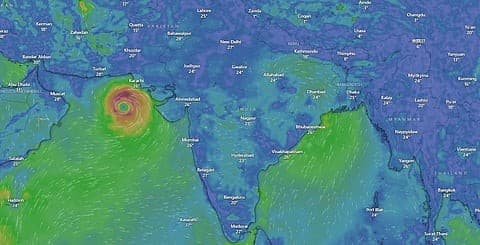
Tropical Cyclone “Shakhti” over northeast Arabian Sea, ~340 km west of Dwarka, Gujarat

Originated from early-Oct 2025 low-pressure area; became Cyclonic Storm on 3 Oct; likely to reach Severe Cyclonic Storm

Illustrates uptick in Arabian Sea cyclones driven by warming sea-surface temperatures

Quick Facts for MCQs

Formation Drivers

  • Warm SST (≈ 29–30 °C) supported rapid intensification
  • Favorable vorticity and moist mid-troposphere sustained convection
  • Limited dry-air intrusion compared to typical Arabian Sea state

Bay–Arabian Contrast

  • Temperature: Bay semi-enclosed, stays 29–30 °C; Arabian Sea cooled by wind-driven evaporation
  • Moisture: Bay fed by river discharge & monsoon flow; Arabian Sea receives dry Oman–Yemen winds
  • External pulses: Pacific typhoons seed Bay lows; Arabian Sea lacks such incoming systems

Hazard & Trend

  • Rising Arabian Sea SST boosting cyclone frequency and strength
  • West-coast zones face higher wind, surge, rainfall threat from Shakhti
  • Trend necessitates enhanced early-warning and coastal resilience plans

Key Data Points

FeatureData-Point
Ocean basinNortheast Arabian Sea
Distance from Dwarka≈ 340 km W
Initial triggerLow-pressure area, early Oct 2025
IMD upgrade date3 Oct 2025 (Cyclonic Storm)
Forecast intensitySevere Cyclonic Storm
Expected trackWest-southwestward
Naming systemWMO/ESCAP regional list; name “Shakhti”
Key hazardsStrong winds, high waves, heavy coastal rain

Related UPSC Prelims PYQs

CAPF_GAI, NDA_GAT 2022PYQ 1

Nisarga, Gati, Nivar, Tauktae and Yaas are names of

CAPF_GAI, NDA_GAT 2021PYQ 2

किस देश द्वारा चक्रवात 'ताउते' (Tauktae) का नामकरण किया गया था?

GS-1Mapping

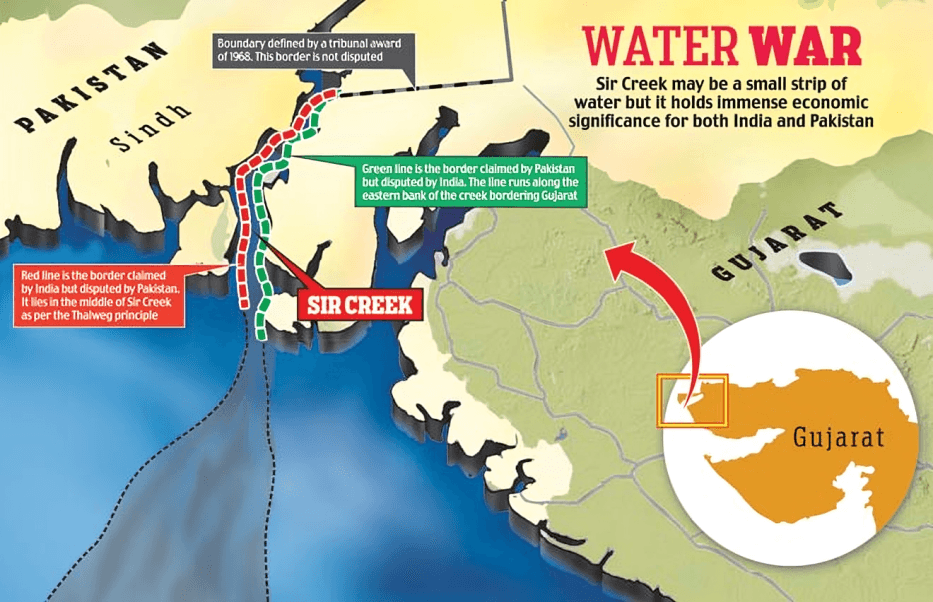
6.Sir Creek Border Dispute (Sir Creek Dispute)

The Hindu
Illustration for Sir Creek Border Dispute (Sir Creek Dispute)

What & Where

Tidal creek; 96 km waterway in Rann of Kutch, Gujarat

Boundary; divides India’s Kutch and Pakistan’s Sindh, draining into Arabian Sea

Colonial rename; once Ban Ganga, retitled Sir Creek by British official

Quick Facts for MCQs

Boundary Dispute

  • Resolution 1914; Pakistan claims entire creek on eastern bank
  • Thalweg principle; India seeks mid-channel line citing high-tide navigability
  • Map 1925; Indian reliance on surveyed pillars marking central channel

Strategic & Security

  • Sensitive border; past naval and patrol confrontations between forces
  • Defence posture; Indian minister warns firm reply to Pakistani aggression
  • Maritime control; creek ownership shapes coastal surveillance and naval reach

Economic & Ecological

  • Fisheries; among Asia’s largest grounds sustaining thousands of livelihoods
  • Hydrocarbon prospects; seabed suspected to host oil and gas reserves
  • Biodiversity; habitat for flamingoes and migratory birds, high conservation value

Key Data Points

FeatureData-Point
Length96 km
Waterway typeTidal estuarine creek
Indian stateGujarat (Kutch district)
Pakistani provinceSindh
Original nameBan Ganga
Key colonial document1914 Resolution
Principle India citesThalweg, mid-channel
Evidence India uses1925 Map & mid-channel pillars

Related UPSC Prelims PYQs

GS1 1999PYQ 1

In the November 1998 Composite Dialogue Process between India and Pakistan, three contentious issues listed below as 1, 2 and 3 were discussed.

GS-3Editorial

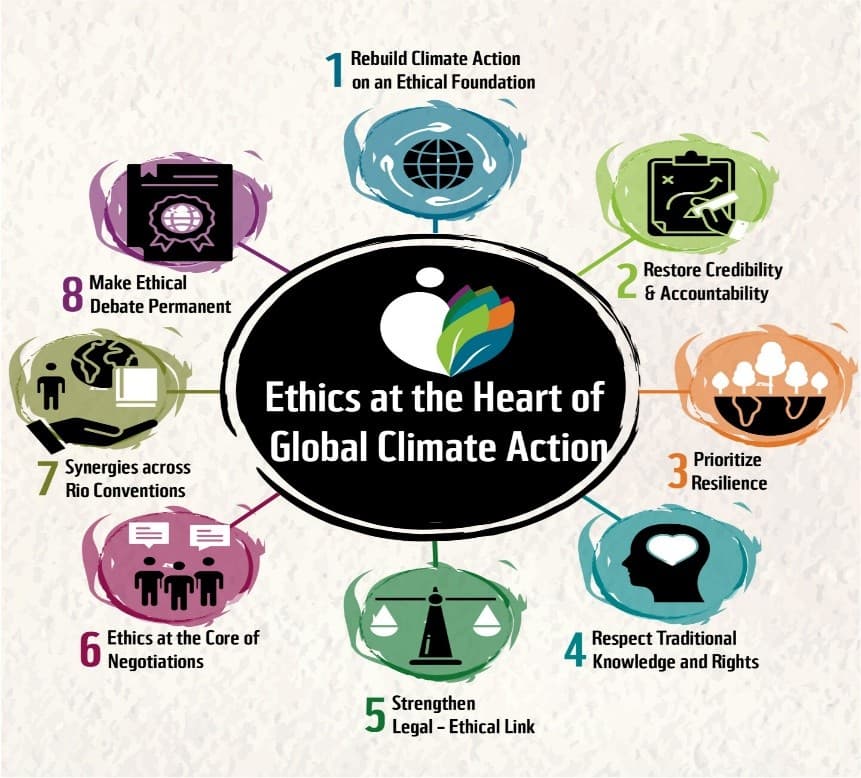
7.Climate Action Ethics (Climate Ethics)

CC
Illustration for Climate Action Ethics (Climate Ethics)

What & Where

Global Ethical Stocktake (GES): new pre-COP30 Brazil mechanism to review climate action via justice–equity–responsibility lens.

Within UNFCCC & Paris Agreement architecture; complements 5-year Global Stocktake, informs next NDC cycle.

Geographic focus global; launch hosted by Brazil (COP30, Belém, 2025).

Quick Facts for MCQs

Ethical Principles

  • Justice: CBDR lets developing nations grow while assigning historic burden to developed.
  • Integrity: Ethics seeks transparent NDCs, curbs promise–delivery gaps and greenwashing.
  • Solidarity: Inclusion of Indigenous, vulnerable groups; Himachal snow-leopard project cited.

Judicial & Constitutional

  • Constitution: Art 48A & 51A(g) impose environmental stewardship duties on state & citizens.
  • Courts: Vellore case embedded precautionary & polluter-pays; global courts link climate to human rights.
  • Due-diligence: Judiciary compels governments to align law with moral climate obligations.

Implementation Gaps

  • Finance: Adaptation support to Global South under-funded, widening ethical deficit.
  • Politics: Denialism, polarization delay consensus, harm multilateral credibility.
  • Corporate conduct: Greenwashing plus weak enforcement erode public trust in climate pledges.

Key Data Points

FeatureData-Point
Launch venue & yearBrazil, ahead of COP30 (2025)
Core ethical triadJustice, Equity, Responsibility
UNFCCC fairness doctrineCommon but Differentiated Responsibilities (CBDR)
Indian constitutional dutiesArt. 48A (State) & Art. 51A(g) (Citizen)
Landmark Indian caseVellore Citizens’ Forum v. UoI, 1996
Human-rights milestoneInter-American Court, 2024: right to climate
Future-generation rulingICJ Advisory, 2025: intergenerational equity central

Related UPSC Prelims PYQs

CAPF_GAI, CDS_GK 2024PYQ 1

Which one among the following statements with regard to the United Nations Climate Change Conference (COP28) is NOT correct?

CAPF_GAI, CDS_GK 2024PYQ 2

Which one of the following resolutions in the final agreement reached at COP28 is associated with the target of achieving 'Net Zero by 2050'?

GS-3Editorial

8.E-Waste Management Strategies (E-waste Recycling)

The Hindu

What & Where

Definition: Discarded electronic equipment containing hazardous metals like lead, mercury, cadmium, chromium

Composition: Includes computers, mobiles, TVs, printers, refrigerators, air-conditioners; intricate assemblies hinder safe dismantling

Hotspots: Seelampur & Mustafabad (Delhi), Moradabad (UP), Bhiwandi (Maharashtra) together exceed 60 % urban volume

Quick Facts for MCQs

Legal & Policy

  • Framework: E-Waste Rules 2016, 2022, 2023, 2024 mandate PRO, EPR, refrigerant safety, certificate trading
  • Band: CPCB fixes EPR certificate prices between 30 % and 100 % of penalty
  • Scrap: 2025 amendment extends EPR to non-ferrous metals with escalating targets to 75 % by 2033

Implementation Gaps

  • Informal: Over half of e-waste burned or acid-leached without safeguards
  • Compliance: Fake EPR certificates and weak penalties reduce deterrence
  • Capacity: Limited advanced recyclers hinder precious-metal recovery and rising volumes

Environmental Impact

  • Health: Workers suffer respiratory, neurological, dermal and DNA damage from toxic emissions
  • Air: Open burning emits particulates, heavy metals, dioxins worsening urban pollution levels
  • Soil-Water: Acid slurries leach lead, cadmium contaminating groundwater, crops and livestock

Proposed Solutions

  • Integration: Upskill informal workers, provide PPE, social security, register as green-collar workforce
  • Technology: Fund bioleaching, advanced shredding, decentralised hubs; promote urban mining
  • Behaviour: Right-to-repair laws, producer take-back schemes, school curricula on circular economy

Key Data Points

FeatureData-Point
India e-waste 20252.2 million MT
Global position3rd after China & USA
Rise since 2017-18150 % jump from 0.71 MT
Formal recycling units322
Installed formal capacity2.2 million MT / yr
Officially processed 2023-2443 % of total
Urban share>60 % from 65 cities
Projected doublingBy 2030
EPR certificate price band30–100 % of environmental compensation
Non-ferrous scrap targets10 % 2026-27 → 75 % 2032-33

Related UPSC Prelims PYQs

GS1 2019PYQ 1

In India, ‘extended producer responsibility’ was introduced as an important feature in which of the following?

GS1 2013PYQ 2

Due to improper/indiscriminate disposal of old and used computers or their parts, which of the following are released into the environment as e-waste?

GS-3Species

9.Snow Leopard Status (High-Altitude Cat)

IT
Illustration for Snow Leopard Status (High-Altitude Cat)

What & Where

Large elusive alpine cat nicknamed Ghost of the Mountains

Native to 12 Central–South Asian countries; in India spans Ladakh, Himachal, Uttarakhand, Sikkim, Arunachal

Indicator for fragile high-altitude ecosystems; State Animal of Himachal Pradesh

Quick Facts for MCQs

Population Survey

  • 2024 Himachal Forest Department survey records 83 snow leopards up from 51 in 2021
  • Represents roughly 63 % rise in three years
  • Data critical for adaptive management in high-altitude landscapes

Biological & Behavioral

  • Diet carnivorous on blue sheep, Himalayan ibex, marmots, pikas, hares
  • Lifestyle solitary, nocturnal, territorial except mating or cub-rearing phases
  • Hind-leg power enables steep-terrain pursuit and long leaps enhancing hunting success

Habitat & Range

  • Occupies cold desert, rocky slopes, cliffs of 3,000–5,500 m elevation
  • Requires vast home ranges due to sparse prey, documented 5–190 sq miles
  • Thick white-grey rosetted fur provides camouflage against snow-covered terrain

Key Data Points

FeatureData-Point
State animalHimachal Pradesh
IUCN statusVulnerable
Indian altitude band3,000 – 5,500 m
Global range12 mountain nations
HP count 2024 survey83 individuals
HP count 202151 individuals
Leap capacityUp to 6 × body length
Territory span5 – 190 sq miles

Related UPSC Prelims PYQs

GS1 2012PYQ 1

Consider the following :

GS1 1999PYQ 2

"India has the largest population of the Asian X. Today, there are just about 20,000 to 25,000 X in their natural habitat spreading across the evergreen forests, dry thorn forests, swamps and grasslands. Their prime habitats are, however, the moist deciduous forests. The X population in India ranges from Northwest India where they are found in the forest divisions of Dehradun, Bijnor and Nainital districts of UP to the Western Ghats in the states of Karnataka and Kerala and in Tamil Nadu. In Cen

GS-3SpeciesQuick Bite

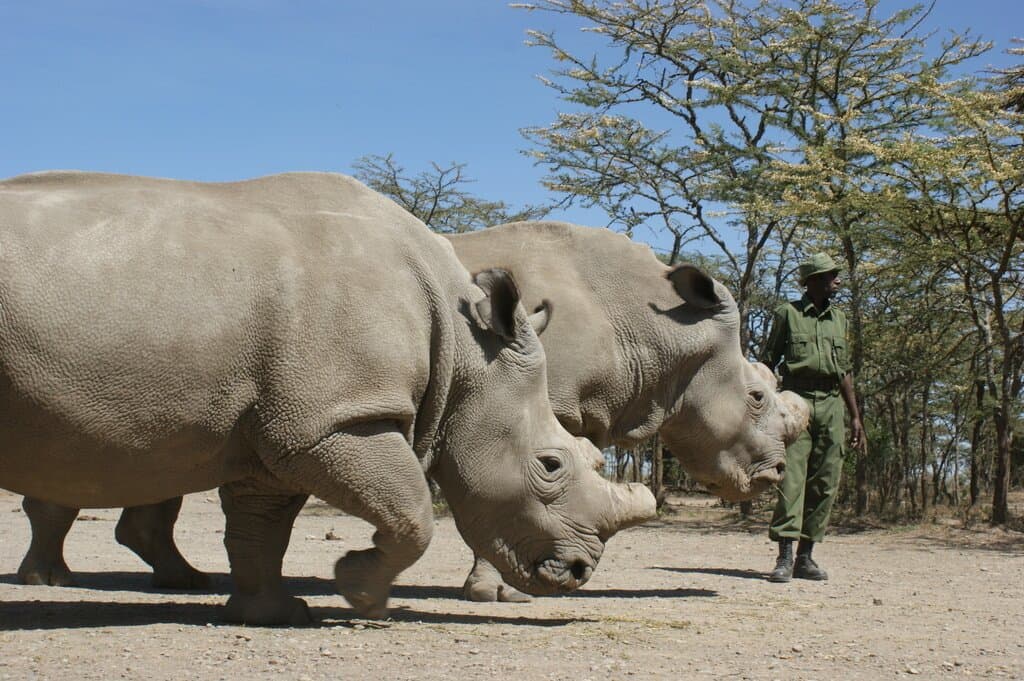
10.White Rhino Conservation (White Rhino)

Indian Express
Illustration for White Rhino Conservation (White Rhino)

What & Where

Northern white-rhino embryo produced via in-vitro fertilisation to rescue a subspecies now reduced to two individuals.

White rhino (square-lipped) inhabits Africa; two subspecies—northern & southern—show stark survival contrasts.

In-vitro fertilisation (IVF) = laboratory union of egg & sperm outside body before embryo transfer to uterus.

Quick Facts for MCQs

Species Status

  • Northern subspecies virtually extinct; southern numbers comparatively stable.
  • Black, Javan, Sumatran rhinos: Critically Endangered; Indian rhino: Vulnerable (IUCN).
  • At least three black-rhino subspecies already extinct.

Assisted Reproductive Tech

  • IVF steps: retrieve mature ova, fertilise in lab, culture embryo, transfer to surrogate.
  • Enables genetic preservation when natural breeding impossible.
  • Critical tool for megafauna conservation amid shrinking populations.

Comparative Rhino Diversity

  • Africa: White (square-lipped, two horns) vs Black (hook-lipped, two horns).
  • Asia: Indian & Javan (single horn); Sumatran (two horns).
  • Lip shape and horn count aid subspecies identification.

Key Data Points

FeatureData-Point
Northern white rhinos alive2
Northern white rhino IUCNCritically Endangered
Southern white rhino IUCNNear Threatened
Overall white rhino IUCNNear Threatened
White rhino aliasSquare-lipped rhinoceros
Land-mammal size rank2nd after elephant
IVF full form originLatin “in glass”
Opposite termIn vivo – “within the living”
IVF belongs toAssisted Reproductive Technology
Embryo placed inUterus
GS-3S&TQuick Bite

11.Compressive Asphyxia in Stampedes (Crowd Crush Asphyxia)

The Hindu

What & Where

Definition: Mechanical asphyxia from external chest/abdomen compression blocking diaphragm-lung movement

Setting: Dense crowds, stampedes, heavy loads; risk peaks at >6–7 persons /m²

Locale example: Karur, Tamil Nadu rally stampede causing 41 deaths, incl. 9 children

Quick Facts for MCQs

Physiology

  • Diaphragm compression impedes lung expansion, rapidly depleting alveolar oxygen
  • CO₂ accumulation produces hypercapnia, accelerating loss of consciousness and organ failure
  • Sustained chest pressure triggers fatal hypoxia within minutes

Clinical Signs

  • Cyanosis of lips/skin indicates critical oxygen shortfall
  • Dizziness and chest tightness precede collapse and unconsciousness
  • Organ failure follows prolonged oxygen deprivation

Emergency Response

  • Priority extraction from crowd; spinal precautions usually unnecessary
  • Immediate oxygen supplementation stabilises before advanced airway placement
  • Continuous monitoring for delayed respiratory complications post-rescue

Recent Incident

  • Karur rally crowd crush exemplifies lethal potential in political/celebrity gatherings
  • Majority deaths confirmed as compressive asphyxia by forensic teams
  • Highlights need for crowd density regulation and rapid medical access

Key Data Points

FeatureData-Point
Asphyxia subtypeCompressive (mechanical)
Critical crowd density>6–7 persons per m²
Primary fatal mechanismOxygen deprivation via restricted diaphragmatic excursion
Key pathological findingsHypoxia, hypercapnia, cyanosis
Earliest symptomShortness of breath
Emergency first stepRemove victim from crushing force
Life-support optionsOxygen therapy, CPR, advanced airway management
Hospital care focusVentilation, organ damage treatment, respiratory monitoring
Stampede death toll (Karur)41 total; 9 children
Common outcome causeCompressive asphyxia, not traumatic injuries
GS-3Editorial

12.Securing India’s Digital Economy (Cyber Frauds)

The Hindu

What & Where

Definition Cyber frauds targeting India’s digital payments and data landscape

Key types Phishing, UPI/OTP scams, identity theft, digital-arrest extortion

Core geography Pan-India; elderly and rural users most hit

Quick Facts for MCQs

Legal & Policy

  • RBI directives mandate real-time alerts, strict KYC, mule account freezing
  • DPDP 2023 sets penalties for negligent data handling
  • Cross-border pursuit aided by Interpol, FATF frameworks

Institutional Gaps

  • Banks issue generic advisories, miss anomaly detection
  • Cyber police lack manpower, AI tools, 24×7 response units
  • Weak KYC enables layering and laundering through mule accounts

Security Dimension

  • Social engineering leverages fear, greed, urgency to extract OTPs, UPI approvals
  • Remote access malware and fake government calls escalate fraud sophistication
  • Identity theft thrives on Aadhaar, PAN leaks due to poor encryption

Tech & Schemes

  • AI/ML piloted for personalised transaction profiling and anomaly flags
  • Proposed National Fraud Intelligence Grid to link banks, telecoms, police
  • Blockchain suggested for tamper-proof KYC and fund traceability

Social Concerns

  • Digital illiteracy magnifies victimhood, especially among seniors
  • Stigma and distrust cause significant under-reporting of cyber offences
  • Targeted literacy drives urged for students, rural communities, pensioners

Key Data Points

FeatureData-Point
Cybercrime cases 202313.9 lakh (NCRB)
Biggest cited loss₹23 crore via digital arrest, 2025
High-risk cohortsElderly, rural, digitally illiterate
Fundamental rightPrivacy under Art 21, Puttaswamy 2017
Property safeguardArt 300A of Constitution
RBI liability ruleZero liability for defined fraud categories
Nodal cyber agencyCERT-In, IT Act 2000
Coordination hubI4C under MHA
Data protection lawDPDP Act 2023
Awareness drivesCyber Jagrookta Abhiyan; RBI Kehta Hai

Related UPSC Prelims PYQs

CAPF_GAI, GS1 2020PYQ 1

भारत में, किसी व्यक्ति के साइबर बीमा पॉलिसी पर, निजी क्षति की भरपाई हेतु अन्य लोगों के अतिरिक्त, सामान्यतः निम्नलिखित में से कौन-से लाभ दिए जाते हैं?

CAPF_GAI, GS1 2022PYQ 2

भारतीय कंप्यूटर आपातकालीन प्रतिक्रिया दल (CERT-In) द्वारा जारी किए गए नवीनतम दिशानिर्देशों के संदर्भ में निम्नलिखित कथनों पर विचार कीजिए:

GS-2Scheme

13.RoDTEP Scheme Extension (RoDTEP Refunds)

The Hindu

What & Where

RoDTEP; Indian export-rebate scheme refunding hidden taxes on exported goods

Process: Digital end-to-end claim, refund credited as transferable scrip against shipping bills

Geography: Applicable pan-India, covering DTA units, SEZs, EOUs, AA holders

Quick Facts for MCQs

Tech & Schemes

  • Digital architecture enables paperless claim, faster settlement, traceability
  • Transferable e-scrip tradable on customs portal, easing liquidity for small exporters

Economic Angle

  • Offsets embedded state, central, local levies, lowering export cost structure
  • Shields exporters from rising US tariffs, global trade headwinds, sustaining competitiveness

Policy Measures

  • Extension signals long-term policy certainty, aiding contract planning through FY 25-26
  • Reinforces Make in India export thrust while honouring WTO subsidy disciplines

Key Data Points

FeatureData-Point
Launch year2021
Validity extended tillMarch 2026
Refund rate band0.3 % – 3.9 % of FOB value
Cumulative payout (till Mar 2025)≈ ₹57,000 crore
WTO statusFully compliant with AoA
Eligible production zonesDTA, SEZ, EOU, AA
Disbursal platformICEGATE automated portal
Budget controlOperates within annual fiscal ceiling

Ready to practice?

Test your knowledge with our UPSC test series.

Start Free Trial