UPSC Current Affairs

17 topicsGS-1: 5GS-2: 5GS-3: 7
0/17 done
GS-2Polity

1.Crime in India 2023 Statistics (Crime Statistics)

Hindustan Times

What & Where

Crime in India 2023 Report — nationwide crime statistics compiled by National Crime Records Bureau (NCRB), MHA.

Covers offences under Indian Penal Code (IPC) & Special/Local Laws; 2023 is final IPC-based edition before Bharatiya Nyaya Sanhita.

Inputs sourced from all State/UT police stations via Crime & Criminal Tracking Network & Systems (CCTNS).

Quick Facts for MCQs

Crime Statistics

  • Spike; one crime logged every five seconds, marking sharp move toward economic & tech-enabled offences.
  • Social-group crimes: ST surge outpaces SC & women offences; children cases climb markedly.
  • Heinous crimes (murder, rape) show downtrend despite overall rise.

Police & Judicial Efficiency

  • Charge-sheeting improves marginally; convictions stagnant at 54 %, signalling prosecution bottlenecks.
  • Pending investigations inch up, underscoring resource and manpower gaps.

Cybercrime Drivers

  • Scale; 800 million mostly first-time users with low digital literacy increase attack surface.
  • Tools; rented phishing kits, botnets enable targeted vishing/smishing using leaked personal data.
  • Jurisdiction; high offshore origin (notably SE Asia) complicates investigation & extradition.

Cybersecurity Framework

  • Laws; IT Act 2000, Digital Personal Data Protection Act 2023 provide statutory base.
  • Institutions; CERT-In, NCIIPC, I4C, Cyber Swachhta Kendra oversee response, protection, coordination.
  • Capacity; Bharat National Cybersecurity Exercise builds inter-agency readiness against complex attacks.

Key Data Points

FeatureData-Point
Total registered crimes 20236.24 million; +7.2 % YoY
IPC cases rise+5.7 %
SLL cases rise+9.5 %
Cybercrime growth+31.2 %
IT Act offences+36 %
Crimes against women4.48 lakh; +0.7 %
Crimes against STs+28.8 %
Crimes against SCs+0.4 %
Crimes against children+9.2 %
Murder trend–2.8 %
Rape trend–5.9 %
Dowry deaths trend–4.6 %
Offences against State–13.2 %
IPC charge-sheeting rate72.7 %
IPC conviction rate54 %
Pending investigations29.2 %
Indian internet users>800 million
NCRB set-up year1986
Parent ministryHome Affairs
GS-3Economy

2.Namchik-Namphuk Commercial Coal Mine (Coal Mining)

LiveMint

What & Where

Namchik-Namphuk Coal Block – Arunachal’s first commercial coal mine under Atmanirbhar Bharat self-reliance drive

Located in Changlang district, Upper Assam coal belt, south-eastern Arunachal Pradesh (India-Myanmar border vicinity)

Holds ~1.5 crore t reserves; extraction planned via eco-centric “Mission Green Coal Regions” framework

Quick Facts for MCQs

Legal & Policy

  • Statute: Coal Mines (Special Provisions) Act 2015 opened sector to private commercial mining
  • Framework: Mines & Minerals (Development & Regulation) Act 1957 remains primary legal backbone
  • Oversight: Ministry of Coal conducts e-auctions, ensuring transparency and revenue maximisation

Economic Angle

  • Revenue: Block projected to earn State exchequer ~₹100 crore annually
  • Imports: Domestic output targets reduced reliance on seaborne thermal coal
  • Jobs: Formal employment rise expected, discouraging illegal artisanal extraction

Environmental Impact

  • Scheme: Mission Green Coal Regions mandates parallel land reclamation and afforestation
  • Compliance: Eco-sensitive mining aligned with community rehabilitation and environmental safeguards
  • Vision: PM-EAST stresses sustainable, balanced Northeast resource development

Key Data Points

FeatureData-Point
StateArunachal Pradesh
DistrictChanglang
Geological beltUpper Assam coal belt
Coal reserve estimate~1.5 crore tonnes
Expected annual revenue~₹100 crore
Policy bannerAtmanirbhar Bharat / PM-EAST
Governing actsMMDR Act 1957; CMSP Act 2015
Monopoly endedCoal India Ltd.
Auction authorityMinistry of Coal

Related UPSC Prelims PYQs

GEO_GS, GS1 2008PYQ 1

In which one of the following States are Namchik-Namphuk Coalfields located?

GEO_GS, GS1 2022PYQ 2

Namchik-Namphuk areas are known for the production of which one of the following resources?

GS-3InfrastructureQuick Bite

3.Cooperative Compressed Biogas Plant (Compressed Biogas Plant)

PIB

What & Where

Kopargaon, Ahmednagar, Maharashtra — India’s first cooperative multi-feed Compressed Biogas (CBG) plant, inaugurated Oct 2025.

Capacity 12 t/day CBG + 75 t/day potash; feedstock jaggery / molasses plus other organic wastes.

CBG via anaerobic decomposition of biomass; renewable fuel with CNG-like calorific value for transport, industry, commerce.

Quick Facts for MCQs

Tech & Schemes

  • SATAT scheme: purchases CBG for transport, cuts imports, curbs vehicular emissions.
  • NCDC funding: 15 cooperative sugar mills to add CBG-potash units.
  • Multi-feed architecture: handles seasonal biomass shifts, enabling continuous operation.

Environmental Impact

  • Emissions: CBG substitution aids 2070 net-zero trajectory.
  • Waste-to-energy: utilises press-mud, dung, stubble, limits open burning.
  • Potash by-product: domestic fertiliser lowers chemical runoff and import load.

Economic Angle

  • Energy security: indigenous CBG trims >50 % natural-gas import reliance.
  • Rural livelihood: biomass sourcing and plant jobs uplift farm communities.
  • Import substitution: potash production reduces fertiliser import bill.

Key Data Points

FeatureData-Point
Daily CBG output12 tonnes
Daily potash output75 tonnes
Core feedstocksJaggery-molasses, agri residue, dung, press-mud, sewage
Production processAnaerobic decomposition (oxygen-free bacterial action)
Natural gas share target15 % of energy mix by 2030
Present gas share≈6 %
NG import dependence FY2550.8 %
SATAT waste utilisation goal62 MMT / year
Net-zero pledge year2070
NCDC sugar mills backed15 units
GS-1HistoryQuick Bite

4.Pandit Chhannulal Mishra Legacy (Thumri Tradition)

The Hindu

What & Where

Thumri – 19th-century semi-classical vocal genre of North India, arose under Nawab Wajid Ali Shah’s Awadh court.

Post-1856 centre shifted to Banaras; imbibed Radha-Krishna devotional flavour, labelled Purab Ang.

Key lineages: Banaras, Lucknow, Patiala gharanas; two styles – Purbi (slow) & Punjabi (fast).

Quick Facts for MCQs

Personalities & Awards

  • Chhannulal Mishra famed for Purab Ang Thumri interpretation.
  • Death marks loss of leading Banaras-style exponent.
  • Padma honours recognise contribution to Hindustani semi-classical revival.

Musical Forms

  • Dadra six-beat cycle, lighter than Thumri.
  • Chaiti, Kajri seasonal folk-rooted songs adopted into semi-classical repertoire.
  • Hori festive Holi songs often fused within Thumri renditions.

Gharana Focus

  • Banaras gharana stresses emotive depth, bol-banav improvisation.
  • Lucknow gharana retains courtly delicacy, dance linkage.
  • Patiala gharana integrates rapid taans, Punjabi linguistic flavour.

Key Data Points

FeatureData-Point
MaestroPandit Chhannulal Mishra (Banaras Gharana)
Highest awardPadma Vibhushan 2020 (also Padma Bhushan 2010)
Signature formsThumri, Dadra, Chaiti, Kajri
Thumri hallmarkBhava-centric, freer than strict raga grammar
Purbi ThumriSlow tempo, lyrical, Banaras-linked
Punjabi ThumriFast tempo, lively, Patiala-linked
Core patronNawab Wajid Ali Shah, Lucknow, 19th c.
Hindustani semi-classical setThumri, Dhamar, Tarana, Tappa, Qawwali, Ghazal

Related UPSC Prelims PYQs

CDS_GK 2024PYQ 1

Renowned classical singer Prabha Atre, who passed away recently, was an exponent of which one of the following Gharanas?

GS-1Editorial

5.India Disaster Resilience Strategy (Disaster Resilience)

The Hindu
Illustration for India Disaster Resilience Strategy (Disaster Resilience)

What & Where

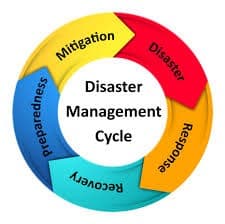
Disaster Resilience: anticipatory, science-based, budget-linked approach replacing relief-centric model.

Key Processes: hazard modelling, nature-based mitigation, decentralised capacity, finance earmarked via 15th FC.

Core Geography: pan-India focus; 2025 ₹5,000-cr rebuild for Uttarakhand, Himachal Pradesh, Assam, Sikkim, Kerala.

Quick Facts for MCQs

Legal & Policy

  • NDMA: multi-hazard national guidelines, state coordination, Home Ministry oversight
  • Panchayat disaster plans: mandated integration into local development schemes
  • School safety: compulsory drills promote behavioural readiness in education sector

Financial Innovation

  • Budget-linkage: domestic funds reduce multilateral debt dependence
  • 15th FC window: embeds DRR line-items in state treasuries, ensures predictable cash flow
  • Micro-insurance proposal: shields vulnerable households, encourages quick recovery

Tech & Nature Solutions

  • Bio-engineering: slope stabilisation, wetland revival, forest-fire fuel breaks
  • Remote sensing & AWS: glacial-lake surveillance, real-time alerts to districts
  • NCMP early-warning systems: eight cyclone-prone states networked

Capacity & Community

  • Geo-spatial labs & NIDM: 36 training disciplines expand professional roster
  • Fire-service modernisation: ₹5,000 crore allocation upgrades gear, communication
  • Volunteer surge: Apda Mitra model institutionalises citizen first-responders

Challenges

  • Fragmented mandates: overlapping ministries delay crisis execution
  • Urban exposure: zoning breaches heighten flood, heat, infrastructure risks
  • Data gaps: lack of unified IMD-ISRO-NDMA platform hampers predictive analytics

Key Data Points

FeatureData-Point
15th Finance Commission DRR kitty₹2.28 lakh crore (2021-26)
Fund splitPrep 10 % / Mitigation 20 % / Response 40 % / Reconstruction 30 %
PM 10-Point Agenda launch2016
NDMA Landslide Guidelines2023
Urban Flood Management Framework2024
Cyclone shelters built700 under NCMP (2011-22)
Apda Mitra & Yuva corps2.5 lakh volunteers
State-wise 2025 rebuild package₹5,000 crore each to 5 Himalayan-coastal states

Related UPSC Prelims PYQs

CDS_GK, ESE_GS 2025PYQ 1

राष्ट्रीय आपदा प्रबंधन संस्थान (NIDM) के संदर्भ में निम्नलिखित में से कौन-सा/कौन-से कथन सही है/हैं?

CDS_GK, ESE_GS 2024PYQ 2

'Scheme for Expansion and Modernization of Fire Services in the States' from the allocation of preparedness and Capacity Building Funding Window under the National Disaster Response Fund for strengthening fire services in the States was introduced by which Union Ministry?

GS-1Environment

6.Blizzard Formation and Features (Snowstorm Phenomenon)

DD News

What & Where

Severe mid-latitude snowstorm with ≥56 km/h winds, sub-zero temperatures, near-zero visibility.

Forms where polar/continental cold air meets moist maritime/tropical air; frequent on mountain slopes, coastal belts.

Variants: Ground Blizzard (wind-lifted pre-existing snow); Nor’easter along North Atlantic coasts.

Quick Facts for MCQs

Atmospheric Dynamics

  • Cold dense air undercuts warm moist air, triggering frontal snowfall.
  • Steep pressure gradient accelerates winds, producing horizontal snow transport.
  • Orographic uplift on Everest intensifies cloud formation and precipitation.

Physical Features

  • Whiteout: visibility <400 m; movement/navigation nearly impossible.
  • Post-storm cold-wave often follows sustained blizzard conditions.
  • Wind speeds may cross 120 km/h in extreme events.

Environmental Impact

  • Fresh snow boosts surface albedo, modifying local energy balance.
  • Heavy accumulation heightens avalanche risk, can momentarily expand glaciers.
  • Snowpack feedbacks influence regional climate patterns.

Human Impact

  • Frostbite, hypothermia major threats to trekkers, residents.
  • Transport, power, communication networks fail under deep snow and high winds.
  • Rescue delays common due to blocked routes and zero visibility.

Key Data Points

FeatureData-Point
Minimum wind speed≥56 km/h
Visibility cutoff<0.4 km for >3 h
Usual wind velocity80–100 km/h; severe >120 km/h
Temperature regimeBelow freezing; high wind-chill
Uplift mechanismsFrontal & orographic
Pressure gradientSteep, drives horizontal snow
Typical durationSeveral hours–days

Related UPSC Prelims PYQs

GEO_GS 2025PYQ 1

Consider the following statements:

GS-1Environment

7.Landslide Causes and Risks (Landslide Hazard)

Indian Express
Illustration for Landslide Causes and Risks (Landslide Hazard)

What & Where

Landslide – down-slope mass movement of rock/soil when shear stress overtops material strength.

Triggers – cloudburst rain, quakes, deforestation, road-cutting, unregulated builds.

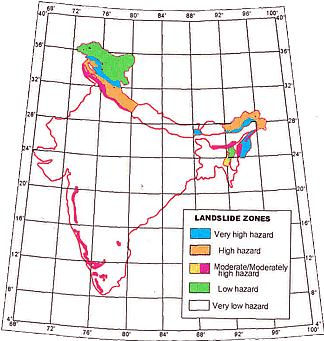
Hotspots – Himalayas, NE hills, Western/Eastern Ghats, Nilgiris; Darjeeling–Kalimpong in Eastern Himalayas.

Quick Facts for MCQs

Regional Vulnerability

  • India: tectonic activity, steep relief amplify slope failures.
  • Northeast: fragile geology, heavy monsoon, contributes 42 % hazard.
  • Darjeeling–Sikkim: young rocks, high rainfall, seismicity.

Darjeeling Profile

  • Unscientific road/hydropower cuts disrupt drainage, destabilising slopes.
  • Encroachments along rivers & jhoras blocking run-off.
  • Repeated collapses threaten bridges, highways, railway to Northeast.

NDMA Strategy

  • Components: hazard zonation, early warning, slope stabilisation, relocation.
  • Tools: IMD rainfall forecast + ISRO DEM for warnings.
  • Partners: GSI, NRSC, DST, CSIR share real-time GIS data.

Mitigation Steps

  • Enforce hill building codes, ban high-risk slope construction.
  • Promote bio-engineering, afforestation, jhora rejuvenation.
  • Propose Himalayan Disaster Research & Management Centre in Darjeeling.

Security Dimension

  • Siliguri Corridor lifeline for NE states, Bhutan, Army logistics.
  • Landslides convert ecological fragility into national security risk.
  • Act East Policy calls for integrated, sustainable Himalayan planning.

Key Data Points

FeatureData-Point
India landslide-prone area0.42 million sq km (13 %)
NE share of hazard zone42 %
Darjeeling major slide years1899 1934 1950 1968 1975 1980 1991 2011 2015
1968 Darjeeling deaths>1,000
2023 Sikkim GLOF loss₹25,000 crore
Destroyed 2024 linksDudhia bridge; Teesta Bazaar road
Siliguri Corridor aliasChicken’s Neck
National Landslide Strategy2019
LHZ map scale1 : 50,000
Core agenciesNDMA GSI IMD ISRO

Related UPSC Prelims PYQs

NDA_GAT 2022PYQ 1

Which of the following statements in respect of landslides are correct?

NDA_GAT 2022PYQ 2

Consider the following features about a geographical phenomenon:

GS-3Environment

8.IUCN World Conservation Congress 2025 (IUCN Congress)

Down to Earth

What & Where

IUCN World Conservation Congress (WCC); quadrennial global summit setting conservation, climate and sustainability agenda

2025 edition in Abu Dhabi, United Arab Emirates; India to release its first national Red List here

Convened by International Union for Conservation of Nature; over 1,400 member organisations vote on policy motions

Quick Facts for MCQs

Organisation & History

  • Genesis 1948 Lausanne Congress initiated soon after IUCN founding
  • India continuous participant since 1969 State Membership
  • Marseille 2021 emphasised post-COVID biodiversity and climate emergency

2025 Themes

  • Scaling-up conservation action targets large-scale restoration and species protection
  • Climate overshoot mitigation aims to avoid irreversible ecological tipping points
  • Nature-positive economies push circular production, green finance, sustainable lifestyles

Participation & Stakeholders

  • Delegates include governments, scientists, civil society, indigenous leaders, private sector
  • Multilateral presence from CBD, UNFCCC, Ramsar, UNEP anticipated
  • Youth and tech innovators spotlighted under disruptive innovation theme

Outputs & Platforms

  • Members vote on resolutions guiding global policy till 2030 biodiversity goals
  • Marketplace platform exchanges research, technology, nature-based solutions
  • Networking hub connects NGOs, corporates, policymakers for joint conservation initiatives

Key Data Points

FeatureData-Point
OrganiserIUCN
Event frequencyEvery 4 years
First Congress year1948
2025 host countryUnited Arab Emirates
2025 venue cityAbu Dhabi
India: IUCN State Member since1969
Previous Congress2021, Marseille (France)
Expected delegates 20259,000+
Core outcomeGlobal Conservation Declaration
Voting body size1,400+ member organisations
Planned Indian highlightDebut national Red List of Endangered Species
Number of 2025 themesFive
Key public componentsExhibitions, film screenings, educational events

Related UPSC Prelims PYQs

CDS_GK, ESE_GS 2024PYQ 1

Which organisation publishes worldwide list of endangered species?

CDS_GK, ESE_GS 2021PYQ 2

The Thirteenth Meeting of the Conference of the Parties to the Convention on the Conservation of Migratory Species of Wild Animals (CMS COP-13) in 2020 was held in

GS-3Environment

9.Southeast Asia Coral Larvae Cryobank (Coral Cryobank)

The Hindu
Illustration for Southeast Asia Coral Larvae Cryobank (Coral Cryobank)

What & Where

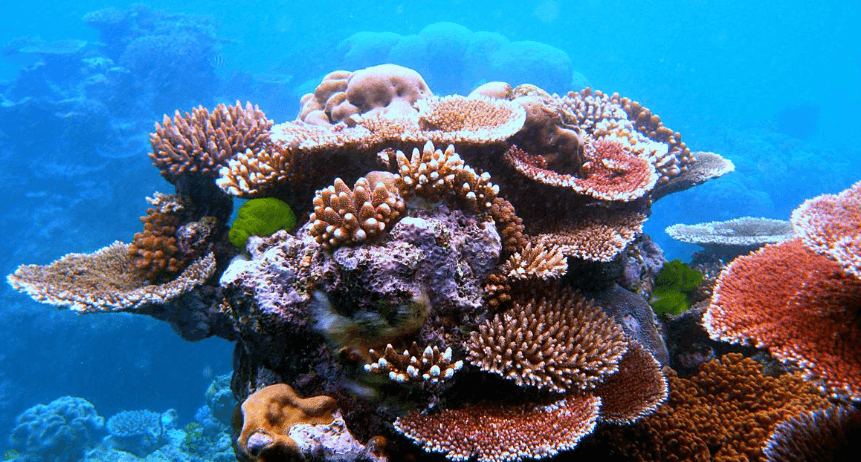
Definition: Cryobank freezing coral larvae in liquid nitrogen to act as genetic “seed vault”.

Location: First Southeast-Asian unit in the Philippines; part of wider Coral Triangle network.

Aim: Safeguard coral diversity and supply material for future reef restoration under climate stress.

Quick Facts for MCQs

Technology & Process

  • Collection: Divers gather spawning-event larvae, immediately immerse in cryoprotective solutions.
  • Freezing: Rapid plunge to achieve glass-like vitrification, preventing cell-damaging ice crystals.
  • Revival: Seconds-long laser warming, seawater rehydration, then monitored settlement in controlled tanks.

Biodiversity Significance

  • Preservation: Stores genetic diversity even if parent colonies vanish in wild bleaching events.
  • Restoration: Enables climate-resilient reef seeding using hardy or heat-tolerant genotypes.
  • Research: Long-term repository for studies on evolution, reproduction, stress resistance.

Limitations & Challenges

  • Technicality: Large, lipid-rich, heat-sensitive larvae complicate uniform vitrification protocols.
  • Species-specificity: Each coral species demands tailored freezing and thaw curves.
  • Cost: Requires specialised labs, continuous nitrogen supply, trained cryobiologists.

Regional Collaboration

  • Governance: Shared protocols and data across Coral Triangle Cryobank Network.
  • Capacity-building: Cross-training among Philippines, Taiwan, Indonesia, Malaysia, Thailand scientists.
  • Expansion: Plan to add endangered species once model-coral methods stabilise.

Key Data Points

FeatureData-Point
Freezing mediumLiquid nitrogen –196 °C
Key stage storedFree-swimming coral larvae
Main techniqueVitrification after cryoprotectant exposure
Thaw methodLaser-based rapid warming
Initial model generaPocillopora, Acropora, Galaxsia
Platform umbrellaCoral Research & Development Accelerator Platform
Participating nationsPhilippines, Taiwan, Indonesia, Malaysia, Thailand
Network titleCoral Triangle Cryobank Network
Core benefitDecades-long preservation of coral genotypes
Major hurdleLipid-rich larvae show low post-thaw survival
GS-3Editorial

10.Rising Cancer Burden in India (Cancer Burden)

Indian Express

What & Where

Lancet-GBD 2023 assesses cancer incidence & mortality globally; contrasts India with world decline.

India 2023: 15 lakh new cases, 12 lakh deaths; rate 107.2 & 86.9 per 1 lakh population.

LMICs, incl. India, forecast >50 % new cases, ≈ 67 % deaths by 2050.

Quick Facts for MCQs

Risk Factors

  • Tobacco, alcohol, poor diet, inactivity contribute 42 % global, ~70 % Indian deaths.
  • Air-pollution (PM2.5), solid-fuel smoke, industrial chemicals labeled Class I carcinogens.
  • Infection-linked: HPV, Hep-B/C, H. pylori drive cervical, liver, stomach cancers.

Indian Drivers

  • Demography; ageing boosts non-communicable disease load.
  • Health-system gaps: late diagnosis, specialist & radiotherapy scarcity, high OOP costs.
  • Lifestyle; 267 m tobacco users, rising obesity & alcohol consumption elevate risk pool.

Policy & Schemes

  • National Programme for Prevention & Control of Cancer, Diabetes, CVD & Stroke (NPCDCS).
  • National Cancer Grid links 300+ centres; HPV vaccine rolled out under Universal Immunisation.
  • National Cancer Registry Programme (ICMR-NCDIR) expanding for real-time surveillance.

Recommended Actions

  • Control: raise tobacco taxes, tighten COTPA enforcement.
  • Universalise HPV & Hep-B jabs; integrate screening via PHC, ASHA, ANM network.
  • Expand Ayushman Bharat coverage, add tertiary cancer centres, boost indigenous research.

Key Data Points

FeatureData-Point
Global incidence 1990220.6/1 lakh
Global incidence 2023205.1/1 lakh
Projected global incidence 2025192.9/1 lakh
India incidence 199084.8/1 lakh
India incidence 2023107.2/1 lakh
India death rate 199071.7/1 lakh
India death rate 202386.9/1 lakh
2023 India new cases~1.5 million
2023 India deaths~1.2 million
Modifiable-risk share global42 % deaths
Modifiable-risk share India≤ 70 % deaths
Global 2050 forecast cases30.5 million
Global 2050 forecast deaths18.6 million (+75 %)
Key India fatal cancersBreast, lung, oesophagus, oral, cervical, stomach, colon
GS-3S&T

11.Revised Schedule M Standards (Pharma GMP)

DH

What & Where

Schedule M, Drugs & Cosmetics Act 1940; codifies Good Manufacturing Practices for all Indian pharma plants.

Revised 2023-24 to mirror WHO-GMP & PIC/S; compliance deadline 31 December 2025 nationwide.

Trigger: child deaths from cough-syrup adulterated with industrial solvent diethylene glycol (DEG).

Quick Facts for MCQs

Legal & Policy

  • Mandates supplier audits, digital traceability, self-inspection for each manufacturing site.
  • Aligns Indian plants with global WHO-GMP, aiding exports to regulated markets.
  • Union Health Ministry orders strict enforcement after recent adulteration deaths.

Quality Control

  • Requires lifecycle validation: Design, Installation, Operation, Performance Qualification.
  • Enforces computerised storage, controlled environments, documented SOPs for every batch.
  • Compulsory risk-based cleaning, maintenance, personnel hygiene protocols.

Toxicology

  • DEG ingestion causes renal failure, metabolic acidosis, death; lethal at ~1 ml/kg.
  • Colorless, odorless nature complicates detection in contaminated syrups.
  • Historical poisoning events linked to poor quality checks and cost-cutting.

Key Data Points

FeatureData-Point
Governing ActDrugs & Cosmetics Act, 1940
First Schedule M issueDrugs & Cosmetics Rules, 1945
Latest revision2023-24
Compliance cut-off31 Dec 2025
Core frameworkPharmaceutical Quality System (PQS)
Risk toolQuality Risk Management (QRM)
Data ruleALCOA+ for integrity
Mandatory post-market stepPharmacovigilance reporting
DEG chemical formulaC₄H₁₀O₃
DEG pharma approvalNot approved; industrial solvent
DEG misuse routeSubstitution for glycerine/propylene glycol
ALCOA+ lettersAttributable, Legible, Contemporaneous, Original, Accurate, Complete, Consistent, Enduring, Available
GS-2Editorial

12.India’s Pitch for UN Reform (UN Reform)

The Hindu

What & Where

United Nations reform = overhaul of Security Council, veto use, financing, accountability via Intergovernmental Negotiations (IGN).

Key processes: G4 expansion demand, veto-curbing initiatives, periodic review clauses, Global South caucusing.

Core geography: UNHQ New York, P5 dominance vs emerging powers from Asia-Pacific, Africa, Latin America.

Quick Facts for MCQs

Structural Issues

  • Gridlock: Single P5 veto can stall resolutions despite majority support.
  • Representation: Africa, Latin America, Global South under-represented; Council mirrors 1945 geopolitics.
  • Credibility: Bosnia, Rwanda, Syria failures expose weak mandates and donor leverage.

India’s Reform Pitch

  • Expansion: Seeks six new permanent seats incl. one for India under G4 blueprint.
  • Advocacy: Positions itself as Global South voice on climate justice, equitable growth, counter-terrorism.
  • Soft power: Yoga Day consensus, decolonisation legacy bolster moral claim.

Proposed Solutions

  • Text-based IGN negotiations with firm deadlines to avoid procedural stalling.
  • Veto reform: Binding restrictions during genocide or war-crime situations; possible GA override.
  • Accountability: Publish performance audits; ten-year review cycle via standing UN Reform Commission.

Key Data Points

FeatureData-Point
Current UNGA session highlighted80th (2025)
Security Council permanent membersUS, UK, France, Russia, China
G4 compositionIndia, Brazil, Germany, Japan
Votes backing Intl Day of Yoga177 member states
Recent UNDP investigations (2023)434 cases
Example veto blocksRussia on Ukraine, US on Israel issues
Major alternative forums citedG20, BRICS, African Union
India’s peacekeeping rank historicallyAmong top troop contributors

Related UPSC Prelims PYQs

CDS_GK, GS1 2023PYQ 1

निम्नलिखित में से कौन-सा, भारत के संविधान के अनुच्छेद 51 का भाग नहीं है?

CDS_GK, GS1 2022PYQ 2

“संयुक्त राष्ट्र प्रत्यय समिति (United Nations Credentials Committee)” के सम्बन्ध में, निम्नलिखित कथनों पर विचार कीजिए:

GS-3SecurityQuick Bite

13.Exercise KONKAN 2025 Bilateral Drill (India-UK Naval Exercise)

The Hindu

What & Where

Exercise Konkan – annual India-UK bilateral maritime drill, first held 2004, 2025 edition conducted off India’s western coast

Two-part format: Harbour Phase (professional exchanges, ship visits); Sea Phase (AA, ASuW, ASW, flying ops)

2025: debut of both nations’ Carrier Strike Groups – INS Vikrant & HMS Prince of Wales

Quick Facts for MCQs

Security Dimension

  • Reinforces free, open, secure Indo-Pacific outlook
  • Enhances carrier battle-group readiness against multi-domain threats
  • Signals deterrence through combined sea-control capability

Interoperability & Capability

  • Standardises tactics, techniques, procedures across two carrier strike groups
  • Facilitates cross-deck flying, communication links, joint logistics
  • Builds familiarity for HADR and maritime security missions

Diplomatic Context

  • Showcases two decades of growing naval ties since 2004 inception
  • Aligns with UK’s tilt to Indo-Pacific and India’s SAGAR vision
  • Acts as visible deliverable under India–UK Defence & International Security Partnership

Key Data Points

FeatureData-Point
Inception year2004
2025 edition nameExercise KONKAN-25
Participant naviesIndian Navy, UK Royal Navy
Flagships 2025INS Vikrant, HMS Prince of Wales
Location 2025Arabian Sea, India’s western coast
Strategic frameworkIndia–UK Vision 2035, Comprehensive Strategic Partnership
Core drillsAnti-air, Anti-surface, Anti-submarine, Carrier air ops
Other India-UK exercisesCobra Warrior, Indradhanush, AJEYA WARRIOR

Related UPSC Prelims PYQs

ESE_GS, NDA_GAT 2021PYQ 1

Which one of the following statements is most appropriate about ‘Exercise Kavach’?

ESE_GS, NDA_GAT 2022PYQ 2

Which one of the following countries did the Indian Navy participate in the U.S. Navy-led Southeast Asia Cooperation and Training (SEACAT) military exercise, to demonstrate its maritime manoeuvres?

GS-2Scheme

14.Critical Mineral Recycling Incentive Scheme (Critical Mineral Recycling)

EET

What & Where

Centrally sponsored Critical Mineral Recycling Incentive Scheme under Ministry of Mines, pan-India scope

Targets recovery of lithium, cobalt, nickel & other critical minerals from e-waste, spent Li-ion batteries, metal scrap

Embedded in National Critical Mineral Mission to cut import reliance for EV, electronics, renewable sectors

Quick Facts for MCQs

Tech & Schemes

  • Eligibility covers domestic recyclers handling authorised secondary sources only
  • Incentives disbursed post-commissioning and performance verification
  • Scheme duration aligns with NCMM timeline till 2029-30

Economic Angle

  • Viability gap funding expected to trigger 5× multiplier on private capital
  • Incentive caps differentiated to encourage MSME & start-up participation
  • Domestic supply buffers against global price shocks for critical minerals

Environmental Impact

  • Recycling prevents landfill of hazardous battery waste, cutting pollution load
  • Saves virgin mineral extraction energy, aiding national decarbonisation goals
  • Aligns with Extended Producer Responsibility rules for electronics and batteries

Strategic Significance

  • Diversifies supply away from China-centric refining hubs
  • Enhances self-reliance for strategic sectors like defence electronics
  • Positions India as regional recycling hub in Global South

Key Data Points

FeatureData-Point
Total incentive outlay₹1,500 crore
Parent initiativeNational Critical Mineral Mission
Administering ministryMines
Eligible unitsNew, expansion, modernisation
Incentive ceiling – large recycler₹50 crore (CapEx + OpEx)
Incentive ceiling – start-up₹25 crore
Focus stageActual mineral extraction, not black-mass
Planned recycling capacity270 kilo tonnes/year
Annual mineral yield target40 kilo tonnes
Expected private investment₹8,000 crore
Job creation estimate70,000 direct + indirect
Key feedstocksE-waste, spent Li-ion batteries, metal-rich scrap
Strategic aimImport reduction for EV & renewable supply chains
Circular economy linkageSupports LiFE mission
GS-2Scheme

15.Dhan-Dhaanya Krishi Yojana (PMDDKY)

Indian Express
Illustration for Dhan-Dhaanya Krishi Yojana (PMDDKY)

What & Where

PM Dhan-Dhaanya Krishi Yojana: converged mission creating 100 Aspirational Agriculture Districts to modernise farming.

Process: pools 36 existing central schemes (11 departments) for 2025-26 → 2030-31 intervention cycle.

Coverage: nationwide; minimum one district per state/UT selected on low productivity, credit, cropping intensity.

Quick Facts for MCQs

Objectives & Outcomes

  • Productivity upgradation; income rise via diversification & value-addition.
  • Self-sufficiency goal in foodgrains, pulses, oilseeds; import bill reduction.
  • Women & youth integration for non-farm rural livelihoods.

Funding & Convergence

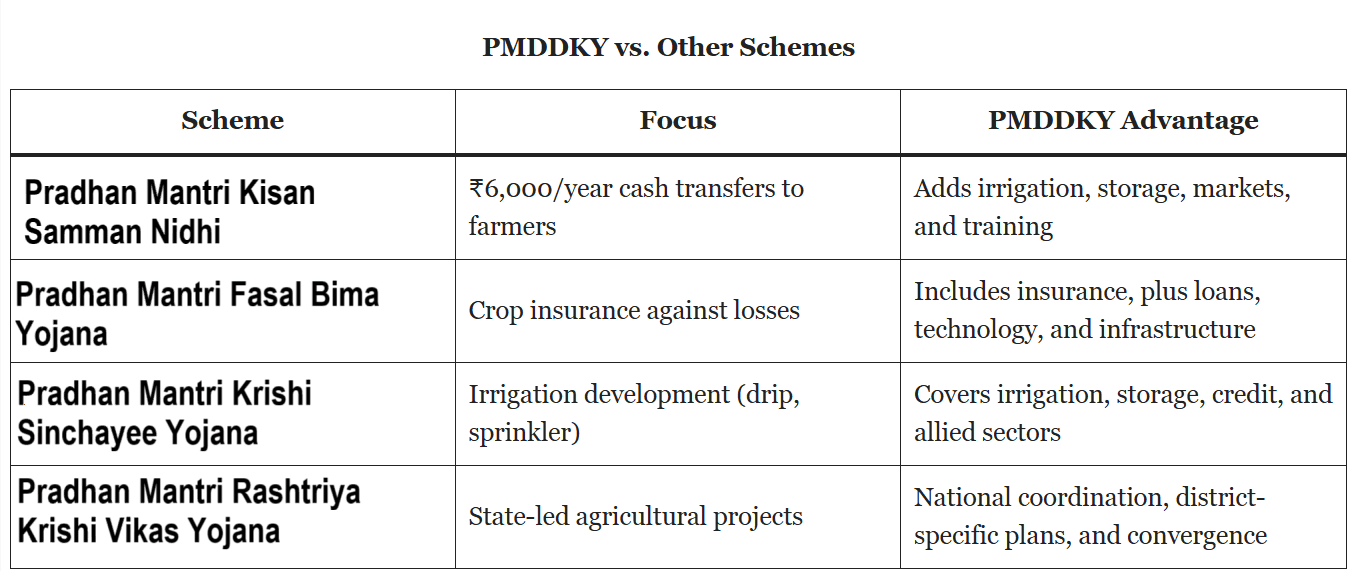
  • Convergence leverages PM-KISAN, PM-FBY, PMKSY, KCC and 32 other schemes.
  • No separate budget; existing allocations realigned under common output metrics.
  • 3C model: convergence, collaboration, competition among districts.

Selection Metrics

  • Yield: wheat < 3.5 t/ha or rice < 2.7 t/ha flagged.
  • Credit: KCC/bank loan penetration under 30% prioritised.
  • Geography: net cropped area share guides state-wise quota.

Implementation Structure

  • DADP drafted locally; approvals through District Planning Committee.
  • Real-time dashboard parallels ADP’s Champions of Change.
  • Monthly reviews by ministry; delta ranking to reward fast improvers.

ADP Model Linkage

  • Shares ADP DNA of data-driven, district-centric governance.
  • Emphasises cooperative-competitive federalism for agri outcomes.
  • Success templates from Chamba & Andhra districts cited for replication.

Key Data Points

FeatureData-Point
Launch announcementUnion Budget 2025
Supervising ministryAgriculture & Farmers’ Welfare
Districts covered100
Scheme windowFY 2025-26 to 2030-31
Total outlay₹1.44 lakh crore
Annual outlay₹24,000 crore
Fund splitSubsidy 40% / Infra 30% / Credit 20% / Skilling-market 10%
Allied sectorsDairy, fisheries, poultry included
Farmers targeted≈1.7 crore
Monitoring officers100 Central Nodal (Joint-Secy level)
District platformDDKY Samiti chaired by Collector
Key selection cut-offsYield below nat. avg; cropping intensity < 1.55; credit access < 30%

Related UPSC Prelims PYQs

CAPF_GAI, ESE_GS 2025PYQ 1

Which one among the following schemes focuses on developing modern infrastructure and optimizing supply chain from farm to retail in Indian agriculture sector?

CAPF_GAI, ESE_GS 2025PYQ 2

Which one of the following Yojanas replaces two schemes – National Agricultural Insurance Scheme (NAIS), 1999 as well as the Modified National Agricultural Insurance Scheme (MNAIS), 2010 – by incorporating the best features of all these schemes while removing the previous shortcomings and weaknesses?

GS-2SchemeQuick Bite

16.Tribal Village Vision 2030 Declaration (Tribal Village Vision)

PIB
Illustration for Tribal Village Vision 2030 Declaration (Tribal Village Vision)

What & Where

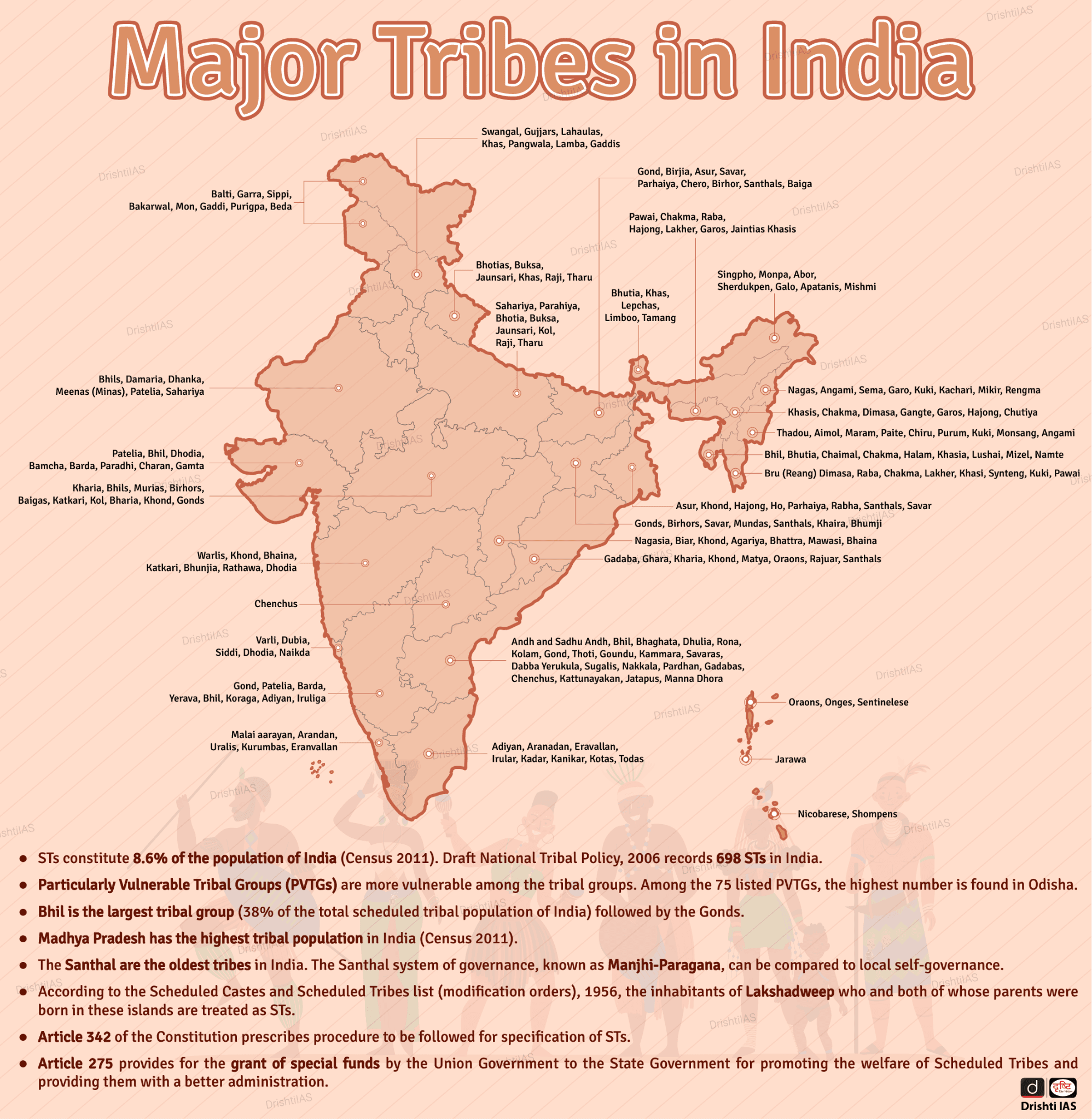
Tribal Village Vision 2030 Declaration; community-drafted development plan adopted via Special Gram Sabhas on 2 Oct 2025

Covers tribal villages/hamlets across India; aligns local priorities with Viksit Bharat@2047; overseen by Ministry of Tribal Affairs

Implemented through Adi Sewa Kendras, AI-driven Adi Vaani app, and convergence with flagship tribal schemes

Quick Facts for MCQs

Governance Architecture

  • Integration; Vision 2030 dovetails with PM-JANMAN, Dharti Aaba Janjatiya Gram Utkarsh Abhiyan 2.0 and other schemes
  • Institutional; Adi Sewa Kendras act as single-window tribal service hubs; villagers pledge 1-hour weekly seva
  • Tech-enabled; AI Adi Vaani provides real-time multilingual communication and progress tracking

Community Engagement

  • Diagnostics; Transect Walks, FGDs, Gap Analysis identify hamlet-level needs and resources
  • Goals; Locally set targets for education, health, livelihoods, financial inclusion, infrastructure up to 2030
  • Bottom-up; Special Gram Sabhas pass declarations ensuring customary participation and ownership

Key Dates

  • 15 Nov birth anniversary of Birsa Munda marks start/end of Janjatiya Gaurav Varsh
  • 17 Sep 2025 Adi Karmayogi Abhiyan launched on Vishwakarma Jayanti
  • 2 Oct 2025 mass Special Gram Sabhas convened on Gandhi Jayanti for Vision 2030 adoption

Key Data Points

FeatureData-Point
Vision Declaration adoption date2 Oct 2025
Celebratory yearJanjatiya Gaurav Varsh (15 Nov 2024–15 Nov 2025)
Leadership missionAdi Karmayogi Abhiyan
Abhiyan launch17 Sep 2025
Population targeted≈ 11.5 crore tribals
Geographic spread~1 lakh villages/tolas in 30 States & UTs
Tech platformAI-enabled Adi Vaani App

Related UPSC Prelims PYQs

CAPF_GAI, CDS_GK 2022PYQ 1

Which one of the following statements is not true with regard to tribal welfare?

CAPF_GAI, CDS_GK 2024PYQ 2

Which one among the following statements about the objectives of Vibrant Village Programme is correct?

GS-1Editorial

17.Unified National Employment Framework (Employment Policy)

The Hindu

What & Where

Unified National Employment Framework: proposed all-India policy merging skill, labour, trade actions for coordinated, measurable job creation.

Trigger: CII notes rising job–skill mismatch despite demographic dividend; seeks integrated response before workforce peaks 2043.

Scope: Nationwide; targets urban–rural balance, gender equity, formal, informal and gig sectors.

Quick Facts for MCQs

Demographic Trend

  • Youth surge; labour supply expanding until 2050 necessitating 12–15 million new jobs annually.
  • Urban migration and automation widen rural–urban employment gap.
  • Women’s participation stagnates despite higher education attainment.

Initiatives & Schemes

  • Skill India & PMKVY offer short-term, industry-linked training with certification.
  • National Career Service Portal digitally links seekers, employers, counsellors; promotes transparency.
  • Gig/Platform Worker Schemes extend social security, welfare to app-based workforce.

Key Challenges

  • Curriculum–industry disconnect yields high graduate unemployability.
  • Job growth clusters in metros, deepening regional inequality.
  • Fragmented, outdated labour statistics hinder evidence-based policy calibration.

Policy Prescriptions

  • Integrated National Employment Policy to federate central–state programmes under single monitoring dashboard.
  • MSME, gig focus: easier credit, digital tools, safety nets to spur job-rich sectors.
  • Re-orient skilling towards AI, robotics, green-tech; consider urban employment guarantee, women-centric incentives.

Key Data Points

FeatureData-Point
Workers India adds by 2050133 million
Share of global workforce (2050)≈18 %
Projected gig-economy jobs by 20309 crore
Female LFPR (PLFS 2024)<35 %
Workforce peak year2043
Skill India skilling target40 crore youth
Labour Codes merged laws29 acts
PLI incentive basisPerformance, sector-specific

Related UPSC Prelims PYQs

GEO_GS, GS1 2018PYQ 1

प्रधान मंत्री कौशल विकास योजना के संदर्भ में, निम्नलिखित कथनों पर विचार कीजिए:

GEO_GS, GS1 2026PYQ 2

With reference to distribution of employment in India for the year 2024-2025, consider the following statements:

Ready to practice?

Test your knowledge with our UPSC test series.

Start Free Trial