UPSC Current Affairs

11 topicsGS-1: 4GS-2: 2GS-3: 5
0/11 done
GS-3Economy

1.System of National Accounts 2025 (National Accounts)

LiveMint
Illustration for System of National Accounts 2025 (National Accounts)

What & Where

Global framework: System of National Accounts 2025, adopted by UN Statistical Commission to overhaul economic measurement.

Scope: Adds sustainability, inequality and unpaid household work to GDP-centric accounts, replacing SNA 2008.

Coverage: Applies worldwide; India aligning via EnviStats, Time-Use and labour-household surveys.

Quick Facts for MCQs

Environmental Impact

  • Natural capital: Minerals, coal, oil, gas depletion deducted from value added calculations.
  • Renewables: Solar, wind, hydro capitalised as wealth, boosting clean-energy balance sheets.
  • Sustainability: Green accounts justify channeling royalties into future-generation or climate funds.

Social Concerns

  • Inequality: Distributional accounts identify beneficiaries of growth, enabling sharper welfare targeting.
  • Gender equity: Time-Use Surveys monetise women’s unpaid care work for inclusion in GDP extensions.
  • Fairness metric: Growth now linked with household consumption and savings disparities.

Implementation Challenges

  • Data integration: PLFS, NSS, AIDIS microdata must be coherently merged with national aggregates.
  • Capacity gap: Centre-state statistical units require training, software and manpower for new modules.
  • Political economy: Resource-rich states may resist GSDP drop from depletion cost booking.

Key Data Points

FeatureData-Point
Adopting bodyUN Statistical Commission
ReplacesSNA 2008
Framework year2025
Natural capital treatmentResource depletion booked as production cost
Renewable energy statusSolar, wind, hydro recorded as assets
Distributional detailIncome, wealth, consumption by household groups
Unpaid work coverageHousehold & care labour included in extended accounts
India EnviStats start2018

Related UPSC Prelims PYQs

CAPF_GAI, ESE_GS 2020PYQ 1

Which one of the following is a measure of sustainable income level that can be secured without decreasing the stock of natural assets?

CAPF_GAI, ESE_GS 2024PYQ 2

हाल के वर्षों में, निम्नलिखित में से कौन-सा, भारतीय अर्थव्यवस्था में, अवरोही क्रम में, माँग का स्रोत रहा है?
GS-1History

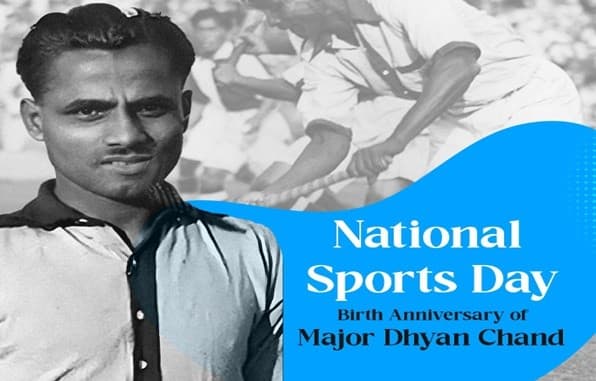
2.National Sports Day Observance (Major Dhyan Chand)

NOA
Illustration for National Sports Day Observance (Major Dhyan Chand)

What & Where

National Sports Day: annual national observance on 29 August across India

Marks birth anniversary of hockey legend Major Dhyan Chand

Celebrated through fitness drives and grassroots sporting events country-wide

Quick Facts for MCQs

Objectives

  • Promotion: encourage daily physical activity and mass sports participation
  • Integration: reinforce national unity, discipline, collective pride through sport
  • Youth Focus: drive grassroots engagement and talent identification

Athlete Profile

  • Skills: legendary ball control, prolific goal-scoring, sportsmanship earned title Hockey Wizard
  • Leadership: pivotal in India’s hat-trick of Olympic hockey golds 1928-36
  • Legacy: birthday institutionalised as National Sports Day symbolising excellence

Honours & Awards

  • Padma Bhushan 1956 recognises extraordinary sporting contribution
  • Khel Ratna renamed Major Dhyan Chand Khel Ratna in 2021 elevating his memory
  • National Sports Day functions often include athlete felicitation and award announcements

Key Data Points

FeatureData-Point
First official observance2012
Fixed date29 August
2025 ThemeEk Ghanta, Khel ke Maidan Main
Honoured sportspersonMajor Dhyan Chand
Olympic golds won3 (1928, 1932, 1936)
BirthplaceAllahabad (now Prayagraj)
National honour renamedMajor Dhyan Chand Khel Ratna, 2021
Civilian award receivedPadma Bhushan, 1956

Related UPSC Prelims PYQs

CDS_GK, ESE_GS 2022PYQ 1

Which one of the following is NOT correct regarding the Khel Ratna Award?

CDS_GK, ESE_GS 2025PYQ 2

Who among the following were awarded the Major Dhyan Chand Khel Ratna Award 2024?

GS-1History

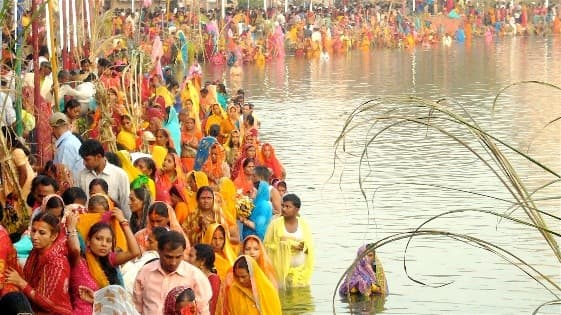
3.Chhath Sun Worship Festival (Sun Worship Festival)

Times of India
Illustration for Chhath Sun Worship Festival (Sun Worship Festival)

What & Where

Definition: 4-day Hindu Vedic Sun-worship festival honouring Surya & Chhathi Maiya

Timing: Celebrated twice yearly—Chaitra (Mar-Apr) & Kartika (Oct-Nov)

Geography: Core in Bihar, Jharkhand, East UP, Nepal; now spread to global diaspora

Quick Facts for MCQs

UNESCO Bid

  • Nomination: Bihar aims global recognition via UNESCO ICH Listing
  • Documentation: INTACH preparing heritage dossier, cultural mapping, audio-visual evidence
  • Precedent: Success would join Yoga, Kumbh Mela on India’s ICH roster

Ritual Sequence

  • Progression: Purification, fasting, sunset offering, sunrise completion ensure cyclical solar homage
  • Abstinence: No salt, onion, garlic; devotees often stand in water during Arghya
  • Community: Collective singing of Sohar, Kadwa Bhar, Banna-Banni folk songs

Cultural Significance

  • Gratitude: Prayer for prosperity, longevity, offspring wellbeing
  • Social-leveler: Participation cuts across caste, gender, economic lines
  • Diaspora: Celebrations now visible in Mauritius, Fiji, USA, UK parks & rivers

Ecological Aspect

  • Sustainability: Use of biodegradable leaf plates, seasonal local produce
  • Water-quality: Rituals historically promoted upkeep of ponds & river ghats
  • Solar reverence: Reinforces awareness of renewable energy centrality

Key Data Points

FeatureData-Point
Knowledge partnerINTACH nominated by Bihar Art & Culture Dept
UNESCO list soughtIntangible Cultural Heritage
Core deitiesSurya (Sun God) & Chhathi Maiya
Scriptural mentionRig Veda; Karna story in Mahabharata
Observance monthsChaitra & Kartika
Total duration4 consecutive days
Day 1 riteNahay Khay: ritual bath, single veg meal
Day 2 riteLohanda/Kharna: day-long fast, kheer–jaggery roti
Day 3 riteSandhya Arghya: offerings to setting sun
Day 4 riteUsha Arghya: dawn offerings to rising sun
Signature prasadThekua, Kasar, Kheer, seasonal fruits
Key venuesRiverbanks, ponds, water bodies
Austerity rule36-hour nirjala fast by many devotees
Ecological ethosEmphasis on clean water, minimal ritual waste

Related UPSC Prelims PYQs

GS1 2024PYQ 1

Which one of the following was the latest inclusion in the Intangible Cultural Heritage List of UNESCO?

GS-1Mapping

4.Japan Location and Geography (Island Nation)

NDTV

What & Where

Japan: East-Asian island nation in North Pacific, separated from China/Korea/Russia by Sea of Japan.

Archipelago: Four main islands—Honshu, Hokkaido, Kyushu, Shikoku—plus Ryukyu, Izu, Bonin, Volcano groups.

Ring-of-Fire location causes frequent earthquakes, tsunamis, volcanic activity.

Quick Facts for MCQs

Geography & Geology

  • Terrain: 80 % mountains; short, fast rivers feed fertile deltas like Kantō, Nōbi, Osaka.
  • Seismic: Situated on Pacific Plate edge; high earthquake, volcanic, tsunami risk.
  • Peak: Stratovolcano Mount Fuji iconically represents active geology.

Climate & Vegetation

  • Rainfall: Abundant, supporting dense temperate forests despite limited arable land.
  • Agriculture: Rice paddies dominate lowland plains; fruit orchards on terraced slopes.
  • Biodiversity: Mixed deciduous–coniferous forests across climatic gradients north–south.

Bilateral Summit

  • Objective: Strengthen India-Japan Special Strategic and Global Partnership.
  • Frequency: 15th Annual Summit continuing institutionalised high-level dialogue since 2006.
  • Significance: First in-person meeting between PMs Modi and Ishiba, focusing on Indo-Pacific cooperation.

Key Data Points

FeatureData-Point
CapitalTokyo
15th Annual Summit venueJapan
Indian counterpartPrime Minister of India
Japanese PM (2022)Shigeru Ishiba
Partnership termSpecial Strategic and Global Partnership
Highest peakMount Fuji – 3,776 m
Mountainous land share~80 %
Dominant oceans/seasPacific Ocean, Sea of Japan, East China Sea

Related UPSC Prelims PYQs

GEO_GS 2025PYQ 1

Which one of the following countries hosted the QUAD Leaders' Summit in 2024?

GS-3Environment

5.Rio Earth Summit 1992 (Rio Declaration)

Down to Earth
Illustration for Rio Earth Summit 1992 (Rio Declaration)

What & Where

UN Conference on Environment & Development (UNCED); Rio de Janeiro, Brazil; June 1992

First Earth Summit; 172 nations, 108 heads of state, 2,400+ NGOs deliberated environment-development link

Coined sustainable development paradigm and Common but Differentiated Responsibilities (CBDR) principle

Quick Facts for MCQs

Legal & Policy

  • Rio Declaration codified 27 voluntary principles shaping international environmental law
  • Agenda 21 offered 40 chapters of non-binding yet comprehensive sustainable development guidance
  • CBDR balanced historical emissions with development rights of Global South

Multilateral Instruments

  • Summit opened for signature UNFCCC, CBD, UNCCD creating binding frameworks post-1992
  • Basis for Kyoto Protocol 1997 and Paris Agreement 2015 under UNFCCC
  • Linked environment with trade, resource sovereignty, technology transfer mandates

Equity Dimension

  • Global South voice amplified via G77+China, led by India and Brazil
  • Equity focus placed greater responsibility on industrialised nations for finance and technology support
  • Sovereign rights over resources upheld while urging cooperation on biodiversity loss and desertification

Key Data Points

FeatureData-Point
Year1992
Official nameUN Conference on Environment & Development
VenueRio de Janeiro, Brazil
Participant nations172
Heads of state108
NGOs present>2,400
Guiding principleCommon but Differentiated Responsibilities
Flagship action planAgenda 21
Foundational declarationRio Declaration (27 principles)
Three new treatiesUNFCCC, CBD, UNCCD

Related UPSC Prelims PYQs

GEO_GS, GS1 2026PYQ 1

The United Nations Framework Convention on Climate Change (UNFCCC) was first signed during

GEO_GS, GS1 2010PYQ 2

The United Nations Framework Convention on Climate Change (UNFCCC) is an international treaty drawn at

GS-3SpeciesQuick Bite

6.Vaquita Porpoise Conservation Status (Endangered Cetacean)

Down to Earth
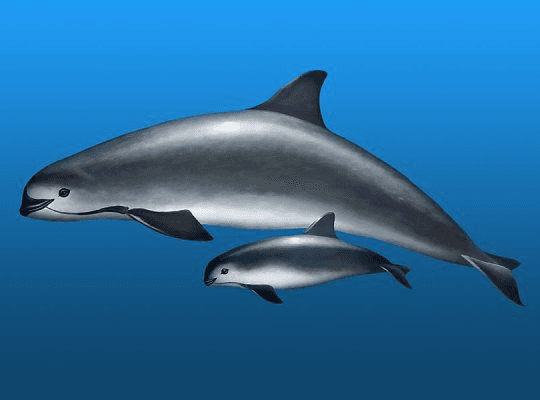
Illustration for Vaquita Porpoise Conservation Status (Endangered Cetacean)

What & Where

Vaquita (Phocoena sinus) — world’s smallest cetacean, one of seven porpoise species, distant dolphin relative.

Endemic to northern Gulf of California, Mexico; prefers shallow coastal waters ≤ 50 m deep.

Sole warm-water porpoise; oversized dorsal fin aids body-heat dissipation.

Quick Facts for MCQs

Biological Traits

  • Smallest cetacean; dark eye patch and large dorsal fin characteristic.
  • Shy, elusive behaviour reduces direct observational data.

Habitat & Range

  • Endemic distribution limits resilience to localised pressures.
  • Occupies turbid, shallow lagoons and estuarine zones ≤ 50 m depth.

Threats & Causes

  • Gill-nets for totoaba induce lethal entanglement; primary mortality driver.
  • Illegal swim-bladder trade escalates unregulated fishing effort.

Legal & Policy

  • IUCN Critically Endangered; CITES Appendix I bans commercial trade.
  • CEC urges immediate enforcement of gill-net bans and habitat protection.

Key Data Points

FeatureData-Point
Spanish meaning“Little cow”
FamilyCetacea (porpoises)
IUCN statusCritically Endangered
CITES listingAppendix I
Key threatGill-net by-catch during totoaba fishing
Distinct markDark ring around eyes
Typical depthUp to 50 m
Core rangeNorthern Gulf of California (Sea of Cortez)
BehaviourShy; avoids boats
Oversight alert2022 CEC report
GS-3S&T

7.Samudrayaan Deep-Sea Mission (Deep Ocean Mission)

Indian Express
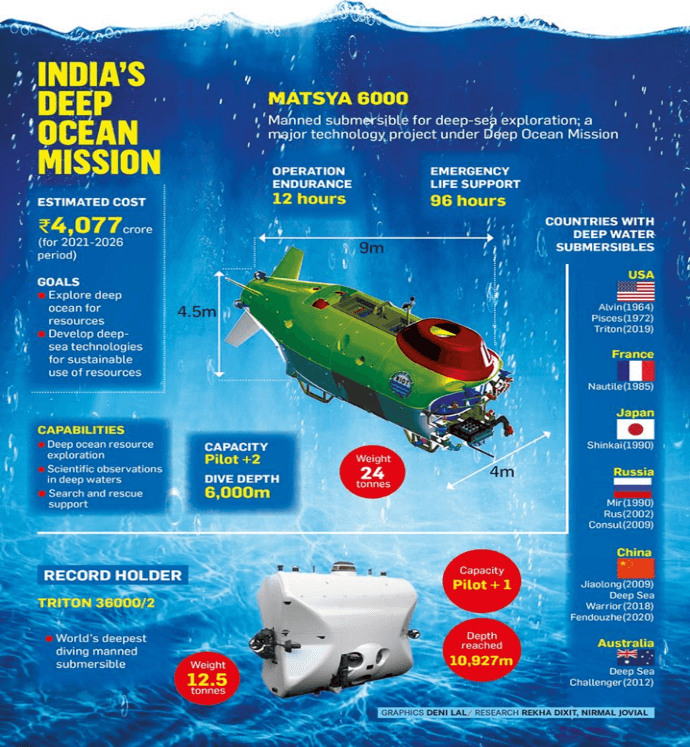
Illustration for Samudrayaan Deep-Sea Mission (Deep Ocean Mission)

What & Where

Samudrayaan Project: India’s first crewed deep-sea mission under Deep Ocean Mission (DOM), approved 2021.

Target zone: up to 6,000 m depth in Indian & Central Indian Ocean Basin.

Purpose: resource survey, biodiversity study, climate‐ocean research.

Quick Facts for MCQs

Tech & Schemes

  • Matsya-6000 design resembles fish; built jointly by NIOT, ISRO, DRDO, L&T.
  • DOM umbrella: six components inc. deep-sea tech, climate, resources, biodiversity.
  • Acoustic comms & robotics indigenously developed to cut foreign dependence.

Economic Angle

  • Polymetallic nodules rich in Mn, Co, Ni, REEs targeted for future strategic metals supply.
  • Blue Economy Policy aligns mission output with ports, fisheries, renewable energy sectors.
  • Deep-sea tech capability expected to open commercial subsea mining services export.

Environmental Impact

  • Mission mandates baseline ecology mapping to minimise disturbance of fragile benthic ecosystems.
  • Data fed into ocean climate advisory models for monsoon & carbon-cycle projections.
  • Findings to guide sustainable extraction norms under UNCLOS & ISA rules.

International Examples

  • Two Indian aquanauts trained to 5,000 m in Atlantic aboard IFREMER’s Nautile (France).
  • India joins elite group with crewed subs >6 km: USA, France, Russia, China, Japan.

Key Data Points

FeatureData-Point
Union Cabinet approval2021
Five-year outlay₹4,077 crore
Crewed submersibleMatsya-6000
Crew capacity3 aquanauts
Normal/Emergency endurance12 h / 96 h
Max depth rating6,000 m (≈600 bar)
Personnel sphere2.1 m, 80 mm titanium, electron-beam welded
Life-supportOxygen scrubbers & re-breather
Comms systemIndigenous acoustic telephone
Nodal agencyNIOT, Chennai
Mining rights areaCentral Indian Ocean Basin (ISA license)
Training dive craftFrench submersible Nautile

Related UPSC Prelims PYQs

CDS_GK, NDA_GAT 2024PYQ 1

Consider the following statements about INS Sagardhwani:

CDS_GK, NDA_GAT 2024PYQ 2

Which of the following statements is not correct?

GS-3S&TQuick Bite

8.UN Global AI Governance Initiative (AI Governance)

Down to Earth

What & Where

Platform – Global Dialogue on AI Governance; UNGA-created forum for state–stakeholder deliberations on AI.

Panel – Independent International Scientific Panel on AI; UN bridge giving evidence-based guidance for global AI regulation.

Venues – Annual panel reports to be tabled at Geneva 2026 and New York 2027 sessions.

Quick Facts for MCQs

UN Initiatives

  • Inclusivity – Dialogue offers multistakeholder UN platform on AI governance questions.
  • Science-policy link – Panel supplies evidence to Dialogue, shaping global regulatory norms.

Indian Frameworks

  • Regulation – Cybercrimes, intermediary liability handled under IT Act 2000; privacy via DPDP Act 2023.
  • Guidance – National Strategy 2018 targets health, agri, education, smart cities, mobility sectors.
  • Ethics – 2021 Responsible AI principles stress safety, accountability, transparency.

Global Engagements

  • Summit – India hosted GPAI Summit 2023, spotlighting democratic AI collaborations.
  • Leadership – Co-chaired AI Action Summit with France in 2025.
  • Forthcoming – India to host AI Impact Summit 2026.

Key Data Points

FeatureData-Point
Launching bodyUnited Nations General Assembly
Two new UN armsGlobal Dialogue on AI Governance; Independent International Scientific Panel on AI
Panel’s core taskRigorous, independent scientific assessments for policymakers
Report presentation years2026 and 2027
2026 report cityGeneva
2027 report cityNew York
India’s dedicated AI lawNone (regulated via existing statutes)
Key Indian statutesIT Act 2000; Digital Personal Data Protection Act 2023; IPR laws
National Strategy on AINITI Aayog, 2018
Principles for Responsible AINITI Aayog, 2021

Related UPSC Prelims PYQs

GEO_GS, GS1 2024PYQ 1

Which of the following statements about GPAI (Global Partnership on Artificial Intelligence) is/are correct?

GEO_GS, GS1 2025PYQ 2

ग्रैण्ड पैलै (Grand Palais) पेरिस में नवम्बर 2025 में आयोजित होने वाले AI शिखर सम्मेलन के सन्दर्भ में, निम्नलिखित कथनों पर विचार कीजिए :

GS-2MiscQuick Bite

9.UN Gaza Famine Declaration (Famine Declaration)

The Hindu

What & Where

Famine = IPC Phase-5 condition of starvation, acute malnutrition, high daily mortality

UN declared Phase-5 famine in Gaza Strip, first recorded in West Asia

Gaza Strip coastal enclave 41 km × 10 km, bordering Israel, Egypt, Mediterranean

Quick Facts for MCQs

Humanitarian Crisis

  • Malnutrition already crosses IPC emergency thresholds among children
  • Massive displacement aggravates access to clean water, sanitation, health care
  • UN and NGOs face restricted entry routes limiting aid volume

Conflict Driver

  • Escalated Israel-Hamas hostilities destroyed farms, markets, supply chains
  • Commercial food imports curtailed by border closures and naval blockade
  • Security checks delay perishable aid, worsening scarcity

Geographical Context

  • Densely populated enclave among world’s highest population densities
  • Mediterranean frontage offers limited fishing due to naval restrictions
  • Proximity to Sinai makes Rafah crossing vital humanitarian chokepoint

Key Data Points

FeatureData-Point
IPC highest levelPhase 5
Household food-gap cutoff≥20 % households starved
Under-5 acute malnutrition≥30 % children
Daily crude death rate≥2 per 10,000 people
People in extreme hunger>5 lakh
Year of UN declaration2025
Gaza land length~41 km
Gaza land width~10 km
BordersIsrael, Egypt, Mediterranean
Regional firstWest Asia’s first famine
Main triggerIsrael-Hamas conflict & supply blockade

Related UPSC Prelims PYQs

GEO_GS 2022PYQ 1

The United Nations has recently warned that 'famine-like conditions have been created by climate change' in which one of the following countries?

GS-2Scheme

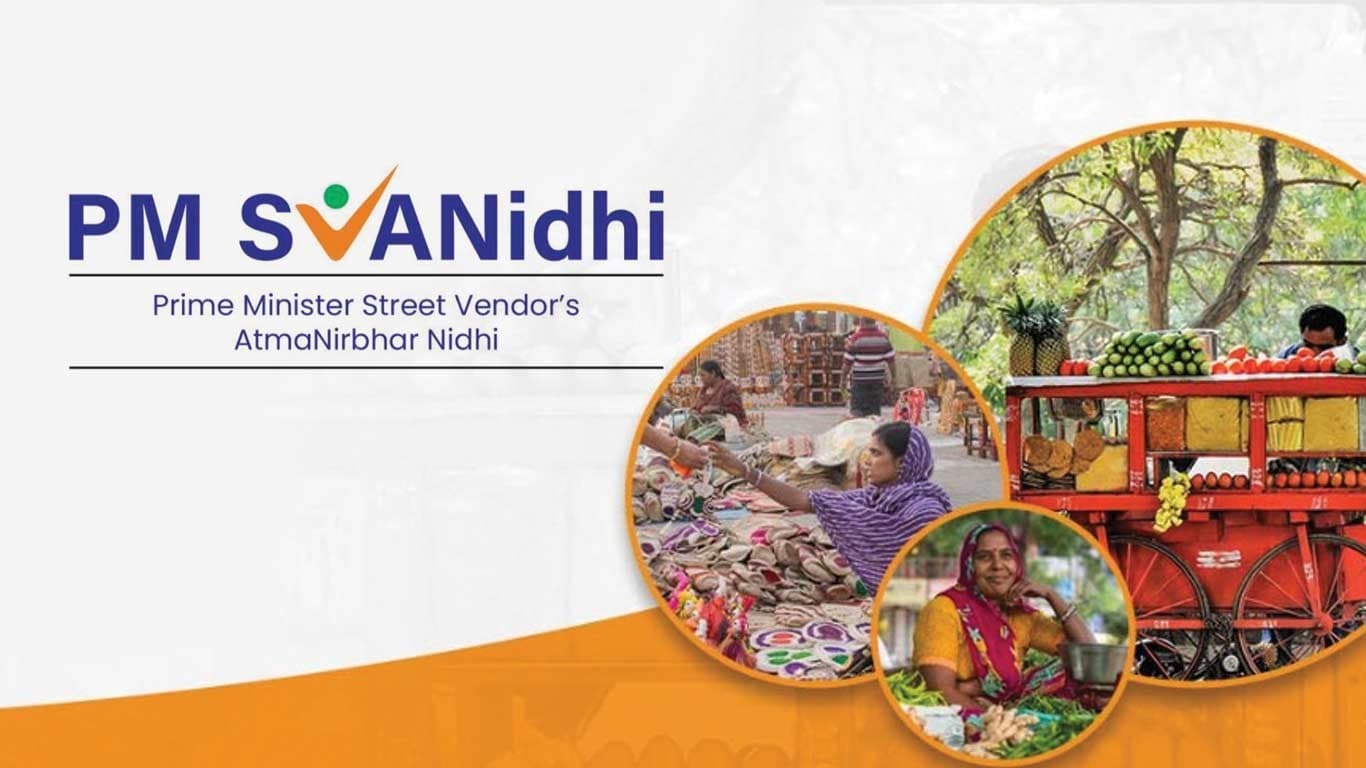
10.PM SVANidhi Micro-Credit Scheme (Street Vendor Loan)

NOA
Illustration for PM SVANidhi Micro-Credit Scheme (Street Vendor Loan)

What & Where

Micro-credit PM Street Vendor’s Atma Nirbhar Nidhi provides collateral-free working-capital to urban street vendors.

Implemented nationwide by MoHUA through States, Urban Local Bodies & partner lenders.

Operational in statutory, census and peri-urban towns across India.

Quick Facts for MCQs

Scheme Design

  • Collateral-free, escalating tranches nurture credit discipline and formal financial footprints.
  • Digital payment push embedded via cashback and UPI integration.
  • Centre–State–ULB–lender convergence ensures on-ground outreach.

2025 Restructuring

  • Cabinet extends lending window to FY 2030 for sustained post-pandemic recovery.
  • Tranche limits raised to ₹15k & ₹25k; ₹50k top-tier unchanged.
  • Coverage widened to census towns and peri-urban areas.

Financial Incentives

  • 7 % interest subsidy reduces effective rate for timely payers.
  • Annual digital cashback up to ₹1,600 rewards electronic transactions.
  • UPI-linked RuPay credit card offers revolving credit after successful 2nd repayment.

Key Data Points

FeatureData-Point
Launch date1 June 2020
Nodal ministryHousing & Urban Affairs
Lending windowUp to 31 Mar 2030
Earlier cutoff31 Dec 2024
1st tranche loan₹15,000
2nd tranche loan₹25,000
3rd tranche loan₹50,000
Interest subsidy7 % p.a.
Digital cashbackMax ₹1,600 per year
Beneficiary target1.15 crore vendors
Credit card linkUPI-RuPay post-2nd tranche

Related UPSC Prelims PYQs

CAPF_GAI 2024PYQ 1

Which of the following statements is NOT correct for Pradhan Mantri Mudra Yojana (PMMY)?

GS-1Editorial

11.India Demographic Dividend Challenge (Demographic Dividend)

The Hindu

What & Where

Demographic dividend: economic growth potential from larger working-age share than dependents

India: world’s largest youth cohort; dividend window open roughly 2020-2045

Realisation locale: labour-intensive exports, services, global ageing markets needing workforce

Quick Facts for MCQs

Economic Angle

  • GDP-boost: closing gender gap may lift GDP 27 %
  • Export-edge: textiles, leather, gems rely on youthful manpower for cost competitiveness
  • Opportunity-window: dividend could add 2 % annual growth if utilised before 2045

Skill Gap

  • Job-ready: Graduate Skills Index 2025 shows only 43 % graduates employable
  • Mismatch: 40–50 % engineering graduates unemployed due to outdated curricula, poor industry linkage
  • Automation-threat: McKinsey projects 70 % Indian jobs susceptible to AI by 2030

Social Concerns

  • Unrest-risk: jobless youth may repeat 1990 Mandal-style agitations
  • Brain-drain: skilled youth migration weakens domestic innovation capacity
  • Poverty-link: productive employment critical for social mobility and inclusive growth

Tech & Schemes

  • Curriculum-revamp: embed AI, digital literacy, critical thinking across schooling
  • Skilling-framework: unified plan aligning education, skills, industry incentives
  • State-models: Karnataka Shakti Yojana free bus travel for women; Rajasthan Urban Employment Guarantee urban wage safety net

Key Data Points

FeatureData-Point
Youth population (<35 yrs)~800 million
Demographic window2020–2045 (≈25 yrs)
Graduate employability43 % job-ready
Engineering unemployment40–50 %
AI job risk by 203070 % roles
Female LFPR37–41.7 %
GDP gain via gender parity+27 % (IMF)
Career awareness gap93 % pupils know only 7 careers

Related UPSC Prelims PYQs

GS1 2013PYQ 1

To obtain full benefits of demographic dividend, what should India do?

GS1 2011PYQ 2

India is regarded as a country with “Demographic Dividend”. This is due to

Ready to practice?

Test your knowledge with our UPSC test series.

Start Free Trial