UPSC Current Affairs

15 topicsGS-1: 2GS-2: 5GS-3: 8
0/15 done
GS-2Editorial

1.Reforming India’s Justice Delivery (Judicial Reforms)

The Hindu

What & Where

Judicial pendency = backlog of unresolved cases in courts

Spread across Supreme Court, 25 High Courts & ~25,600 District/Subordinate courts

Relief routes: regular litigation, ADR (mediation/conciliation/arbitration) & e-Courts digital process

Quick Facts for MCQs

Statistics & Trends

  • Backlog concentrates at district tier; civil matters lag far behind criminal
  • Rising PILs & legal awareness balloon annual filings
  • CJI notes bail-grant “fear psychosis” choking lower courts

Structural Gaps

  • Infrastructure shortfall: courtrooms, staffing, ICT, case-management tools
  • Adjournment culture; Delhi HC sample: 70 % cases got > 3 adjournments
  • ADR uptake low; no unified performance data yet

Reform Measures

  • e-Courts, FASTER, virtual hearings drive paperless, time-bound processes
  • Proposed National Judicial Infrastructure Authority to standardise facilities
  • Mediation Act 2023, scaled Lok Adalats, Tele-Law & Pro-Bono aimed at decongestion

Key Data Points

FeatureData-Point
Total pending cases (mid-2025)5 crore +
District-court share90 % ≈ 4.6 crore
High-Court pendency63.3 lakh +
Supreme Court pendency86,700 +
Judge–population ratio15 / 10 lakh
1987 Law Commission target50 / 10 lakh
HC criminal disposal ≤ 1 yr85.3 %
District civil disposal ≤ 1 yr38.7 %
Civil backlog > 5 yrs~20 %
Govt share in total cases~50 %
Women judges: lower courts38 %
Women judges: High Courts14 %
Lok Adalat cases settled ’21-2527.5 crore
SC judge appointments ’14-2462
HC judge appointments ’14-24976
GS-3Editorial

2.Strengthening ESG Oversight in India (ESG Regulation)

The Hindu

What & Where

ESG standards: evaluate corporate Environmental, Social, Governance performance.

India plan: Parliamentary finance panel urges MCA to set up dedicated ESG oversight body.

Greenwashing: firms’ false or overstated eco-claims to lure sustainability-minded consumers.

Quick Facts for MCQs

Legal & Policy

  • Amendment push: embed ESG in corporate objectives, enforceable under Companies Act 2013.
  • Committee seeks sector-specific ESG guidelines plus MSME assistance.
  • Calls to tighten CSR oversight for transparency & impact.

Regulatory Gaps

  • Dispersed ESG rules across multiple laws, no unified compliance framework.
  • Voluntary Eco-Mark and weak plastic rules enable unchecked “eco-friendly” labelling.
  • Lack of stiff penalties reduces deterrence against greenwashing.

Reporting & Disclosure

  • BRSR aligns with GRI & SASB global standards, covers environmental, social, governance metrics.
  • Oversight body to include forensic experts to audit ESG claims, deter fraud.
  • Early-warning mechanisms advocated to curb financial crimes linked to ESG misreporting.

Key Data Points

FeatureData-Point
Standing CommitteeFinance (Lok Sabha)
Proposed host ministryCorporate Affairs (MCA)
SEBI mandateBRSR for top 1,000 listed companies
2024 extreme-weather days (CSE)322 / 366
Suggested statute changeAmend Companies Act 2013 to make ESG directors’ duty
Key fraud agenciesSFIO & NFRA (to be strengthened)
Eco-label statusBIS Eco-Mark voluntary, low uptake
Core penalty askStricter, faster fines for false ESG claims
Main consumer watchdogCCPA under Consumer Protection Act 2019

Related UPSC Prelims PYQs

ESE_GS, GS1 2024PYQ 1

To increase transparency and consumer awareness and handle customer complaints, a 'Centralised Receipt and Processing Centre' and an 'Integrated Ombudsman Scheme' have been set up. These two schemes are related to which one of the following institutions?

ESE_GS, GS1 2025PYQ 2

Consider the following statements:

GS-1History

3.Kakori Conspiracy Train Robbery (Freedom Movement)

DD News

What & Where

Event Kakori Train Robbery armed seizure of colonial treasury from 8-Down train on 9 Aug 1925

Group Hindustan Republican Association cadres led daring action to fund revolutionary movement against British rule

Location Near Kakori railway station between Saharanpur and Lucknow in present Uttar Pradesh

Quick Facts for MCQs

Key Personalities

  • Martyrs Ram Prasad Bismil Ashfaqulla Khan Rajendra Lahiri Roshan Singh executed December 1927
  • Escaper Chandrashekhar Azad evaded arrest continued armed struggle till encounter at Alfred Park 1931
  • Chronicler Manmathnath Gupta later authored detailed account aiding historiography

British Response

  • Crackdown Over 40 arrests nationwide swift conviction under Kakori Conspiracy Case
  • Sentences Four death penalties multiple life transportations reflecting harsh colonial justice
  • PublicOutcry Nationwide meetings petitions including Congress demanding commutation highlighting unity across communities

Organisational Evolution

  • Weakening HRA restructured 1928 under Bhagat Singh Sukhdev Shiv Verma
  • Ideology Shift from nationalist militancy to revolutionary socialism inspired by Russian examples
  • Renaming Hindustan Socialist Republican Association declared objectives complete independence workers peasant rights

Key Data Points

FeatureData-Point
Date of raid9 August 1925
Train targeted8-Down passenger Saharanpur–Lucknow
Station vicinityKakori, Uttar Pradesh
OrganisationHindustan Republican Association (HRA)
Seized itemBritish government treasury cash boxes
Executed leadersBismil, Ashfaqulla, Lahiri, Roshan Singh (Dec 1927)
Escaped leaderChandrashekhar Azad
Court case nameKakori Conspiracy Case
Reorganisation year1928
New nameHindustan Socialist Republican Association (HSRA)

Related UPSC Prelims PYQs

GS1 1997PYQ 1

Match List I with List II and select the correct answer by using the codes given below the lists:

GS-1Mapping

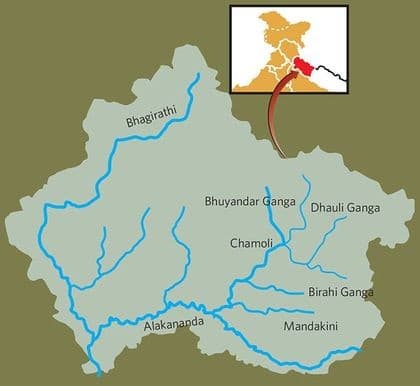
4.Bhagirathi River Course and Tributaries (River Mapping)

Times of India
Illustration for Bhagirathi River Course and Tributaries (River Mapping)

What & Where

Headstream; Himalayan tributary of Ganga, mythologically brought to earth by King Bhagiratha

Origin; emerges from Gaumukh Glacier (3,892 m), flows through Gangotri–Tehri corridor in Uttarakhand

Course change; 2024 Dharali flash flood diverted Bhagirathi, reactivated Kheer Gad’s old channel

Quick Facts for MCQs

Hydrology & Morphology

  • High sediment load causes frequent channel shifts, landslide-induced damming
  • Tributary Bhilangna lengthens catchment, enhances discharge at Tehri reservoir
  • ISRO imagery mapped post-flood course alteration near Dharali

Cultural & Mythological

  • Revered in Hindu texts; Bhagiratha’s penance legend associates river with salvation
  • Ritual bathing points at Gangotri, Uttarkashi, Devprayag attract pilgrims
  • Mentioned in Ramayana, Puranas reinforcing its sacred status

Environmental Sensitivity

  • Glacier-fed river vulnerable to climate-driven meltwater surges, GLOFs, flash floods
  • Catchment lies in active Himalayan seismic belt, heightening landslide frequency
  • Ecologically fragile zone restricts large-scale development under existing regulations

Strategic Infrastructure

  • Tehri Dam provides 1,000 MW hydro, irrigation, drinking water to Delhi, UP
  • NH-34 & Chardham road follow valley, raising slope destabilisation risk
  • Disaster impact affects hydropower production, road connectivity for troops near LAC

Key Data Points

FeatureData-Point
Origin glacierGaumukh (Gangotri) Glacier
Source elevation3,892 m
Primary stateUttarakhand
Major townsGangotri, Harsil, Uttarkashi, Tehri, Devprayag
JoinsAlaknanda at Devprayag
Name after confluenceRiver Ganga
Key damTehri Dam (≈1,000 MW)
Major tributariesKedar, Jadh, Kakora, Jalandhari, Siyan, Asi, Bhilangna
Hydrological noteAlaknanda longer & higher discharge
Recent eventDharali flash flood; Kheer Gad returned to old course

Related UPSC Prelims PYQs

GEO_GS, GS1 2008PYQ 1

On which one of the following rivers is the Tehri Hydropower Complex located?

GEO_GS, GS1 2023PYQ 2

The Kumaon Himalayas lie between

GS-3Editorial

5.India’s Groundwater Contamination Crisis (Groundwater Pollution)

The Hindu

What & Where

Groundwater contamination: toxic chemicals, heavy metals, pathogens accumulating in aquifers used for Indian drinking & irrigation

Main sources: industrial effluents, excessive agro-chemical leaching, geogenic arsenic-fluoride mobilised by over-pumping

Hotspots: Indo-Gangetic plains, Malwa-Punjab belt, Kanpur-Vapi industrial clusters, Rajasthan fluoride zone

Quick Facts for MCQs

Causes

  • Industrial effluents release lead, cadmium, chromium, mercury unchecked
  • High fertiliser nitrogen drives nitrate surge; phosphate fertiliser mobilises uranium
  • Septic leakage and over-pumping concentrate geogenic fluoride, arsenic, salinity

Health Impact

  • Fluorosis skeletal deformities rampant in Rajasthan, MP, UP
  • Arsenic up to 200 µg/L linked cancers in Bihar, UP
  • Blue-baby syndrome rising with nitrate >45 mg/L in Punjab, Haryana, Karnataka

Institutions

  • CGWA created 1997 under Environment Act regulates extraction yet lacks statutory teeth
  • CGWB under Jal Shakti maps and monitors aquifers, issued 2024 report
  • SPCBs & CPCB enforce Water Act 1974 but remain under-resourced, coordination weak

Reforms & Schemes

  • Proposal for National Groundwater Pollution Control Framework granting CGWB enforcement powers
  • Atal Bhujal Yojana & Jal Jeevan Mission expand community monitoring, CWPPs, piped safe water
  • Zero Liquid Discharge mandate plus PKVY organic farming aim to curb industrial and agrochemical loads

Key Data Points

FeatureData-Point
Report year2024 Annual Groundwater Quality Report
Assessing agencyCentral Ground Water Board
Indians dependent on groundwater>600 million
WHO fluoride limit1.5 mg/L
WHO arsenic limit10 µg/L
WHO nitrate limit45 mg/L
Malwa samples over uranium limit66 %
Fluorosis affected population~66 million

Related UPSC Prelims PYQs

GS1 2020PYQ 1

Consider the following statements:

GS1 2013PYQ 2

Which of the following can be found as pollutants in the drinking water in some parts of India?

GS-3Environment

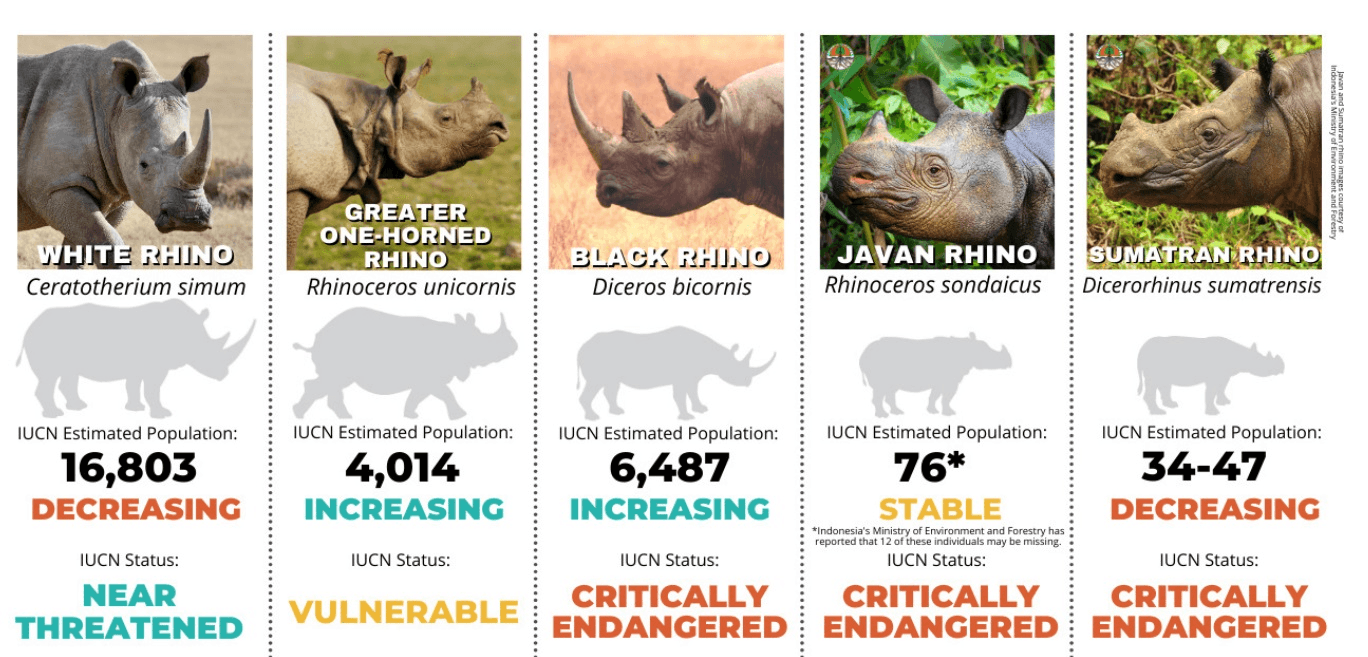
6.Rhisotope Project Radioisotope Rhino Protection (Rhino Conservation)

The Hindu
Illustration for Rhisotope Project Radioisotope Rhino Protection (Rhino Conservation)

What & Where

Rhisotope Project – 2021 South Africa initiative inserting measured radioisotope chips into live rhinoceros horns.

Process: rhino sedated; two tiny radioactive inserts render horn toxic and scanner-visible for ≈ 5 years.

Geography: Piloted in South African reserves; objective is detection at international border posts worldwide.

Quick Facts for MCQs

Tech & Schemes

  • Radioisotopes: detectable by standard cargo radiation portals, boosting interception probability.
  • Durability: single insertion cheaper than repeated dehorning, improving conservation budgets.
  • Toxicity: treated horn unfit for traditional medicine, aiming to collapse end-user demand.

Legal & Policy

  • Anti-terrorism laws can prosecute smugglers carrying radioactive horns, raising sentence severity.
  • CITES Appendix I already bans rhino horn trade; isotope tagging strengthens enforcement.
  • India parallels: Wildlife (Protection) Act 1972, Environment Act 1986, Biodiversity Act 2002 noted.

Conservation Statistics

  • Poaching spike: 499 kills despite conventional measures, underscoring need for novel deterrents.
  • Previous tactics: dehorning and chemical poisoning failed to halt illegal hunting.
  • Economic driver: high horn value sustains organised transnational crime networks.

Key Data Points

FeatureData-Point
Host countrySouth Africa
Launch year2021
Radio-chip per horn2 units
Isotope effective life~5 years
Dehorning cycle savedEvery 18 months
Rhinos poached 2023 (SA)499 animals
Year-on-year poaching rise11 % over 2022
Black-market horn priceComparable to gold/cocaine
Animal safety statusSub-clinical radiation dose
GS-3Species

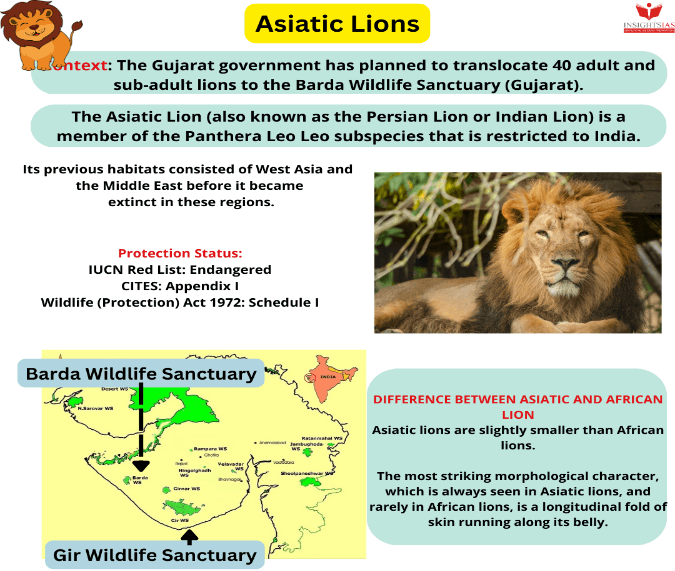
7.Asiatic Lion 16th Census Findings (Wildlife Census)

NDTV
Illustration for Asiatic Lion 16th Census Findings (Wildlife Census)

What & Where

Periodic census of Asiatic lion Panthera leo persica under Project Lion

Executed by Gujarat Forest Department with MoEFCC support

Core range Saurashtra (Gir landscape) with expanding satellite habitats

Quick Facts for MCQs

Population Dynamics

  • Growth 2020-25 +217; adult females up 70 enhancing breeding base
  • Cubs 79 logged in Amreli indicating healthy recruitment
  • Corridor lions 22 signal natural dispersal and gene flow

Regional Spread

  • Satellite sites nine: Barda WLS, Jetpur, Babra-Jasdan among others
  • Highest numbers Amreli 82 adult males, 117 females, 79 cubs
  • Declines in Girnar −4 % and Bhavnagar Coast −12 %

Conservation Significance

  • Keystone predator sustaining grassland–scrubland ecological balance
  • Only wild Asiatic lion population worldwide; cultural emblem of Gujarat
  • Decadal rise 70.36 % marks notable conservation success

Schemes & Agencies

  • Project Lion funds habitat, prey, disease surveillance measures
  • Census employed 3 000+ staff, PIP camera traps, GPS tracking
  • MoEFCC oversight aligns with Wildlife Protection Act mandates

Key Data Points

FeatureData-Point
Report edition16th (year 2025)
Total lions891
Growth since 202032.2 %
Decadal growth70.36 %
Adult females330
Female rise26.9 %
Satellite lions497 in 9 sites
Corridor lions22 first-time record
Top districtAmreli
Highest growth siteMitiyala WLS (+100 %)
Population decline siteGirnar WLS (−4 %)
Range expansion decade~60 %

Related UPSC Prelims PYQs

GS1 1999PYQ 1

"India has the largest population of the Asian X. Today, there are just about 20,000 to 25,000 X in their natural habitat spreading across the evergreen forests, dry thorn forests, swamps and grasslands. Their prime habitats are, however, the moist deciduous forests. The X population in India ranges from Northwest India where they are found in the forest divisions of Dehradun, Bijnor and Nainital districts of UP to the Western Ghats in the states of Karnataka and Kerala and in Tamil Nadu. In Cen

GS1 2017PYQ 2

Recently there was a proposal to translocate some of the lions from their natural habitat in Gujarat to which one of the following sites?

GS-3Editorial

8.AI Reshapes India’s IT Sector (AI Adoption)

The Hindu

What & Where

Restructuring: Indian IT services shifting to AI-first, outcome-based delivery models

Core processes: generative AI, low-code platforms, automation replacing routine coding, testing, maintenance

Geography: Predominantly India, serving global clients modernising legacy systems

Quick Facts for MCQs

Economic Angle

  • Productivity: AI accelerates coding, debugging, testing, trimming delivery timelines
  • Margins: Automation cuts operational costs, aligning with investor pressure for higher profitability
  • Client demand: Global firms seek modernisation, data cleansing, regulatory compliance support

Workforce Impact

  • Displacement: Routine coding, maintenance, back-office roles most vulnerable to automation
  • Reskilling: Mass training in AI, ML, data governance essential for retention
  • Cultural shift: Move from billable hours to IP-led value creation meets resistance

Policy & Schemes

  • National AI Mission: Funding research, compute infrastructure, workforce development
  • Digital India: Strengthening data privacy, responsible AI frameworks
  • Startup incentives: Tax breaks, funding, IP support for deep-tech ventures

Key Data Points

FeatureData-Point
Productivity gain>30 % faster software development with AI tools
Emerging modelAI-driven, high-value, outcome-linked services
Traditional modelManpower-heavy, billable-hour outsourcing
Workforce riskMid-level routine roles face automation
Skill gapAcute shortage of AI-skilled professionals
Government missionNational AI Mission for research, infra, skilling
TCS actionHiring freeze and selective job cuts toward AI focus

Related UPSC Prelims PYQs

GS1 2025PYQ 1

विश्व बैंक ने यह चेतावनी दी है कि भारत वह पहला देश बन सकता है जहाँ आर्टिफ़िशियल इंटेलिजेंस-आधारित ऑटोमेशन (डेटा-ड्रिवन ऑटोमेशन) के कारण 35% से अधिक नौकरियाँ प्रभावित होंगी। निम्नलिखित कथनों पर विचार कीजिए:

GS1 2020PYQ 2

विकास की वर्तमान स्थिति में, कृत्रिम बुद्धिमत्ता (Artificial Intelligence), निम्नलिखित में से किस कार्य को प्रभावी रूप से कर सकती है?

GS-3S&T

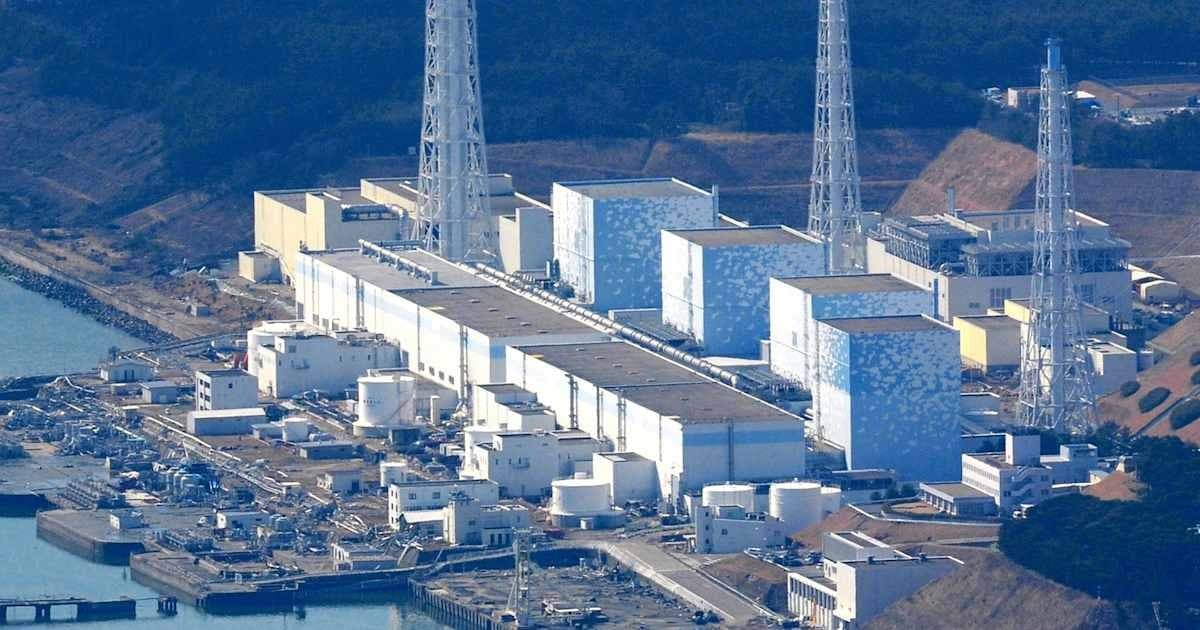
9.Tritium Properties and Fukushima Discharge (Radioactive Isotope)

The Hindu
Illustration for Tritium Properties and Fukushima Discharge (Radioactive Isotope)

What & Where

Tritium-laden wastewater from Fukushima Daiichi NPP, Ōkuma town, eastern Pacific coast of Japan

Tritium (³H) radioactive hydrogen isotope naturally and reactor-produced, mainly exists as tritiated water HTO

Global ocean-model study finds discharge meets safety limits, negligible radiological risk beyond plant vicinity

Quick Facts for MCQs

Environmental Impact

  • Dilution factor sharp; tritium concentration predicted orders of magnitude below WHO drinking-water limit outside 3 km
  • Beta radiation absorbed within water column; minimal bioaccumulation expected in marine life
  • International Atomic Energy Agency review endorses TEPCO monitoring protocols

Health Aspect

  • Internal exposure large doses may elevate cancer risk; planned release keeps public dose <0.03 µSv yr–¹ vs 1000 µSv limit
  • External exposure insignificant; beta particles stopped by epidermis or few mm of air
  • Tritium in organic form rarer; biological half-life roughly 10 days in humans

Tech & Schemes

  • ALPS filtration employs multiple sorbents and ion-exchange to cut 62 radionuclides below detection
  • Storage tanks capacity nearing limit; controlled ocean release chosen over vapor dispersion due to lower atmospheric routing
  • Continuous seawater samplers and satellite data feed real-time dashboards for regulators and fishing cooperatives

Key Data Points

FeatureData-Point
Tritium nucleus1 proton + 2 neutrons
Tritium half-life32 years
Radiation typeLow-energy β, cannot penetrate skin
Main hazard modeInhalation / ingestion only
Natural productionCosmic-ray spallation in upper atmosphere
Artificial productionLithium irradiation, reactor fission by-product
Fukushima reactors6 Boiling Water Reactors
Accident trigger2011 Tōhoku earthquake & tsunami
Waste treatmentALPS system removes radionuclides except tritium
Discharge plan≤30 years, below safety thresholds
Study resultOcean dilution renders risk negligible
GS-3S&T

10.Animal Stem Cell Biobank Hyderabad (Animal Biotechnology)

PIB

What & Where

Animal Stem Cell Biobank: preserves and studies livestock stem cells for regenerative medicine, disease modelling, reproductive biotechnology.

Key processes: stem-cell culture, 3-D bioprinting, tissue engineering, cryostorage for long-term viability.

Geography: Inside National Institute of Animal Biotechnology (NIAB), Hyderabad, Telangana.

Quick Facts for MCQs

Tech & Schemes

  • National Biopharma Mission funding channels through BIRAC for cutting-edge lab infrastructure.
  • 3-D bioprinter enables customised tissue scaffolds accelerating livestock regenerative studies.
  • Modern air-handling units plus UPS safeguard sterile conditions and sample integrity.

Agricultural Impact

  • Cell-based therapies aim to boost livestock productivity, raising farmer incomes.
  • Supports Evergreen Revolution goals in animal husbandry via biotechnology.
  • Disease-specific models promise reduced economic losses from brucellosis and mastitis.

One Health Angle

  • Facility embodies One Health by integrating animal research with human and environmental health concerns.
  • Early zoonotic-risk insights can inform national disease surveillance and control policies.
  • Positions India as an early mover in biotech-led agriculture–health convergence.

Key Data Points

FeatureData-Point
Parent departmentDepartment of Biotechnology (DBT)
Implementing instituteNational Institute of Animal Biotechnology
Supporting missionNational Biopharma Mission (NBM) – DBT-BIRAC
Inaugurated byUnion Minister of Science & Technology
Year2024
LocationHyderabad, Telangana
Core equipmentStem-cell culture unit, 3-D bioprinter, bacterial lab, autoclave rooms
Storage systemCryostorage with uninterrupted power backup
Research focusRegenerative medicine, brucellosis & mastitis models, tissue engineering
Strategic lensOne Health integration
GS-3S&TQuick Bite

11.Iron-Rich Biofortified Potatoes Launch (Biofortification)

The Hindu

What & Where

Biofortified potatoes = iron-dense cultivars bred by CIP Peru to curb iron-deficiency anaemia.

Process = germplasm enrichment → ICAR-CPRI Shimla adaptation → seed multiplication → farmer rollout.

Geography = CIP South Asia Regional Centre planned at Agra, Indo-Gangetic Plains—world’s largest potato zone.

Quick Facts for MCQs

Institutions & Centres

  • CIP opening South Asia hub at Agra to serve Indo-Gangetic potato belt.
  • ICAR-CTCRI releases SP-95/4 for higher tribal nutrition.
  • ICAR-CPRI handles Indian field trials and seed scaling.

Nutrient Traits

  • Iron-rich potato adds Fe, Zn, Vit C versus conventional tubers.
  • Orange sweet potato supplies provitamin A, preventing night blindness in children.
  • Protein or amino-acid enhancement attempted in sorghum, cassava.

Social & Programmatic Angle

  • 2-year shelf-stable sweet potato apt for Mid-day Meal, ICDS menus.
  • Biofortification aligns with food-based strategy of Poshan Abhiyaan.
  • Iron-potato rollout targets high-anaemia districts first.

Crop Advantages

  • Versatile cooking: boiling, baking, snacks, confectionery without preservatives.
  • No cold-chain cuts post-harvest losses, aiding smallholders.
  • High yields of SP-95/4 boost income in tribal belts.

Key Data Points

FeatureData-Point
Lead developerInternational Potato Center (CIP), Peru
Indian breederICAR–Central Potato Research Institute, Shimla
New regional centreAgra, Uttar Pradesh
Primary micronutrient addedIron
Target ailmentIron-deficiency anaemia
Sweet-potato varietySP-95/4 (beta-carotene rich)
Key vitamin in orange sweet potatoVitamin A (β-carotene)
Sweet-potato shelf life≈ 2 years without refrigeration
Main cultivation states (β-carotene SP)Odisha, West Bengal, Karnataka, Assam
Biofortification methodsConventional breeding, agronomic inputs, modern biotech
GS-2Editorial

12.India-Middle East-Europe Economic Corridor Progress (IMEC Corridor)

Indian Express
Illustration for India-Middle East-Europe Economic Corridor Progress (IMEC Corridor)

What & Where

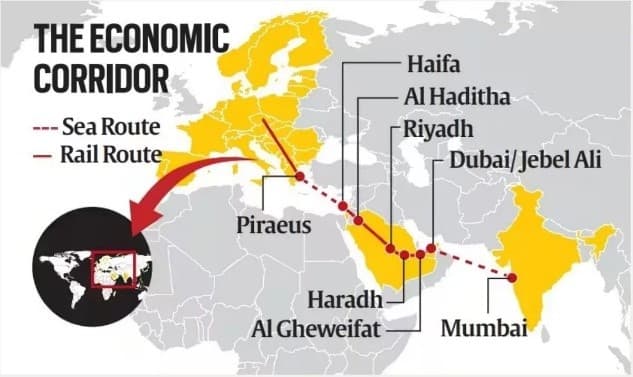
Multimodal economic corridor announced at G20 Delhi 2023 linking India, Gulf and Europe via sea-rail-pipeline-digital links

Eastern leg: Indian west-coast ports → UAE (sea) → Saudi & Jordan (rail) → Haifa, Israel

Western leg: Haifa → Greece/Italy (sea) → onward into existing European rail network

Quick Facts for MCQs

Economic Angle

  • Trade diversification cuts Suez dependence and lowers Asia-Europe transit time and cost
  • Faster EU access boosts Indian export competitiveness and invites supply-chain investments
  • Corridor positions Gulf states as logistics hubs enhancing regional freight volumes

Energy & Digital

  • Green-hydrogen pipelines integrate India into Gulf–Europe clean energy value chains
  • Blue Raman cable makes India pivotal node for Asia-Europe data traffic
  • UPI rollout in UAE and Saudi improves fintech connectivity for corridor trade

Security Dimension

  • Gaza conflict stalls Saudi–Israel rapprochement delaying western leg implementation
  • Yemen–Lebanon spill-overs may raise insurance premiums and deter private investors
  • Saudi–UAE rivalry over logistics dominance risks tariff and port harmonisation delays

Key Data Points

FeatureData-Point
LaunchSept 2023 G20 Summit, New Delhi
Partners count10 (India, Saudi, UAE, EU, France, Italy, Germany, US, Israel, Jordan)
Eastern leg routeIndia–UAE sea; Saudi–Jordan rail; Haifa port
Western leg routeHaifa–Greece/Italy sea; EU rail grid
EU–India trade FY 2023-24USD 137.41 billion
Flagship subsea cableBlue Raman, Mumbai–Genoa

Related UPSC Prelims PYQs

GS1 2025PYQ 1

भारत, अंतर्राष्ट्रीय उत्तर-दक्षिण परिवहन कॉरिडोर (INSTC), जो एक बहु-राष्ट्रीय परिवहन गलियारा है, के सदस्य राज्यों में से एक है। यह कॉरिडोर किन्हें जोड़ता है?

GS1 2017PYQ 2

भारत द्वारा चाबहार बंदरगाह विकसित करने का क्या महत्त्व है ?

GS-2Scheme

13.Khelo India ASMITA Women’s League (Women Sports Scheme)

PIB

What & Where

Scheme; Khelo India ASMITA is an affirmative-action sports initiative to boost girls’ participation, grassroots talent

Geography; inaugural under-13 football league hosted 2025-26 in Jalgaon district, Maharashtra

Scope; nationwide rollout under Ministry of Youth Affairs & Sports, aligning with Khelo Bharat Niti

Quick Facts for MCQs

Tech & Schemes

  • Alignment; integrates talent ID, coaching, scouting similar to existing Khelo India leagues
  • Structure; age-group leagues with national-state coordination ensure pipeline to higher competitions

Social Concerns

  • Inclusion; affirmative slots for first-time girl players from underrepresented areas
  • Empowerment; challenges patriarchal norms, projects young female role models in sport

Institutional Support

  • Governance; SAI provides funding and infrastructure, AIFF handles technical conduct
  • State role; WIFA coordinates local logistics, district associations mobilise schools and clubs

Key Data Points

FeatureData-Point
Full nameKhelo India ASMITA (Affirmative, Sports, Mainstreaming, Inclusion, Talent, Alliance)
Launch cycle2025-26
First sportFootball league
First venueJalgaon, Maharashtra
Nodal ministryYouth Affairs & Sports
Key support bodiesSAI, AIFF, WIFA
Core target groupGirls ≤13 years
Focus communitiesTribal, rural, minority, other marginalised
Policy linkageKhelo Bharat Niti
Primary objectiveCorrect gender imbalance via structured competition

Related UPSC Prelims PYQs

ESE_GS 2021PYQ 1

The Ministry of Sports and Youth Affairs has recently approved the inclusion of four indigenous games to be part of Khelo India Youth Games 2021. Which one of the following is NOT included ?

GS-2Scheme

14.PM E-Drive Electric Vehicle Subsidy (EV Subsidy Scheme)

Business Standard
Illustration for PM E-Drive Electric Vehicle Subsidy (EV Subsidy Scheme)

What & Where

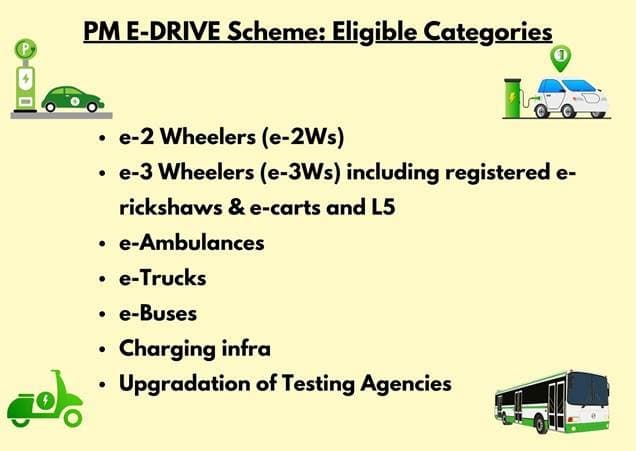
PM E-Drive Subsidy Scheme: national incentive to accelerate electric-vehicle adoption, manufacturing and charging.

Coverage pan-India with priority for nine cities exceeding 40 lakh population.

Nodal agency Ministry of Heavy Industries; effective till FY 2027-28 or fund exhaustion.

Quick Facts for MCQs

Legal & Policy

  • Extension approved, unused funds allow scheme to run two extra years till 2027-28.
  • Subsidy phase-out fixed for two- and three-wheelers on 31 Mar 2026, providing certainty to industry.
  • Alignment with GST cuts, Income-tax Sec 80EEB and PLI for batteries reinforces comprehensive EV policy stack.

Budget & Incentives

  • Outlay split roughly 34 % demand incentives, 66 % e-buses, chargers and testing.
  • Electric trucks eligible for ₹5,000/kWh incentive or 10 % ex-factory, addressing commercial freight electrification.
  • Dedicated ₹500 crore earmarked; ambulance subsidy guidelines due by 2026.

Infrastructure Push

  • ₹2,000 crore reserved for nationwide fast-charging network, prioritising highways and dense urban clusters.
  • Target installation 22,100 car chargers, 1,800 bus chargers, 48,400 two-/three-wheeler points.
  • Upgradation of testing and certification labs planned to boost safety and localisation.

Key Data Points

FeatureData-Point
Launch date1 Oct 2024
Predecessor schemeElectric Mobility Promotion Scheme 2024
Total outlay₹10,900 crore
Demand-incentive corpus₹3,679 crore
E-bus + infra corpus₹7,171 crore
Scheme validityUp to 31 Mar 2028
2-wheeler subsidy FY25₹5,000/kWh; cap ₹10,000
E-rickshaw/autos FY25₹5,000/kWh; cap ₹25-50 k
Truck subsidy₹5,000/kWh or 10 % ex-factory price
Chargers funded22,100 (4W) + 1,800 (buses) + 48,400 (2 & 3W)
Ambulance allocation₹500 crore
2-& 3-wheeler subsidy ends31 Mar 2026
GS-2Scheme

15.MERITE Technical Education Improvement Scheme (Technical Education)

PIB
Illustration for MERITE Technical Education Improvement Scheme (Technical Education)

What & Where

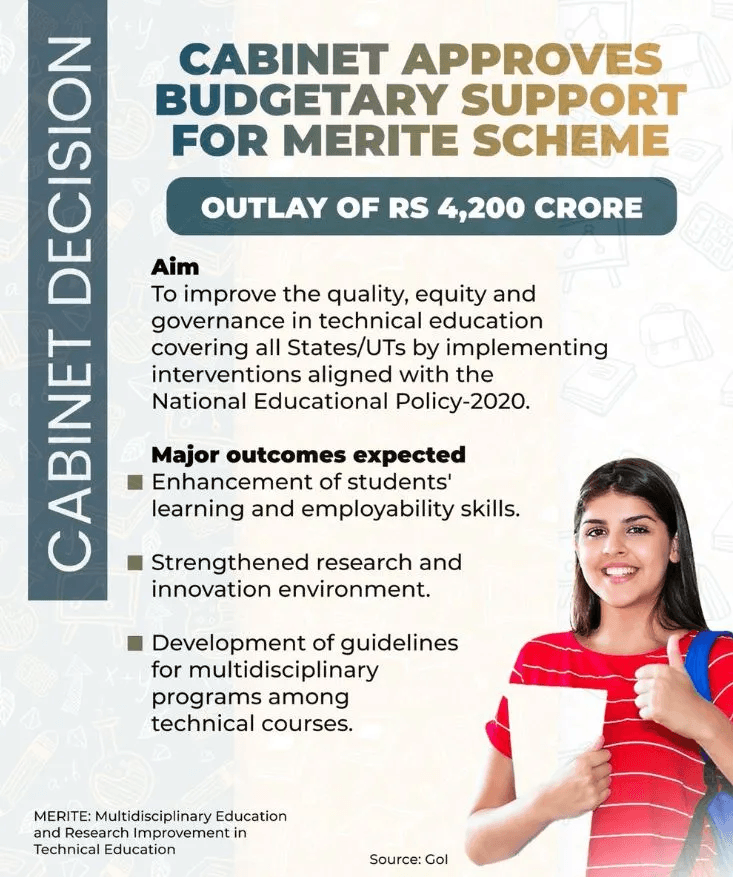
MERITE = Multidisciplinary Education & Research Improvement in Technical Education; Cabinet-approved Central Sector scheme under NEP 2020.

Process: quality, research, digitalisation and accreditation push across technical institutes via IIT–IIM mentorship and World Bank co-financing.

Geography: all States & UTs; 275 engineering institutions/polytechnics; ~7.5 lakh students.

Quick Facts for MCQs

Funding & Timeline

  • Budget 4,200 crore; equal split Government–World Bank loan.
  • Five-year window 2025-30; funds released as Central Sector grants.

Institutional Coverage

  • Targets NITs, state engineering colleges, affiliating technical universities, selected polytechnics.
  • Leverages IITs, IIMs, AICTE, NBA for faculty training, accreditation support.

Quality Focus

  • Prioritises digital learning platforms, multidisciplinary courses, outcome-based pedagogy.
  • Boosts research infrastructure, quality assurance systems, women academic leadership pipelines.

Key Data Points

FeatureData-Point
Scheme natureCentral Sector
Total outlay₹4,200 crore
World Bank share₹2,100 crore (50 %)
Duration2025-26 to 2029-30
Institutions covered275 engineering institutes & polytechnics
Main beneficiaries≈7.5 lakh students
Alignment documentNational Education Policy 2020
Mentor bodiesIITs, IIMs, AICTE, NBA
Cabinet approval date11 Aug 2025
Key curricular goalLabour-market aligned, multidisciplinary programs

Ready to practice?

Test your knowledge with our UPSC test series.

Start Free Trial