UPSC Current Affairs

13 topicsGS-1: 3GS-2: 5GS-3: 5
0/13 done
GS-2Polity

1.Ladakh Statehood and Sixth Schedule Demand (Sixth Schedule)

Times of India
Illustration for Ladakh Statehood and Sixth Schedule Demand (Sixth Schedule)

What & Where

Ladakh became Union Territory without legislature after Article 370 abrogation on 5 Aug 2019.

Protesters seek full statehood plus Sixth Schedule autonomy for tribal-majority Ladakh.

Sixth Schedule areas currently only in Assam, Meghalaya, Tripura, Mizoram (N-East India).

Quick Facts for MCQs

Legal & Policy

  • Article 370 abrogation enabled direct Union control over Ladakh governance.
  • Sixth Schedule inclusion needs Parliament amendment under Art 368 plus presidential reference.
  • Statehood demand aims 7th Schedule powers, elected CM & assembly.

Governance Structure

  • Autonomous District Council: elected body with legislative, executive, limited judicial competence.
  • Village councils adjudicate intra-tribal disputes; appeal lies with District Council.
  • Council laws override conflicting state acts on listed subjects after Governor assent.

Social Concerns

  • Sixth Schedule prevents tribal land alienation to non-tribals.
  • Empowers cultural, linguistic preservation through local legislation.
  • Wangchuk-led movement frames autonomy as safeguard against demographic, ecological erosion.

Key Data Points

FeatureData-Point
UT status day31 Oct 2019 (Ladakh UT operational)
Sixth Schedule articles244(2) & 275(1)
Present Sixth Schedule statesAssam, Meghalaya, Tripura, Mizoram
Key protection mechanismAutonomous District & Regional Councils
Council election term5 years (same as state legislature)
Governor powersNotify areas, alter boundaries, assent to council laws
Council legislative subjectsLand, forests, water, agriculture, village admin, customs
Council revenue powersTaxes on land, trade, professions, markets
Funds sourceGrants from Consolidated Fund of India, Art 275(1)
Main Ladakh demandInclusion under Sixth Schedule + elected legislature
GS-2Polity

2.Supreme Court Orders Stray Dog Relocation (Judiciary Order)

LL
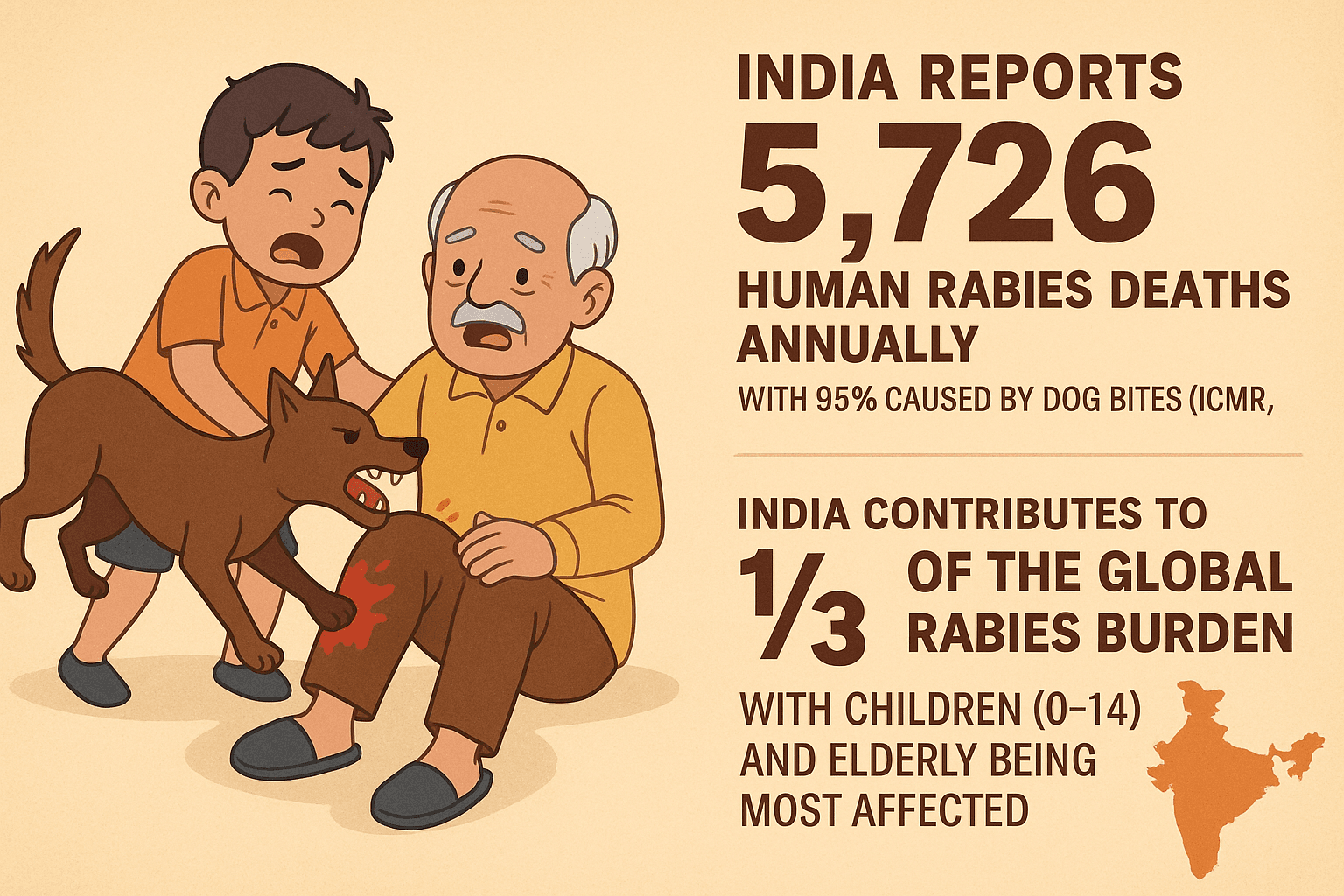
Illustration for Supreme Court Orders Stray Dog Relocation (Judiciary Order)

What & Where

Order: Supreme Court directs permanent capture of all stray dogs in Delhi, Noida, Gurugram, Ghaziabad

Geography: Applies to National Capital Region core and peri-urban zones

Purpose: Reduce rabies deaths and dog-bite incidents, especially for children and elderly

Quick Facts for MCQs

Legal & Policy

  • Compliance: Disobedience invokes contempt, overriding conflicting Animal Birth Control Rules
  • Reform: Future amendments to align Prevention of Cruelty to Animals framework with SC mandate
  • Accountability: CCTV, record keeping ordered for transparent dog capture and sheltering

Public Health

  • Justification: 95 percent rabies cases linked to dog bites, necessitating preventive removal
  • Mobility: Safer streets framed as extension of Article 21 safe movement right
  • Vaccination: Mass drives advised to complement relocation strategy

Animal Welfare

  • Risk: Overcrowding in hastily built shelters could breach welfare norms
  • Mitigation: Humane design, nutrition, medical care mandated for detained canines
  • Adoption: Controlled rehoming encouraged under strict vetting to avoid future strays

Key Data Points

FeatureData-Point
SC instructionNo release back to locality
Shelter capacity5,000 dogs per new facility
Deadline to build shelters8 weeks
Helpline responseAction within 4 hours of bite report
Constitutional article citedArticle 21 right to life
Annual rabies deaths India≈ 5,700
High-risk groups<14 yrs & >60 yrs
Contempt warningAgainst obstruction of removal
GS-3Economy

3.Revised Income Tax Bill 2025 Reforms (Direct Tax Reform)

Financial Express

What & Where

What: Revised Income Tax Bill, 2025 – new code to overhaul India’s direct-tax law.

Where: Tabled in Lok Sabha; will apply uniformly across India once enacted.

Scope: Incorporates majority of 566 Select-Committee suggestions, replacing Income Tax Act, 1961.

Quick Facts for MCQs

Legal & Policy

  • Consolidation: Merges scattered provisions into single, re-numbered, cross-referenced code.
  • Transparency: Clearer drafting, modern terminology to curb interpretative disputes.
  • Governance: Removes obsolete clauses; CBDT given flexible delegated powers.

Compliance & Administration

  • Refunds: Post-deadline ITRs now eligible, cutting grievance cases.
  • Documentation: Structured section numbering eases navigation for taxpayers & officials.
  • Digital push: Framework aligned for e-assessment, e-communication, NIL-TDS self-declaration.

Sectoral Reliefs

  • Corporates: ₹8 crore dividend deduction reinstated; inter-company flows incentivised.
  • MSMEs: Uniform definition eases benefit eligibility, compliance parity.
  • Trusts & LLPs: Transfer-pricing relaxations, AMT scrapped to lower effective tax load.

Key Data Points

FeatureData-Point
Legacy Act replacedIncome Tax Act, 1961
Parliamentary inputs566 recommendations, most accepted
Core timeline termSingle “Tax Year” replaces “Previous/Assessment Year”
Late-ITR refundsAllowed even after statutory due date
Inter-corporate dividend deduction₹8 crore (₹80 million) restored
Property taxationNotional rent on vacant property abolished
MSME definitionSynced with MSME Act, 2006 turnover/investment norms
LLP taxationAlternate Minimum Tax eliminated
Rule-making authorityCBDT empowered for digital-era regulations
NIL-TDS facilityAvailable to zero-tax-liability taxpayers

Related UPSC Prelims PYQs

GS1 2004PYQ 1

Which of the following is not a recommendation of the task force on direct taxes under the chairmanship of Dr. Vijay L. Kelkar in the year 2002?

GS-1History

4.Iron Age Settlement Found at Topra Kalan (Archaeological Site)

Indian Express

What & Where

Topra Kalan (Yamunanagar, Haryana): newly-excavated settlement c. 1500 BC, bridging Indus Valley decline & Indian Iron Age onset.

Finds show Late Bronze/Early Iron toolkit: Painted Grey Ware, Black-and-Red Ware, moulded bricks, iron slag, beads.

Site also original base of Delhi-Topra Ashokan pillar, shifted to Delhi by Firoz Shah Tughlaq (14 th c).

Quick Facts for MCQs

Archaeological Finds

  • Walls, platforms, room-units reveal planned architecture; associated iron slag indicates onsite smelting.
  • Stupa-like dome suggests enduring Buddhist presence since Mauryan era.
  • Beads, terracotta discs aid cultural sequencing to PGW horizon.

Iron Age Cultures

  • Black-and-Red Ware marks transition phase; inverted firing gives dual colours.
  • PGW culture: grey ware, Ganga-Yamuna doab, early iron tools & Mahabharata legend context.
  • NBPW: lustrous black pottery, urban centres, Mauryan expansion, standardised iron technology.

Regional Sites

  • North: Hastinapur, Atranjikhera (PGW); Rajghat, Kausambi (NBPW).
  • Deccan/Vidarbha: Naikund furnaces; Paiyampalli iron slag heaps.
  • Malwa cluster: Nagda, Eran, Ahar show 750–500 BC iron horizons.

Key Data Points

FeatureData-Point
Probable age of Topra layer~1500 BC
Excavation depth4–5 m below present ground
Key structureDome-like brick stupa
Signature potteryPainted Grey Ware (grey body, black motifs)
Companion potteryBlack-and-Red Ware, stamped sherds
Iron Age span (North India)1500 BC – 600 BC
Text where iron (ayas) first namedAtharvaveda
Second Urbanisation window700 BC – 100 BC
Northern Iron Age culturesBRW → PGW → NBPW
South-Indian counterpartMegalithic with smelting furnaces
Earliest southern iron hintSivagalai, TN – 4th millennium BC
Pillar moverSultan Firoz Shah Tughlaq (AD 1356)

Related UPSC Prelims PYQs

CDS_GK 2021PYQ 1

The painted illustration of the moving of the Ashoka Pillar at Topra is found in

GS-1Mapping

5.Dardanelles Strait Maritime Corridor (Strategic Strait)

BBC
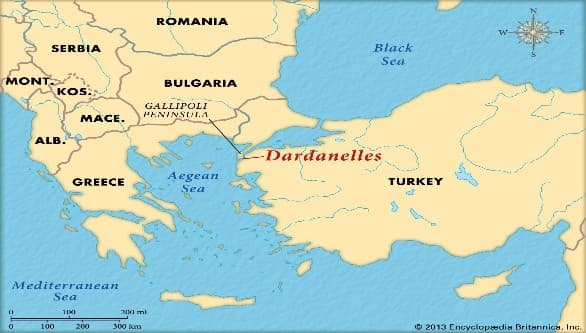
Illustration for Dardanelles Strait Maritime Corridor (Strategic Strait)

What & Where

Strait; connects Aegean Sea with Sea of Marmara; ancient name Hellespont

Sits in north-western Turkey, dividing Gallipoli Peninsula (Europe) from Asia Minor (Asia)

Critical chokepoint on Black Sea–Mediterranean maritime route

Quick Facts for MCQs

Historical Significance

  • Persian, Macedonian and WWI forces used strait as invasion gateway
  • Gallipoli Campaign shaped Turkish national identity under Atatürk
  • Mythology: Leander–Hero legend, Xerxes’ pontoon bridges

Security Dimension

  • NATO views strait as flank for Black Sea access control
  • Montreux Convention grants Turkey wartime closure powers
  • Current wildfire-led shutdown shows rapid enforcement capability

Trade & Shipping

  • Closure stalls Europe–Asia bulk, oil and grain traffic
  • Together with Bosporus forms only maritime link for Black Sea ports
  • Undercurrent salinity exchange affects ballast water management norms

Environmental Impact

  • Çanakkale wildfires forced evacuations and strait traffic halt
  • Aerial tankers, helicopters deployed; land burning exceeds 6 sq km
  • Smoke plumes threaten visibility for navigation and tourism

Key Data Points

FeatureData-Point
Length61 km
Width range1.2 – 6.5 km
Average depth~55 m
Maximum depth~90 m
Surface currentMarmara → Aegean
UndercurrentAegean → Marmara
Alternative nameHellespont
Main portsGallipoli, Eceabat, Çanakkale
Territorial controlEntirely Turkish waters
Key battles480 BCE Persian, 334 BCE Alexander, 1915 Gallipoli

Related UPSC Prelims PYQs

GS1 2014PYQ 1

Turkey is located between

GS-3Environment

6.Operation Falcon Rhino Anti-Poaching Drive (Rhino Protection)

New Indian Express
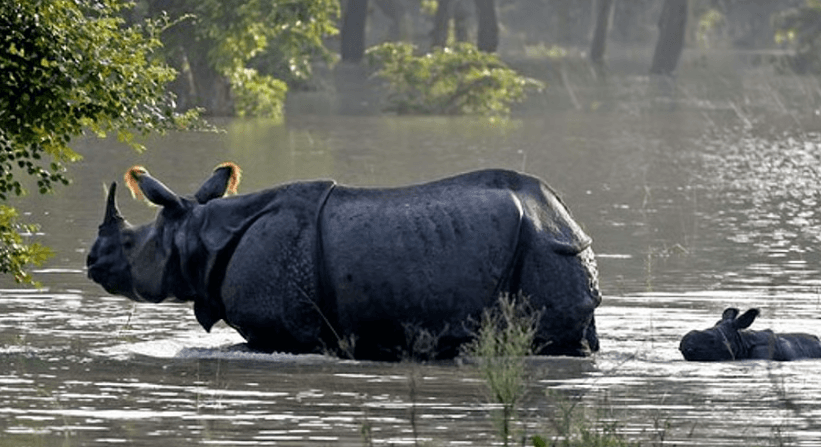
Illustration for Operation Falcon Rhino Anti-Poaching Drive (Rhino Protection)

What & Where

Initiative: Operation Falcon, joint anti-poaching drive, Assam Police + Assam Forest Dept, launched 2024

Target: Rhino-poaching networks in Assam’s protected areas, chiefly Kaziranga landscape

Geography: Statewide Assam, focus districts with greater one-horned rhino habitats

Quick Facts for MCQs

Security Dimension

  • Tactics: Integrated digital tracking, rapid-response teams, multi-district coordination
  • Outcome: Nine poaching attempts neutralised before kill could occur
  • Deterrence: Large-scale arrests weakened organised wildlife-crime networks

Environmental Impact

  • Species: Safeguards endangered Rhinoceros unicornis, flagship of Indo-Gangetic grasslands
  • Biodiversity: Protection aids associated megafauna like swamp deer, Asian elephant
  • Indicator: Zero kills marks healthiest rhino survival year on record for Assam

Tech & Schemes

  • Tools: Real-time intelligence platforms, GPS-enabled patrol routes, drone reconnaissance
  • Scheme link: Complements Project Rhino and National Rhino Conservation Strategy
  • Data use: Arrest analytics inform future hotspot deployment

Economic Angle

  • Tourism: Increased visitor confidence in Kaziranga and Pobitora sanctuaries
  • Revenue: Wildlife-based tourism sustains local livelihoods, park maintenance
  • Branding: Enhances India’s global conservation image, potential for green funding

Key Data Points

FeatureData-Point
Launch year2024
Lead agenciesAssam Police; Assam Forest Department
2025 rhino deathsZero
Poachers arrested42
Poaching gangs busted6
Attempts foiled9
Poaching decline since 201686 %
Protected speciesGreater one-horned rhinoceros
Conservation benefitEco-tourism boost in Kaziranga
Intelligence methodDigital tracking + on-ground surveillance
GS-3Environment

7.Biochar Carbon Drawdown for Sustainable Growth (Biochar Technology)

The Hindu
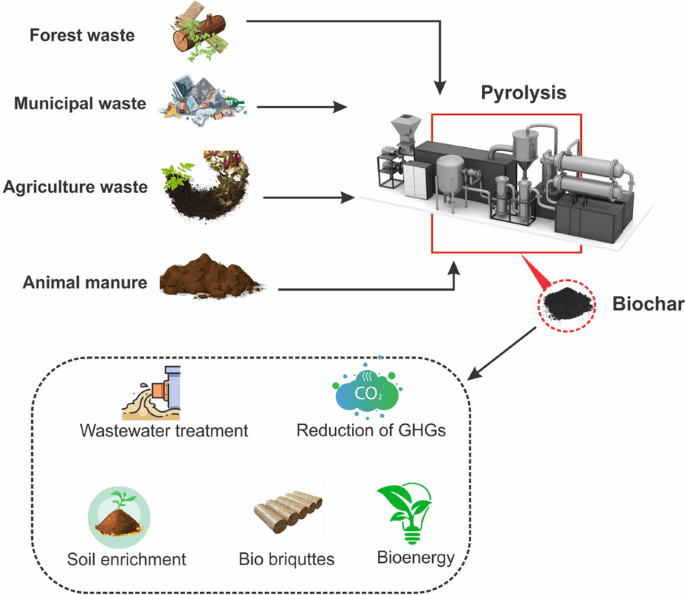
Illustration for Biochar Carbon Drawdown for Sustainable Growth (Biochar Technology)

What & Where

Biochar = carbon-rich charcoal from pyrolysing farm residue & organic waste; locks carbon in soil 100–1000 years

Key CO₂-removal pathways for India: biochar, BECCS, DAC, CCUS, nature-based; carbon market starts 2026

Emission hotspots: coal-powered electricity belt & expanding road transport corridors across India

Quick Facts for MCQs

Policy & Market

  • Carbon-market launch slated 2026 under Bureau of Energy Efficiency oversight
  • Pricing signal expected to monetise biochar carbon credits boosting rural pyrolysis units
  • Alignment with Paris NDC targets and forthcoming Carbon Credit Trading Scheme amendments

Energy & Materials

  • Pyrolysis yield: 20–30 Mt syngas enabling 8–13 TWh annual electricity generation
  • Bio-oil output 24–40 Mt could replace 12–19 Mt diesel lowering crude imports by >2 percent
  • Concrete blend 2–5 percent biochar raises strength, 20 percent heat resistance, sequesters 115 kg CO₂ / m³

Agriculture & Environment

  • Soil-application improves moisture retention in semi-arid fields enhancing yields and farm resilience
  • Nitrous oxide emissions drop 30–50 percent with biochar cutting 273-fold stronger greenhouse gas
  • Wastewater filtration using biochar offers low-cost treatment for 70 billion L daily municipal effluent

Key Data Points

FeatureData-Point
India cumulative GHG share4 % (1850-2019)
Per-capita emission~⅓ world average
GDP emission-intensity cut36 % during 2005-2020
Global emitter rank3rd after China, USA
Power sector CO₂ share≈50 % of fuel-related
Road transport share≈12 % energy-related
Agri residue generated600 Mt / year
Municipal waste generated60 Mt / year
Potential biochar CO₂ removal0.1 Gt CO₂-eq / year
Syngas electricity potential8–13 TWh / year
Bio-oil diesel replacement12–19 Mt / year
Biochar in concrete capture115 kg CO₂ per m³
Nitrous oxide cut with biochar30–50 %
Concrete heat resistance gain20 %
Indian carbon market year2026

Related UPSC Prelims PYQs

GS1 2020PYQ 1

What is the use of biochar in farming?

GS-3Environment

8.Elephant Conservation Efforts and Human-Wildlife Conflict (Elephant Conservation)

The Hindu

What & Where

World Elephant Day 12 Aug 2012, founded by Patricia Sims & Elephant Reintroduction Foundation

Species: African Savanna, African Forest, Asian; Indian subspecies Elephas maximus indicus is National Heritage Animal

India hosts ≈30 k elephants across South, Northeast, Central; 33 Elephant Reserves, 150 validated corridors

Quick Facts for MCQs

Legal & Policy

  • Protection: WPA 1972 Sch I, CITES Appendix I, IUCN Endangered tag
  • Project Elephant centrally sponsored; supports 22 states for habitat, corridors, welfare
  • FY 2023-24 merger created Project Tiger & Elephant for unified funding

Conservation Infrastructure

  • Reserves: 33 elephant reserves overlap tiger reserves, WLS, reserve forests
  • Corridors: 150 ground-validated links across 15 states secure migration, gene flow
  • MIKE programme plus WII Elephant Cell provide poaching data, staff training

Threats & Mortality

  • Rail hits: 186 deaths; hotspots Assam, West Bengal, Odisha, Kerala, Uttarakhand
  • Fragmented habitat triggers 400-500 human and ≈60 elephant deaths each year
  • Ongoing risks: ivory poaching, sagging power lines, bomb traps, open wells

Mitigation Techniques

  • Rail safety: earthen ramps, underpasses, overpasses, Intrusion Detection Systems
  • Bio-barriers: bee-fences, chili-oil ropes, banana & napier trap crops near farms
  • Tech tools: GPS collars and LULC satellites enable real-time alerts, habitat tracking

Key Data Points

FeatureData-Point
Date of World Elephant Day12 August
Gestation length22 months
Asian elephant IUCN statusEndangered
Project Elephant start1992
Merged scheme 2023-24Project Tiger & Elephant
Elephant Reserves33 in 14 states
Wild elephants (2017)29,964
Train-collision deaths 2009-24186
Annual human deaths in conflict400–500

Related UPSC Prelims PYQs

GS1 2020PYQ 1

With reference to Indian elephants, consider the following statements :

GS1 1999PYQ 2

"India has the largest population of the Asian X. Today, there are just about 20,000 to 25,000 X in their natural habitat spreading across the evergreen forests, dry thorn forests, swamps and grasslands. Their prime habitats are, however, the moist deciduous forests. The X population in India ranges from Northwest India where they are found in the forest divisions of Dehradun, Bijnor and Nainital districts of UP to the Western Ghats in the states of Karnataka and Kerala and in Tamil Nadu. In Cen

GS-3S&T

9.Envelope Dimer Epitope Drives Dengue Immunity (Dengue Immunity)

The Hindu

What & Where

Definition: Envelope Dimer Epitope (EDE) = quaternary site on paired envelope (E) proteins of mature dengue virions

Process: Target of broadly neutralising EDE-like antibodies giving cross-serotype protection, low after first infection, high later

Geography: Dengue endemic belts—South & Southeast Asia, Latin America, parts of Africa—prime zones for EDE-focused vaccines

Quick Facts for MCQs

Vaccine Implications

  • Targeted-design: EDE-focussed candidates may grant universal serotype coverage without ADE risk
  • Policy-shift: Could enable mass immunisation regardless of previous infection status
  • Efficacy-metric: EDE antibody titre offers quick surrogate endpoint in trials

Therapeutic Prospects

  • Monoclonal-antibodies: Lab-made EDE-mAbs can deliver instant, broad protection during outbreaks
  • Emergency-use: Passive immunisation viable for pregnant women or immunocompromised in endemic zones

Public Health Angle

  • Surveillance-tool: Population EDE-titre mapping helps forecast outbreak severity
  • Resource-allocation: High-risk, low-titre districts prioritised for new vaccine roll-out

Key Data Points

FeatureData-Point
Epitope locationInterface of two E proteins on mature virus
Virus serotypes coveredAll four (DENV-1 to DENV-4)
Antibody breadthBroadly neutralising, cross-serotype
Production peakSecondary infection or prior-exposed vaccination
Level in primary infectionRare / low titres
Disease correlationHigh titres → fewer severe cases, hospitalisations
Biomarker useGauge vaccine efficacy, existing immunity
Licensed vaccinesDengvaxia, QDENGA
Vaccine limitationNeed confirmed prior exposure to avoid ADE
ADE meaningAntibody-Dependent Enhancement—worsened disease if non-neutralising antibodies dominate

Related UPSC Prelims PYQs

CDS_GK 2024PYQ 1

डेंगू ज्वर का कारक जीव एक महत्ववर्णीय वायरस है, जो निम्नलिखित में से किस श्रेणी से संबंधित है?

GS-2Editorial

10.India Presents Third SDG Voluntary Review (SDG Review)

PIB

What & Where

Voluntary National Review (VNR): self-authored country report on SDG progress, tabled at UN High-Level Political Forum.

HLPF: annual ECOSOC, quadrennial UNGA platform steering global 2030 Agenda; venue—UNHQ, New York.

India’s 3rd VNR 2025: compiled by NITI Aayog; accents “whole-of-government/society” and SDG localisation.

Quick Facts for MCQs

Monitoring & Localisation Tools

  • SDG India Index ranks states, flags gaps for policy push.
  • District SDG indices guide targeted schemes and budgets.
  • MPI adoption integrates health, edu, living-standards into poverty mapping.

Social Progress Metrics

  • Poverty reduction: 248 mn exited multidimensional poverty in nine years.
  • Health spending shift: OOP share cut by over 23 percentage points.
  • Food security: PKGAY supplies free grain to 80 crore beneficiaries.

Tech & Schemes

  • JAM stack enables leak-proof digital transfers and inclusion.
  • UPI dominance delivers nearly half of world’s real-time payments.
  • Green Hydrogen, KUSUM, Surya Ghar propel SDG-7 clean-energy targets.

UN Mechanism

  • VNRs: voluntary, transparent peer-learning reports on SDG strides.
  • HLPF issues negotiated declarations, steers global SDG review.
  • Review cycle: yearly under ECOSOC; four-yearly high-level UNGA.

Key Data Points

FeatureData-Point
India VNR years2017, 2020, 2025
Nodal agencyNITI Aayog
Key monitoring indicesSDG India, NER District SDG, MPI
People out of multidimensional poverty248 million (2013-14 → 2022-23)
PM-Garib Kalyan Anna Yojana reach81.35 crore; extended 2024-29
Health OOP spend share62.6 % (2014-15) → 39.4 % (2020-21)
India share, global real-time payments48.5 % in FY 2025
UPI transaction volume rise41.7 % YoY FY 2025
Clean-energy missions citedNGHM, PM-KUSUM, PM Surya Ghar
HLPF establishmentJuly 2013

Related UPSC Prelims PYQs

CDS_GK 2023PYQ 1

SDG India Index, developed by NITI Aayog, includes 17 SDGs for each State. Which one of the following is not included in that index?

GS-2Scheme

11.National Anubhav Awards for Retiring Officials (Pensioners Awards)

PIB

What & Where

National Anubhav Awards – annual honours for top retirement memoirs from Central Govt, CPSU & PSB staff on Anubhav Portal.

Selection by DoPPW via objective marking; 10th edition ceremony on 18 Aug 2025, Vigyan Bhawan, New Delhi.

Instituted 2015 to archive institutional memory and showcase replicable good governance practices.

Quick Facts for MCQs

Objectives

  • Preservation; institutional memory stored as public digital narratives.
  • Replication; good practices, innovation, procedural simplification highlighted for other agencies.
  • Recognition; formal applaud for feedback, service excellence and valour by retiring personnel.

Eligibility Norms

  • Service; entrant must belong to Central Govt, CPSU or PSB cadre.
  • Timing; memoir submission only within notified upload window, retirement proximity criterion mandatory.
  • Format; write-ups hosted exclusively on Anubhav Portal for consideration.

Award Structure & Diversity

  • Categorisation; themes span accounts, IT, research, public dealing, governance reforms etc.
  • Expansion; inclusion of PSB & CPSU staff commenced 2024, widening talent pool.
  • Diversity push; explicit target met with one-third women winners in 2025 list.

Key Data Points

FeatureData-Point
Admin MinistryDoPPW, Ministry of Personnel, PG & Pensions
Launch Year2015
Edition in 202510th
Ceremony Date18 August 2025
VenueVigyan Bhawan, New Delhi
Eligible SectorsCentral Govt, CPSUs, PSBs
Retirement Window≤ 8 months before or ≤ 3 years after superannuation
Upload Window1 Apr 2024 – 31 Mar 2025
Award Slots5 Best Write-ups + 10 Jury Certificates
Women Share (2025)~33 % of awardees
Assessment ToolObjective marking system
Capacity-building Arm“Anubhav Awardees’ Speak” webinars
GS-2SchemeQuick Bite

12.GeM Platform Marks Ninth Foundation Day (Government eMarketplace)

PIB

What & Where

Government e-Marketplace (GeM): online public procurement portal, launched 2016 by Ministry of Commerce & Industry.

Covers Central/State ministries, departments, PSUs, autonomous bodies across India; mandatory under General Financial Rules 2017.

Operated by GeM SPV, 100 % Government-owned, not-for-profit.

Quick Facts for MCQs

Legal & Policy

  • Mandatory-procurement clause inserted via Rule 149, GFR 2017 by Ministry of Finance.
  • GeM aligns with Sections 7 & 10 of Public Procurement (Preference to MSEs) Order.

Economic Angle

  • World Bank calculates ~10 % average savings, boosting fiscal efficiency.
  • Scale economies through centralised buying enhance value, curb redundant tenders.

Tech & Schemes

  • GeMAI, first generative-AI chatbot for Indian public sector, offers bilingual voice/text assistance.
  • Platform enables real-time price comparison, e-bidding, reverse auction modules.

Social Inclusion

  • Preferential onboarding drives market access for MSEs, artisans, women, start-ups.
  • Reserved categories benefit via dedicated seller panels and relaxed bid thresholds.

Key Data Points

FeatureData-Point
Foundation Day 2025 themeEase, Access and Inclusion
Current age9th year (launched 2016)
Supervising ministryCommerce & Industry
Enforcing ruleGFR 2017 mandates GeM use
Managing entityGeM Special Purpose Vehicle
Ownership model100 % Government, not-for-profit
Independent validationWorld Bank study
Avg. cost saving~10 % on gov. procurement
Registered MSEs10 lakh+
Artisans & weavers onboard1.3 lakh
Women entrepreneurs1.84 lakh
Start-ups31,000
AI chatbot nameGeMAI
Language supportVoice & text in 10 Indian languages
GS-1Editorial

13.Digital Education Push Challenges and Opportunities (Digital Education)

Indian Express

What & Where

Digital transformation in Indian education: AI, VR, online platforms (DIKSHA, SWAYAM) per NEP-2020 vision

Administrative digitisation: SPARSH defence-pension portal, single-window admission sites for higher education

Geography focus: rural anganwadis to national portals, bridging remote regions to central servers

Quick Facts for MCQs

Opportunities

  • Access: remote learners can stream quality lectures without relocating
  • Transparency: centralised digital portals curb discretion in admissions, pensions
  • Employability: early tech exposure aligns students with future digital-economy skills

Challenges

  • Divide: device & bandwidth gaps exclude rural, poorer students
  • Pedagogy: AI/VR may displace sensory, hands-on early learning crucial for cognition
  • Fatigue: prolonged screen time linked to stress and shorter attention spans

Ethical & Governance

  • Equity: tech rollout must not widen socio-economic disparities
  • Autonomy: over-standardisation risks eroding teacher flexibility and contextual methods
  • Privacy: student data collection demands strict consent and protection norms

Way Forward

  • Hybrid: mix digital tools with traditional, relational teaching models
  • Infrastructure: expand broadband, subsidised devices in underserved zones
  • Interfaces: design multilingual, user-friendly portals with offline help desks

Key Data Points

FeatureData-Point
Policy anchorNational Education Policy 2020
Key e-learning platformsDIKSHA, SWAYAM
Defence pension portalSPARSH (System for Pension Administration – RAKSHA)
Early-learning tech usedInteractive boards, Virtual-Reality devices
Age group exposed in anganwadisBelow 3 years
Core concerns flaggedEquity, pedagogy, empathy

Related UPSC Prelims PYQs

CDS_GK 2025PYQ 1

निम्नलिखित में से कौन-सा, एकीकृत शिक्षक प्रशिक्षण कार्यक्रम है?

CDS_GK 2025PYQ 2

NEP 2020 के दिशा-निर्देश के अनुसार, 'पोषण और पढ़ाई पूर्व' (PPBP), निम्नलिखित में से किस कार्यक्रम के अंतर्गत प्रारंभ की गई है?

Ready to practice?

Test your knowledge with our UPSC test series.

Start Free Trial