UPSC Current Affairs

16 topicsGS-1: 3GS-2: 5GS-3: 8
0/16 done
GS-2Polity

1.ECI Voter Roll Manipulation Allegations (Electoral Rolls)

TW
Illustration for ECI Voter Roll Manipulation Allegations (Electoral Rolls)

What & Where

Election Commission of India: constitutional, autonomous authority managing all Union, State & Panchayat/municipal polls.

Born 25 Jan 1950; headquarters — Nirman Bhavan, New Delhi; jurisdiction spans entire Republic of India.

Core processes: delimitation, electoral-roll preparation/revision, party recognition & symbol allotment, Model Code enforcement.

Quick Facts for MCQs

Legal & Policy

  • Adult-suffrage Article 326 ensures universal vote; Article 329 bars court interference during election process.
  • RPA 1951 defines corrupt practices, disqualifications; EC decisions quasi-judicial yet subject only to election petitions.
  • Model Code of Conduct, though non-statutory, gains legal teeth via Art 324 powers during poll period.

Operational Anomalies

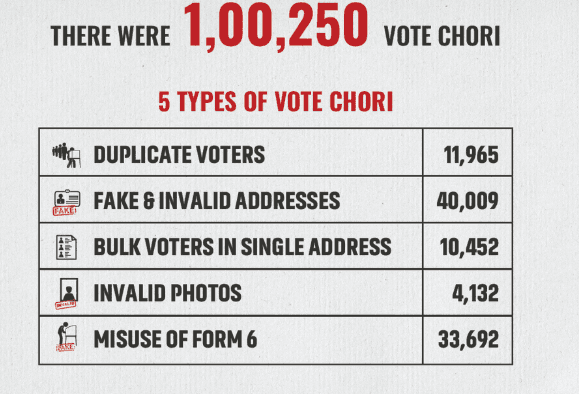
  • Duplicate-entry: 11,900 names repeated; one voter listed in four booths within same constituency.
  • Fake-address: ~40,000 entries carried non-existent homes; random characters in father’s-name field indicated lax verification.
  • Multi-registration: single room showed 80 voters; brewery address held 68; individuals found on rolls of 2–3 states.

Reform Suggestions

  • Digital-rolls: machine-readable, publicly downloadable lists enable civil-society error hunting and transparency.
  • Independent-audit: neutral third parties to vet rolls pre-poll, bolstering credibility and spotting systemic gaps.
  • Penal-tightening: tougher, swifter RPA 1951 sanctions for fraudulent enrolment to deter vote theft.

Key Data Points

FeatureData-Point
Establishment day25 January 1950
HQ locationNew Delhi
Constitutional baseArticle 324
Related Articles325–329
CompositionCEC + 2 Commissioners
Appointing authorityPresident of India
Tenure limit6 yrs or 65 yrs age
Key statuteRepresentation of the People Act 1951
Form 6 useFirst-time voter enrolment
Advisory articlesArt 103 (Parl), 192 (State)

Related UPSC Prelims PYQs

GEO_GS 2021PYQ 1

Which one of the following statements about the Election Commission of India is NOT correct?

GEO_GS 2022PYQ 2

Article 324 of the Constitution of India provides for the establishment of which one of the following institutions in India?

GS-3Economy

2.FAO Food Price Index (Food Prices)

FAO
Illustration for FAO Food Price Index (Food Prices)

What & Where

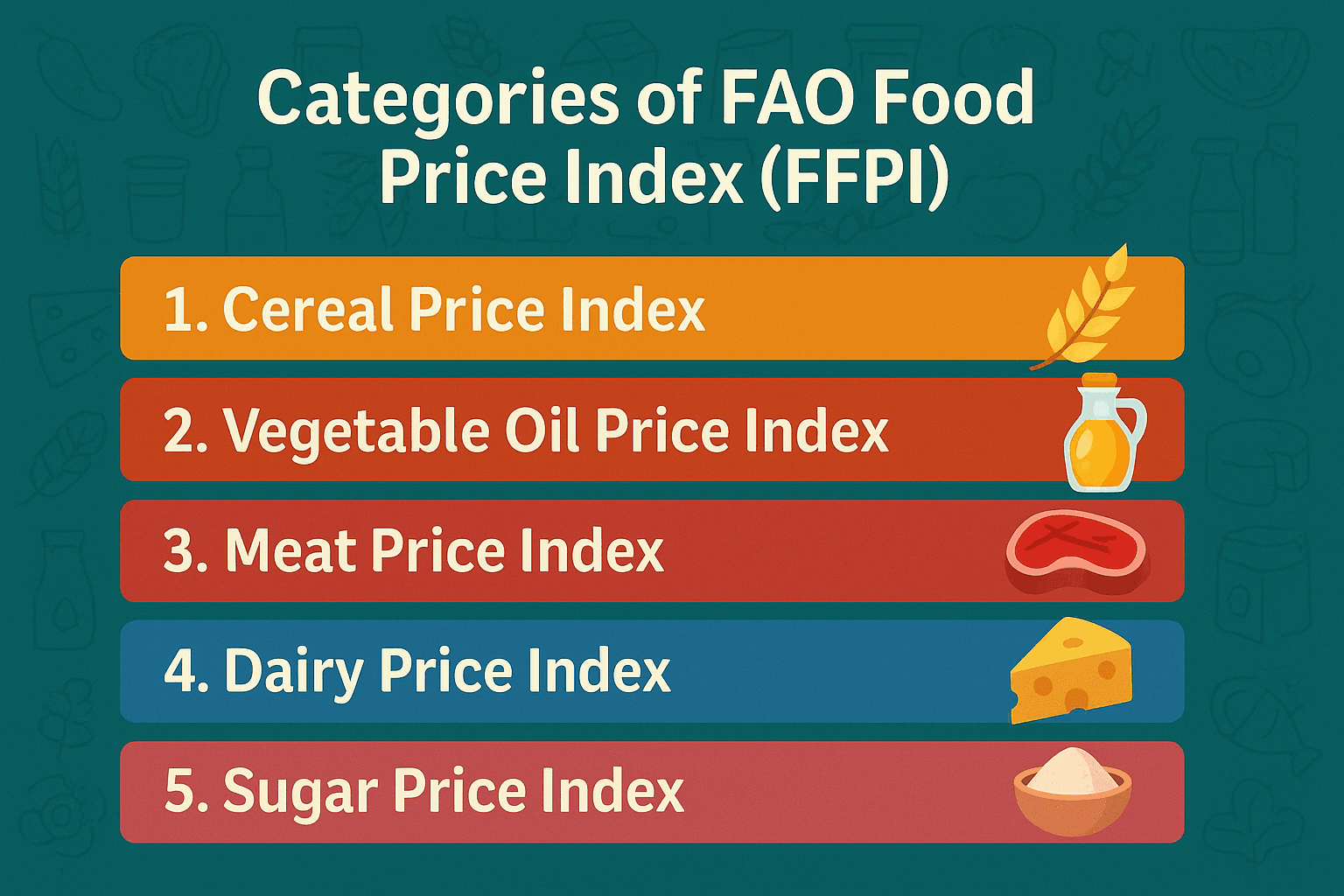
Definition: FAO Food Price Index tracks monthly changes in international prices of five key food commodity groups

Coverage: Global export price data, weighted by 2014-2016 average export shares, published from Rome by FAO

Launch: Introduced 1996; methodology overhaul July 2020 to update base period and broaden commodity basket

Quick Facts for MCQs

Methodology & Metrics

  • Calculation: Laspeyres-type composite index combining nominal and real series
  • Data-source: Global trade quotations updated monthly via FAO Market and Trade Division
  • Comparative: Real index deflates nominal values for long-term trend assessment

Commodity Composition

  • Cereals sub-index: wheat, maize, barley, rice export prices
  • Vegetable-oil sub-index: palm, soy, rapeseed, sunflower global quotes
  • Separate indices allow pinpointing commodity-specific shocks

Policy Significance

  • Benchmark: Guides governments on inflation monitoring and food-security alerts
  • Utility: Supports trade policy, humanitarian response, market risk assessment
  • Users: Central banks, financial institutions, UN agencies track volatility indicators

Market Drivers

  • Influencers: Weather anomalies, geopolitical disruptions, biofuel demand, trade restrictions
  • July 2025 spike: Meat supply tightness, oilseed processing issues amplify prices
  • Offsetting factors: Large cereal harvest forecasts, subdued sugar demand restrained overall rise

Key Data Points

FeatureData-Point
Publishing bodyFood & Agriculture Organization (UN)
FrequencyMonthly
Latest peak (Jul 2025)130.1 points, 2-year high
Commodity groupsCereals, Vegetable oils, Dairy, Meat, Sugar
Weighting base years2014-2016 export shares
Price basisInternational export (not retail/wholesale)
First launch year1996
Major revisionJuly 2020
July 2025 drivers ↑Record meat, surge in vegetable oils
July 2025 drivers ↓Cereals, dairy, sugar prices
GS-3Economy

3.Money Laundering Enforcement Challenges (PMLA Enforcement)

The Hindu

What & Where

Money laundering: concealing illicit proceeds via placement → layering → integration to appear legitimate.

Key techniques: smurfing, trade-based invoicing, shell firms, real-estate and crypto conversions.

India focus: PMLA 2002 (in force 2005) enforced nationwide by Enforcement Directorate & FIU-IND.

Quick Facts for MCQs

Legal Framework

  • PMLA enables attachment, seizure, confiscation of crime-linked assets after “scheduled offence” trigger.
  • ECIR substitutes FIR; initiates ED investigation without prior police case.
  • Section 45 reversal of bail onus upheld yet criticised for stringency.

Enforcement Record

  • 5,892 probes vs 15 convictions reflects evidence gaps, slow trials, procedural challenges.
  • Section 5 provisional attachment often invoked pre-FIR, alleged for political targeting.
  • Informal cash sectors, jewellery, realty amplify laundering volumes.

Judicial Oversight

  • SC urges fast-track PMLA courts, strict rule-of-law compliance by ED.
  • P. Chidambaram 2019: Court termed laundering a sovereignty threat.
  • Vir Bhadra Singh 2017 affirmed ECIR sufficiency for proceedings.

International Cooperation

  • DTAAs facilitate cross-border data, yet limited real-time exchange impedes tracing.
  • FATF recommendations demand transparency, beneficial-ownership disclosure, crypto monitoring.
  • SC favours regulating, not banning, cryptocurrencies to curb misuse.

Security Dimension

  • Laundered funds bankroll organised crime, narcotics, terror networks.
  • Distorts monetary policy, inflates asset prices, deters FDI.
  • Diverts welfare resources, widens socio-economic inequality.

Key Data Points

FeatureData-Point
ED cases under PMLA since 20155,892
Convictions secured15
Conviction rate≈0.25 %
Core statutePrevention of Money Laundering Act, 2002
Enforcement start year1 July 2005
Bail governing sectionSec 45, “twin” conditions
Latest major SC rulingVijay Madanlal Chaudhury v UoI, 2022
2019 changeRule 3A—Special Court notice to claimants
2023 changeBroader NGO & PEP disclosure, FATF-aligned
DTAA partners85 + countries

Related UPSC Prelims PYQs

CDS_GK, GS1 2021PYQ 1

Which one of the following is not correct in respect of Directorate of Enforcement?

CDS_GK, GS1 2003PYQ 2

Which one of the following statements is correct with reference to FEMA in India?

GS-3Economy

4.RBI Liquidity Framework Reforms (Liquidity Management)

Business Standard

What & Where

Liquidity Management Framework (LMF): RBI toolkit to steer banking system cash and short-term rates

Core mechanism: liquidity adjustment facility corridor with repo–reverse repo around policy rate; overnight WACR as operating target

Geography: applies across India’s scheduled commercial banks and money market

Quick Facts for MCQs

Policy Tools

  • WACR correlation with other overnight rates ensures efficient transmission
  • Supplementary instruments: OMO, CRR, SLR used for medium/long liquidity
  • SDF preference reflects market tilt toward shorter tenors

IWG Recommendations

  • Continuity: keep WACR as operating target
  • Shift: manage liquidity via 7-day repo/reverse repo, scrap 14-day VRR/VRRR primacy
  • Flexibility: allow ad-hoc same-day operations when liquidity spikes

Operational Protocols

  • Notice: mandatory 1-day advance for scheduled operations
  • Reserve discipline: maintain 90 % daily CRR compliance
  • Corridor: policy repo central, SDF/MSF define floor-ceiling around WACR

Key Data Points

FeatureData-Point
Framework launchFeb 2020
Operating targetOvernight Weighted Average Call Rate (WACR)
Recommended primary operations7-day repo/reverse repo (overnight–14 day range)
Auctions to discontinue14-day VRR / VRRR as main tools
Advance notice suggestedMinimum 1 day for repo / reverse repo
Daily CRR compliance90 % of requirement

Related UPSC Prelims PYQs

CDS_GK 2024PYQ 1

Consider the following statements regarding instruments of monetary policy:

CDS_GK 2024PYQ 2

Which of the following indicators is/are used to observe the monetary transmission mechanism in the economy?

GS-3Infrastructure

5.Rudrastra Longest Freight Train (Rail Freight)

TN
Illustration for Rudrastra Longest Freight Train (Rail Freight)

What & Where

Rudrastra = 4.5 km long-haul freight train formed by coupling six standard rakes into one operational unit.

Trial run: Ganjkhwaja (Uttar Pradesh) ➜ Garhwa (Jharkhand); East Central Railway’s DDU Division with Dhanbad Division coordination.

Partly runs on Dedicated Freight Corridor, partly on conventional tracks within India.

Quick Facts for MCQs

Tech & Schemes

  • Distributed power configuration prevents coupler strain, enables smoother acceleration/deceleration.
  • Part-use of Dedicated Freight Corridor tests corridor interoperability with conventional lines.
  • Demonstrates Indian Railways’ long-haul initiative akin to South Africa’s Train-in-Train concept.

Economic Angle

  • Single run saves crew hours, path allocation, and fuel vis-à-vis six separate trains.
  • Reduced terminal handling lowers loading/unloading turnaround, boosting rolling-stock availability.
  • Higher payload per path increases revenue yield per train-kilometre.

International Examples

  • Australia’s 7.3 km train (Rio Tinto, Pilbara) remains global record; South Africa’s 4 km coal trains comparable.
  • Long-haul practice common on freight-only heavy-haul lines in USA, China for bulk commodities.

Key Data Points

FeatureData-Point
Train length4.5 km (Asia’s longest, India’s first of this size)
Total wagons354
Wagons capacity~72 t each
Locomotives used7 (2 front, rest distributed)
Average speed40 km h⁻¹ over 209 km
Long-haul makeupThree twin-train combos (2×3)
Operating divisionPandit Deendayal Upadhyaya (DDU), ECR
BenchmarkBelow Australia’s 7.3 km record train
GS-1History

6.Swadeshi Movement Legacy (Nationalist Movement)

PIB

What & Where

National Handloom Day: 7 August; pan-India observance marking Swadeshi Movement launch (Calcutta Townhall, 1905).

Swadeshi Movement: boycott-cum-indigenous production campaign against Bengal Partition; spread by Lal-Bal-Pal, Tagore, samitis.

Handloom geography: largest cottage industry; 35 lakh workers, 72 % women; India supplies 95 % of world hand-woven fabric.

Quick Facts for MCQs

Historical Movement

  • Trigger: Curzon’s Bengal Partition + Indian Universities Act; mass boycott of Manchester cloth, Liverpool salt.
  • Methods: samitis, national schools, festival mobilisations; Tagore’s Raksha Bandhan symbolised Hindu-Muslim unity.
  • Outcome: Imports dipped 1905-08; Morley-Minto Reforms 1909 introduced to placate unrest.

Economic Angle

  • Swadeshi spurred firms like Bengal Chemicals, Lakshmi Cotton Mills; focus shifted from petitions to indigenous enterprise.
  • Handloom sector ensures eco-friendly rural livelihoods; mats, rugs, scarves dominate US-led export basket.
  • Khadi sales up 447 %, jobs 1.94 crore (2013-25), reflecting cottage-industry revival.

Policy & Schemes

  • NHDP, RMSS, Workshed provide yarn subsidy, design support, workspace; 1.8 lakh weavers on GeM.
  • Social security via PMJJY, PMSBY, converged MGBBY; Mudra loans enable low-interest working capital.
  • 14-sector PLI plus GI protection reinforce “vocal for local” manufacturing.

Contemporary Initiatives

  • Atmanirbhar Bharat revives Swadeshi ethos: local-for-global supply chains, defence export push, pandemic-era resilience.
  • Make in India lifted Ease-of-Doing rank, exports USD 437 bn (2024), India 39th in Global Innovation Index.
  • Economic nationalism tools: tariff shields, import substitution in defence, health, energy critical sectors.

Key Data Points

FeatureData-Point
Govt declaration of Handloom Day2015
2025 official theme“Weaving Innovation into Tradition”
Bengal Partition date16 Oct 1905
Annulment year1911 (Lord Hardinge)
INC first Swaraj resolutionCalcutta session 1906, presided by Dadabhai Naoroji
Women share in handloom workforce72 %
Handloom exports FY23USD 10.94 bn
Atmanirbhar stimulus size₹20 lakh crore (~10 % GDP)
FDI inflow FY25 (Make in India era)USD 81.04 bn
GI-tagged handloom products104

Related UPSC Prelims PYQs

GS1 2009PYQ 1

In the context of the Indian freedom struggle, 16th October 1905 is well known for which one of the following reasons?

GS1 2023PYQ 2

Consider the following statements:

GS-1History

7.World War II Overview (Global Conflict)

Indian Express
Illustration for World War II Overview (Global Conflict)

What & Where

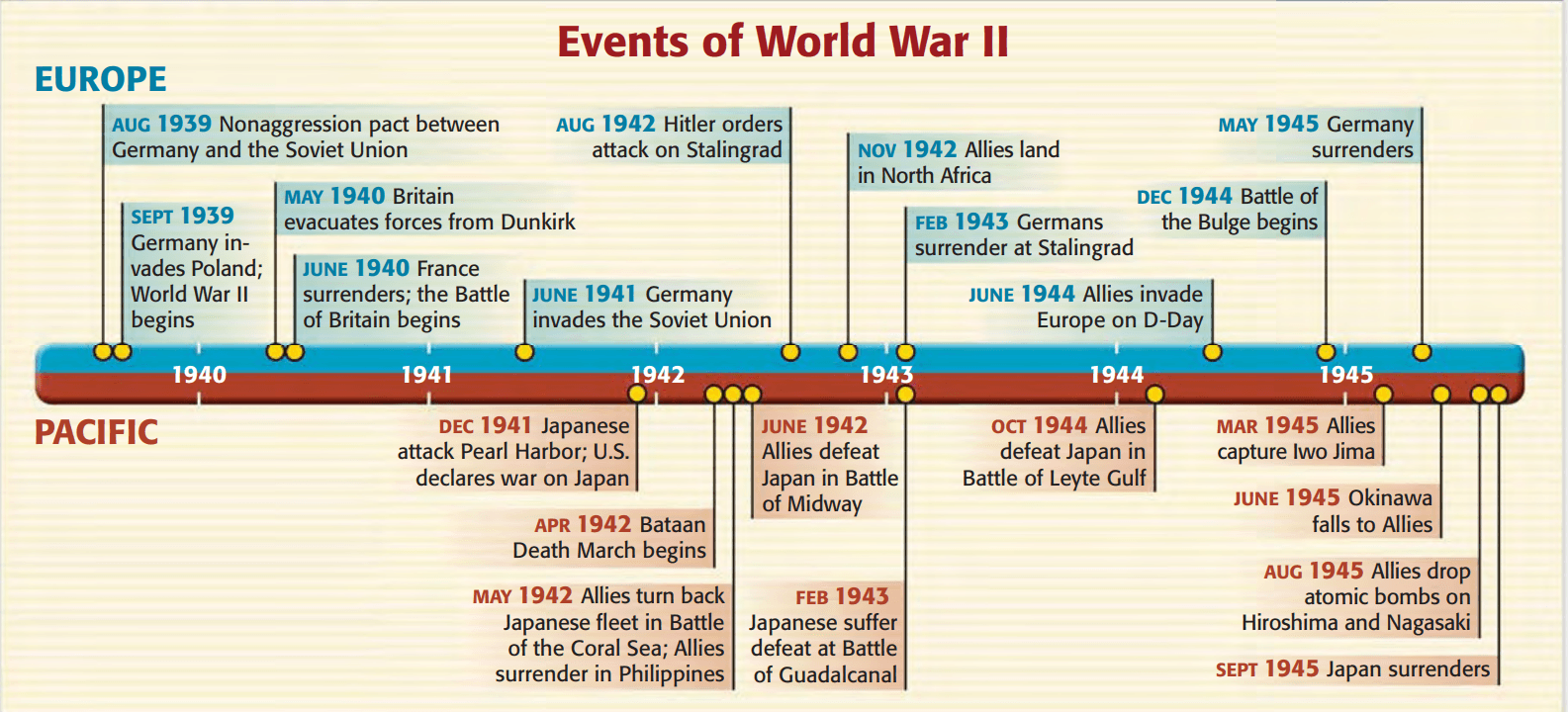
Definition World War II: 1939-45 worldwide conflict between Axis (Germany-Italy-Japan) and Allies (UK-USSR-USA-China-France).

Key actors/processes Axis expansionism, Allied coalition building, total war mobilisation of ≈100 million combatants.

Core geography Main theatres: Europe, North Africa, Atlantic, Pacific & East/Southeast Asia.

Quick Facts for MCQs

Causes

  • Versailles Treaty 1919 imposed reparations, disarmament; bred German revanchism enabling Nazi ascent.
  • Great Depression triggered mass unemployment; extremist regimes gained legitimacy via economic rescue promises.
  • League of Nations weakness; failure in Manchuria 1931 & Abyssinia 1935 emboldened aggressors.

Turning Points

  • Britain defended skies in Battle of Britain 1940 preventing Operation Sea Lion invasion.
  • Soviet victory at Stalingrad Feb 1943 broke German eastern momentum.
  • Allied North Africa win May 1943 opened Mediterranean route for Italy campaign.

Post-war Outcomes

  • United Nations founded Oct 1945 to replace League and avert future wars.
  • Marshall Plan 1948 channelled ≈US $13 bn for West European reconstruction.
  • Decolonisation wave; Asian-African colonies gained independence 1945-70s.

India & WWII

  • Political fallout INC ministries resigned 1939 protesting unilateral war declaration by Viceroy Linlithgow.
  • Economic strain wartime inflation, taxation, Bengal famine 1943 caused ≈3 million deaths.
  • Military legacy Returnee soldiers, INA trials, Quit India movement accelerated 1947 independence goal.

Key Data Points

FeatureData-Point
Formal start1 Sept 1939, German invasion of Poland
End date2 Sept 1945, Japanese surrender aboard USS Missouri
Global deaths70-85 million (≈3% world population)
Hiroshima strike6 Aug 1945, “Little Boy”, uranium-235 bomb
Nagasaki strike9 Aug 1945, “Fat Man”, plutonium-239 bomb
India’s troop strength>2.5 million volunteers, world’s largest colonial army
INA formation1942, Subhas Chandra Bose with Japanese support
Key Allied winBattle of Midway, June 1942, halted Japanese advance
Nazi ideology termLebensraum = “living space” sought in Eastern Europe
GS-1Mapping

8.Sea of Galilee (Freshwater Lake)

WN
Illustration for Sea of Galilee (Freshwater Lake)

What & Where

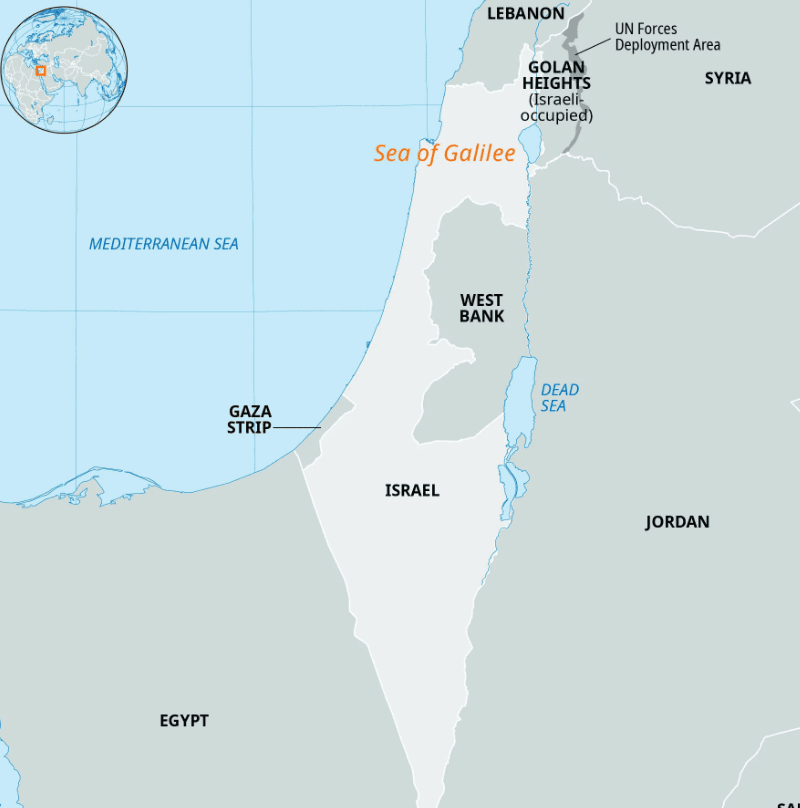
Sea of Galilee = freshwater lake in Israel’s Jordan Rift Valley, fed chiefly by the Jordan River.

Alternate scriptural names: Lake of Gennesaret (NT), Sea of Chinnereth (OT).

Recent red tint from Botryococcus braunii algal bloom tied to warmer, nutrient-rich waters.

Quick Facts for MCQs

Environmental Impact

  • Algal bloom; sunlight blockage risks hypoxia, stressing native fish fauna.
  • Decomposition; oxygen depletion can disrupt entire freshwater food web.
  • Climate warming plus nutrient runoff identified as primary bloom drivers.

Geography & Climate

  • Rift-valley topography creates mild winters, hot summers enabling year-round agriculture.
  • Neighbouring plains: Gennesaret northwest, Bet Ẓayda northeast, Yarmūk valley southeast.
  • Semi-arid climate heightens sensitivity to temperature anomalies.

Cultural Significance

  • Biblical landmarks: Sermon on the Mount, ancient towns Tiberias, Capernaum fringe the lake.
  • Continuous pilgrimage inflow sustains local tourism economy.
  • Historical freshwater reliance shaped regional settlement patterns.

Key Data Points

FeatureData-Point
Surface area166 sq km
Max depth48 m
Length × width13 mi × 7 mi
Altitude settingBelow sea level in Jordan Rift Valley
Western borderLower Galilee hills
Eastern borderGolan Heights
Main inflow/outflowJordan River
Winter temp~14 °C
Summer temp~31 °C
Key cropsBananas, dates, citrus, vegetables
Economic usesFishing, irrigation, tourism, National Water Carrier
Algae speciesBotryococcus braunii
Pigment producedRed carotenoids
2022 parallelDead Sea sinkhole algae reddening
GS-3Environment

9.Groundwater Contamination Crisis India (Water Pollution)

The Hindu

What & Where

Definition: Groundwater contamination is the presence of nitrates, fluoride, arsenic, uranium, heavy metals, pathogens in aquifers.

Geography: CGWB 2024 report flags contamination in 440+ districts; worst pockets in Gangetic plain, Malwa, Deccan hard-rock belts.

Dependence: 85 % rural drinking water and 65 % irrigation drawn from groundwater, magnifying health‐security risk.

Quick Facts for MCQs

Contaminant Hotspots

  • Nitrates: Punjab, Haryana, Karnataka face Blue-Baby risk.
  • Fluoride: Desert & Deccan belts report dental/skeletal fluorosis.
  • Heavy-metals: Kanpur, Vapi industrial clusters show neurological toxicity threats.

Anthropogenic Sources

  • Fertilisers: Excess nitrogen, phosphate leach into shallow aquifers.
  • Industry: Lead, cadmium, mercury enter via untreated effluents.
  • Sewage: Leaky septic systems introduce pathogens in peri-urban zones.

Geogenic Sources

  • Fluoride: Elevated in granitic rocks, worsened by deep borewell pumping.
  • Arsenic: Released from Gangetic sediments under reducing conditions.
  • Uranium: Mobilised from siliceous formations; phosphate fertiliser synergy.

Governance Issues

  • Fragmentation: CGWB, CPCB, SPCBs act in silos, no single regulator.
  • Enforcement: Poor compliance, minimal penalties for illegal discharge.
  • Monitoring: Sparse stations, outdated kits, limited public disclosure.

Policy Prescriptions

  • Statutory: Grant CGWB regulatory powers; create National Groundwater Pollution Control Framework.
  • Technology: Deploy real-time sensors; link data with HMIS/IHIP health platforms.
  • Mitigation: Arsenic/fluoride removal units; Jal Jeevan Mission piped supply to cut well dependency.

Key Data Points

FeatureData-Point
CGWB report year2024
Districts affected440 +
Rural drinking water share85 %
Irrigation share65 %
Major anthropogenic pollutantNitrates
Major geogenic pollutantsFluoride, Arsenic, Uranium
Fluoride hotspot statesRajasthan, Andhra Pradesh, Telangana
Arsenic hotspot statesBihar, West Bengal, Uttar Pradesh
Uranium hotspotPunjab Malwa region
Governing statute gapWater Act 1974 excludes groundwater

Related UPSC Prelims PYQs

GS1 2020PYQ 1

Consider the following statements:

GS1 2013PYQ 2

Which of the following can be found as pollutants in the drinking water in some parts of India?

GS-3S&T

10.Third Sriharikota Launch Pad (Launch Infrastructure)

IT
Illustration for Third Sriharikota Launch Pad (Launch Infrastructure)

What & Where

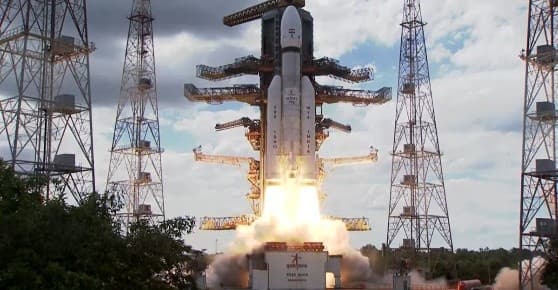
Launch pad: third at Satish Dhawan Space Centre, Sriharikota, Andhra Pradesh

Purpose: serve Next Generation Launch Vehicle, heavy-lift, human and deep-space missions

Timeline: civil works May 2028; full commissioning March 2029

Quick Facts for MCQs

Technology & Capacity

  • NGLV: 91 m tall, higher thrust, new jet deflection system
  • Propellant: supports cryogenic and semi-cryogenic high-thrust operations
  • Modular: multiple work packages enable parallel construction and upgrades

Strategic Dimension

  • Redundancy: third pad avoids single-pad failure delays
  • Human spaceflight: cornerstone for Gaganyaan and later crewed station modules
  • Deep-space: vital for lunar landing and interplanetary mission assembly

Industry & Economy

  • Make in India: private, MSME firms contracted for civil, fluid, launch systems
  • Commercial: higher launch rate expands domestic and foreign customer base
  • Supply-chain: indigenisation of cryogenic, semi-cryogenic components stimulated

Key Data Points

FeatureData-Point
LocationSDSC, Sriharikota, Andhra Pradesh
DesignationThird Launch Pad (TLP)
Commissioning targetMarch 2029
Civil works completeMay 2028
Fluid systems readyJuly 2028
Launch systems readySept 2028
Core vehicle91 m Next Generation Launch Vehicle
Height comparisonNGLV ≈ 2 × LVM-3
Backup forLVM-3 missions
Key mission supportGaganyaan crewed flights
Propellant handlingCryogenic and semi-cryogenic
Construction modelMultiple modular work packages
Private/MSME roleInfrastructure, systems supply
Strategic benefitEliminates single-pad dependency
Economic pushBoosts commercial launch capacity

Related UPSC Prelims PYQs

CDS_GK, GS1 2018PYQ 1

भारत के उपग्रह प्रक्षेपित करने वाले वाहनों के संदर्भ में, निम्नलिखित कथनों पर विचार कीजिए :

CDS_GK, GS1 2022PYQ 2

India's maiden human space mission will be launched in 2023. What is its name?

GS-3S&T

11.Private Space Talent Shortage (Space Workforce)

LiveMint

What & Where

Private-space talent crisis: dearth of specialised engineers for rocketry, propulsion, photonics, sensors in India

Core process: startups hire cross-domain grads, then 6–12 month intensive upskilling

Geography: Indian aerospace hubs—Bengaluru, Hyderabad, Chennai, Pune

Quick Facts for MCQs

Talent Supply Gap

  • Limited specialised courses constrain pipeline; only 0.5 % engineers trained annually
  • Brain-drain persists as overseas salaries outstrip domestic offers
  • Low student awareness of viable space careers

Training Burden

  • Startups spend up to a year making recruits project-ready, delaying R&D milestones
  • Cross-domain engineers need reskilling in rocketry, sensors, cryogenics

Government & Policy

  • IN-SPACe, AICTE drafting space-centric curricula; short-term certification modules launched
  • Liberalised FDI plus Make-in-India incentives to boost private R&D and manufacturing

Economic Angle

  • Private innovation vital for US$9 billion space economy ambition
  • Talent crunch threatens India’s share in global launch and satellite markets

Key Data Points

FeatureData-Point
UG aerospace institutes175
PG aerospace institutes75
Annual aerospace graduates~8,000 (0.5 % of engineers)
Freshers in startup hiring~30 %
Typical in-house training6–12 months
Main lateral-hire sectorsAutomotive, metallurgy
Space economy target (2030)US$9 billion
Key missing specialisationsPhotonics, cryogenics, optical engg
Gov-industry curriculum linkIN-SPACe-AICTE tie-up
FDI stance in spaceLiberalised norms
GS-3S&TQuick Bite

12.Diabetes Prevalence Among Indians (Noncommunicable Disease)

Indian Express

What & Where

Diabetes chronic non-communicable disease marked by insulin deficit or resistance causing blood-sugar imbalance

Key types Type 1 autoimmune, Type 2 lifestyle-linked, Gestational pregnancy-related, new Type 5 malnutrition-induced in lean youth

India LASI-2019 shows 20 % diabetics among ≥45 yrs with 40 % undiagnosed

Quick Facts for MCQs

Health Statistics

  • LASI covers adults 45+ across 31 states / UTs yielding nationally representative diabetes data
  • Silent burden highlighted with two in five cases remaining undiagnosed

Types & Pathophysiology

  • Type 1 destroys pancreatic beta cells necessitating lifelong insulin
  • Type 2 shows insulin resistance or inadequate secretion, largely preventable by weight control and activity
  • Type 5 arises from protein-energy malnutrition damaging beta cells in lean adolescents

Government Initiatives

  • Fit India promotes physical activity and balanced diets to curb NCDs
  • Ayushman Arogya Mandirs provide population-based diabetes screening and early management
  • CBSE mandates sugar-content display boards to build dietary literacy in schools

Key Data Points

FeatureData-Point
LASI survey year2019
Prevalence ≥45 yrs1 in 5 Indians
Undiagnosed share≈40 % of diabetics
Dominant type shareType 2 >95 % cases
New Type 5 BMI cut-off<18.5 kg/m²
Core hormoneInsulin
Screening platformAyushman Arogya Mandirs
Lifestyle pushFit India Movement
School awareness toolCBSE ‘sugar boards’
GS-2Security

13.India-UAE Defence Cooperation Meeting (India-UAE Defence)

PIB

What & Where

JDCC: bilateral India-UAE forum reviewing & planning defence cooperation; 13th meet held Aug 2025, New Delhi.

MoU: Indian Coast Guard–UAE National Guard pact covering maritime security, SAR, anti-piracy, pollution response across Indian Ocean Region.

Geography: Cooperation spans Gulf of Oman, Arabian Sea, wider IOR; manufacturing tie-ups target both Indian & UAE defence hubs.

Quick Facts for MCQs

Defence Cooperation

  • Training: Enhanced inter-service exercises, SME exchanges, aim for full tri-service interoperability.
  • Industry: Co-development of AI tools, shipbuilding refits, maintenance of shared platforms envisaged.
  • Maritime: Real-time info-sharing grid for piracy, SAR, spill response across IOR chokepoints.

Economic Ties

  • Trade: Petroleum, gems, agri, textiles, chemicals, engineering goods dominate bilateral basket.
  • Finance: Integrated payment & LCS system to cut forex costs, speed cross-border transactions.
  • Manufacturing: Small-arms JV signals shift from buyer-seller to joint producer model.

Strategic Platforms

  • I2U2: India-UAE-USA-Israel grouping leverages UAE capital for Indian projects.
  • IMEC: Emirati participation in India-Europe corridor boosts connectivity and supply-chain resilience.
  • Abraham Accords: UAE-Israel normalisation widens trilateral tech & energy opportunities for India.

Key Data Points

FeatureData-Point
JDCC edition/year13th / 2025
VenueNew Delhi
UAE rank in India’s trade3rd overall, 2nd for exports
India rank in UAE’s trade2nd
Indian diaspora in UAE≈3.5 million
New defence MoU partiesIndian Coast Guard & UAE National Guard
Key joint industry tie-upICOMM–CARACAL small arms manufacturing
Strategic petroleum roleUAE supplies SPR crude to India
Currency settlement pactLocal Currency Settlement System (rupee–dirham)

Related UPSC Prelims PYQs

CAPF_GAI, NDA_GAT 2024PYQ 1

Which of the following statements with regard to the outcomes of the talks between the Prime Minister of India and the President of UAE held in February, 2024 is/are correct?

CAPF_GAI, NDA_GAT 2020PYQ 2

'Naseem-Al-Bahr' is a bilateral naval exercise between India and

GS-2Scheme

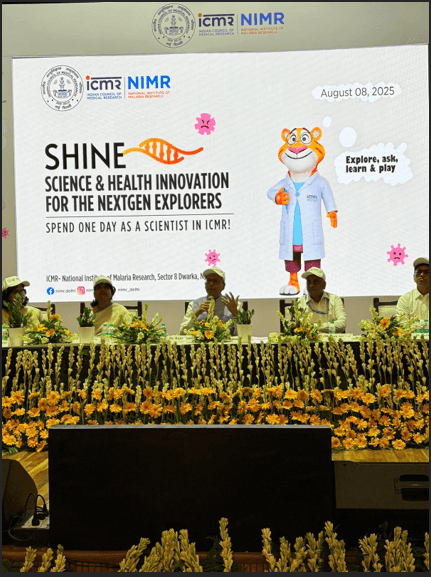
14.SHINE Science Outreach Programme (Science Outreach)

Economic Times
Illustration for SHINE Science Outreach Programme (Science Outreach)

What & Where

SHINE = Science, Health & Innovation for Nextgen Explorers; nationwide science-outreach programme.

Launched 2024 by Indian Council of Medical Research with Department of Health Research.

Conducted across 39 districts in 16 States/UTs via ICMR institutes.

Quick Facts for MCQs

Objectives

  • Inspiration; spark curiosity toward biomedical research careers.
  • Familiarisation; showcase real-world health science applications.
  • Innovation; nurture problem-solving mindset for public-health challenges.

Outreach Scale

  • Nationwide; simultaneous events at 16 ICMR institutes.
  • Inclusive; urban-rural mix spanning 39 districts.
  • Large-volume engagement; >13 k students on single open day.

Content & Tools

  • Experiential; lab walkthroughs, live research demonstrations.
  • Audio-visual; short films on Covaxin, iDRONE, TB mission.
  • Branding; Dr. Curio mascot simplifies complex science for teens.

Key Data Points

FeatureData-Point
Full formScience, Health and Innovation for Nextgen Explorers
Launch year2024
Nodal bodiesICMR + Department of Health Research
Target classesGrades 9-12
Students reached (1st open day)13,150
Schools covered300 +
Districts / States-UTs39 / 16
Key activitiesLab tours, exhibitions, poster walks, live demos
Career interfaceDirect interactions with ICMR scientists
Engagement mascot“Dr. Curio”
Flagship films shownCovaxin, iDRONE, TB elimination, pandemic drills
Core aimSpark curiosity & pipeline for biomedical research careers

Related UPSC Prelims PYQs

CDS_GK 2025PYQ 1

“Million Minds Augmenting National Aspirations and Knowledge” (MANAK), a scheme under the flagship programme, Innovation in Science Pursuit for Inspired Research (INSPIRE), caters to:

GS-2Scheme

15.Pradhan Mantri Ujjwala Yojana (Clean Cooking)

The Hindu

What & Where

Scheme: Pradhan Mantri Ujjwala Yojana—deposit-free LPG links for poor women.

Geography: Pan-India rollout by Oil Marketing Companies under MoPNG.

Aim: Replace solid fuels with clean LPG for health, environment, gender gains.

Quick Facts for MCQs

Legal & Policy

  • Continuation: Cabinet cleared FY 2025-26 ₹300-per-cylinder subsidy for PMUY cohort.
  • Identification: SECC-2011 list + Aadhaar + bank linkage mandatory.
  • Expansion: Extra 75 lakh new connections sanctioned.

Social Concerns

  • Health: Lower indoor air pollution cuts respiratory disease burden.
  • Gender: LPG access trims fuel-gathering drudgery, frees time for education/earning.
  • Migration: Address-proof waiver eases urban migrant inclusion.

Environmental Impact

  • Deforestation: Reduced firewood demand safeguards forest biomass.
  • Emissions: LPG combustion slashes particulates & CO₂ versus solid fuels.
  • Tagline: “Swachh Indhan Behtar Jeevan” stresses sustainability message.

Economic Angle

  • Fiscal: Subsidy buffers poor households from market LPG price spikes.
  • Industry: Higher LPG adoption stokes stove, cylinder, logistics demand.
  • DBT: Direct transfer curbs leakage, heightens subsidy efficiency.

Key Data Points

FeatureData-Point
LaunchMay 2016, Ballia (Uttar Pradesh)
Nodal MinistryPetroleum & Natural Gas
Core BeneficiaryAdult BPL woman (SECC-2011)
Connection Charge₹0 security deposit
Stove AidOne-time govt assistance
Current Subsidy₹300 per 14.2 kg cylinder
Refill Limit9 subsidised refills/year
5 kg CylinderSubsidy proportionate
Delivery ModeDBT into Aadhaar-linked bank
ImplementationPMUY 1.0, 2.0, +75 lakh add-on
Aggregate Target10.35 crore connections
Migrant ClauseNo address proof needed (2.0)

Related UPSC Prelims PYQs

CAPF_GAI, CDS_GK 2020PYQ 1

Saubhagya, a Government of India Scheme, relates to which of the following areas?

CAPF_GAI, CDS_GK 2020PYQ 2

SAUBHAGYA, a Central Government scheme, is related to

GS-2SchemeQuick Bite

16.MANAS Anti-Drug Helpline (Drug Control)

PIB

What & Where

MANAS Helpline = Madak-Padarth Nished Asoochna Kendra, secure anonymous portal to report NDPS-Act drug offences & seek help

Nationwide coverage; operated online & call-based by Narcotics Control Bureau, Ministry of Home Affairs

Focus areas : crime-reporting, prevention, treatment, rehabilitation of substance abuse

Quick Facts for MCQs

Tech & Schemes

  • Platform features : end-to-end encryption, caller anonymity, 24×7 multilingual support
  • Integrates with NIDAAN for real-time offender mapping
  • Offers referral links to govt-run de-addiction centres

Legal & Policy

  • NDPS Act empowers NCB to investigate, seize, prosecute narcotics offences
  • PITNDPS Act enables preventive detention of traffickers for up to two years
  • State governments derive power from Article 47 to impose prohibition measures

International Framework

  • India’s treaty obligations mandate scheduling, control, and reporting of narcotic & psychotropic substances
  • Helpline data aids annual compliance report to INCB (UN body)
  • Conventions facilitate cross-border intelligence sharing against drug trafficking

Key Data Points

FeatureData-Point
Launch monthJuly 2024
First-year reports70,000 + citizen inputs
Implementing bodyNarcotics Control Bureau (NCB)
Parent ministryHome Affairs
Constitutional backingArticle 47—State duty to curb intoxicants
Core lawNDPS Act 1985
Supplementary lawsDrugs & Cosmetics Act 1940; PITNDPS Act 1988
Key international pacts1961 Single Convention; 1971 Psychotropic Convention; 1988 UN Illicit Traffic Convention
Related portalsNIDAAN
Mass campaignNasha Mukt Bharat Abhiyan

Related UPSC Prelims PYQs

GEO_GS 2025PYQ 1

Which one of the following statements about Tele MANAS App is correct?

Ready to practice?

Test your knowledge with our UPSC test series.

Start Free Trial