UPSC Current Affairs

15 topicsGS-1: 2GS-2: 4GS-3: 9
0/15 done
GS-2Polity

1.Motor Vehicle Aggregator Guidelines 2025 (Aggregator Guidelines)

DH

What & Where

MVAG-2025: national guidelines regulating app-based mobility aggregators under Motor Vehicles Act 1988

Issued by Ministry of Road Transport & Highways; enforceable across all Indian states & UTs

Covers taxis, auto-rickshaws, bike-taxis, EV fleets, Divyangjan-friendly vehicles under one licence

Quick Facts for MCQs

Driver Welfare

  • Revenue share floor 80 % own-vehicle, 60 % aggregator-owned
  • Mandatory insurance package ₹15 lakh total; periodic health, psychological checks
  • Quarterly training for bottom 5 % driver ratings

Passenger Protection

  • Insurance cover ₹5 lakh per passenger; meter counts pick-up to drop-off only
  • Grievance window three days; outcome communication mandatory
  • Cancellation misuse penalty 10 % fare, cap ₹100 on rider/driver

Pricing & Compliance

  • Base fare set by states; dynamic pricing allowed 0.5–2× base
  • Violation fines ₹1 lakh–₹1 crore; repeat offence brings 3-month suspension
  • Licence management via central online portal, dedicated grievance officer compulsory

Green & Inclusive Mobility

  • Bike-taxi legality extended to private motorcycles, subject to state nod
  • States may impose annual EV adoption targets on aggregators
  • Divyangjan-accessible vehicles inclusion mandatory in fleets

Key Data Points

FeatureData-Point
Year notified2025
Parent ActMotor Vehicles Act 1988
Driver share (own vehicle)≥ 80 % of fare
Driver share (aggregator vehicle)≥ 60 % of fare
Health insurance per driver₹5 lakh
Term insurance per driver₹10 lakh
Passenger travel cover₹5 lakh per ride
Complaint resolution≤ 3 days
Dynamic pricing band0.5× – 2× state base fare
Cancellation penalty10 % fare; cap ₹100
Bike-taxi provisionPrivate motorcycles allowed, state nod
EV mandateStates may set annual targets
Accessibility clauseDivyangjan-friendly vehicles compulsory
Fine range₹1 lakh – ₹1 crore
Licence suspension3 months on repeat offence
GS-2Polity

2.TV Rating Guidelines 2025 (TV Ratings)

PIB

What & Where

Television Rating Point (TRP): metric quantifying TV programme reach and popularity in India

TV Rating Guidelines 2025: draft policy by Ministry of Information & Broadcasting to reform TRP ecosystem

Coverage: pan-India, impacting ~230 million television households and emerging digital screens

Quick Facts for MCQs

Legal & Policy

  • Draft_Guidelines: authorises parallel agencies, ends single-agency regime
  • Clause_1.4: narrows prohibition to conflict-of-interest, permits general consultancy
  • Clauses_1.5 & 1.7: deleted to unlock market entry and competition

Tech & Schemes

  • Connected_Measurement: mandates inclusion of streaming apps, smart-TVs, mobile consumption
  • Investment_Model: broadcasters and advertisers may co-fund meters under regulated oversight
  • Transparency: framework seeks audit-ready, publicly disclosed methodologies

Market Competition

  • Monopoly_Issue: BARC sole operator since 2014 restricting innovation and checks
  • Sample_Deficit: 58 k meters inadequate for vast, diverse audience base
  • Digital_Shift: absence of connected-device data misguides ad allocation and content strategy

Key Data Points

FeatureData-Point
Admin ministryMinistry of Information & Broadcasting
Present regulatorBroadcast Audience Research Council (BARC)
Existing framework year2014 Policy Guidelines for TV Rating Agencies
Current meter sample58 000 households
Share of TV homes0.025 % of 230 million
Draft issued forTV Rating Guidelines 2025
Key reformMultiple rating agencies allowed
Clause 1.4 tweakLimits only conflict-of-interest
Clauses removed1.5, 1.7 (entry barriers)
New coverage mandateSmart TV, OTT, mobile devices
GS-2Polity

3.Overseas Citizen of India Scheme (OCI Card)

Business Standard
Illustration for Overseas Citizen of India Scheme (OCI Card)

What & Where

Definition: Overseas Citizen of India (OCI) = lifelong, multiple-entry residency visa for foreign nationals of Indian origin.

Launch: August 2005 under Citizenship (Amendment) Act 2005; handled by Ministry of Home Affairs.

Geography: Applicable worldwide; latest extension reaches Indian diaspora up to 6th generation in Trinidad & Tobago.

Quick Facts for MCQs

Eligibility Matrix

  • Lineage: Ex-citizens post-26 Jan 1950, eligible citizens on that date, or from territories joining India post-15 Aug 1947.
  • Descendants: Children, grandchildren, great-grandchildren; minor kids with ≥1 Indian parent qualify.
  • Spousal: Foreign spouse of Indian/OCI eligible if marriage ≥2 years and still subsisting.

Rights & Restrictions

  • Rights: Live, work, study, own non-farmland, open bank accounts, avail NRI financial benefits.
  • Restrictions: No voting, no contesting elections, no constitutional posts, no govt employment.
  • Parity: Treated on par with NRIs for economic, educational, housing matters.

Recent Update

  • Announcement: PM extended OCI eligibility to Indian-origin persons up to sixth generation in Trinidad & Tobago.
  • Significance: Deepens diaspora engagement without altering single-citizenship policy.
  • Implementation: Same online OCI portal processes; documentation of lineage up to six generations required.

Key Data Points

FeatureData-Point
Governing law clauseSection 7A, Citizenship Act 1955
Administering bodyMinistry of Home Affairs
Visa validityLifelong, multiple-entry
Police reportingNil, regardless of stay length
Property rightsResidential & commercial; no agricultural land
Educational paritySame as NRIs in admissions & fees
EmploymentFree to work without additional visa
Excluded ancestriesPakistan, Bangladesh & govt-notified states
Spouse conditionMinimum 2-year valid marriage
Latest expansionUp to 6th-generation Indian-origin in T&T
GS-3Economy

4.RBI Bans Loan Prepayment Charges (Loan Prepayment)

Financial Express

What & Where

Pre-payment: early settlement of floating-rate loans by individuals & MSEs in India

Types: Part-prepayment (lump sum with EMIs) and Full prepayment/foreclosure of entire outstanding

Directive: RBI bans pre-payment penalties w.e.f. 1 Jan 2026 for new/renewed loans

Quick Facts for MCQs

Legal & Policy

  • RBI master direction covers commercial banks, NBFC-ULs, UCBs, RRBs alike
  • Powers used: Banking Regulation Act & RBI Act supervisory mandate
  • Uniform rule harmonises earlier scattered caps below ₹50 lakh

Economic Angle

  • Loan portability boost; competition may compress lending spreads
  • Lower exit cost eases credit for MSEs, aiding employment & Atmanirbhar Bharat goals
  • Potential uptick in first-time rural and women borrowing

Consumer Protection

  • Addresses opaque, inconsistent fee practices flagged in RBI reviews
  • Eliminates unfair burden on borrowers seeking early closure
  • No fund-source or timing restrictions maximises repayment flexibility

Key Data Points

FeatureData-Point
RegulatorReserve Bank of India
Effective date1 January 2026
Loan categoryFloating-rate only
Eligible borrowersIndividuals (non-business) & MSEs
ScopeNew or renewed sanctions post-date
Pre-payment formsPart & Full payments
Penalty chargesCompletely prohibited
Lock-in periodNone; anytime repayment allowed
Fund source conditionIrrelevant; borrower choice
Mandatory disclosuresSanction letter, Loan agreement, Key Facts Statement

Related UPSC Prelims PYQs

GS1 2016PYQ 1

What is/are the purpose/purposes of the 'Marginal Cost of Funds based Lending Rate (MCLR)' announced by RBI?

GS-3Economy

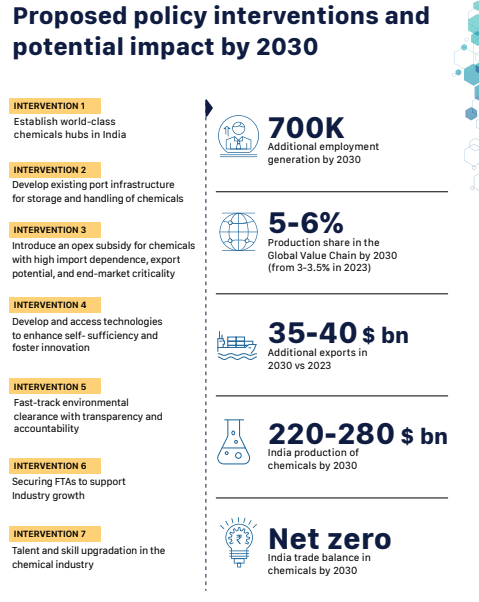
5.NITI Report on Chemical Industry (Chemical Industry)

ANI
Illustration for NITI Report on Chemical Industry (Chemical Industry)

What & Where

Definition: NITI Aayog 2024 blueprint to make India a USD 1 trn global chemical powerhouse by 2040

Key segments: bulk, petro, specialty, knowledge chemicals powering pharma, textiles, agro, construction value chains

Core geography: Current clusters Dahej-Gujarat, Taloja-Maharashtra, Cuddalore-Tamil Nadu; proposed mega-hubs Paradeep, Dahej, Vizag

Quick Facts for MCQs

Economic Angle

  • Contribution: Sector backbone for pharma, textiles; imports >60 % critical APIs from China
  • Logistics: Freight cost 2–3 x global peers, eroding export margins
  • Feedstock: Heavy crude and naphtha import dependence exposes price-shock vulnerability

Challenges & Bottlenecks

  • Regulatory: Multi-agency clearances, frequent policy shifts deter capex
  • Infrastructure: Legacy clusters lack modern storage, safety, effluent treatment
  • Skill gap: 30 % shortage in green chemistry, process safety, nanotech

Policy & Schemes

  • Hubs: Upgrade clusters, Chemical Fund, empowered committees for Paradeep, Dahej, Vizag
  • Opex subsidy: Reward import substitution and export-oriented incremental output
  • FTAs: Insert chemical-specific clauses, simplify origin proofs for UAE, EU, ASEAN markets

Skill & Innovation

  • Interface body: DST-led platform to spur academia–industry collaboration, technology transfer
  • Training: Expanded ITIs, new courses in polymer science, process safety, specialty formulation
  • R&D goal: Raise spend toward global 2.3 % benchmark, enable green and high-value innovation

Key Data Points

FeatureData-Point
Global production rank6th (world), 3rd (Asia)
Share in manufacturing GDP>7 %
Present GVC share3.5 %
Target GVC share 204012 %
Output goal 2040USD 1 trillion
2023 trade deficitUSD 31 billion
Industry R&D spend0.7 % of revenue
Global avg R&D spend2.3 %
Skilled jobs potential7 lakh by 2030
EC delay duration12–18 months

Related UPSC Prelims PYQs

ESE_GS 2026PYQ 1

Which institution released the report titled “India’s Blue Economy: Strategy for Harnessing Deep-Sea and Offshore Fisheries”?

GS-1Environment

6.Roll Cloud Formation (Cloud Formation)

Indian Express
Illustration for Roll Cloud Formation (Cloud Formation)

What & Where

Rare, detached, horizontal tube-shaped cloud appearing to roll; not linked to thunderstorm base or rotating vortex

Forms when cool moist maritime air undercuts hot dry continental air, creating gravity waves under a temperature inversion

Typical over U.S. Plains, Gulf of Carpentaria (Australia) and Atlantic coasts of Europe, incl Portugal’s recent sighting

Quick Facts for MCQs

Formation Drivers

  • Contrasting-air interaction triggers density shear and frontal lifting
  • Temperature inversion traps cool air, enabling horizontal wave propagation
  • Gravity-wave crests condense moisture creating the visible roll

Physical Characteristics

  • Shape elongated cylindrical cloud rolling along its axis
  • Structure single cloud band with sharp leading and trailing edges
  • Movement speed governed by prevailing low-level wind flow

Geographic Hotspots

  • Gulf of Carpentaria records world-famous annual Morning Glory events
  • Great Plains USA and Atlantic Europe host episodic occurrences during frontal passages
  • Coastal transition zones with strong sea-breeze fronts most conducive

Meteorological Significance

  • Indicator of lower-tropospheric instability and strong horizontal temperature gradient
  • May precede local squalls or storm outflows though seldom severe
  • Offers valuable field for studying meso-scale atmospheric dynamics

Key Data Points

FeatureData-Point
Cloud typeLow-level, arciform, single roll
AttachmentCompletely detached from parent storm
Usual lengthCan span hundreds of km
Altitude bandFew hundred metres above surface
Peak timingEarly morning; nicknamed “Morning Glory”
Core driverInteraction of maritime cool air & continental hot air
Key dynamicAtmospheric gravity waves under inversion
AlignmentGenerally parallel to low-level wind or sea-breeze front
Danger levelLargely visual; minimal direct hazard
Heatwave linkFormed during 2023 European heatwave over Portugal
GS-3Environment

7.Model Rules for Agroforestry Promotion (Agroforestry Rules)

PIB

What & Where

Agroforestry = tree–crop/livestock land-use; key variants – farm, extension, mixed forestry & shelterbelts.

MoEFCC Model Rules 2025 govern tree felling on all Indian agricultural lands via NTMS digital portal.

India’s agroforestry footprint ≈ 28.4 million ha (8.65 % of land); dominant farm species – teak, eucalyptus, poplar.

Quick Facts for MCQs

Legal & Policy

  • Model Rules override state felling/transit norms; SLC monitors compliance.
  • Empanelled agencies verify applications beyond 10-tree limit.
  • NAP-2014 made India global pioneer in agroforestry legislation.

Tech & Schemes

  • NTMS uses geo-tagged photos, KML files & AI image recognition for transparency.
  • GROW leverages Remote Sensing & Agroforestry Suitability Index on ISRO’s Bhuvan portal.
  • SMAF under NMSA funds seedlings, protection; converges with MNREGA, RKVY, NABARD.

Economic Angle

  • Supplies ~50 % fuelwood, 60 % pulpwood, 9–11 % green fodder demand nationally.
  • High-value timber on farms curbs imports, boosts rural income diversification.
  • Financial hurdles: long gestation, scarce credit/insurance, weak buy-back links.

Environmental Impact

  • Sequestration aids 2070 net-zero goal; complements ARR carbon-sink efforts.
  • Leaf-litter & N-fixing trees enrich soil, cut chemical-fertiliser need.
  • Supports land-degradation neutrality & 9 of 17 SDGs.

Key Data Points

FeatureData-Point
Issue year of Model Rules2025
Portal nameNational Timber Management System (NTMS)
Self-declaration ceiling≤ 10 trees
Verification needed when> 10 trees
Agroforestry area28.4 million ha (8.65 %)
Carbon sink potential> 2.5 billion t CO₂e by 2030
N-fixation by trees50–100 kg N/ha/yr
Land restoration target (GROW)26 million ha by 2030
First dedicated policy yearNational Agroforestry Policy 2014

Related UPSC Prelims PYQs

GS1 1996PYQ 1

Consider the following programmes:

GS1 2005PYQ 2

Consider the following statements:

GS-3Environment

8.CITES 50th Anniversary (CITES Anniversary)

UN

What & Where

Multilateral treaty regulating international trade in ≈40 000 wild animal & plant species

Signed 3 Mar 1973 (Washington); entered into force 1 Jul 1975; Secretariat under UNEP, Geneva

185 Parties worldwide, including India (since 1976) and the European Union

Quick Facts for MCQs

Legal & Policy

  • Permit system ensures trade is legal, sustainable, traceable
  • Conference of the Parties decides Appendix I & II amendments; two-thirds majority required
  • Appendix III listings added or removed unilaterally by any Party

Conservation Impact

  • CITES Trade Database offers open access record of legal wildlife trade flows
  • MIKE programme data show falling elephant poaching trends in Africa & Asia
  • Listings credited with recovery of African elephants, pangolins, Nile & saltwater crocodiles

Indian Context

  • Wildlife (Protection) Amendment Act 2022 synchronises national Schedule IV with entire CITES appendices
  • Management Authority: MoEFCC; enforcement by Customs, Wildlife Crime Control Bureau, state forest officers
  • Harmonisation aids biodiversity targets, rural livelihoods, SDG-15 compliance

Key Data Points

FeatureData-Point
Alternate nameWashington Convention
Signing date3 March 1973
Entry into force1 July 1975
Administered byUN Environment Programme
Secretariat locationGeneva, Switzerland
Total Parties185 + EU
Listed taxa≈40 000 species
Appendix ITrade only in exceptional cases
Appendix IIControlled trade; not yet endangered
Appendix IIIUnilateral national listing
Permit typesExport, import, re-export, introduction-from-sea
CoP roleAmends Appendices I & II
World Wildlife Day3 March (UNGA 2013)
India’s statusParty since 1976
WLPA 2022 linkAll CITES species in Schedule IV

Related UPSC Prelims PYQs

GS1 2015PYQ 1

With reference to the International Union for Conservation of Nature and Natural Resources (IUCN) and the Convention on International Trade in Endangered Species of Wild Fauna and Flora (CITES), which of the following statements is/are correct?

GS1 2018PYQ 2

भारत में माल के भौगोलिक संकेत (रजिस्ट्रीकरण और संरक्षण) अधिनियम, 1999 को निम्नलिखित में से किससे संबंधित दायित्वों के अनुपालन के लिए लागू किया गया ?

GS-3SpeciesQuick Bite

9.New Tree Species Garcinia kusumae (New Tree Species)

The Hindu

What & Where

Garcinia kusumae: newly discovered dioecious evergreen tree in Golaghat district, Assam, India

Belongs to genus Garcinia (family Clusiaceae) noted for tropical, resin-bearing trees/shrubs

Adds to Assam’s rich Garcinia diversity (now 13 species, 3 varieties)

Quick Facts for MCQs

Biodiversity & Distribution

  • Genus concentration India-wide highest in Western Ghats & Northeast; Assam holds > 35 % Indian Garcinia diversity
  • Discovery underscores Eastern Himalayan biodiversity hotspot status
  • Fieldwork conducted in Doyang Reserve Forest, Golaghat district

Morphology

  • Leaves opposite, leathery; male & female flowers on separate trees
  • Ripe fruit exudes yellow oleo-resin unlike reddish resin of G. cowa
  • Pollen, sepal numbers, stigma shape separate it from nearest congeners

Ethnobotany

  • Fruit pulp diluted as summer sherbet preventing heat stroke
  • Slice added to fish/meat curries for sourness, consumed with salt-chilli mix
  • Rural healers employ decoction for diabetes control, diarrhoea & dysentery relief

Key Data Points

FeatureData-Point
Taxonomic familyClusiaceae
GenusGarcinia
New species nameGarcinia kusumae
Local Assamese nameThoikora
Growth formDioecious evergreen tree
Maximum height≈ 18 m
Flowering seasonFebruary – April
Fruiting seasonMay – June
Global Garcinia tally414 species
Indian tally33 species + 7 varieties
Assam tally (post-discovery)13 species + 3 varieties
Key morphological traitDistinct flower structure & yellow resin in ripe fruit
Closest comparatorsG. assamica, G. cowa, G. succifolia
Ethnobotanical usesSherbet, curry souring, raw condiment, remedies for diabetes & dysentery
GS-3EnvironmentQuick Bite

10.Kariyachalli Island Conservation Efforts (Kariyachalli Island)

Down to Earth

What & Where

Kariyachalli Island — shrinking coral-sand cay inside Gulf of Mannar Marine NP, Tamil Nadu; vital to dugong-seagrass ecosystem.

Gulf of Mannar — Laccadive Sea embayment between Rameswaram & Mannar Island; holds 21 islets, South Asia’s first Marine Biosphere Reserve.

TNSHORE project — state-led coastal resilience plan deploying artificial reefs, seagrass and coral restoration to curb erosion and submergence.

Quick Facts for MCQs

Biodiversity

  • Diversity: corals, seagrass, seaweeds, pearl oysters, sacred chank, whale sharks, sea turtles, dugongs.
  • Habitats: reefs, mangroves, mudflats, creeks, estuaries, sandy, rocky shores within 560 km² reserve.
  • Productivity: riverine nutrients heighten primary production supporting rich trophic webs.

Threats & Degradation

  • Climate drivers: sea-level rise, stronger waves accelerate island shrinkage; bleaching erodes reef resilience.
  • Anthropogenic stress: coastal development, port activity, pollution compound natural degradation.
  • Forecast: island may vanish within decade if mitigation falters.

Tech & Schemes

  • Artificial-reef modules dissipate wave energy, promote coral larval settlement, stabilize shoreline.
  • Seagrass planting restores dugong forage, enhances carbon sinks, traps sediments.
  • TNSHORE funded under National Coastal Mission; showcases state-level blue-carbon and adaptation strategy.

Key Data Points

FeatureData-Point
Major coral-reef regionsGulf of Mannar, Gulf of Kutch, Lakshadweep, A&N Islands
Kariyachalli land-loss (since 1969)≈ 70 %
Expected full submergence2036
Coral already bleached30 %
Artificial reef modules8,500 units
Module designPerforated trapezoidal ferro-cement + steel
Key flagship speciesDugong – IUCN Vulnerable
Gulf of Mannar islets21
Marine NP notification year1982
Adjacent seaLaccadive Sea
Rivers draining inTambraparni, Aruvi
Nearby major portTuticorin (Thoothukudi)

Related UPSC Prelims PYQs

CDS_GK, GS1 1999PYQ 1

The first marine sanctuary in India, having within its bounds coral reefs, Mollusca, dolphins, tortoises and various kinds of sea birds, has been established in

CDS_GK, GS1 2021PYQ 2

Which one of the following biosphere reserves comprises islands with estuaries, beaches, coral reefs, salt marshes and mangroves?

GS-3S&T

11.Healthy Ageing Biomarkers Study (Healthy Ageing)

The Hindu

What & Where

Definition: Healthy ageing = sustained physical, mental, functional ability despite chronological age

Process: Ageing driven by telomere shortening, cumulative infections, pollution, social support impacts

Geography: BHARAT biomarker study piloted by IISc Bengaluru; targets pan-India elder cohorts

Quick Facts for MCQs

Demographic Shift

  • Rapidity: India ageing faster than many OECD nations
  • Skew: Rural districts witnessing sharpest elder share rise
  • Gender: Females live longer yet endure more disability years

Diagnostic Mismatch

  • Reference-values: Western CRP, HDL, B12 cut-offs often misclassify Indians
  • Vegetarian diet: Common low B12 may not equal pathology
  • Early infection load: Alters immune markers, confounding imported standards

Healthcare Gaps

  • Infrastructure: Sparse geriatric wards; urban concentration eg Tamil Nadu
  • Finance: NHM lacks dedicated ageing budget component
  • Workforce: Limited geriatric specialists despite new PG courses

Tech & Schemes

  • BHARAT: First Indian bio-bank for ageing indicators, aims contextual cut-offs
  • NPHCE: Geriatric clinics, home-care units under district hospitals
  • ABDM link: Proposed integration of elder biometrics for AI-based predictive tools

Social Concerns

  • Family change: Smaller units eroding traditional elder care
  • Elder homes: Rising numbers in Maharashtra, Karnataka indicate intergenerational strain
  • Screening hesitancy: Tribal elders often refuse hospital-based tests

Key Data Points

FeatureData-Point
Elderly (60+) share by 205020 % ≈ 319 million (UNFPA)
Parkinson’s disease rise 1990-2050+168 % (Lancet 2024)
Dementia rise 1990-2050+200 % (Lancet 2024)
Women DALY burden vs menHigher despite longer lifespan
Formal pension coverage28 % of elderly (NSSO 75th)
PHCs with geriatric OPD<5 % (MoHFW survey)
Kerala projected dependency ratio35 % by 2030s
IGNOAPS reach<20 % aged poor covered
LASI coverage72,000+ elders across 30 States/UTs
Biomarker examplesCRP, HDL, vitamin B12, metabolites
GS-3S&T

12.Blocking AI Web Crawlers (AI Web Crawlers)

Indian Express

What & Where

Definition: Automated bots harvesting online content to train Large Language Models (LLMs) or feed live AI answers.

Types: Model-training crawlers (GPTBot, Amazonbot, GoogleOther) and live-retrieval crawlers supporting Bing, ChatGPT.

Geography: Blocking first by major US-UK publishers; India now weighing consent-based safeguards.

Quick Facts for MCQs

Legal & Policy

  • Absence: India has no dedicated framework regulating AI web-scraping or licensing.
  • Mandate: MeitY & I&B urged to legally define “unauthorised scraping”, enable consent-based licensing.
  • Precedent: EU AI Act 2024 begins governing copyrighted datasets.

Copyright Enforcement

  • Issue: News, blogs, educational content mined without permission or revenue.
  • Ambiguity: Indian “fair use” versus unlicensed AI training still unsettled.
  • Demand: Publishers seek statutory right to block or license crawler access.

Ethical & Social

  • Disclosure: AI firms seldom reveal training sources, denying attribution.
  • Risk: Unvetted data propagates bias, inaccuracies, eroding public trust.
  • Equity: Free Indian content benefits big tech, sidelines small publishers.

Technical Safeguards

  • Tool: Cloudflare-style AI-bot blockers proposed for Indian websites.
  • Action: Leading US-UK publishers already enforcing crawler bans.
  • Goal: Offer dashboards letting creators monitor, allow, or deny specific bots.

Key Data Points

FeatureData-Point
Core purposeGather web text/images for generative AI
Key model-training botsGPTBot, Amazonbot, GoogleOther
Live-retrieval platformsBing AI, ChatGPT Search
Indian statute gapCopyright Act 1957 lacks AI clauses
Benchmark lawEU AI Act 2024
GS-2Polity

13.Russia Recognises Taliban Regime (Taliban Recognition)

NDTV

What & Where

Russia : trans-continental state in Eastern Europe & Northern Asia, c-17 million sq km, 11 time zones

First country to officially recognise Taliban-led Islamic Emirate of Afghanistan since 2021 takeover

Capital Moscow; borders 16 nations—maximum globally

Quick Facts for MCQs

Diplomatic Move

  • Recognition 2024 marks first formal legitimacy for Taliban since 2021 power seizure
  • Step may influence other Eurasian states’ Afghanistan stance
  • Could reshape regional security calculus in Central Asia

Political Structure

  • President heads state, sets foreign policy; PM leads government operations
  • Federation allows 89 federal subjects with varying autonomy
  • Semi-presidential model combines parliamentary oversight with executive presidency

Physical Geography

  • Ural range legally and physically divides Europe-Asia landmass
  • Biomes stretch from Arctic tundra to steppe and semi-desert zones
  • Vast permafrost hampers infrastructure but locks methane and mineral wealth

Natural Resources

  • Proven reserves rich in oil, natural gas, metals, timber
  • Siberian basins key to global LNG supply routes via Arctic Northern Sea Route
  • Resource revenue underpins federal budget and geopolitical leverage

Key Data Points

FeatureData-Point
Governance modelFederal semi-presidential republic
PresidentVladimir Putin
Prime MinisterMikhail Mishustin
Land area~17 mn sq km
Time zones spanned11
Land neighbours16
Maritime neighboursJapan, USA
Highest peakMt Elbrus, Caucasus
Longest riverVolga
Major Siberian riversLena, Yenisei, Ob
Deepest freshwater lakeLake Baikal
Largest European lakeLake Ladoga
GS-3Security

14.Defence Acquisition Council Approvals (Defence Procurement)

LiveMint
Illustration for Defence Acquisition Council Approvals (Defence Procurement)

What & Where

Defence Acquisition Council (DAC) – apex decision-making body for capital procurement under India’s Ministry of Defence.

Key process chain: Acceptance of Necessity → categorisation (Buy Indian, Buy Indian-IDDM, Make etc.) → contract sanction.

Geography: functions pan-India; secretariat in MoD, South Block, New Delhi.

Quick Facts for MCQs

Procurement Approvals

  • Naval assets: Moored Mines, Mine Counter-Measure Vessels, Submersible Autonomous Vessels, Super Rapid Gun Mounts.
  • All 10 proposals mandate 100 % indigenous sourcing to boost Aatmanirbharta.
  • AoN clearance precedes detailed cost negotiations and final CCS sanction.

DAC Structure & Powers

  • Authority: approves AoN, accords in-principle nod to 15-yr LTIPP, resolves single-vendor cases.
  • Can decide Transfer-of-Technology clauses and offset obligations.
  • Monitors field trials and performance evaluations for major platforms.

Indigenisation Drive

  • Category Buy (Indian-IDDM) demands ≥50 % indigenous content, often higher for sub-systems.
  • HAL, BDL, Bharat Electronics, and private shipyards key beneficiaries.
  • Targets time-bound, cost-effective capability accretion without import dependence.

Key Data Points

FeatureData-Point
Capital acquisition AoNs cleared (Mar 2024)₹1.05 lakh cr
Proposals categoryBuy (Indian-IDDM)
Individual proposals cleared10
Biggest helicopter deal156 LCH ‘Prachand’; ₹62,700 cr
Upcoming Army QR-SAM buy3 regiments; ~₹30,000 cr
DAC formation year2001
Trigger for creationGroup of Ministers report post-Kargil War
DAC chairDefence Minister of India
MembersCDS + Chiefs of Army, Navy, Air Force
Offset rule threshold>₹300 cr

Related UPSC Prelims PYQs

CAPF_GAI, ESE_GS 2024PYQ 1

Ministry of Defence signed contract with which one of the following organizations for Upgraded Super Rapid Gun Mount (SRGM) and other equipment for around 3000 crores?

CAPF_GAI, ESE_GS 2025PYQ 2

Which one among the following statements about the Department of Defence (DoD) is not correct?

GS-1Editorial

15.Custodial Torture and Deaths in India (Custodial Torture)

The Hindu

What & Where

Custodial torture → intentional physical or mental suffering inflicted on persons in police/authority custody, often causing custodial deaths.

Two broad methods : Physical (beatings, electric shocks, sexual assault) & Psychological (threats, sleep-deprivation, mock executions).

Geography hotspot : Tamil Nadu leads southern states with 490 custodial deaths (2016-22); Uttar Pradesh tops nationally at 2,630.

Quick Facts for MCQs

Constitutional Safeguards

  • Article14 equality before law prohibits immunity for custodial acts.
  • Article21 right to life extends to freedom from torture and degrading treatment.
  • Article20(3) self-incrimination bar protects against coerced confessions.

Legal & Policy Gaps

  • Absence of standalone anti-torture statute despite 2017 draft Prevention of Torture Bill.
  • Bharatiya Nyaya Sanhita sec 120 criminalises hurt for confession yet lacks UNCAT specificity.
  • NHRC/SHRC advisories non-binding, funding and sanction dependence weaken enforcement.

Judicial Guidelines

  • DK Basu 1997 prescribed arrest memo, medical exam, lawyer access; state liable for violations.
  • Ram Sagar Yadav 1985 burden of innocence on accused police in torture cases.
  • Nambi Narayanan 2018 highlighted psychological harm from wrongful custody, enabled compensation.

Institutional Shortfalls

  • Oversight : Police Complaints Authorities absent/weak in many states.
  • Human-rights commissions lack prosecution power; recommendations often ignored.
  • Victims deterred by fear, lack of legal aid, slow courts, witness intimidation.

Key Data Points

FeatureData-Point
National custodial deaths 2016-2211,656
Tamil Nadu share 2016-22490 deaths
Highest state 2016-22Uttar Pradesh – 2,630 deaths
SC detainees in TN 202238.5 % vs 20 % population
Preventive-detention cases TN 20222,129 (≈50 % of India)
Prison occupancy rate130 %
Judicial inquiries 2017-22345; zero convictions
UNCAT statusSigned 1997, not ratified

Related UPSC Prelims PYQs

CAPF_GAI, GS1 2023PYQ 1

The Judgment of the Supreme Court in Peoples’ Union for Civil Liberties v. Union of India 2004 is related to which of the following ?

CAPF_GAI, GS1 2023PYQ 2

Consider the following statements:

Ready to practice?

Test your knowledge with our UPSC test series.

Start Free Trial