
 View answer copy →
Aayushi BansalAIR 7CSE 2024
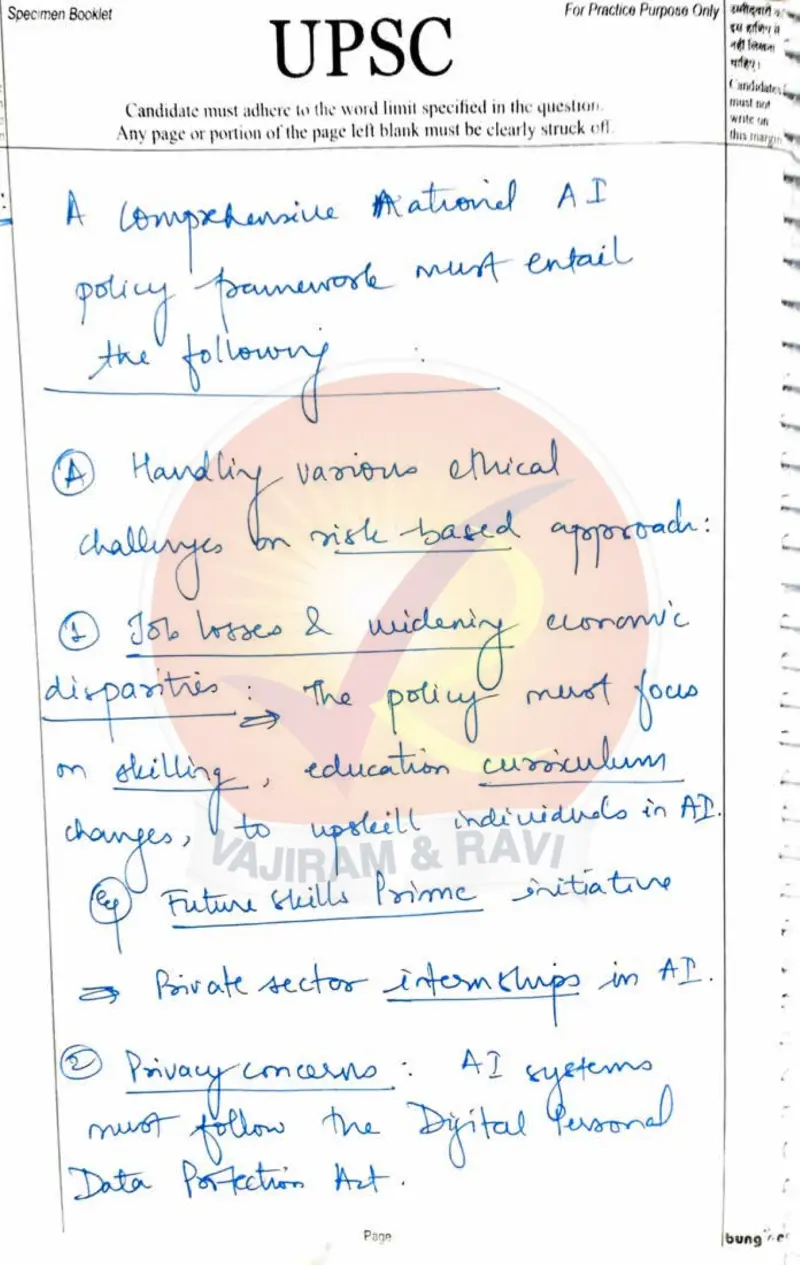
Answered a very similar question
Their question: “Formulate a comprehensive national AI policy framework — jobs, privacy, bias, accountability, black-box”
The 2024 PYQ asks for an ethical critique of AI as an input for administrative decision-making; Aayushi's AI-policy answer (bias, privacy via Puttaswamy/DPDP, accountability, black-box) supplies the ethical dimensions and legal hooks.
Key learnings from their answer
- ›She grounds ethics arguments in specific legal and governance hooks rather than leaving them theoretical, K.C. Puttaswamy & Article 21 and the DPDP Act for the AI-privacy answer (Q14), DBT/RTI/mandamus writ for accountability-vs-efficiency (Q5), CPGRAMS and Citizen Charters like LIC/IRCTC for governance (Q1/Q5). Lesson: tying an ethical point to a real judgment, Act or scheme turns it from opinion into a defensible, administration-aware answer.
- ›She closes answers on a deliberate value-laden maxim that fits the question, 'Yogakshema' for the welfare-state accountability answer (Q5), 'Vasudhaiva Kutumbakam' for global inequality (Q8), Aristotelian 'eudaimonia' for the AI-policy answer (Q14), 'Nari Shakti' for women's participation (Q13). Lesson: a short, topic-matched maxim as your last line gives Ethics answers a memorable 'signature' ending, but pick one that actually maps to the question, not a stock phrase.
Quotes used: “'Eudaimonia' — Aristotelian flourishing [Q14]”