
 View answer copy →
Answered a very similar question
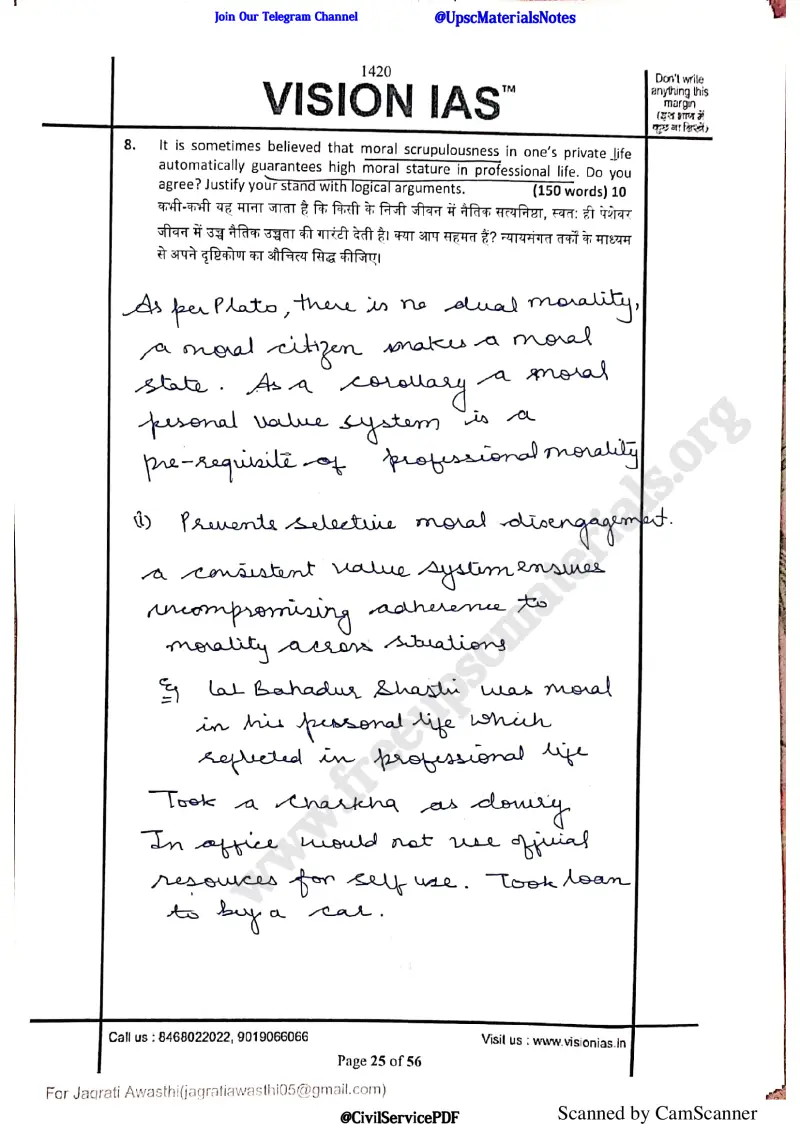
Their question: “Private/personal morality vs professional morality (whether a public servant can hold dual standards)”
The Max Weber PYQ debates precisely whether public administration should have a bureaucratic morality separate from personal conscience; the topper argues the same question via Plato's 'no dual morality' with concrete integrity anecdotes.
Key learnings from their answer
- ›She backs abstract integrity arguments with two precise Indian administrative exemplars in Q8, Lal Bahadur Shastri accepting a charkha (not cash/goods) as dowry, and M. Visvesvaraya using separate oil lamps for official versus personal work. -> Memorise a small bank of concrete, specific integrity anecdotes (the exact detail, 'charkha', 'separate oil lamps', is what makes them land) rather than relying on generic claims that a civil servant should be honest.
- ›She uses thinkers to settle the actual question, not as decoration: in Q8 Plato is invoked for 'no dual morality, a moral citizen makes a moral State' to argue a public servant cannot hold two standards, and in Q14 Gandhi's 'Science without Humanity' (from the Seven Social Sins) frames the bioethics of gene editing. -> Tie each quotation directly to the demand of the question so the thinker advances your argument; pick the quote that resolves the dilemma, don't just sprinkle a famous name.
What they cited: Lal Bahadur Shastri — accepting a charkha as dowry, as an example of personal integrity — Q8 · M. Visvesvaraya — using separate oil lamps for official and personal work — Q8
Quotes used: “Plato — invoked for the idea that there is no dual morality and that a moral citizen makes a moral State (Q8; paraphrased in the answer)”