
 View answer copy →
Shakti DubeyAIR 1CSE 2024
Answered a very similar question
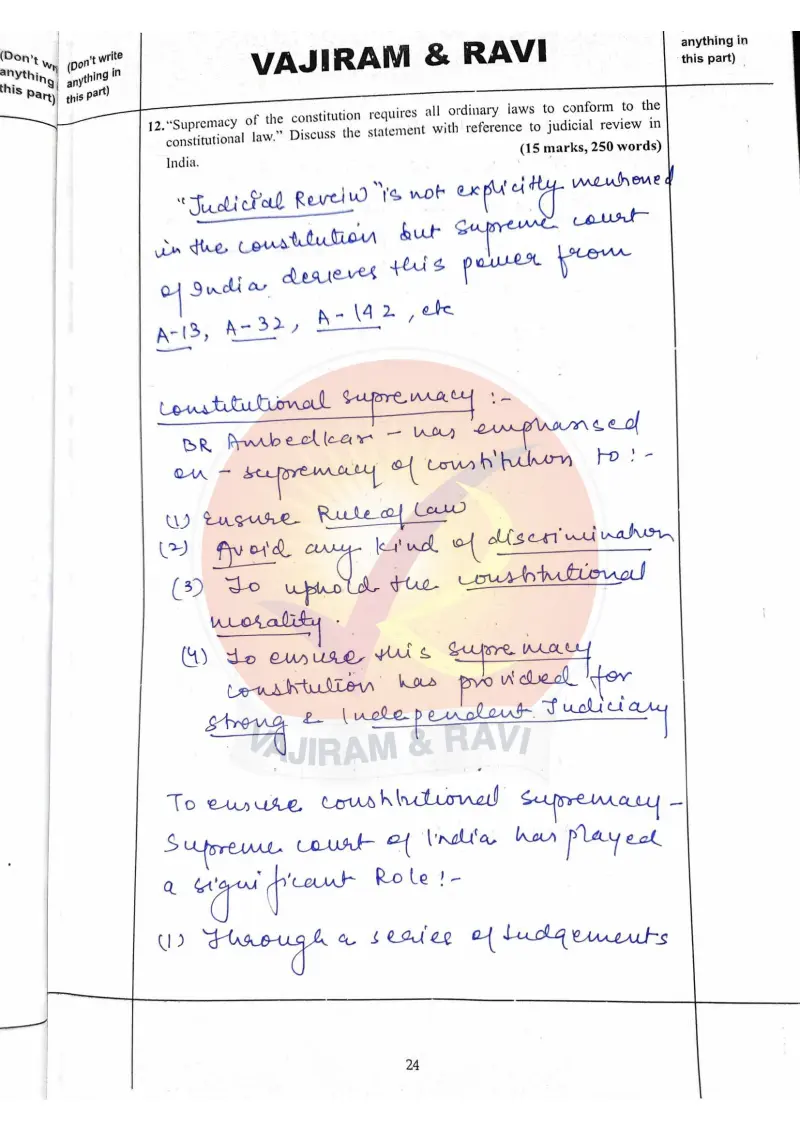
Their question: “Supremacy of the constitution and judicial review in India (15m)”
The topper cites IR Coelho and Kesavananda Bharati to establish judicial review as part of the basic structure, precisely the demand of the 2016 PYQ on what was held in the Coelho case and judicial review's place among the basic features.
Key learnings from their answer
- ›Polity and governance answers are validated with the right named authorities and case law rather than generic theory: Kesavananda Bharati and IR Coelho on judicial review/supremacy of the constitution (Q12), and Granville Austin's 'Holding Together' / quasi-federal characterisation paired with the amendment-count contrast on the US-vs-India question (Q4). -> Carry one canonical case or thinker per core constitutional concept so you can cite Kesavananda/Coelho or Austin precisely where the demand calls for it.
- ›The 15-mark answers run on a disciplined, repeatable skeleton, intro -> provisions/analysis -> Issues/Challenges -> Way Forward -> one-line conclusion, and concepts are compressed visually, e.g. the Venn diagram showing Government n Citizen = Civil Servants in Q15 and spider mind-maps for civil-service values and features of good governance. -> Pre-fix one structural template for 15-markers so you never lose time deciding layout, and reserve a diagram for the one idea best shown as an overlap or web rather than spelled out.