
The aquatic plant commonly used as bio fertilizer in the water-logged rice field is -
- (a)Wolfia
- (b)Trapa
- (c)Azolla
- (d)Lemna
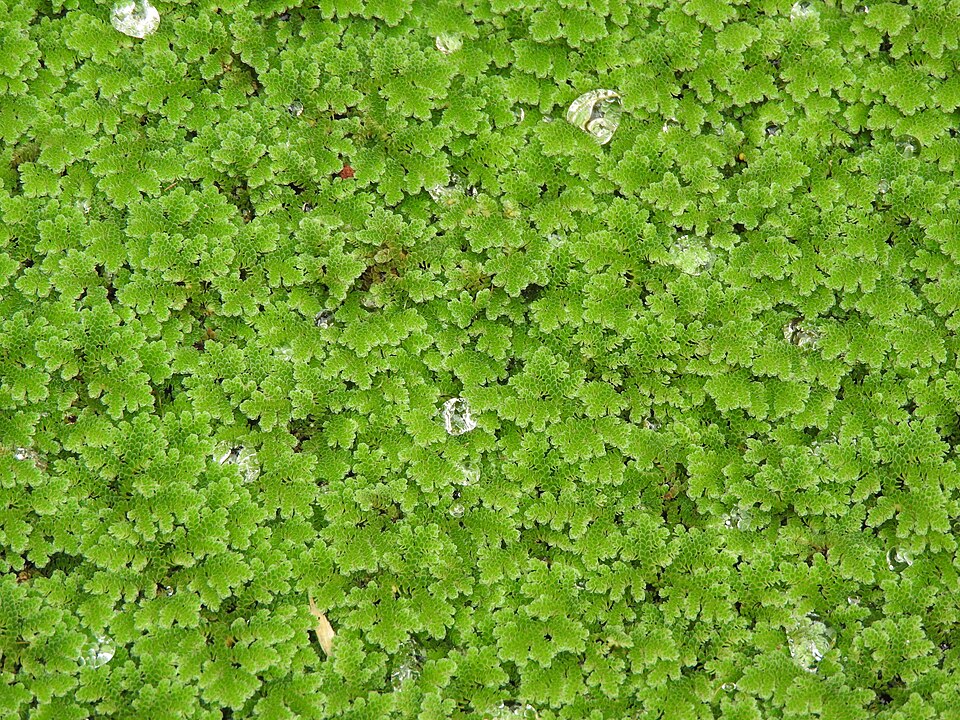
Correct — C, Azolla. Azolla is a small floating water fern that harbours the nitrogen-fixing cyanobacterium Anabaena azollae in cavities of its leaves. Grown on the standing water of submerged (water-logged) paddy fields, this symbiosis fixes atmospheric nitrogen and, when the fern decomposes, releases it into the soil — which is why Azolla is a classic bio-fertilizer for rice. It also multiplies quickly and adds organic matter.
- (a)Wolfia — Wolffia is the world's smallest flowering plant (a rootless duckweed); it is used locally as fodder/food but does not fix nitrogen and is not a paddy bio-fertilizer.
- (b)Trapa — Trapa is the water chestnut (singhara), grown for its edible fruit — a food crop, not a nitrogen-fixing bio-fertilizer.
- (d)Lemna — Lemna (common duckweed) is useful for wastewater treatment and as fodder, but it does not fix atmospheric nitrogen and is not the rice bio-fertilizer meant here.
Bio-fertilizers are living organisms that enrich soil nutrients. In paddy, the Azolla-Anabaena symbiosis is the key nitrogen-fixing bio-fertilizer: the fern floats on the field's standing water while its cyanobacterial partner converts atmospheric N2 into plant-available nitrogen.
All four options are aquatic plants, so the trap is picking any floating plant. The distinguishing feature is biological nitrogen fixation through a cyanobacterial symbiont — a property unique here to Azolla.
- Azolla is a floating aquatic fern; its symbiont is the cyanobacterium Anabaena azollae.
- The symbiosis fixes atmospheric nitrogen, making Azolla a bio-fertilizer for rice/paddy.
- Wolffia (smallest flowering plant), Trapa (water chestnut) and Lemna (duckweed) do not fix nitrogen.
- Blue-green algae (cyanobacteria) such as Anabaena and Nostoc are the usual paddy bio-fertilizers.
- Choosing a floating plant on appearance (Lemna/Wolffia) instead of the nitrogen-fixer
- Thinking the fern itself fixes nitrogen — the fixer is the cyanobacterium Anabaena living inside it
UPSC/UPPSC repeatedly ask 'which organism is a bio-fertilizer for rice/paddy', sometimes routed through Anabaena, Nostoc or blue-green algae.
Which one of the following organisms can serve as a biofertilizer for rice crop?
- (a) Blue-green algae
- (b) Rhizobium sp
- (c) Mycorrhizal fungi
- (d) Azotobacter sp
Answer(a) Blue-green algae
Same concept — the nitrogen-fixing bio-fertilizer for rice/paddy (blue-green algae are the cyanobacteria that Azolla partners with).
Consider the following organisms: 1. Agaricus 2. Nostoc 3. Spirogyra. Which of the above is/are used as biofertilizer/biofertilizers?
- (a) 1 and 2
- (b) 2 only
- (c) 2 and 3
- (d) 3 only
Answer(b) 2 only (Nostoc)
Same concept — identifying the nitrogen-fixing organism (cyanobacterium Nostoc) used as a bio-fertilizer.
- practice — not a real PYQ
The nitrogen-fixing cyanobacterium that lives in symbiosis with the Azolla fern is:
- (a)Rhizobium leguminosarum
- (b)Anabaena azollae
- (c)Azotobacter
- (d)Nostoc muscorum
Answer(b) Anabaena azollae — it lives in the leaf cavities of Azolla and fixes nitrogen. - practice — not a real PYQ
Rhizobium bacteria fix atmospheric nitrogen in association with the roots of:
- (a)cereal crops
- (b)leguminous plants
- (c)mosses
- (d)aquatic ferns
Answer(b) leguminous plants — via a root-nodule symbiosis.