
Which of the following is an insectivorous plant?
- (a)Nepenthes
- (b)Nelumbo
- (c)Nyctanthes
- (d)Nicotiana
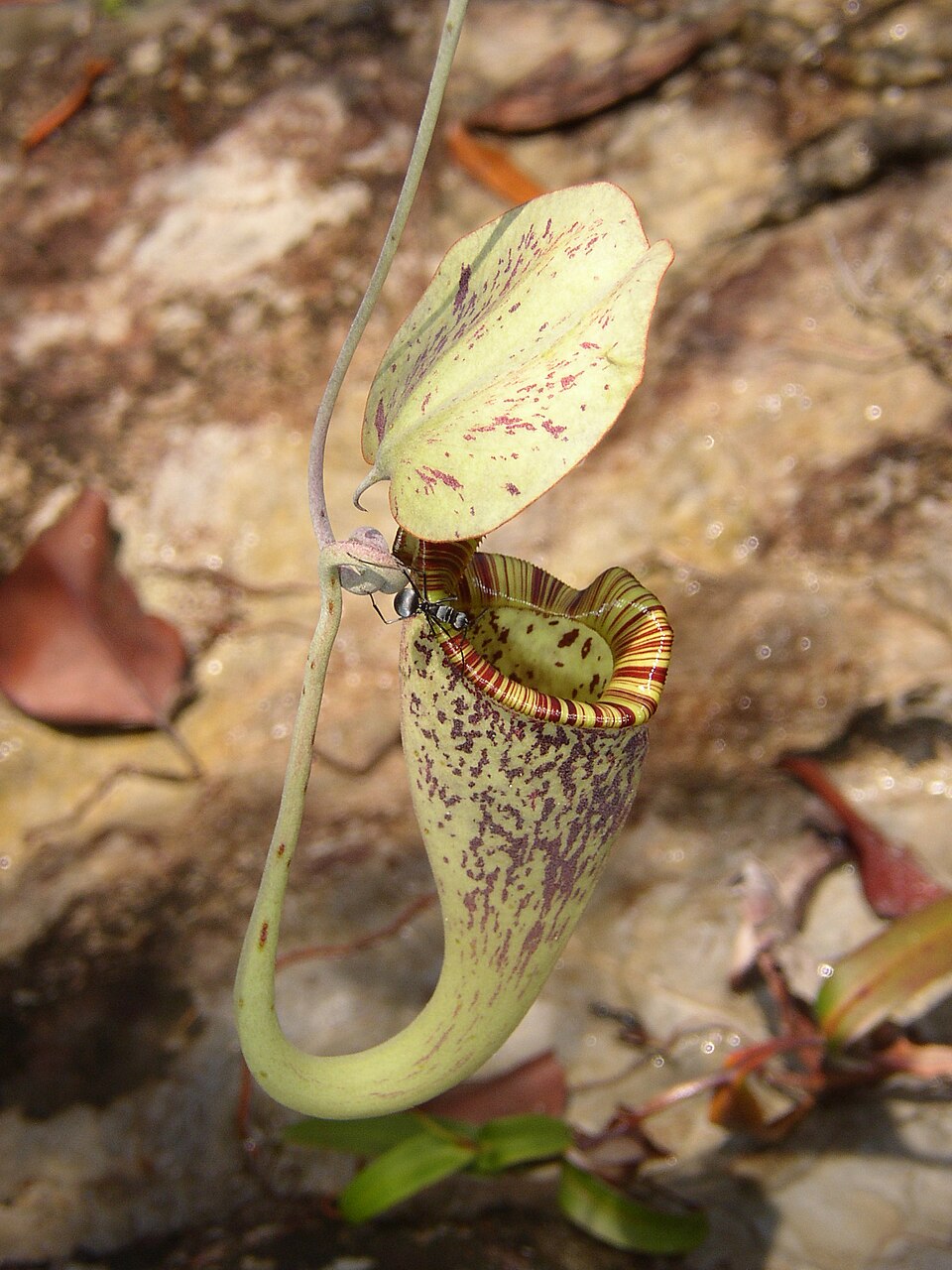
Correct — A, Nepenthes. Nepenthes, the tropical pitcher plant, is a carnivorous (insectivorous) plant whose leaf tip is modified into a jug-shaped 'pitcher' holding digestive fluid; insects that slip in are trapped and dissolved. Such plants grow in nitrogen-poor, boggy soils and digest insects to obtain the nitrogen the soil cannot supply — they still photosynthesise for energy.
- (b)Nelumbo — This is the lotus genus (e.g. Nelumbo nucifera, the sacred lotus) — an aquatic flowering plant, not carnivorous.
- (c)Nyctanthes — Nyctanthes arbor-tristis is the night-flowering jasmine (harsingar / parijat) — an ornamental shrub, not insectivorous.
- (d)Nicotiana — This is the tobacco genus (source of nicotine) — an ordinary crop plant that feeds from the soil, not insectivorous.
Insectivorous (carnivorous) plants supplement their nutrition by trapping and digesting insects. They typically grow on nitrogen-deficient soils (bogs, marshes) and use the insects as a nitrogen source, while still making their own food by photosynthesis. In Nepenthes the trapping organ is a modified leaf that forms the pitcher, with a lid and slippery, enzyme-filled interior.
The trap here is that all four options begin with 'N', so recognition rests on knowing the genera: Nelumbo (lotus), Nyctanthes (harsingar), Nicotiana (tobacco) are ordinary plants, while Nepenthes is the classic pitcher plant.
- Nepenthes traps insects using pitcher-shaped modified leaves that secrete digestive enzymes.
- Insectivorous plants trap insects for nitrogen (poor soils), not for energy — they still photosynthesise.
- Other carnivorous plants: Drosera (sundew), Utricularia (bladderwort), Dionaea (Venus flytrap).
- Nepenthes khasiana is India's only native pitcher plant, endemic to the Khasi hills of Meghalaya (endangered).
- Confusing Nelumbo (lotus) or Nicotiana (tobacco) with a carnivorous plant.
- Assuming insectivorous plants do not photosynthesise — they do; they trap insects only for nitrogen.
Straight 'which is an insectivorous/carnivorous plant', or 'which part of the pitcher plant is modified into the pitcher (the leaf)', or 'why are some plants insectivorous (nitrogen-poor soils)'.
Which one of the following is an insectivorous plant?
- (a) Passion flower plant
- (b) Pitcher plant
- (c) Night queen
- (d) Flame of the forest
Answer(b) Pitcher plant
Same concept — identifying the insectivorous plant; the pitcher plant is Nepenthes.
Which one of the following parts of the pitcher plant becomes modified into a pitcher?
- (a) Stem
- (b) Leaf
- (c) Stipule
- (d) Petiole
Answer(b) Leaf
Same subject (Nepenthes) — the pitcher is a modified leaf that traps insects.
- practice — not a real PYQ
Insectivorous plants typically grow in soils deficient in:
- (a)Nitrogen
- (b)Carbon
- (c)Oxygen
- (d)Potassium
Answer(a) Nitrogen — they trap insects to obtain nitrogen the soil lacks. - practice — not a real PYQ
In the pitcher plant (Nepenthes), the pitcher is a modification of the:
- (a)Stem
- (b)Root
- (c)Leaf
- (d)Flower
Answer(c) Leaf — the lamina is modified into the pitcher.