
Seaweeds are important source of -
- (a)Argon
- (b)Iodine
- (c)Chlorine
- (d)Bromine
Correct — B, Iodine. Seaweeds (marine macroalgae, especially brown seaweeds/kelps such as Laminaria) take up and concentrate iodine from seawater to levels many thousands of times higher than the surrounding water, storing it in their tissues. Historically, burnt dried seaweed ('kelp ash') was the world's principal commercial source of iodine in the 19th century, and seaweed remains one of the richest natural dietary sources of the element — which is why iodine deficiency is rare in seaweed-eating coastal populations.
- (a)Argon — Argon is an inert noble gas obtained by the fractional distillation of liquefied air. It is not produced by any living organism, so seaweed plays no part in its supply — this is the obvious throw-away option.
- (c)Chlorine — Chlorine is obtained industrially by the electrolysis of brine (common-salt solution), i.e. from the dissolved sodium chloride in seawater, not from seaweed tissue. Seaweed is not a commercial source of chlorine.
- (d)Bromine — Bromine is extracted from seawater and salt-lake brines (bromide ions) and from the Dead Sea — again from the water/brine, not from seaweed. The signature element that seaweed selectively accumulates and was historically harvested for is iodine, not bromine.
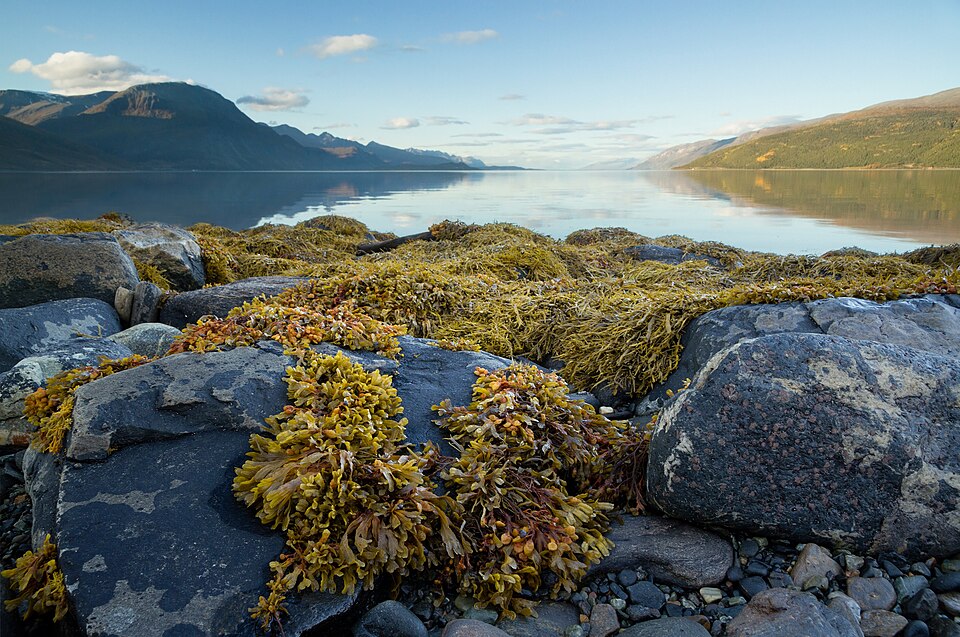
Seaweeds are photosynthetic marine algae, grouped as green, brown and red. Brown seaweeds/kelps are notable bio-accumulators of iodine, absorbing iodide from seawater and concentrating it in their tissue. Besides iodine, seaweeds are the source of important hydrocolloids: agar and carrageenan from red algae, and algin/alginate from brown algae, all widely used in food and pharmaceuticals.
The trap is that iodine, chlorine and bromine are all halogens present in seawater, so a candidate may reason 'it comes from the sea, so it could be any halogen'. The specific biological fact to remember is that seaweed selectively concentrates iodine. Argon (a) is the giveaway wrong choice — a noble gas with nothing to do with algae.
- Brown seaweeds/kelps can concentrate iodine to tens of thousands of times its concentration in seawater.
- The 19th-century iodine industry ran on 'kelp ash' (burnt seaweed) before Chilean caliche/nitrate deposits took over.
- Seaweed is among the richest dietary sources of iodine; iodine deficiency causes goitre, which is why table salt is iodised.
- Seaweeds also yield agar and carrageenan (red algae) and alginates (brown algae) used in food and pharma.
- Picking chlorine or bromine because all halogens occur in seawater.
- Forgetting that argon is a noble gas unrelated to any organism.
UPSC and UPPSC test 'source of X' one-liners in the Science/Environment section — pair each halogen with its characteristic source and remember seaweed = iodine.
- practice — not a real PYQ
Iodine deficiency in the diet most directly causes which of the following disorders?
- (a)Rickets
- (b)Goitre
- (c)Scurvy
- (d)Beriberi
Answer(b) Goitre — enlargement of the thyroid gland, since iodine is required to synthesise the thyroid hormone thyroxine. - practice — not a real PYQ
Agar, used as a microbiological culture medium and food-setting agent, is obtained from which of the following?
- (a)Brown seaweed
- (b)Red algae (red seaweed)
- (c)Fungi
- (d)Lichens
Answer(b) Red algae (red seaweed) — agar (and carrageenan) are extracted from red seaweeds; alginates come from brown seaweeds.