
'Milind Panho' is in the form of a dialogue between King Milind and a Buddhist saint. The concerned saint was -
- (a)Nagarjun
- (b)Kumaril Bhatt
- (c)Nagbhatt
- (d)Nagasena
Correct — D, Nagasena. The Milindapanha ('Questions of Milinda') is a Pali Buddhist text framed as a dialogue between the Indo-Greek king Menander I (Milinda), who ruled c. 2nd century BCE in north-west India, and the Buddhist monk Nagasena. Nagasena answers the king's doubts on Buddhist doctrine — the nature of the self, karma, rebirth and nirvana — so he is the saint of the dialogue.
- (a)Nagarjun — Nagarjuna was the c. 2nd-century-CE founder of the Madhyamaka ('Middle Way') school of Mahayana Buddhism — a different figure separated from Nagasena by roughly 300 years. He is not the interlocutor of the Milindapanha; this Nagasena-vs-Nagarjuna swap is the classic trap (UPSC 2023 itself set 'Milinda-panha — Nagarjuna' as a wrong pair).
- (b)Kumaril Bhatt — Kumarila Bhatta was a 7th–8th-century Mimamsa (Brahmanical) philosopher who defended Vedic ritualism — not a Buddhist monk and unconnected to the Milindapanha.
- (c)Nagbhatt — Nagabhata refers to the Pratihara rulers (Nagabhata I and II) of early-medieval north India — kings, not Buddhist saints, and unrelated to the text.
The Milindapanha is among the most important non-canonical works of Pali Buddhist literature. It records the philosophical exchange between Menander I (Milinda), a Greek king of the Indo-Greek kingdom, and the learned Buddhist elder Nagasena. Through the dialogue Nagasena explains core Buddhist ideas — anatta (no permanent self), karma, rebirth and nirvana — and tradition holds that Menander was eventually won over to Buddhism.
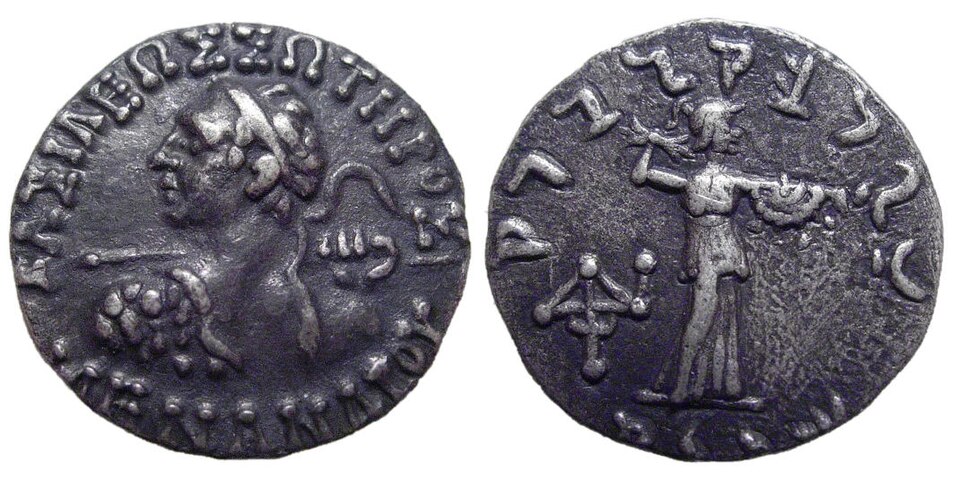
Menander/Milinda is the same Indo-Greek king famous from his abundant bilingual (Greek–Kharoshthi) coins, so the 'king' half is well documented. The whole difficulty is Nagasena vs Nagarjuna — two similar-sounding monks about three centuries apart. Lock the chain: Milinda (Menander) ↔ Nagasena ↔ Milindapanha.
- Text: Milindapanha ('Questions of Milinda'), composed in Pali.
- Dialogue partners: Indo-Greek king Menander I (Milinda) and the monk Nagasena.
- Nagasena expounds anatta, karma, rebirth and nirvana to the king.
- Menander I ruled c. 165/155–130 BCE and is famed for his bilingual coins.
- Nagasena (Milindapanha) vs Nagarjuna (founder of Madhyamaka)
- Treating Menander (Milinda, ~2nd c. BCE) as a contemporary of the Buddha — he lived about four centuries later
Both UPPSC and UPSC ask 'who authored/features in text X' or set match-the-pairs of work↔author; the Milindapanha–Nagasena link recurs across years.
Milindapanho is in the form of a dialogue between the King Menander and the Buddhist monk
- (a) Nagasena
- (b) Nagarjuna
- (c) Nagabhatta
- (d) Kumarilabhatta
Answer(a) Nagasena
Near-identical UPSC 1997 question with the very same four names — the Milindapanha dialogue is with the monk Nagasena.
With reference to ancient Indian History, consider the following pairs: Literary work — Author: 1. Devichandragupta — Bilhana; 2. Hammira-Mahakavya — Nayachandra Suri; 3. Milinda-panha — Nagarjuna; 4. Nitivakyamrita — Somadeva Suri. How many of the above pairs are correctly matched?
- (a) Only one
- (b) Only two
- (c) Only three
- (d) All four
Answer(b) Only two
Tests the same Nagasena-vs-Nagarjuna trap — 'Milinda-panha — Nagarjuna' is a wrong pair (the author/monk is Nagasena).
- practice — not a real PYQ
The Milindapanha, a dialogue with the monk Nagasena, features which Indo-Greek king?
- (a)Demetrius
- (b)Menander I
- (c)Antialcidas
- (d)Eucratides
Answer(b) Menander I (Milinda) — the king whose questions the text records. - practice — not a real PYQ
Nagarjuna is best known as the founder of which school of Buddhist philosophy?
- (a)Yogachara
- (b)Madhyamaka
- (c)Sautrantika
- (d)Vaibhashika
Answer(b) Madhyamaka ('Middle Way') — not to be confused with Nagasena.