
The blood glucose level is commonly expressed as
- (a)MM of Hg
- (b)Milligram per decilitre
- (c)Parts per million
- (d)Gram per litre
Correct — B, Milligram per decilitre (mg/dL). In clinical and laboratory practice blood glucose (blood sugar) is reported as milligrams of glucose per decilitre of blood; a normal fasting value is roughly 70-99 mg/dL. (The SI alternative used in many countries is millimoles per litre, mmol/L, but among the four options given, mg/dL is the standard expression.) Hence option (b) is correct.
- (a)MM of Hg — Wrong — millimetres of mercury (mm Hg) is a unit of PRESSURE (e.g. blood pressure, gas partial pressures), not of a dissolved substance's concentration like glucose.
- (c)Parts per million — Wrong — parts per million (ppm) is used for very dilute/trace concentrations (e.g. pollutants, water hardness), not for the routine reporting of blood glucose.
- (d)Gram per litre — Wrong — grams per litre is not the conventional clinical unit for blood glucose; laboratories report it in milligrams per decilitre (mg/dL), the smaller, standard unit.
Blood glucose is the concentration of glucose (the body's main circulating sugar) in the blood, kept within a narrow range by the hormones insulin and glucagon. It is conventionally measured in milligrams per decilitre (mg/dL). Typical reference values: fasting about 70-99 mg/dL, with 100-125 mg/dL flagged as pre-diabetic and >=126 mg/dL (fasting) indicating diabetes. The SI unit millimoles per litre (mmol/L) is used in some countries, but Indian and US reports use mg/dL.
Match the quantity to the right kind of unit. Glucose is a solute, so its amount is expressed as a mass-per-volume concentration — mg/dL. mm Hg measures pressure (a distractor borrowed from blood-pressure readings), ppm is for trace amounts, and g/L is not the standard clinical unit. That reasoning isolates mg/dL, option (b).
- Blood glucose is reported in milligrams per decilitre (mg/dL); the SI alternative is mmol/L.
- Normal fasting blood glucose is about 70-99 mg/dL.
- mm Hg is a unit of pressure (blood pressure), not concentration.
- Blood glucose is regulated by insulin (lowers it) and glucagon (raises it).
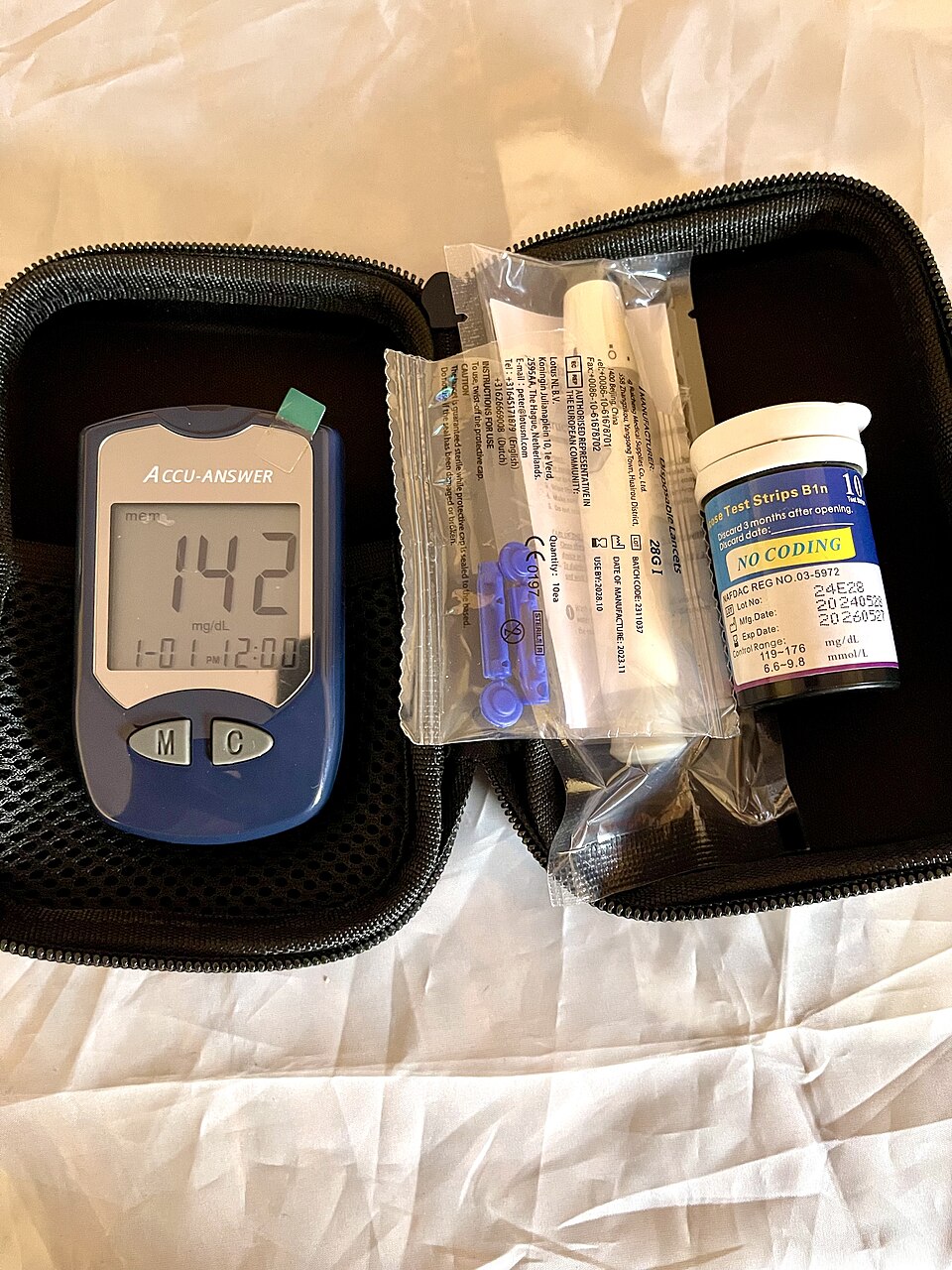
- Picking 'mm of Hg' by association with blood-pressure readings — that is a pressure unit, not a concentration
- Confusing ppm (trace-level unit) or g/L with the standard clinical mg/dL
UPSC/UPPSC ask units-and-measurement and human-physiology items — link each quantity to its unit (glucose = mg/dL, blood pressure = mm Hg) and know the hormones/organs that regulate blood sugar.
The blood glucose level is commonly expressed as
- (a) mm of Hg
- (b) milligram per decilitre
- (c) parts per million
- (d) grams per litre
Answer(b) milligram per decilitre
Essentially the identical question — UPSC 2000 asked the very same thing with the same options and answer (mg/dL), which UPPSC repeated verbatim in 2021.
Which of the following are associated with diabetes mellitus, a common disease in adults? I. Higher sugar level in blood II. Lower sugar level in blood III. Lower insulin level in blood IV. Higher insulin level in blood Select the correct answer using the codes given below:
- (a) I and IV
- (b) I and II
- (c) II and III
- (d) I and III
Answer(d) I and III
Same concept area — blood glucose in health and disease. Diabetes mellitus means high blood sugar (measured in mg/dL) from low insulin, reinforcing what the blood-glucose reading in this UPPSC item quantifies.
- practice — not a real PYQ
Which hormone lowers the blood glucose level in the human body?
- (a)Glucagon
- (b)Insulin
- (c)Adrenaline
- (d)Thyroxine
Answer(b) Insulin — secreted by the beta cells of the Islets of Langerhans in the pancreas, insulin lowers blood glucose; glucagon raises it. - practice — not a real PYQ
The unit 'millimetre of mercury (mm Hg)' is commonly used to express which of the following?
- (a)Blood glucose level
- (b)Blood pressure
- (c)Body temperature
- (d)Haemoglobin content
Answer(b) Blood pressure — mm Hg is a pressure unit used for blood pressure; blood glucose is expressed in mg/dL.