
'World Ozone Day' is celebrated on
- (a)25th December
- (b)21st April
- (c)16th September
- (d)30th January
Correct — C, 16th September. The International Day for the Preservation of the Ozone Layer — commonly called World Ozone Day — is observed every year on 16 September. The date marks the anniversary of the signing of the Montreal Protocol on Substances that Deplete the Ozone Layer on 16 September 1987. The United Nations General Assembly proclaimed the day in 1994 (resolution 49/114) to raise awareness of ozone-layer depletion and the phase-out of ozone-depleting substances such as chlorofluorocarbons (CFCs).
- (a)25th December — Wrong — 25 December is not an environmental observance related to the ozone layer; the ozone day is fixed to the Montreal Protocol anniversary of 16 September.
- (b)21st April — Wrong — no ozone observance falls here; the well-known April environmental date is Earth Day on 22 April, which is a different, broader campaign.
- (d)30th January — Wrong — 30 January is observed in India as Martyrs' Day (anniversary of Mahatma Gandhi's death); it has no connection with the ozone layer.
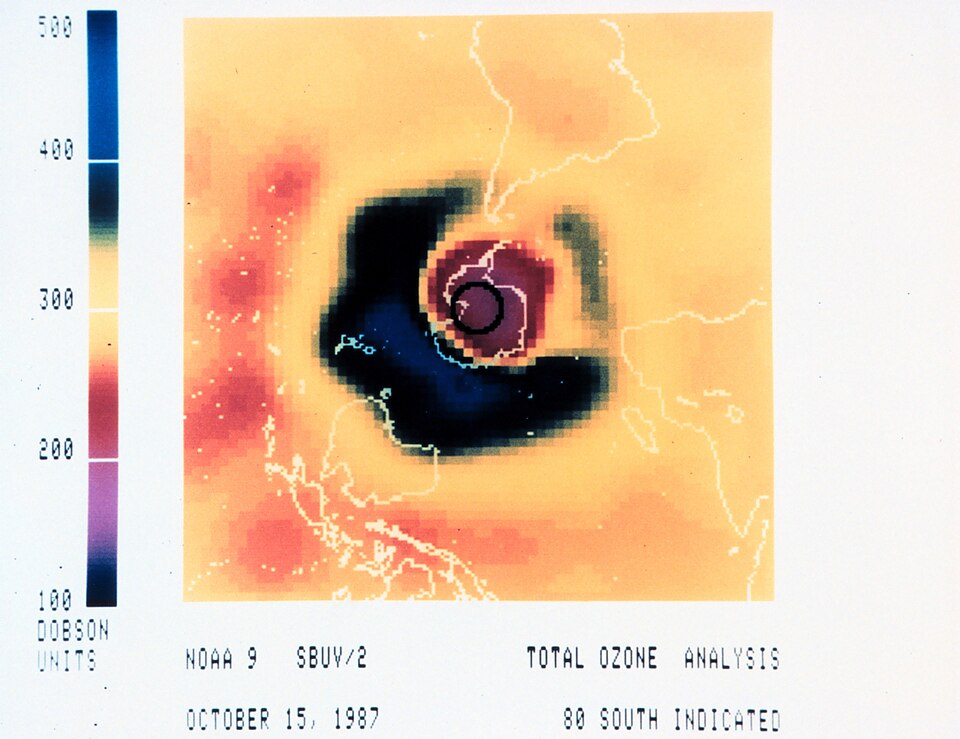
The ozone layer in the stratosphere absorbs most of the Sun's harmful ultraviolet (UV-B) radiation. Man-made chemicals — chiefly CFCs, halons and related compounds — release chlorine and bromine that catalytically destroy ozone, thinning the layer and creating the seasonal Antarctic 'ozone hole'. The 1987 Montreal Protocol, one of the most successful environmental treaties, committed nations to phasing out these substances, and World Ozone Day (16 September) commemorates its signing.
This is a straight date-recall question. Anchor it to the Montreal Protocol: the treaty was signed on 16 September 1987, so World Ozone Day is 16 September. The other three dates are unrelated observances used as distractors; knowing the Montreal link removes any doubt.
- World Ozone Day = 16 September every year (International Day for the Preservation of the Ozone Layer).
- Marks the signing of the Montreal Protocol on 16 September 1987.
- Proclaimed by the UN General Assembly in 1994.
- The Montreal Protocol phases out ozone-depleting substances (CFCs, halons); its 2016 Kigali Amendment adds HFCs (potent greenhouse gases).
- Confusing World Ozone Day (16 Sept) with World Environment Day (5 June) or Earth Day (22 April)
- Mixing up the Montreal Protocol (ozone) with the Kyoto Protocol / Paris Agreement (climate change)
Environment days are asked as direct 'celebrated on which date' recall or as a match-the-day-to-the-date list — memorise the ozone day and its Montreal Protocol link.
Match List I (Important Day) with List II (Date): I. World Environment Day II. World Forestry Day III. World Habitat Day IV. World Ozone Day A. March 20 B. June 5 C. September 16 D. October 3 E. December 10 Select the correct answer using the codes given below.
- (a) I-B, II-A, III-D, IV-E
- (b) I-A, II-B, III-D, IV-C
- (c) I-A, II-B, III-C, IV-D
- (d) I-B, II-A, III-D, IV-C
Answer(d) I-B, II-A, III-D, IV-C
Same exact fact — this match-list pairs World Ozone Day (IV) with 16 September (C), the answer to the UPPSC question.
The formation of ozone hole in the Antarctic region has been a cause of concern. What could be the reason for the formation of this hole?
- (a) Presence of prominent tropospheric turbulence; and inflow of chlorofluorocarbons
- (b) Presence of prominent polar front and stratospheric clouds; and inflow of chlorofluorocarbons
- (c) Absence of polar front and stratospheric clouds; and inflow of methane and chlorofluorocarbons
- (d) Increased temperature at polar region due to global warming
Answer(b) Presence of prominent polar front and stratospheric clouds; and inflow of chlorofluorocarbons
Same concept — the ozone layer and the CFC-driven Antarctic ozone hole that World Ozone Day and the Montreal Protocol exist to address.
- practice — not a real PYQ
World Ozone Day is observed to mark the signing of which international agreement?
- (a)Kyoto Protocol
- (b)Montreal Protocol
- (c)Paris Agreement
- (d)Basel Convention
Answer(b) Montreal Protocol — signed on 16 September 1987, the day now observed as World Ozone Day. - practice — not a real PYQ
Which of the following is a major ozone-depleting substance targeted by the Montreal Protocol?
- (a)Carbon dioxide
- (b)Methane
- (c)Chlorofluorocarbons (CFCs)
- (d)Nitrous oxide
Answer(c) Chlorofluorocarbons (CFCs) — their chlorine catalytically destroys stratospheric ozone.