
Diffusion of light in the atmosphere takes place due to
- (a)Carbon dioxide
- (b)Dust particles
- (c)Helium
- (d)Water vapours
Correct — B, Dust particles. Diffusion (scattering) of light in the atmosphere is caused mainly by the fine dust and suspended particulate matter (aerosols) floating in the air. When sunlight strikes these tiny particles it is scattered in all directions — the Tyndall effect — which is why daylight reaches us as soft, diffuse illumination and why a dusty beam of light becomes visible. Among the given options, dust particles are the principal scatterers.
- (a)Carbon dioxide — Wrong — CO2 is only a trace atmospheric gas; while air molecules do scatter light (Rayleigh scattering), CO2 specifically is not the cause of the general diffusion of light and is not the intended answer.
- (c)Helium — Wrong — helium is an inert gas present in minute amounts; it plays no significant role in scattering sunlight.
- (d)Water vapours — Wrong — water vapour can absorb light and, as droplets, scatter it, but the everyday diffusion of light in the atmosphere is attributed mainly to suspended dust and particulate matter, not water vapour.
When light passes through a medium containing fine suspended particles, it is redirected in many directions — a process called scattering or diffusion of light. Larger suspended particles such as atmospheric dust and aerosols produce the Tyndall effect, scattering light broadly across the spectrum and making beams visible and daylight diffuse. (Very small air molecules cause wavelength-dependent Rayleigh scattering, which makes the sky blue — but the general diffusion of light in this question is attributed to dust particles.)
Eliminate the trace gases: helium and carbon dioxide are present in tiny quantities and are not responsible for the visible diffusion of light. Water vapour mainly absorbs; the dominant diffusers are the countless dust and aerosol particles suspended in air. So the answer is dust particles.
- Scattering of light by suspended particles is called the Tyndall effect (diffusion of light).
- Atmospheric dust and aerosols are the chief scatterers that diffuse sunlight.
- Rayleigh scattering by air molecules (intensity proportional to 1/wavelength^4) makes the sky appear blue and the setting Sun red.
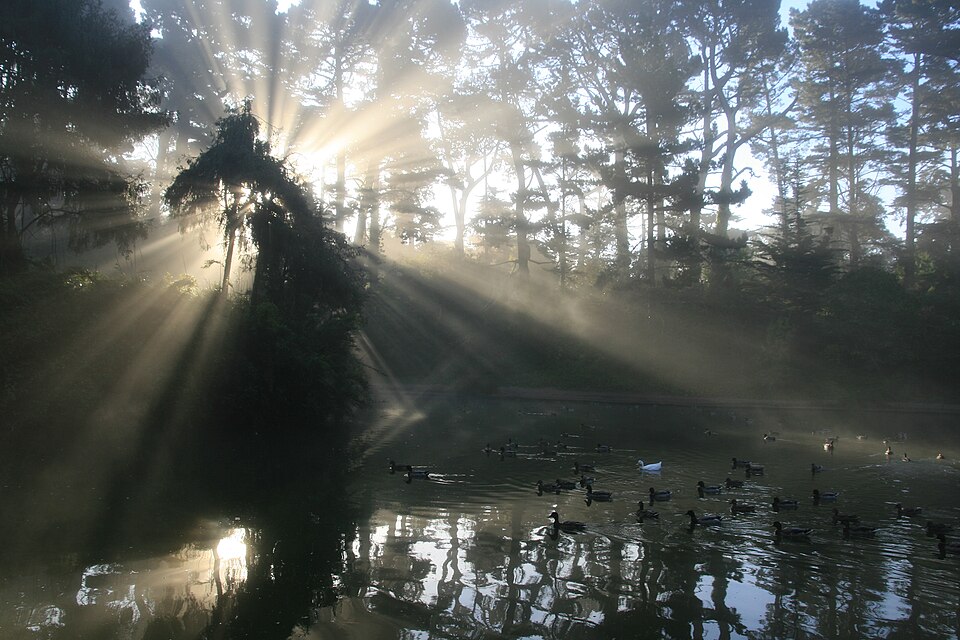
- A beam of light becomes visible (e.g. through a dusty room or fog) because particles scatter it towards the eye.
- Confusing scattering (diffusion) with reflection or refraction
- Assuming a specific gas (CO2 or water vapour) causes diffusion when suspended dust particles are the main scatterers
UPSC/UPPSC ask one-liners on atmospheric optics — link the phenomenon (blue sky, red sunset, visible beams, diffuse daylight) to scattering by particles or molecules.
Diffusion of light in the atmosphere takes place due to
- (a) Carbon dioxide
- (b) Dust particles
- (c) Helium
- (d) Water vapours
Answer(b) Dust particles
Identical UPSC PYQ — the very same question ('Diffusion of light in the atmosphere takes place due to'), confirming dust particles as the answer; UPPSC 2021 reused it verbatim.
- practice — not a real PYQ
The blue colour of the clear sky is due to
- (a)Reflection of light
- (b)Refraction of light
- (c)Scattering of light
- (d)Total internal reflection
Answer(c) Scattering of light — shorter (blue) wavelengths are scattered most by air molecules (Rayleigh scattering). - practice — not a real PYQ
The Tyndall effect is best illustrated by
- (a)A rainbow
- (b)A beam of light made visible by dust in air
- (c)A mirror image
- (d)Twinkling of stars
Answer(b) A beam of light made visible by dust in air — scattering of light by suspended particles.