
With reference to the radioactivity, which of the following statements is/are correct ? 1. Radioactivity is a nuclear property. 2. Hydrogen bomb is prepared on the principle of nuclear fission. Select the correct answer using the codes given below. Codes :
- (a)Only 1
- (b)Only 2
- (c)Both 1 and 2
- (d)Neither 1 nor 2
Correct — A, Only 1. Statement 1 is true: radioactivity is a property of the atomic NUCLEUS — an unstable nucleus spontaneously emits alpha, beta or gamma radiation, and this happens regardless of the atom's chemical combination or physical state. Statement 2 is false: a hydrogen (thermonuclear) bomb releases its energy by nuclear FUSION of light hydrogen isotopes (deuterium and tritium), not fission. A fission bomb is used only as the trigger to reach the extreme temperature that ignites fusion — so the guiding principle of the hydrogen bomb is fusion, not fission. Hence only statement 1 is correct.
- (b)Only 2 — Wrong — statement 2 is false. The hydrogen bomb works on nuclear fusion, not fission; fission only serves as its trigger. (And statement 1 is in fact true.)
- (c)Both 1 and 2 — Wrong — statement 1 is correct, but statement 2 wrongly attributes the hydrogen bomb to fission when its principle is fusion.
- (d)Neither 1 nor 2 — Wrong — statement 1 is correct: radioactivity is genuinely a nuclear property.
Radioactivity is the spontaneous disintegration of an unstable atomic nucleus, emitting alpha particles, beta particles or gamma rays; because it originates in the nucleus it is unaffected by temperature, pressure or chemical combination — a purely nuclear property. Nuclear energy can be released two ways: fission (splitting a heavy nucleus such as U-235 or Pu-239, used in atom bombs and reactors) and fusion (joining light nuclei such as hydrogen isotopes, the Sun's power source and the basis of the hydrogen bomb).
Statement 1 is a straightforward true fact. The decisive judgement is statement 2: students who remember only that 'a nuclear bomb = fission' fall for it. The hydrogen bomb is the classic FUSION device — it needs a fission bomb merely to reach ignition temperature, so calling its principle 'fission' is wrong. Rejecting statement 2 leaves 'Only 1'.
- Radioactivity originates in the nucleus and is independent of chemical/physical state — hence a nuclear property.
- Atom bomb and nuclear reactors work on nuclear FISSION (splitting heavy nuclei like U-235, Pu-239).
- Hydrogen/thermonuclear bomb works on nuclear FUSION of hydrogen isotopes (deuterium, tritium); a fission bomb only triggers it.
- Fusion powers the Sun and stars and releases far more energy per unit mass than fission.
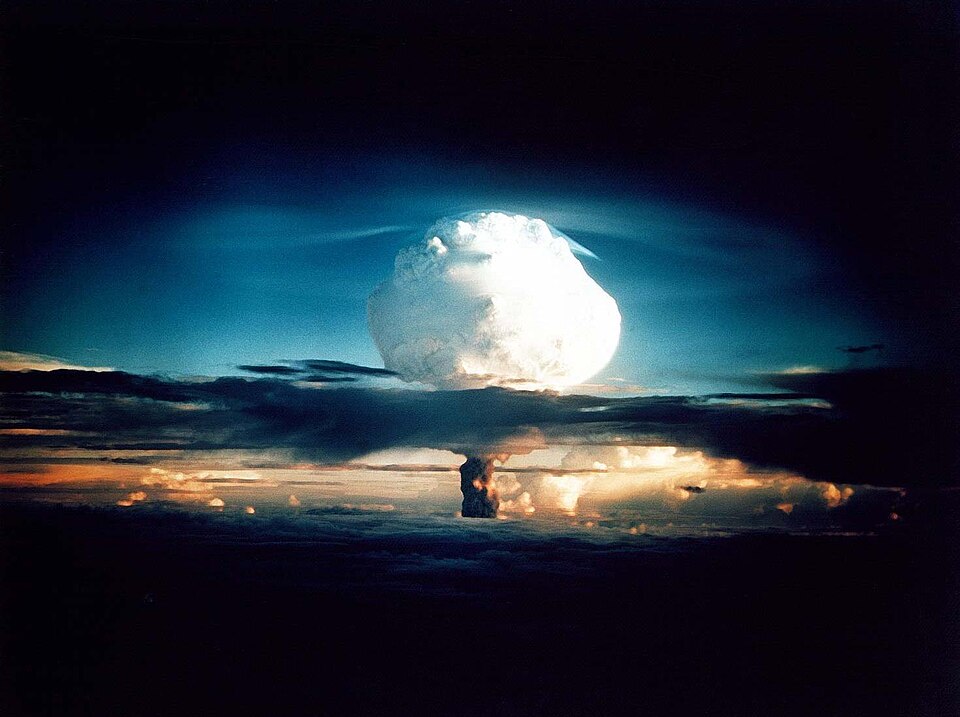
- Assuming every nuclear weapon works on fission — the hydrogen bomb is a fusion device
- Forgetting that the hydrogen bomb still uses a fission bomb as its trigger, which tempts the 'fission' answer
Science questions here are statement-based true/false — learn the one-line distinction: fission = splitting heavy nuclei (A-bomb / reactor); fusion = joining light nuclei (H-bomb / Sun).
Which one of the following is NOT radioactive?
- (a) Astatine
- (b) Francium
- (c) Tritium
- (d) Zirconium
Answer(d) Zirconium
Same concept — radioactivity as a nuclear/atomic property; it rewards knowing which elements and isotopes are inherently radioactive (statement 1 of this question).
Consider the following statements: In a nuclear reactor, self-sustained chain reaction is possible, because I. More neutrons are released in each of the fission reactions. II. The neutrons immediately take part in the fission process. III. The fast neutrons are slowed down by Graphite. IV. Every neutron released in the fission reaction initiates further fission. Which of these statements are correct?
- (a) I, II and III
- (b) I and III
- (c) II and IV
- (d) II, III and IV
Answer(b) I and III
Same concept — the fission chain reaction; it clarifies that fission (splitting heavy nuclei) powers reactors and atom bombs, whereas the hydrogen bomb of this question uses fusion.
- practice — not a real PYQ
The energy released by the Sun is primarily due to
- (a)Nuclear fission of uranium
- (b)Nuclear fusion of hydrogen
- (c)Chemical combustion
- (d)Radioactive decay of thorium
Answer(b) Nuclear fusion of hydrogen — the same principle used in a hydrogen bomb. - practice — not a real PYQ
An atom bomb (fission bomb) is based on the splitting of which of the following?
- (a)Deuterium
- (b)Helium
- (c)Uranium-235
- (d)Hydrogen
Answer(c) Uranium-235 — fission of a heavy nucleus, unlike the fusion-based hydrogen bomb.