
A clove represents to which of the following ?
- (a)Terminal bud
- (b)Accessory bud
- (c)Flower bud
- (d)Vegetative bud
Correct — C, Flower bud. The clove of commerce is the dried, unopened flower bud of the evergreen tree Syzygium aromaticum (family Myrtaceae). The buds are picked while still closed — just as they turn from green to bright pink/red — and sun-dried; the familiar clove shape is a long calyx tube tipped with four sepals and a ball-shaped head of tightly folded, unopened petals. Because the structure is a bud that would have opened into a flower, a clove is a flower bud.
- (a)Terminal bud — Wrong — a terminal (apical) bud sits at the growing tip of a stem or branch and extends the main shoot; a clove is not a shoot-tip bud, it is a bud borne on the flowering shoot that would have produced a flower.
- (b)Accessory bud — Wrong — accessory buds are the extra buds that form beside a main axillary bud at a node; the term describes a bud's position, not the clove, which is specifically a reproductive (flower) bud.
- (d)Vegetative bud — Wrong — a vegetative bud develops into leaves and shoots, not flowers. A clove is reproductive: left on the tree it would have opened into a flower, so it is a flower bud, not a vegetative one.
Buds are classified by position (terminal/apical vs axillary/lateral, with accessory buds beside them) and by what they produce (vegetative buds → leaves/shoots; flower/reproductive buds → flowers). A clove is the classic example of an edible, unopened flower bud harvested as a spice — comparable to how broccoli and cauliflower are immature flower clusters, while saffron is the flower's stigma.
The trap is to reach for 'vegetative' or a positional term. Anchor instead on what a clove would have become: it is picked before opening precisely because the closed flower bud holds the maximum aromatic oil (eugenol). A bud that would open into a flower is, by definition, a flower bud.
- Clove = the dried, unopened flower bud of Syzygium aromaticum (family Myrtaceae).
- Buds are harvested before they open (when they turn pink/red) and then dried.
- The pungent aroma comes chiefly from eugenol in clove oil, used as an antiseptic and analgesic in dentistry.
- Leading producers are Indonesia, Madagascar and Tanzania (Zanzibar/Pemba); India grows cloves in Kerala, Tamil Nadu and Karnataka.
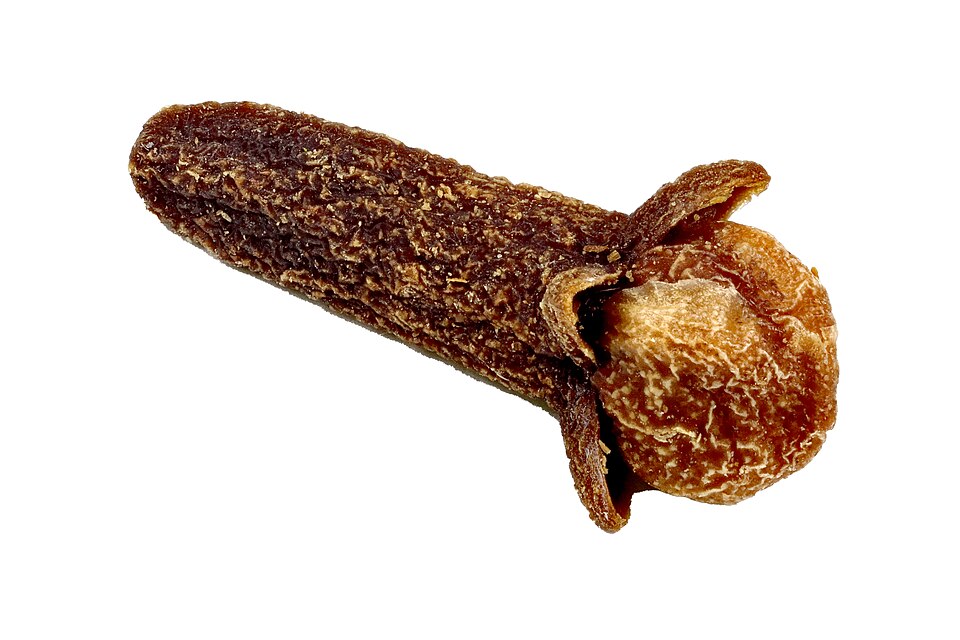
- Choosing 'vegetative bud' by default — a clove is reproductive, not vegetative
- Confusing which plant part a spice comes from (clove = flower bud, not seed, fruit or leaf)
UPPSC and UPSC ask 'which plant part yields spice X' or classify a named structure (clove, saffron, cinnamon) as bud/stigma/bark/fruit.
In making the saffron spice, which one of the following parts of the plant is used?
- (a) Leaf
- (b) Petal
- (c) Sepal
- (d) Stigma
Answer(d) Stigma
Same concept — identifying which floral/plant part yields a common spice; saffron is the flower's stigma, just as a clove is the flower bud, both testing spice-to-plant-part morphology.
- practice — not a real PYQ
The spice clove is obtained from which part of the plant Syzygium aromaticum?
- (a)Dried fruit
- (b)Unopened flower bud
- (c)Root bark
- (d)Seed
Answer(b) Unopened flower bud — picked before it opens and then dried. - practice — not a real PYQ
A bud that grows into leaves and shoots (rather than flowers) is called a:
- (a)Flower bud
- (b)Vegetative bud
- (c)Accessory bud
- (d)Adventitious bud
Answer(b) Vegetative bud — it produces leaves/shoots, whereas a flower bud produces flowers.