
Match List – I with List – II and select the correct answer using the codes given below the lists. List – I (Text) A. Ragamala B. Rasa Kaumudi C. Raga Vibodh D. Chaturdandi Prakashika List – II (Author) 1. Somanath 2. Venkatraman 3. Pundrik Vitthal 4. Sri Kantha Codes :
- (a)A-3, B-4, C-1, D-2
- (b)A-4, B-2, C-1, D-3
- (c)A-2, B-3, C-4, D-1
- (d)A-1, B-2, C-3, D-4
Correct — A, A-3 B-4 C-1 D-2. The four Sanskrit music treatises map to their authors as: A. Ragamala → Pundarika Vitthala (3); B. Rasa Kaumudi → Srikantha (4); C. Raga Vibodha → Somanatha (1); D. Chaturdandi Prakashika → Venkatamakhin, given here as 'Venkatraman' (2). Two of these pairs are firmly settled and alone pin the answer: Raga Vibodha is the well-known 1609 treatise of Somanatha (C-1), and the Chaturdandi Prakashika (c. 1650) is Venkatamakhin's work that laid down the 72-Melakarta raga-classification still used in Carnatic music (D-2). Only option (a) carries BOTH C-1 and D-2 — option (b) breaks D-2, and options (c) and (d) break C-1 — so the answer is fixed at (a). The remaining pairs follow: Pundarika Vitthala (16th-century theorist at the Mughal court) authored the Ragamala, and Srikantha wrote the Rasa Kaumudi.
- (b)A-4, B-2, C-1, D-3 — Keeps C-1 (Raga Vibodha–Somanatha) right but misplaces the rest — it wrongly gives Chaturdandi Prakashika to Srikantha (D-3) instead of Venkatamakhin, and Ragamala to Srikantha (A-4) instead of Pundarika Vitthala.
- (c)A-2, B-3, C-4, D-1 — Every pair is shifted — it assigns Raga Vibodha to Venkatraman (C-4) rather than Somanatha, and Chaturdandi Prakashika to Somanatha (D-1) rather than Venkatamakhin.
- (d)A-1, B-2, C-3, D-4 — Wrongly gives Ragamala to Somanatha (A-1) and Chaturdandi Prakashika to Srikantha (D-4); Raga Vibodha is Somanatha's and Chaturdandi Prakashika is Venkatamakhin's.
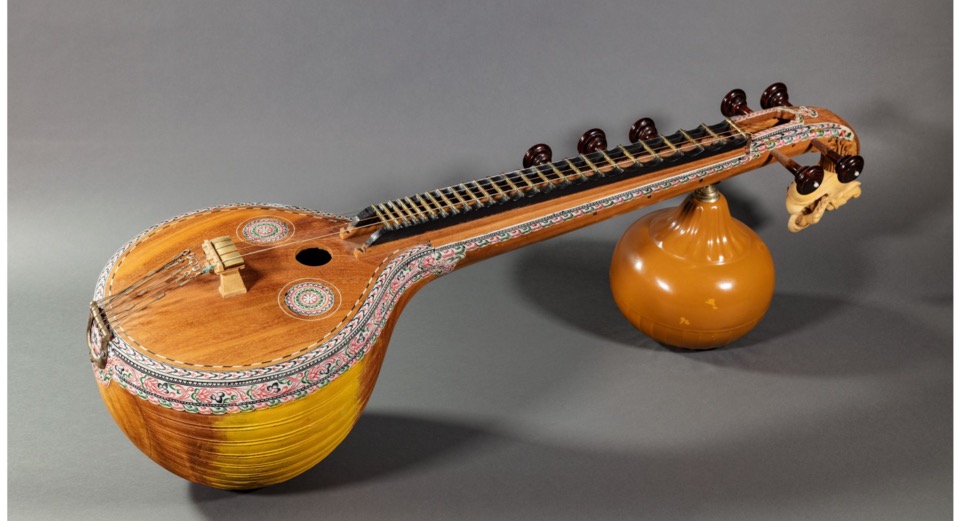
These are four Sanskrit sangita (music-theory) treatises of the medieval to early-modern period, each tied to a distinct author. Raga Vibodha (1609) is Somanatha's work on raga theory and the veena; the Chaturdandi Prakashika (c. 1650) is Venkatamakhin's landmark text that systematised the 72 Melakarta (parent) ragas — the backbone of Carnatic raga classification to this day. Pundarika Vitthala, a 16th-century theorist associated with north Indian courts, wrote a quartet of works including the Ragamala; and Srikantha authored the Rasa Kaumudi. Such 'text ↔ author' match-lists on Indian music/culture recur in UPPSC and UPSC.
The reliable technique in a four-pair match-list is to anchor on the pairs you are certain of and eliminate. Here the two textbook-standard pairs — Somanatha's Raga Vibodha (C-1) and Venkatamakhin's Chaturdandi Prakashika (D-2) — appear together only in option (a). You do not even need to recall the Pundarika Vitthala or Srikantha attributions to lock the answer; the two well-known pairs eliminate every other option.
- Raga Vibodha (1609) — Somanatha; a key treatise on ragas and veena technique.
- Chaturdandi Prakashika (c. 1650) — Venkatamakhin (listed as 'Venkatraman'); defined the 72 Melakarta raga system of Carnatic music.
- Ragamala — Pundarika Vitthala, a 16th-century music theorist (part of his quartet of works).
- Rasa Kaumudi — Srikantha.
- Interchanging Raga Vibodha (Somanatha) and Chaturdandi Prakashika (Venkatamakhin) — the two anchor pairs.
- Not recognising 'Venkatraman' in the options as Venkatamakhin, author of the Melakarta scheme.
UPPSC favours 'text ↔ author' match-lists on Indian music/literature; UPSC tests the same by naming a treatise (e.g., Sangita Ratnakara) and asking its author, or vice versa.
Match List I with List II and select the correct answer using the codes given below the Lists: List I I. Pandit Vishnu Digambar Paluskar II. Venkatamahi III. Shyama Shastri IV. Amir Khusru List II A. Introduced the scheme of Raga classification of Indian music B. Proponent of Carnatic music C. Proponent of the Khayal form of Hindustani music D. Wrote the music for the song 'Vande Mataram' Codes:
- (a) I-D, II-A, III-C, IV-B
- (b) I-D, II-A, III-B, IV-C
- (c) I-A, II-D, III-C, IV-B
- (d) I-A, II-D, III-B, IV-C
Answer(b) I-D, II-A, III-B, IV-C
Same concept — a match-list on Indian music theorists that hinges on 'Venkatamahi' (Venkatamakhin) being the author of the raga-classification scheme (II-A), which is exactly the Chaturdandi Prakashika / Melakarta attribution tested in this UPPSC item (D-2).
Match List I (Books) with List II (Authors) and select the correct answer using the codes given below the Lists: List I I. My Music, My Life II. Adha Gaon III. Radha IV. The Pilferer List II A) Laxman Gaikwad B) Rahi Masoom Raza C) Ramakanta Rath D) Ravi Shankar Codes:
- (a) I-C, II-B, III-D, IV-A
- (b) I-D, II-B, III-C, IV-A
- (c) I-D, II-A, III-C, IV-B
- (d) I-C, II-A, III-D, IV-B
Answer(b) I-D, II-B, III-C, IV-A
Same 'text ↔ author' matching skill in Indian cultural history (its lead pair is the music memoir 'My Music, My Life' → Ravi Shankar), mirroring how this UPPSC question asks candidates to tie each music treatise to its author.
- practice — not a real PYQ
The Chaturdandi Prakashika, which set out the 72 Melakarta raga classification of Carnatic music, was written by
- (a)Somanatha
- (b)Venkatamakhin
- (c)Sharngadeva
- (d)Pundarika Vitthala
Answer(b) Venkatamakhin — his c. 1650 treatise laid down the Melakarta (parent raga) scheme still used in Carnatic music. - practice — not a real PYQ
The famous 13th-century music treatise 'Sangita Ratnakara' was composed by
- (a)Somanatha
- (b)Sharngadeva
- (c)Venkatamakhin
- (d)Srikantha
Answer(b) Sharngadeva — his Sangita Ratnakara is a foundational text revered in both Hindustani and Carnatic traditions.