
Which of the following natural substances contains iron (Fe) ?
- (a)Chlorophyll
- (b)Collagen
- (c)Keratin
- (d)Myoglobin
Correct — D, Myoglobin. Myoglobin is the oxygen-storing protein of muscle; each molecule carries a heme (haem) group whose central atom is iron (Fe). The iron binds and stores oxygen inside muscle cells, and it is this iron-heme pigment (not blood) that gives red meat its colour. The related blood protein haemoglobin also contains iron in its heme.
- (a)Chlorophyll — Chlorophyll has the same porphyrin-ring architecture as heme, but its central metal atom is magnesium (Mg), not iron — that is why plants are green, not red.
- (b)Collagen — Collagen is the main structural protein of connective tissue (skin, tendon, bone matrix); it is built from amino acids (rich in glycine, proline, hydroxyproline) and contains no iron.
- (c)Keratin — Keratin is the structural protein of hair, nails and the skin's outer layer; it is rich in sulphur-containing cysteine but has no iron.
A favourite exam theme is 'which biomolecule holds which metal at its core'. Iron sits in the heme of haemoglobin and myoglobin (oxygen transport/storage). Magnesium sits at the centre of chlorophyll (light capture). Structural proteins such as collagen and keratin hold no metal ion — they are chains of amino acids.
The trap is chlorophyll: its ring looks like heme and students 'pair' it with iron. But chlorophyll's metal is magnesium; iron belongs to myoglobin/haemoglobin. Remembering 'green = Mg, red = Fe' resolves the question instantly.
- Myoglobin (and haemoglobin) — iron in a heme group; stores/carries oxygen.
- Chlorophyll — magnesium at the centre of its porphyrin ring.
- Collagen (connective tissue) and keratin (hair, nails) — amino-acid structural proteins, no metal.
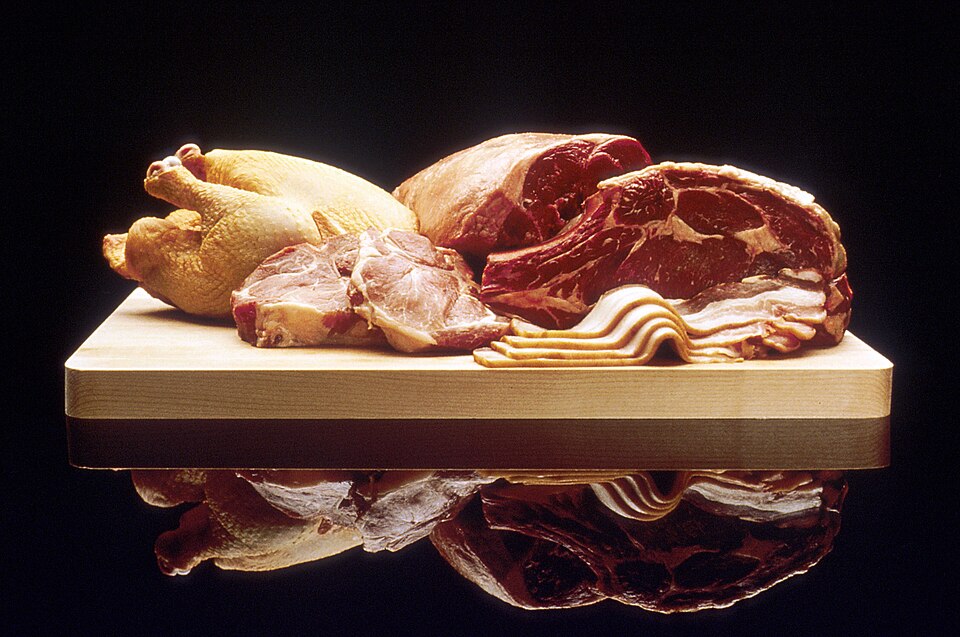
- The red colour of meat is due to myoglobin, not residual blood.
- Pairing chlorophyll with iron because its ring resembles heme — its metal is magnesium
- Thinking meat is red because of blood rather than myoglobin
UPSC/UPPSC ask 'which element/metal is present in X' or match biomolecule to its central metal — lock 'iron ↔ haemoglobin/myoglobin' and 'magnesium ↔ chlorophyll'.
Consider the following minerals: 1. Calcium 2. Iron 3. Sodium. Which of the minerals given above is/are required by human body for the contraction of muscles?
- (a) 1 only
- (b) 2 and 3 only
- (c) 1 and 3 only
- (d) 1, 2 and 3
Answer(d) 1, 2 and 3
Overlaps on iron's biological role — the UPSC key counts iron because it is a component of myoglobin, the same iron-protein that is the answer here.
- practice — not a real PYQ
The central metal atom present in a molecule of chlorophyll is:
- (a)Iron
- (b)Magnesium
- (c)Calcium
- (d)Manganese
Answer(b) Magnesium — it sits at the centre of chlorophyll's porphyrin ring. - practice — not a real PYQ
In the human body, iron is an essential component of which of the following?
- (a)Insulin
- (b)Haemoglobin
- (c)Thyroxine
- (d)Vitamin B12
Answer(b) Haemoglobin — the iron-bearing oxygen-carrying pigment of red blood cells.