
With reference to Eutrophication, which of the following statement(s) is/are correct ? 1. It decreases dissolved oxygen of water. 2. It is a phenomenon of nutrient enrichment of a water body. Select the correct answer from the codes given below.
- (a)1 only
- (b)2 only
- (c)Both 1 and 2
- (d)Neither 1 nor 2
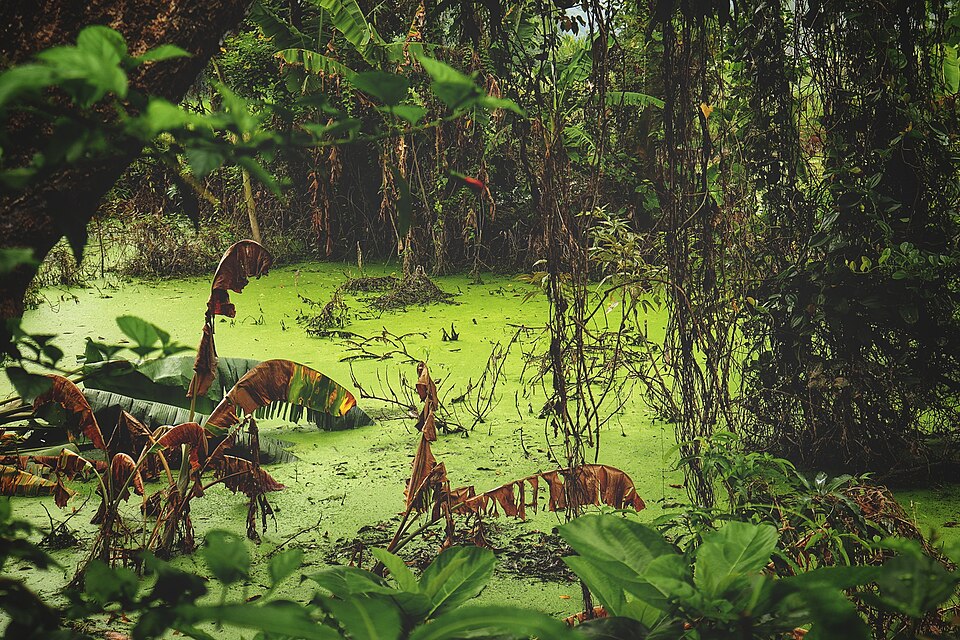
Correct — C, Both 1 and 2. Eutrophication is the process by which a water body becomes over-enriched with nutrients — chiefly nitrogen and phosphorus from fertiliser run-off, sewage and detergents (statement 2 is the very definition of eutrophication, correct). This nutrient loading triggers explosive growth of algae and aquatic plants (an algal bloom); when that biomass dies, its decomposition by aerobic bacteria consumes large amounts of dissolved oxygen, while the surface bloom also blocks sunlight and gas exchange. The result is oxygen-depleted (hypoxic) water and fish kills — so statement 1 (it decreases dissolved oxygen) is also correct. Both are true, hence (c).
- (a)1 only — Incomplete — statement 2 (nutrient enrichment of a water body) is the very definition of eutrophication and is also correct.
- (b)2 only — Incomplete — statement 1 is also correct: decomposition of the algal bloom consumes dissolved oxygen, lowering it.
- (d)Neither 1 nor 2 — Wrong — both statements accurately describe eutrophication.
Eutrophication is nutrient (nitrogen and phosphorus) enrichment of a water body. The chain of effects is: excess nutrients from run-off/sewage → algal bloom → the bloom dies → aerobic bacteria decompose it, raising biochemical oxygen demand (BOD) → dissolved oxygen falls (hypoxia) → aquatic life, especially fish, dies. Human-accelerated eutrophication is called 'cultural eutrophication'.
A common trap is to reason that algae produce oxygen by photosynthesis, so eutrophication must add oxygen. The NET effect is the opposite: decomposition of the dense, short-lived bloom and the blocking of surface gas exchange deplete dissolved oxygen. Both given statements — the cause (nutrient enrichment) and the effect (lower dissolved oxygen) — are correct.
- Eutrophication = enrichment of a water body with nutrients, mainly nitrogen and phosphorus (fertilisers, sewage, detergents)
- It triggers algal blooms; their decay raises BOD and depletes dissolved oxygen (hypoxia)
- Consequences: fish kills, loss of aquatic biodiversity, 'dead zones'
- Some blooms also release toxins — 'harmful algal blooms'; the human-driven form is 'cultural eutrophication'
- Thinking eutrophication adds oxygen because algae photosynthesise — the net effect is oxygen depletion from decomposition and blocked exchange
- Confusing eutrophication (nutrient enrichment) with biomagnification (toxin build-up up the food chain)
As statement-based 'which is correct about eutrophication', or by asking for its causes (nutrient run-off) or effects (algal bloom, low dissolved oxygen, fish kill).
There is a concern over the increase in harmful algal blooms in the seawaters of India. What could be the causative factors for this phenomenon? 1. Discharge of nutrients from the estuaries. 2. Run-off from the land during the monsoon. 3. Upwelling in the seas. Select the correct answer from the codes given below.
- (a) 1 only
- (b) 1 and 2 only
- (c) 2 and 3 only
- (d) 1, 2 and 3
Answer(d) 1, 2 and 3
Same concept — nutrient enrichment (eutrophication) driving algal blooms; UPSC lists the nutrient sources (estuarine discharge, land run-off, upwelling) that fuel the blooms which then deplete dissolved oxygen.
- practice — not a real PYQ
Eutrophication of a water body is most directly caused by the enrichment of which nutrients?
- (a)Nitrogen and phosphorus
- (b)Carbon and sulphur
- (c)Iron and manganese
- (d)Sodium and chlorine
Answer(a) Nitrogen and phosphorus — mainly from fertiliser run-off, sewage and detergents. - practice — not a real PYQ
The death of fish in a eutrophic lake is chiefly due to
- (a)an increase in dissolved oxygen
- (b)depletion of dissolved oxygen
- (c)a rise in salinity
- (d)a fall in water temperature
Answer(b) depletion of dissolved oxygen — decomposition of the algal bloom consumes O2 (hypoxia).