
Valley of Kashmir is situated between
- (a)Kangara and Dhauladhar ranges
- (b)Pir-Panjal and Himadri ranges
- (c)Mahabharat and Dhauladhar ranges
- (d)Pir-Panjal and Mahabharat ranges
Correct — B, Pir-Panjal and Himadri ranges. The Kashmir Valley is an elongated intermontane (between-mountain) valley in the north-western Himalayas. Its south-western wall is the Pir Panjal Range (part of the Lesser/Middle Himalayas) and its north-eastern wall is the Great Himalaya, also called the Himadri (Zaskar) range. The valley floor, drained by the Jhelum, lies between these two parallel ranges — hence (b).
- (a)Kangara and Dhauladhar ranges — These frame the Kangra Valley in Himachal Pradesh (between the Dhauladhar and the outer ranges), not the Kashmir Valley.
- (c)Mahabharat and Dhauladhar ranges — The Mahabharat Range is the Lesser Himalaya of Nepal and the Dhauladhar lies in Himachal Pradesh; neither borders the Kashmir Valley.
- (d)Pir-Panjal and Mahabharat ranges — Pir Panjal is right for the south-western side, but the north-eastern wall is the Great Himalaya (Himadri), not the Mahabharat Range, which lies far east in Nepal.
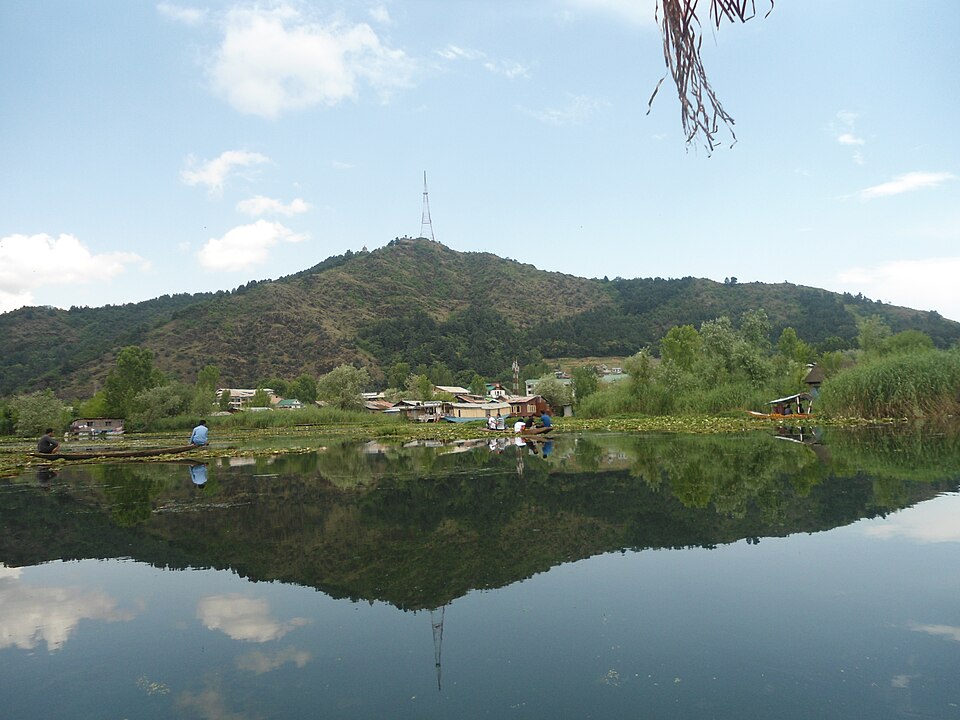
The Kashmir Valley (Vale of Kashmir) is a synclinal/tectonic trough about 135 km long and about 32 km wide, cradled between the Pir Panjal Range to the south-west and the Great Himalaya (Himadri/Zaskar) to the north-east. It is drained by the Jhelum (Vitasta) and dotted with lakes such as Dal and Wular. Its floor is covered by Karewas — old lake-bed (lacustrine) deposits that support saffron, apples and almonds.
The trap is that all four options pair genuine Himalayan/sub-Himalayan ranges, but only Pir Panjal (SW) and Himadri (NE) actually enclose the Kashmir Valley. Dhauladhar and Kangra belong to Himachal Pradesh; the Mahabharat Range belongs to Nepal. Anchor to the correct pair by remembering the Jawahar Tunnel / Banihal Pass, which pierce the Pir Panjal to enter the valley.
- Kashmir Valley lies between the Pir Panjal Range (south-west) and the Great Himalaya / Himadri–Zaskar (north-east)
- Drained by the Jhelum (Vitasta); contains Dal Lake and Wular Lake
- Valley floor covered by Karewas — old lacustrine deposits famous for saffron and orchards
- Historically entered across the Pir Panjal via the Banihal Pass / Jawahar Tunnel
- Confusing the Kashmir Valley with the Kangra Valley (Dhauladhar, Himachal Pradesh)
- Placing the Mahabharat Range (Nepal) or Dhauladhar (Himachal) around Kashmir
UPPSC/UPSC test the parallel Himalayan ranges by asking which two ranges bound a named valley (Kashmir, Kangra, Kullu) or by matching ranges to states — fix each range to its state and its river.
- practice — not a real PYQ
The valley floor of the Kashmir Valley is covered with old lacustrine deposits known as:
- (a)Bhabar
- (b)Karewas
- (c)Bhangar
- (d)Duns
Answer(b) Karewas — old lake-bed deposits of the Kashmir Valley, famed for saffron cultivation. - practice — not a real PYQ
Which river drains the Kashmir Valley?
- (a)Chenab
- (b)Ravi
- (c)Jhelum
- (d)Beas
Answer(c) Jhelum — the Jhelum (Vitasta) flows through the Kashmir Valley, feeding Wular Lake.