
How many more 'Ramsar Sites' were added to Uttar Pradesh in January, 2020 ?
- (a)3
- (b)6
- (c)9
- (d)12
Correct — B, six. Around January 2020, six Uttar Pradesh wetlands were designated Ramsar Sites (Wetlands of International Importance), taking the state's tally from 1 to 7. The six were Nawabganj Bird Sanctuary, Parvati Arga Bird Sanctuary, Saman Bird Sanctuary, Samaspur Bird Sanctuary, Sandi Bird Sanctuary and Sarsai Nawar Jheel — added to UP's only earlier Ramsar site, the Upper Ganga River (Brijghat–Narora stretch, designated 2005).
- (a)3 — Three is too few — six new UP wetlands received Ramsar status in this round, not three.
- (c)9 — Nine overstates the addition; the correct number of new UP Ramsar sites in early 2020 was six (taking the state total to seven).
- (d)12 — Twelve is far too high; UP added six new Ramsar sites in this batch, and even its later total remained well below twelve at the time.
The Ramsar Convention (signed 2 February 1971 at Ramsar, Iran) is an intergovernmental treaty for the conservation and 'wise use' of wetlands; sites of international importance are listed as 'Ramsar Sites'. India acceded in 1982, and its first two sites — Chilika Lake (Odisha) and Keoladeo National Park (Rajasthan) — were designated in 1981. World Wetlands Day is observed on 2 February.
This is a factual current-affairs recall. The clean anchor is 'UP went from 1 to 7', i.e. six new sites were added in early 2020. Remembering that UP had only the Upper Ganga River (2005) before this batch makes the '+6' easy to reconstruct. (Sur Sarovar/Keetham near Agra and Haiderpur Wetland were designated later, in 2020-21.)
- Six UP wetlands got Ramsar status around Jan 2020, raising UP from 1 to 7 sites
- The six: Nawabganj, Parvati Arga, Saman, Samaspur, Sandi Bird Sanctuaries and Sarsai Nawar Jheel
- UP's earlier lone Ramsar site was the Upper Ganga River (Brijghat–Narora), designated 2005
- Ramsar Convention: signed 1971 at Ramsar, Iran; India a party since 1982; World Wetlands Day = 2 February
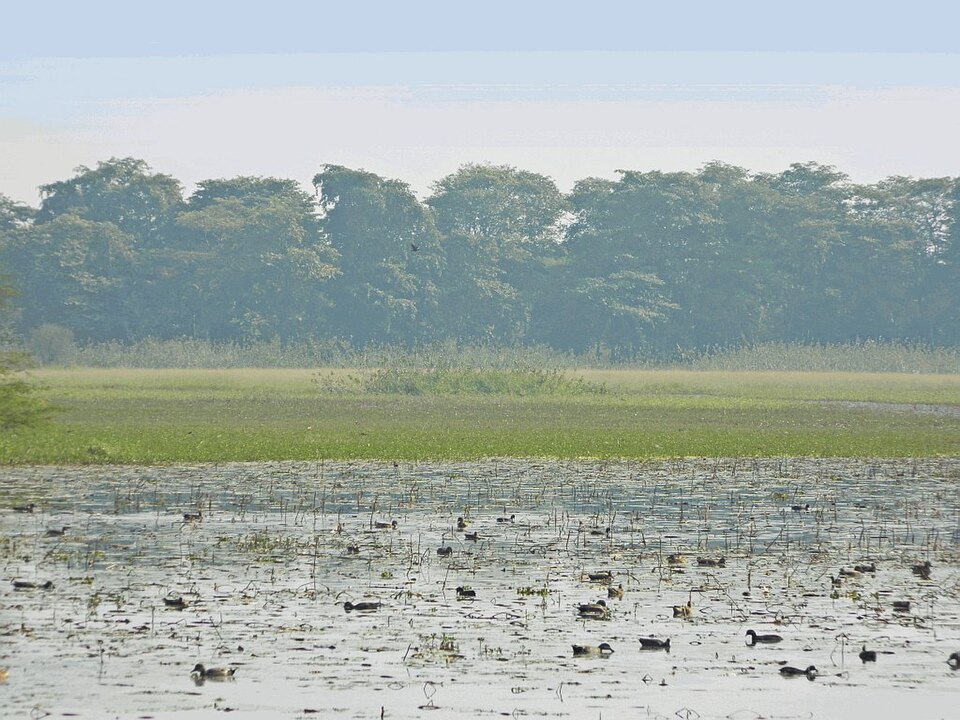
- Confusing 'number added' (6) with 'state total after addition' (7)
- Mixing up later UP designations (Sur Sarovar, Haiderpur) that came after this Jan-2020 batch
UPPSC asks a precise number ('how many added'); UPSC tends to ask conceptually about the Ramsar Convention and 'wise use' — know both the count and the treaty's purpose.
India is a party to the Ramsar Convention and has declared many areas as Ramsar Sites. Which of the following statements best describes how we should maintain these sites in the context of this Convention?
- (a) Keep all the sites completely inaccessible to man so that they will not be exploited.
- (b) Conserve all the sites through ecosystem approach and permit tourism and recreation only.
- (c) Conserve all the sites through ecosystem approach for a period without any exploitation, with specific criteria and specific period for each site, and then allow sustainable use of them by future generations.
- (d) Conserve all the sites through ecosystem approach and allow their simultaneous sustainable use.
Answer(d) Conserve all the sites through ecosystem approach and allow their simultaneous sustainable use.
Same concept — Ramsar Sites. UPPSC asks how many were added to UP; UPSC tests the Convention's core 'wise use' principle (conserve via an ecosystem approach while allowing sustainable use).
- practice — not a real PYQ
The Ramsar Convention, an international treaty adopted in 1971, is concerned with the conservation of:
- (a)Deserts
- (b)Wetlands
- (c)Coral reefs
- (d)Mountain forests
Answer(b) Wetlands — the Ramsar Convention (Ramsar, Iran, 1971) is for the conservation and wise use of wetlands. - practice — not a real PYQ
Which of the following was among India's first Ramsar Sites, designated in 1981?
- (a)Wular Lake
- (b)Chilika Lake
- (c)Loktak Lake
- (d)Sambhar Lake
Answer(b) Chilika Lake — Chilika (Odisha) and Keoladeo NP (Rajasthan) were India's first Ramsar Sites (1981).