
Who among the following was the author of the book 'Kitab-i-Nauras' ?
- (a)Ibrahim Adil Shah II
- (b)Ali Adil Shah
- (c)Quli Qutab Shah
- (d)Akbar II
Correct — A, Ibrahim Adil Shah II. Ibrahim Adil Shah II, the Adil Shahi Sultan of Bijapur (r. 1580-1627), was a scholar-musician who wrote the Kitab-i-Nauras ('Book of Nine Rasas') — a collection of songs in Dakhani (Deccani) set to Indian ragas. Reflecting his famously syncretic outlook, its verses invoke both the Hindu goddess Saraswati and the Sufi saint Gesu Daraz (Banda Nawaz) of Gulbarga, and it carries a Persian preface by his court poet Zuhuri.
- (b)Ali Adil Shah — Ali Adil Shah (I) was an earlier Bijapur Sultan of the same Adil Shahi line, not the author of the Kitab-i-Nauras — that was Ibrahim Adil Shah II.
- (c)Quli Qutab Shah — Muhammad Quli Qutb Shah of Golconda was himself a celebrated Dakhani poet (and founder of Hyderabad), which makes him a tempting choice — but the Kitab-i-Nauras was Ibrahim Adil Shah II's work, not his.
- (d)Akbar II — Akbar II was a much later Mughal emperor (r. 1806-1837) with no connection to the 16th-17th-century Deccani Kitab-i-Nauras, so the choice is anachronistic.
The Deccan Sultanates (Bijapur, Golconda, Ahmadnagar and others) were major patrons of the Dakhani language and of a composite Indo-Islamic court culture. Ibrahim Adil Shah II of Bijapur exemplified this: a devotee of the Sufi saint Gesu Daraz who also revered Saraswati, he earned the epithet 'Jagadguru' and authored the musical anthology Kitab-i-Nauras. His reign was Bijapur's cultural high-point, which also produced monuments such as the Ibrahim Rauza.
All four options are (or sound like) Deccan or Mughal royals, so the question tests the specific author. The reliable anchor is Bijapur's Ibrahim Adil Shah II, repeatedly linked in Indian history with the Kitab-i-Nauras, Saraswati worship and the 'Jagadguru' title. Quli Qutb Shah is the trap because he too composed Dakhani poetry.
- Kitab-i-Nauras ('Book of Nine Rasas') — songs in Dakhani set to Indian ragas, by Ibrahim Adil Shah II of Bijapur (r. 1580-1627).
- Its verses invoke the goddess Saraswati and the Sufi saint Gesu Daraz (Banda Nawaz).
- For his religious tolerance Ibrahim II was hailed as 'Jagadguru'; his court poet was Zuhuri.
- He belonged to the Adil Shahi dynasty of Bijapur, one of the Deccan Sultanates.
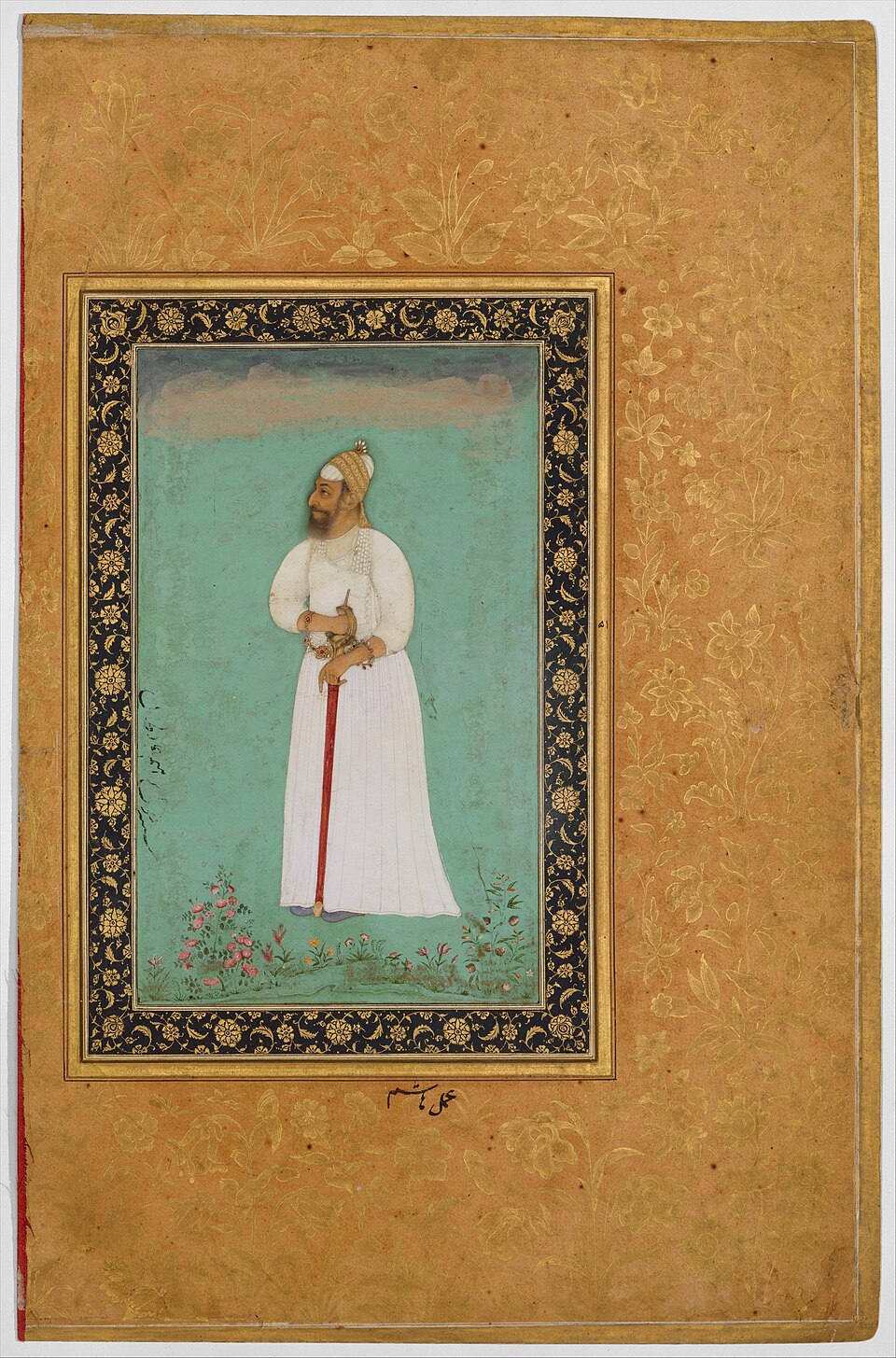
- Choosing Quli Qutb Shah (Golconda's Dakhani poet-king) instead of Bijapur's Ibrahim Adil Shah II.
- Being misled by 'Akbar II', who is a 19th-century Mughal, not a Deccan sultan.
UPSC/UPPSC pair a Deccan Sultan with his cultural signature — Ibrahim Adil Shah II with the Kitab-i-Nauras / 'Jagadguru' / Saraswati, and Quli Qutb Shah with founding Hyderabad and writing Dakhani verse.
Consider the following statements: 1. Kitab-I-Nauras, a collection of songs in praise of Hindu deities and Muslim saints, was written by Ibrahim Adil Shah II. 2. Amir Khusrau was the originator in India of the early form of the musical style known as Qawwali. Which of these statements is/are correct?
- (a) Only 1
- (b) Only 2
- (c) Both 1 and 2
- (d) Neither 1 nor 2
Answer(c) Both 1 and 2 — the Kitab-i-Nauras was written by Ibrahim Adil Shah II, and Amir Khusrau originated the early Qawwali form.
Directly tests the same fact — that Ibrahim Adil Shah II authored the Kitab-i-Nauras — which is exactly what this UPPSC question asks.
Which one of the following Muslim rulers was hailed as the 'Jagadguru' by his Muslim subjects because of his belief in secularism?
- (a) Husain Shah
- (b) Zain-ul-Abidin
- (c) Ibrahim Adil Shah
- (d) Mahmud II
Answer(c) Ibrahim Adil Shah — Ibrahim Adil Shah II of Bijapur was called 'Jagadguru' for his tolerance.
Same figure — Ibrahim Adil Shah II of Bijapur, author of the Kitab-i-Nauras — tested through his other signature identifier, the 'Jagadguru' epithet.
- practice — not a real PYQ
Which Bijapur Sultan was hailed as 'Jagadguru' for his religious tolerance?
- (a)Ibrahim Adil Shah II
- (b)Yusuf Adil Shah
- (c)Muhammad Adil Shah
- (d)Ali Adil Shah I
Answer(a) Ibrahim Adil Shah II — his syncretism (Saraswati worship, patronage of Hindu and Muslim arts) earned him the title 'Jagadguru'. - practice — not a real PYQ
The Kitab-i-Nauras is best described as a work of which kind?
- (a)A collection of Dakhani songs set to Indian ragas
- (b)A revenue and land-settlement manual
- (c)A Persian chronicle of Mughal wars
- (d)A treatise on temple architecture
Answer(a) A collection of Dakhani songs set to Indian ragas — the 'Book of Nine Rasas' by Ibrahim Adil Shah II.