
Who was the ruler of Golkonda when Aurangzeb seized the fort of Golkonda in 1687 ?
- (a)Abul Hasan Qutb Shah
- (b)Sikandar Adil Shah
- (c)Ali Adil Shah II
- (d)Shayasta Khan
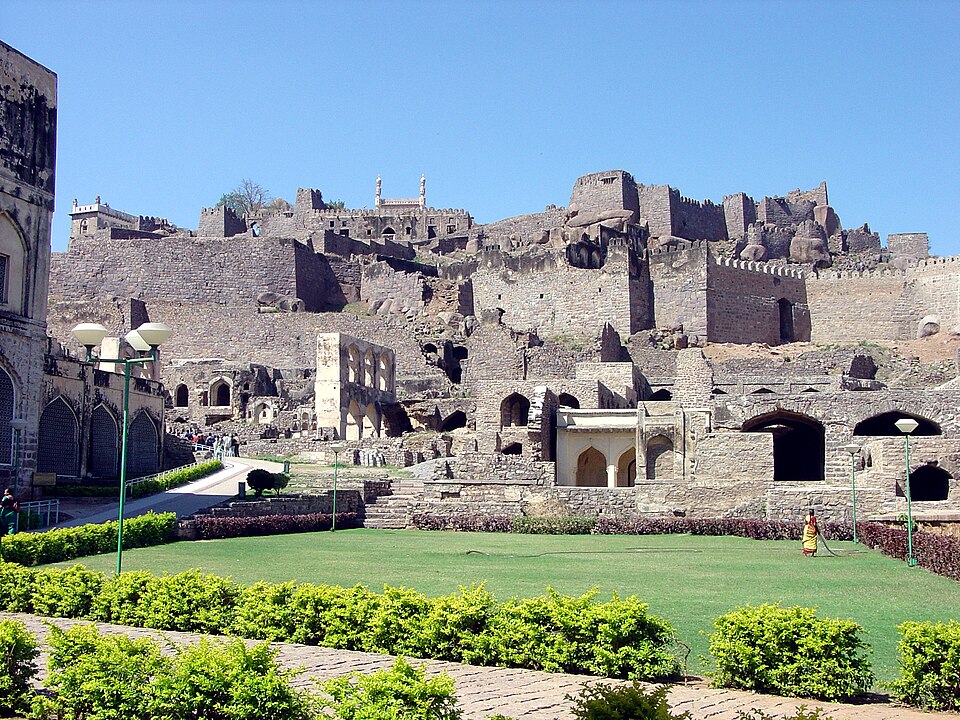
Correct — A, Abul Hasan Qutb Shah. He was the last ruler of the Qutb Shahi dynasty of Golconda (popularly called Abul Hasan 'Tana Shah'). When Aurangzeb marched into the Deccan, he besieged Golconda and, after a long siege, took the fort in 1687 by treachery; Abul Hasan was captured and imprisoned at Daulatabad, ending the Qutb Shahi kingdom, which was annexed to the Mughal empire.
- (b)Sikandar Adil Shah — Sikandar Adil Shah was the last ruler of the Adil Shahi dynasty of Bijapur — the OTHER Deccan sultanate. Aurangzeb annexed Bijapur in 1686, one year before Golconda; Sikandar ruled Bijapur, not Golconda.
- (c)Ali Adil Shah II — Ali Adil Shah II was an earlier ruler of Bijapur (Adil Shahi, r. c. 1656-1672), again a Bijapur (not Golconda) sultan, and he had died well before 1687.
- (d)Shayasta Khan — Shaista Khan was a Mughal noble and general (Aurangzeb's maternal uncle), famous for his campaigns against Shivaji and as governor of the Deccan and Bengal — a Mughal officer, not the ruler of Golconda.
Golconda was the seat of the Qutb Shahi dynasty (founded by Quli Qutb Shah, 1518), one of the Deccan sultanates that emerged from the break-up of the Bahmani kingdom. Aurangzeb, obsessed with subduing the Deccan, extinguished both surviving sultanates — Bijapur (Adil Shahi) in 1686 and Golconda (Qutb Shahi) in 1687 — bringing the Mughal empire to its greatest territorial extent, though the Deccan campaigns drained its treasury.
The distractors deliberately mix the two Deccan sultanates: (b) and (c) are Bijapur/Adil Shahi rulers, (d) is a Mughal general. Remember the pairing — Golconda = Qutb Shahi = Abul Hasan (Tana Shah), 1687; Bijapur = Adil Shahi = Sikandar, 1686. That separates Golconda's ruler from the Bijapur names.
- Golconda = capital of the Qutb Shahi dynasty (founded 1518 by Quli Qutb Shah)
- Abul Hasan Qutb Shah ('Tana Shah') was its last ruler; Aurangzeb took Golconda in 1687
- Bijapur (Adil Shahi, last ruler Sikandar Adil Shah) fell to Aurangzeb a year earlier, in 1686
- The annexation of both sultanates marked the Mughal empire's greatest extent under Aurangzeb
- Confusing Golconda's Qutb Shahi rulers with Bijapur's Adil Shahi rulers
- Mistaking Shaista Khan (a Mughal general) for a Deccan sultan
- Swapping the years — Bijapur fell in 1686, Golconda in 1687
UPSC/UPPSC test the Deccan sultanates via ruler-kingdom-year matches or via Aurangzeb's annexations — fix Golconda↔Qutb Shahi↔Abul Hasan↔1687 firmly.
Which one of the following Muslim rulers was hailed as the 'Jagadguru' by his Muslim subjects because of his belief in secularism?
- (a) Husain Shah
- (b) Zain-ul-Abidin
- (c) Ibrahim Adil Shah
- (d) Mahmud II
Answer(c) Ibrahim Adil Shah
Same theme — the Deccan Sultanates. This UPPSC question is on Golconda's Qutb Shahi ruler Abul Hasan (and Bijapur's Adil Shahi rulers as distractors); the UPSC one tests Ibrahim Adil Shah II of Bijapur, the neighbouring Adil Shahi sultanate.
- practice — not a real PYQ
The Qutb Shahi dynasty, extinguished by Aurangzeb in 1687, had its capital at which fort?
- (a)Bijapur
- (b)Golconda
- (c)Daulatabad
- (d)Ahmadnagar
Answer(b) Golconda — the Qutb Shahi seat, near later Hyderabad. - practice — not a real PYQ
Which two Deccan sultanates did Aurangzeb annex in 1686 and 1687 respectively?
- (a)Ahmadnagar and Berar
- (b)Bijapur and Golconda
- (c)Bidar and Berar
- (d)Golconda and Ahmadnagar
Answer(b) Bijapur (Adil Shahi, 1686) and Golconda (Qutb Shahi, 1687).