
Match List – I with List – II and select the correct answer using the codes given below the lists : List – I: A. Indus Valley Civilization, B. Later Vedic Society, C. Rigvedic Society, D. Medieval Period List – II: 1. Pastoral, 2. Land Lordism, 3. Agrarian, 4. Urban
- (a)A-4, B-2, C-3, D-1
- (b)A-2, B-1, C-4, D-3
- (c)A-3, B-4, C-1, D-2
- (d)A-4, B-3, C-1, D-2
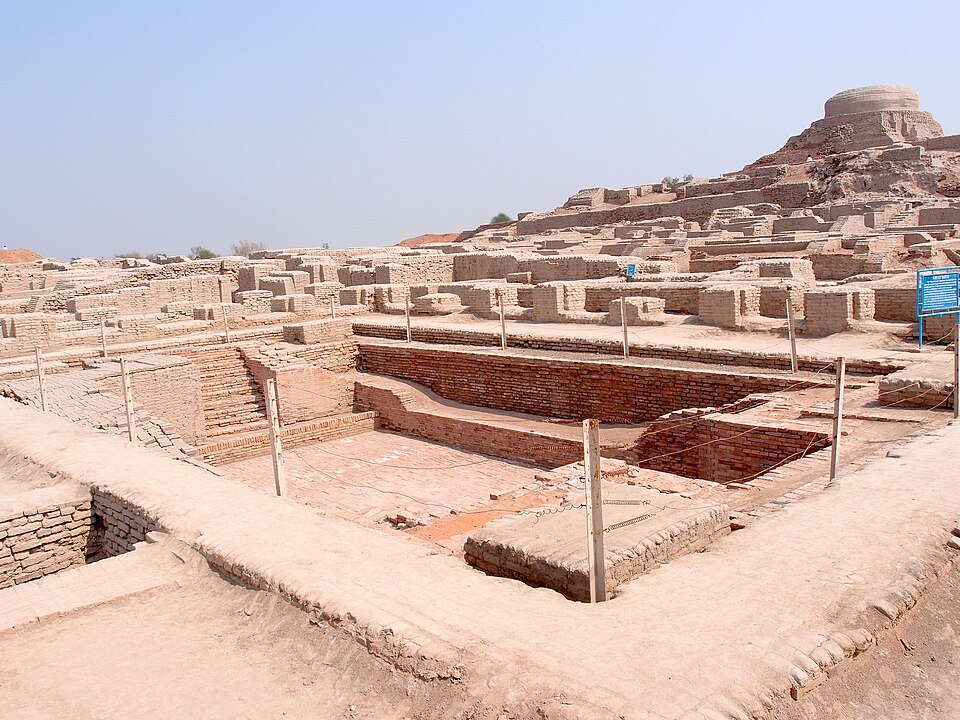
Correct — D, A-4, B-3, C-1, D-2. Each society is paired with its dominant economic character. (A) The Indus Valley Civilization (c. 2600-1900 BCE) was India's first URBAN economy — planned brick cities such as Mohenjo-daro and Harappa with grid streets, granaries, drains and standardised weights → 4-Urban. (B) Later Vedic Society (c. 1000-600 BCE) shifted east into the Ganga plains, adopted iron tools and the plough, and became settled and AGRARIAN → 3-Agrarian. (C) Rigvedic Society (c. 1500-1000 BCE) was chiefly PASTORAL — cattle were the main wealth (the word for war, gavishti, literally means 'search for cattle') → 1-Pastoral. (D) The Medieval Period was marked by LAND LORDISM — feudal land-grants (agrahara, iqta, jagir, zamindari) that created an intermediary landholding class → 2-Land Lordism. Only code (d) matches all four.
- (a)A-4, B-2, C-3, D-1 — Gets only A-4 (IVC-Urban) right. It wrongly labels Later Vedic society as Land Lordism (B-2), the pastoral Rigvedic society as Agrarian (C-3), and the feudal Medieval period as Pastoral (D-1) — the last three are all mismatched.
- (b)A-2, B-1, C-4, D-3 — Every pairing is wrong: it calls the urban Indus Valley 'Land Lordism' (A-2), the agrarian Later Vedic society 'Pastoral' (B-1), the pastoral Rigvedic society 'Urban' (C-4) and the feudal Medieval period 'Agrarian' (D-3).
- (c)A-3, B-4, C-1, D-2 — Fixes C-1 (Rigvedic-Pastoral) and D-2 (Medieval-Land Lordism), but swaps the first two: it wrongly makes the urban Indus Valley 'Agrarian' (A-3) and the agrarian Later Vedic society 'Urban' (B-4). The IVC, not the Later Vedic age, was the urban one.
Indian economic history before modern times is often summarised as a sequence of dominant modes: the Harappans built an URBAN civilization; the Rigvedic Aryans who followed were mainly PASTORAL cattle-keepers; the Later Vedic people, using iron and the plough in the Ganga valley, became settled AGRARIANS; and by the Medieval period a system of LAND LORDISM (feudal land-grants and intermediaries between the state and the tiller) dominated.
The trap is that the Indus Valley is chronologically the OLDEST yet the most 'advanced' (urban), while the Vedic ages that came after it were less urban. Candidates who assume 'older = simpler' wrongly tag the IVC as pastoral or agrarian. Two anchors crack the match: IVC = cities = Urban (A-4), and Rigveda = cattle = Pastoral (C-1). Those alone rule out every option except (d).
- Indus Valley Civilization: India's first urbanisation — planned cities, drainage, granaries, standardised weights (Urban).
- Rigvedic society: pastoral and semi-nomadic; cattle (gau) were the chief measure of wealth and cause of conflict (gavishti).
- Later Vedic society: eastward move to the Ganga plains + iron ploughshare made settled agriculture the base (Agrarian).
- Medieval period: feudal land-grants (agrahara/iqta/jagir/zamindari) produced an intermediary landlord class (Land Lordism).
- Assuming the older Indus Valley must be less developed than the Vedic ages — it was the urban one.
- Confusing pastoral Rigvedic society with the agrarian Later Vedic society that followed it.
UPPSC and UPSC test the evolution of the ancient Indian economy by pairing a period with a keyword (urban/pastoral/agrarian/feudal) or by contrasting two stages — fix the two hardest anchors (IVC = urban, Rigveda = cattle/pastoral) and the rest falls out.
With reference to the difference between the culture of Rigvedic Aryans and Indus Valley people, which of the following statements is/are correct? 1. Rigvedic Aryans used the coat of mail and helmet in warfare whereas the people of Indus Valley Civilization did not leave any evidence of using them. 2. Rigvedic Aryans knew gold, silver and copper whereas Indus Valley people knew only copper and iron. 3. Rigvedic Aryans had domesticated the horse whereas there is no evidence of Indus Valley people having been aware of this animal.
- (a) 1 only
- (b) 2 and 3 only
- (c) 1 and 3 only
- (d) 1, 2 and 3
Answer(c) 1 and 3 only — statements 1 and 3 are correct; statement 2 is wrong because the Indus people did not know iron.
Directly contrasts the two societies whose economic-cultural character this match tests — the (pastoral, horse-using) Rigvedic Aryans versus the (urban) Indus Valley people.
- practice — not a real PYQ
In Rigvedic society, the term 'gavishti', literally 'search for cattle', came to mean which of the following?
- (a)A religious sacrifice
- (b)War or conflict
- (c)A land measure
- (d)A trade guild
Answer(b) War or conflict — because cattle were the chief form of wealth in the pastoral Rigvedic economy, the word for a cattle-raid ('gavishti') became the word for war. - practice — not a real PYQ
The transition from a pastoral to a settled agrarian economy in the Later Vedic period is most directly linked to the spread of which technology?
- (a)The potter's wheel
- (b)Bronze weaponry
- (c)Iron tools and the ploughshare
- (d)The horse-drawn chariot
Answer(c) Iron tools and the ploughshare — iron (krishna ayas) let the Later Vedic people clear and till the heavier soils of the Ganga plains, making settled agriculture the economic base.