
The National Chambal Sanctuary does NOT fall in which of the following States?
- (a)Uttar Pradesh
- (b)Madhya Pradesh
- (c)Haryana
- (d)Rajasthan
Correct — C, Haryana. The National Chambal Sanctuary (National Chambal Gharial Wildlife Sanctuary) is a tri-state protected area along the Chambal River spanning Rajasthan, Madhya Pradesh and Uttar Pradesh — it lies near the tripoint where these three states meet. Haryana is not among them (the Chambal does not flow through Haryana), so the sanctuary does NOT fall in Haryana.
- (a)Uttar Pradesh — Uttar Pradesh is one of the three states the sanctuary genuinely spans, so it is not the correct 'does NOT fall in' answer.
- (b)Madhya Pradesh — Madhya Pradesh is part of the tri-state sanctuary (it was first declared here in 1978), so the sanctuary does fall in MP.
- (d)Rajasthan — Rajasthan is the third of the three states the Chambal Sanctuary covers, so it is not the exception.
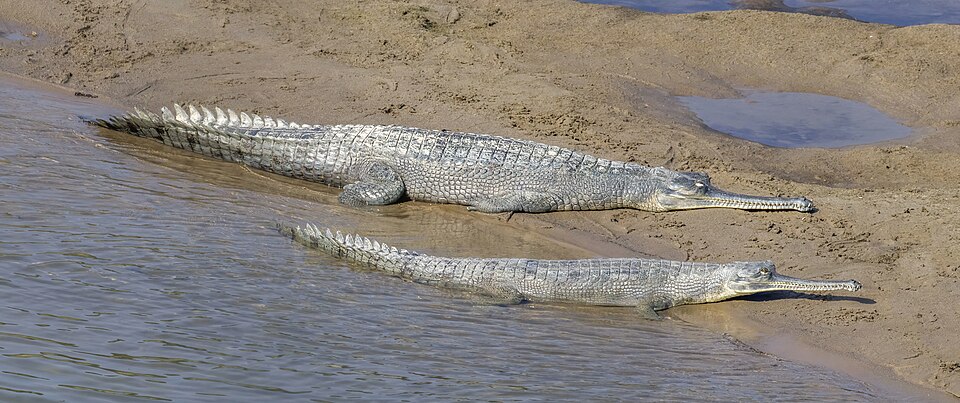
The National Chambal Sanctuary is a ~5,400 sq km riverine protected area established in 1978 along a stretch of the Chambal River, a tributary of the Yamuna. It is one of India's most important habitats for the Critically Endangered gharial, and also shelters the red-crowned roofed turtle, mugger crocodile, Gangetic dolphin and Indian skimmer. It is jointly administered by the three states through which the river runs.
The question tests where the Chambal River — and hence its sanctuary — actually flows. The Chambal originates in Madhya Pradesh, flows through Rajasthan, then forms part of the MP-Rajasthan and MP-UP boundaries before joining the Yamuna in UP. Haryana lies outside this basin, making it the odd one out.
- National Chambal Sanctuary is a tri-state protected area across Rajasthan, Madhya Pradesh and Uttar Pradesh.
- Established in 1978 along the Chambal River (a tributary of the Yamuna); ~5,400 sq km.
- Flagship species: the Critically Endangered gharial; also home to the Gangetic dolphin and Indian skimmer.
- Haryana is NOT part of the sanctuary — the Chambal does not flow through it.
- Assuming a sanctuary lies in only one state — Chambal is shared by three (RJ, MP, UP).
- Adding Haryana to the Chambal basin — the river does not flow through Haryana.
UPSC/UPPSC ask the Chambal Sanctuary either through its flagship species (gharial) or through which states/rivers it is associated with — testing the RJ-MP-UP tri-state fact.
If you want to see gharials in their natural habitat, which one of the following is the best place to visit?
- (a) Bhitarkanika Mangroves
- (b) Chambal River
- (c) Pulicat Lake
- (d) Deepor Beel
Answer(b) Chambal River — the National Chambal Sanctuary supports the largest wild gharial population.
Directly links to the same National Chambal Sanctuary as the best gharial habitat — the subject of this UPPSC question.
Consider the following fauna of India: 1. Gharial 2. Leatherback turtle 3. Swamp deer. Which of the above is/are endangered?
- (a) 1 and 2 only
- (b) 3 only
- (c) 1, 2 and 3
- (d) None
Answer(c) 1, 2 and 3 — the gharial (Critically Endangered), leatherback turtle and swamp deer are all threatened.
Tests the conservation status of the gharial, the flagship species of the National Chambal Sanctuary in this question.
- practice — not a real PYQ
The National Chambal Sanctuary is best known as a habitat for which Critically Endangered species?
- (a)Gharial
- (b)Great Indian Bustard
- (c)Snow Leopard
- (d)Asiatic Lion
Answer(a) Gharial — the Chambal is India's principal stronghold for the Critically Endangered gharial. - practice — not a real PYQ
The Chambal River is a tributary of which of the following rivers?
- (a)Yamuna
- (b)Ganga (directly)
- (c)Narmada
- (d)Betwa
Answer(a) Yamuna — the Chambal joins the Yamuna; it is not a tributary of the Narmada or Betwa.