
Consider the following statements about human brain : 1. The brain is responsible for regulating the heart beat. 2. It is responsible for balancing the body. Select the correct answer using the codes given below. Codes :
- (a)Only 1 is correct
- (b)Only 2 is correct
- (c)1 and 2 both are correct
- (d)Neither 1 nor 2 is correct
Correct — C, both statements are true. Statement 1: the medulla oblongata, part of the brainstem, houses the cardiac centre that regulates the rate of the heartbeat through the autonomic nervous system — so the brain does regulate the heartbeat (the beat itself is initiated by the heart's own SA node, but the brain controls how fast or slow it runs). Statement 2: the cerebellum, the second-largest part of the brain, maintains balance, posture and muscular coordination. Both jobs are done by parts of the brain, so both statements are correct.
- (a)Only 1 is correct — Incomplete — statement 2 is also correct, because the cerebellum controls balance and posture, so 'only 1' is wrong.
- (b)Only 2 is correct — Incomplete — statement 1 is also correct, because the medulla oblongata regulates the heart rate, so 'only 2' is wrong.
- (d)Neither 1 nor 2 is correct — Both statements are in fact correct (heartbeat regulation by the medulla, balance by the cerebellum), so 'neither' is wrong.
The human brain has three major divisions with distinct roles. The cerebrum governs higher functions — thought, memory and voluntary movement. The cerebellum controls balance, posture and fine motor coordination. The brainstem, especially the medulla oblongata, runs the involuntary vital functions — heartbeat, breathing, blood pressure and reflexes such as swallowing and vomiting.
Both statements point to different brain regions, so the trap is thinking only one can be right. Recognise that heartbeat regulation (medulla) and balance (cerebellum) are two separate brain functions — hence 'both correct'.
- Medulla oblongata regulates involuntary vital functions: heart rate, breathing, blood pressure, swallowing and vomiting
- Cerebellum controls balance, posture and fine muscular coordination
- The heartbeat originates in the heart's SA node (myogenic), but its rate is modulated by the brain's medulla via the autonomic nervous system
- The cerebrum is the seat of higher functions — thought, memory and voluntary action
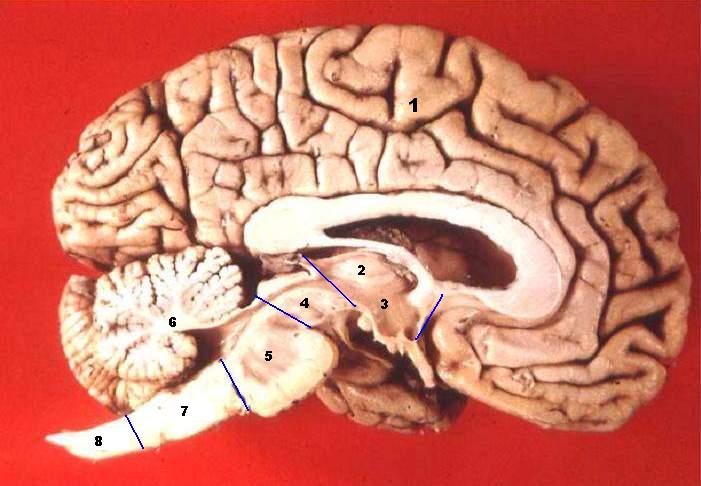
- Confusing the cerebrum (thought) with the cerebellum (balance)
- Assuming the heartbeat is purely a heart function and ignoring the brain's regulatory role
As statement-based items or 'which part of the brain controls X' — UPSC and UPPSC pair brain regions with functions (medulla = vital involuntary centres, cerebellum = balance).
Which one of the following parts of the human brain is the regulating centre for swallowing and vomiting?
- (a) Cerebellum
- (b) Cerebrum
- (c) Medulla oblongata
- (d) Pons
Answer(c) Medulla oblongata
Same concept — mapping brain parts to their functions; the medulla oblongata is the centre for involuntary reflexes and vital functions (swallowing, vomiting and, as in this 2020 question, heart-rate regulation), while the cerebellum handles balance.
- practice — not a real PYQ
Which part of the human brain is chiefly responsible for maintaining balance and posture?
- (a)Cerebrum
- (b)Cerebellum
- (c)Medulla oblongata
- (d)Hypothalamus
Answer(b) Cerebellum — it coordinates balance, posture and fine movement. - practice — not a real PYQ
The regulating centre for heartbeat and breathing in humans is located in the
- (a)cerebellum
- (b)medulla oblongata
- (c)cerebrum
- (d)hypothalamus
Answer(b) medulla oblongata — the brainstem centre for involuntary vital functions.