
What is the legal nature of the Preamble of the Constitution ?
- (a)It is enforceable
- (b)It is not enforceable
- (c)It may be enforced in special circumstances
- (d)None of the above
Correct — B, it is not enforceable. The Preamble is a declaration of the source of the Constitution's authority ('We, the People of India'), of the nature of the State it creates, of the objectives it sets, and of the date of its adoption. What it is not is an operative provision. It confers no power on any organ of the State and imposes no prohibition on any of them, so there is nothing in it for a court to enforce. The Supreme Court has said this consistently — in the Berubari Union reference (1960) and again in Kesavananda Bharati (1973) — and the position holds even though Kesavananda settled that the Preamble IS a part of the Constitution. Being part of the Constitution and being justiciable are two different things: Part IV is also part of the Constitution, and Article 37 expressly says its provisions are not enforceable by any court. The Preamble's real work is interpretive: where an Article is ambiguous, courts read it in the light of the Preamble's objectives. But that is an aid to construction, not a right that can be sued upon, which is why the answer is that it is not enforceable.
- (a)It is enforceable — No litigant can go to court on the strength of the Preamble alone. It is not a source of power and not a limitation on power; the ideals it names — justice, liberty, equality, fraternity — become enforceable only where an operative provision such as Article 14, 19, 21 or 32 gives them legal shape. This option confuses the Constitution's stated aims with its legally operative machinery.
- (c)It may be enforced in special circumstances — There is no such intermediate category in Indian constitutional law. Courts do resort to the Preamble in a 'special circumstance' — when the language of a provision is ambiguous or capable of two meanings — but they use it to interpret that provision, and the relief still flows from the provision itself. Interpretation is not enforcement, and the Preamble never becomes independently actionable.
- (d)None of the above — Option (b) states the settled position accurately, so a 'none of the above' cannot be right. This choice only attracts candidates who believe the earlier options are all partly true and none complete — but non-enforceability is the complete and correct description of the Preamble's legal nature.
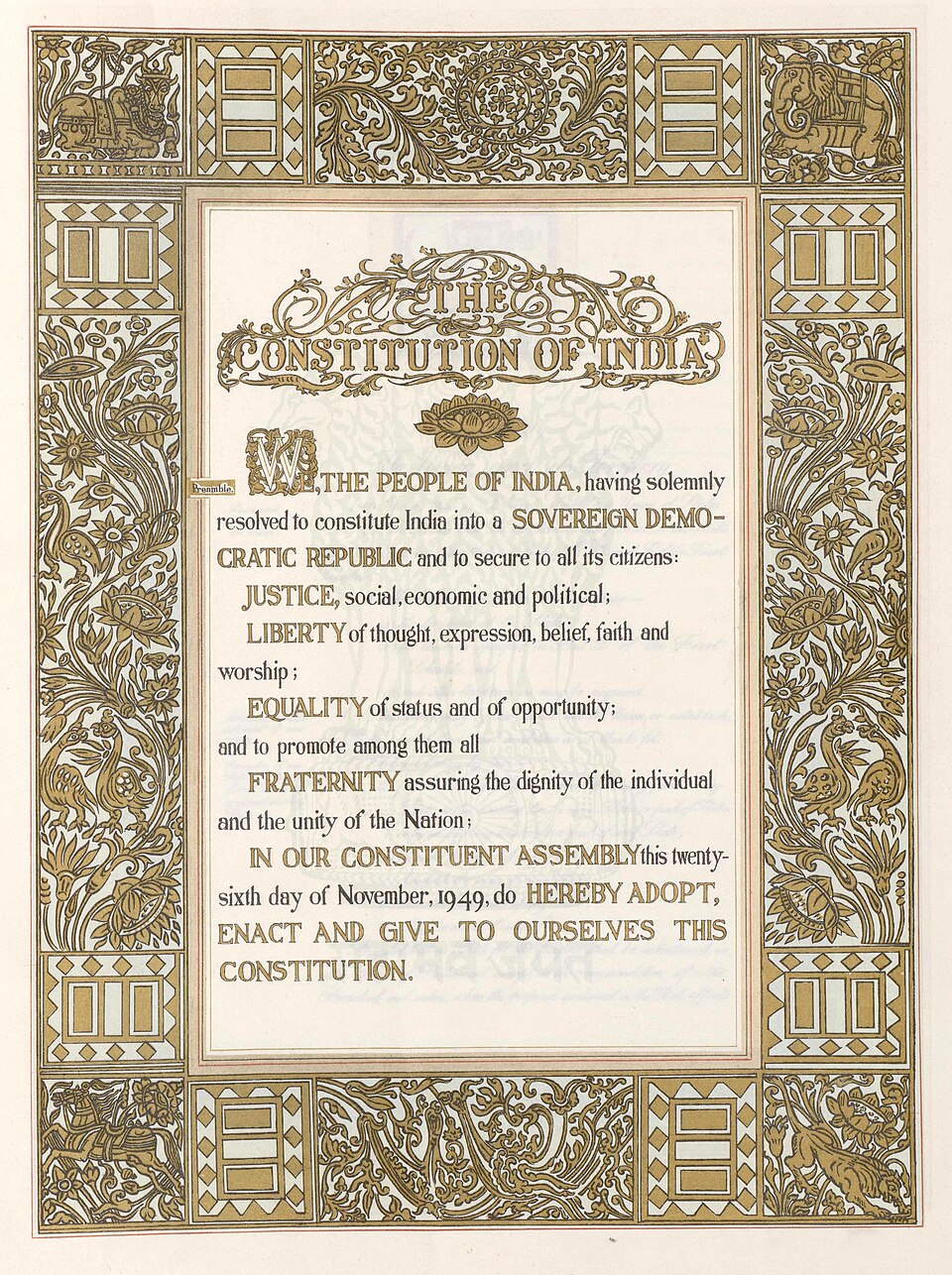
The Preamble to the Constitution of India performs four jobs: it names the source of authority (the people of India), the nature of the polity (a Sovereign Socialist Secular Democratic Republic), the objectives (justice — social, economic and political; liberty of thought, expression, belief, faith and worship; equality of status and of opportunity; and fraternity assuring the dignity of the individual and the unity and integrity of the Nation), and the date of adoption (26 November 1949). Its language descends from the Objectives Resolution moved by Jawaharlal Nehru in the Constituent Assembly on 13 December 1946. Two judgments define its legal status. In the Berubari Union reference (1960) the Supreme Court described the Preamble as a key to open the mind of the makers but held that it was not a part of the Constitution. In Kesavananda Bharati (1973) the Court corrected that: the Preamble is a part of the Constitution and can be amended under Article 368, provided the basic structure is not damaged. Through both rulings one point stayed constant — the Preamble is non-justiciable.
The trap here is precisely the Kesavananda holding. A candidate who has learnt 'the Preamble is a part of the Constitution' jumps to the conclusion that it must therefore be enforceable, and picks (a). The corrective is to hold the two propositions separately: what a document contains and what a court can enforce are different questions. The Directive Principles are the ready analogy — indisputably part of the Constitution, and expressly unenforceable under Article 37. Option (c) baits a different instinct, the feeling that a constitutional text surely cannot be wholly without legal effect. It is not without effect — it is used to interpret ambiguous provisions and it was relied on in developing the basic structure doctrine — but effect through interpretation is not the same as being enforceable. Note also the phrasing UPSC used for the very same idea in 2020: 'a part of the Constitution but has no legal effect independently of other parts'. That sentence is the fullest statement of the position, and UPPSC's 'not enforceable' is the short form of it.
- The Preamble is non-justiciable — it is not enforceable in a court of law, because it neither confers power nor imposes a prohibition.
- Berubari Union reference (1960): the Supreme Court called the Preamble a key to the minds of the makers but held it was not a part of the Constitution.
- Kesavananda Bharati (1973): the Court held the Preamble IS a part of the Constitution and can be amended under Article 368, subject to the basic structure.
- The Preamble has been amended only once — by the 42nd Amendment Act, 1976, which added the words 'Socialist', 'Secular' and 'Integrity'.
- It is used as an aid to interpretation where a constitutional provision is ambiguous, but the remedy in any case rests on the operative Article, not on the Preamble.
- It records the date of adoption of the Constitution as 26 November 1949, whereas the Constitution commenced on 26 January 1950.
- Its wording derives from the Objectives Resolution moved by Nehru in the Constituent Assembly on 13 December 1946 and adopted on 22 January 1947.
- Treating 'a part of the Constitution' as equal to 'enforceable' — Kesavananda settled the first question, not the second.
- Believing the Preamble cannot be amended at all; it can, within the basic structure, and it has been amended once, by the 42nd Amendment.
- Citing Berubari as current law on whether the Preamble is part of the Constitution — that specific holding was overruled in Kesavananda.
UPSC has asked this exact point as a four-way statement on the Preamble's legal effect (2020) and as a content question on which objective is not embodied in it (2017); UPPSC prefers the vocabulary angle — which word is or is not in the Preamble (2021) — alongside a direct legal-nature item like this one.
The Preamble to the Constitution of India is
- (a) a part of the Constitution but has no legal effect
- (b) not a part of the Constitution and has no legal effect either
- (c) a part of the Constitution and has the same legal effect as any other part
- (d) a part of the Constitution but has no legal effect independently of other parts
Answer(d) a part of the Constitution but has no legal effect independently of other parts
The same question with the answer spelled out in full: the Preamble is part of the Constitution (Kesavananda) yet has no legal effect on its own — which is exactly why UPPSC's shorter option, 'it is not enforceable', is the right one.
The mind of the makers of the Constitution of India is reflected in which of the following?
- (a) The Preamble
- (b) The Fundamental Rights
- (c) The Directive Principles of State Policy
- (d) The Fundamental Duties
Answer(a) The Preamble
The other half of the doctrine — the Preamble is the 'key to open the mind of the makers', the phrase used in Berubari. That interpretive role is what it has instead of enforceability.
Which of the following words is NOT mentioned in the Preamble of the Constitution of India?
- (a) Sovereign
- (b) Democratic
- (c) Secular
- (d) Federal
Answer(d) Federal
UPPSC returned to the Preamble two years later from the content side — which words it actually contains. Read together with this 2019 item, the message is that both the text and the legal status of the Preamble are standing UPPSC targets.
- practice — not a real PYQ
In which case did the Supreme Court of India hold that the Preamble is a part of the Constitution?
- (a)Berubari Union reference, 1960
- (b)Golaknath case, 1967
- (c)Kesavananda Bharati case, 1973
- (d)Minerva Mills case, 1980
Answer(c) Kesavananda Bharati case, 1973 — it reversed the Berubari view that the Preamble was not part of the Constitution, and held that the Preamble is part of the Constitution and amendable under Article 368 subject to the basic structure.
- practice — not a real PYQ
The Preamble to the Constitution of India has been amended
- (a)never
- (b)once, by the 42nd Amendment Act, 1976
- (c)twice, by the 42nd and the 44th Amendment Acts
- (d)three times
Answer(b) Once, by the 42nd Amendment Act, 1976 — which inserted the words 'Socialist' and 'Secular' into the description of the Republic and added 'and integrity' to the fraternity clause.