
'The Rise and Growth of Economic Nationalism in India' was written by
- (a)Partha Sarthi Gupta
- (b)S. Gopal
- (c)B. R. Nanda
- (d)Bipin Chandra
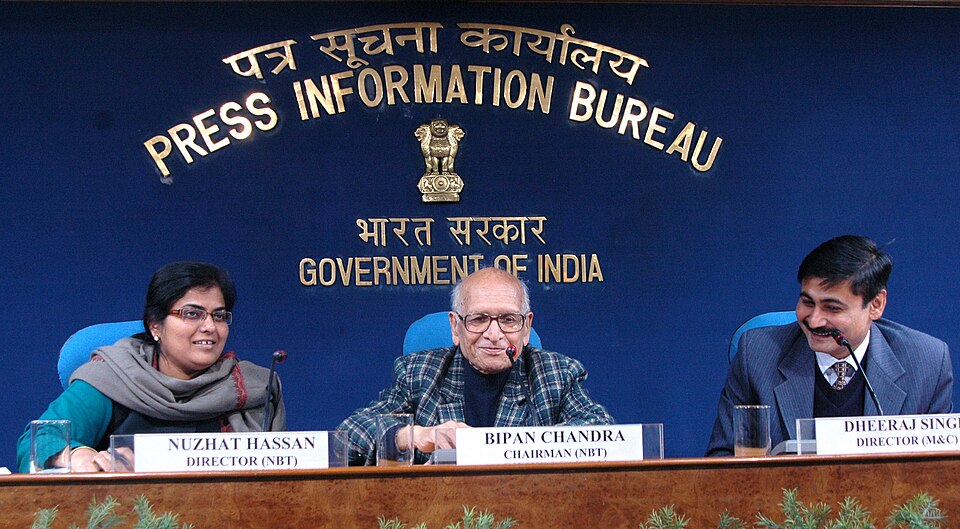
Correct — D, Bipin Chandra. The book is 'The Rise and Growth of Economic Nationalism in India: Economic Policies of Indian National Leadership, 1880–1905', first published in 1966 by the historian Bipan Chandra (the paper prints the name as 'Bipin', but the author himself signed it Bipan Chandra). It is the standard study of the economic critique of colonialism — Chandra worked through the speeches, journalism and evidence of the early Congress leadership and showed that men like Dadabhai Naoroji, M.G. Ranade, R.C. Dutt and G. Subramania Iyer had built a systematic economic case against British rule: the drain of wealth, the de-industrialisation of Indian handicrafts, a tariff and railway policy tilted towards British capital, and a land-revenue and Home Charges burden that impoverished the countryside. His argument — that this economic critique, not merely constitutional grievance, was the intellectual foundation of Indian nationalism — is why the book remains prescribed reading for the modern-history syllabus.
- (a)Partha Sarthi Gupta — Partha Sarathi Gupta was a historian of British imperialism and of the British labour movement, and of the imperial armed forces — a different field from the economic thought of the early Indian nationalists. He did not write this book.
- (b)S. Gopal — Sarvepalli Gopal, the son of S. Radhakrishnan, was a diplomatic and political historian best known for his three-volume biography of Jawaharlal Nehru and for his work on British policy in India. His subject was high politics and biography, not the economic writings of the Moderates.
- (c)B. R. Nanda — B.R. Nanda, founder-director of the Nehru Memorial Museum and Library, was pre-eminently a biographer — of Mahatma Gandhi, of Gokhale, and of the Nehrus. Biography, not economic history, is his signature, and this title is not his.
'Economic nationalism' is the name historians give to the argument, developed between roughly 1880 and 1905, that British rule was not merely politically unrepresentative but economically extractive. Its components were the drain of wealth (India's surplus transferred to Britain as Home Charges, remittances, pensions and profits), de-industrialisation (the destruction of Indian handicrafts by free-trade tariff policy), and a fiscal and infrastructure policy built for imperial rather than Indian needs. Bipan Chandra's book is the study that assembled this scattered polemic into a coherent body of thought and treated the Moderates as serious economic analysts rather than as timid petitioners.
Book-and-author questions look like blind memory but usually reward matching a title's subject to a historian's known field. Read the title before you read the options: 'economic nationalism' is economics-and-ideas, which rules out the two biographers on the list (S. Gopal, B.R. Nanda) and the historian of British imperialism and labour (Partha Sarathi Gupta), leaving only Bipan Chandra — the one Marxist historian of modern India in the set, and the one whose whole output is about the ideas and social forces behind the national movement.
- Full title: 'The Rise and Growth of Economic Nationalism in India: Economic Policies of Indian National Leadership, 1880–1905', first published 1966.
- Bipan Chandra (1928–2014) taught modern Indian history at Jawaharlal Nehru University; his other well-known works include 'India's Struggle for Independence, 1857–1947', 'Nationalism and Colonialism in Modern India' and 'Communalism in Modern India'.
- The nationalist economists analysed in the book include Dadabhai Naoroji, M.G. Ranade, R.C. Dutt and G. Subramania Iyer.
- The two foundational texts of that critique are Naoroji's 'Poverty and Un-British Rule in India' (1901) and R.C. Dutt's two-volume 'The Economic History of India' (1902 and 1904).
- Do not confuse the historian Bipan Chandra with the Extremist leader Bipin Chandra Pal (1858–1932) of the Lal–Bal–Pal trio; the similar spelling in the option is the point of the question.
- Reading the option 'Bipin Chandra' as Bipin Chandra Pal, the Extremist leader — a different man from a different century of activity.
- Assuming that any book with 'nationalism' in the title must be by a biographer of a national leader; the biographers in this list (S. Gopal, B.R. Nanda) wrote about people, not about economic ideas.
- Attributing the drain theory itself to Bipan Chandra. He analysed it; Dadabhai Naoroji formulated it, decades earlier.
UPPSC repeatedly runs a plain 'book — author' item in Paper-I (it asked for the author of 'The Challenge of World Poverty' in 2023 and of 'Silent Spring' in 2020), while UPSC prefers to test the content of the economic critique — who the economic critics of colonialism were (2015), who coined 'Un-British' (2008), what 'Home Charges' covered (2011).
Who of the following was/were economic critic/critics of colonialism in India? 1. Dadabhai Naoroji 2. G. Subramania Iyer 3. R.C. Dutt
- (a) 1 only
- (b) 1 and 2 only
- (c) 2 and 3 only
- (d) 1, 2 and 3
Answer(d) 1, 2 and 3
The people inside the book: the economic critics of colonialism whose writings Bipan Chandra assembled into 'economic nationalism'. UPPSC asks who wrote the study; UPSC asks who the study is about.
Who among the following used the phrase ‘Un-British’ to criticize the English colonial control of India?
- (a) Anandmohan Bose
- (b) Badruddin Tyabji
- (c) Dadabhai Naoroji
- (d) Pherozeshah Mehta
Answer(c) Dadabhai Naoroji
Tests the founding text of the same tradition — Naoroji's 'Poverty and Un-British Rule in India' (1901), the drain-theory statement that Bipan Chandra's book takes as its starting point.
- practice — not a real PYQ
Bipan Chandra's 'The Rise and Growth of Economic Nationalism in India' examines the economic policies of the Indian national leadership for which period?
- (a)1757–1857
- (b)1880–1905
- (c)1905–1919
- (d)1920–1947
Answer(b) 1880–1905 — that span is the book's own subtitle, and it covers the formative decades of the early Congress, from the years just before its founding in 1885 to the eve of the Swadeshi movement.
- practice — not a real PYQ
The 'drain of wealth' theory, the central plank of the economic nationalism analysed in Bipan Chandra's book, was first systematically developed by
- (a)R.C. Dutt
- (b)Dadabhai Naoroji
- (c)M.G. Ranade
- (d)Gopal Krishna Gokhale
Answer(b) Dadabhai Naoroji — he built the drain argument over decades of papers and set it out fully in 'Poverty and Un-British Rule in India' (1901). R.C. Dutt, Ranade and Gokhale extended and popularised the economic critique but the drain theory itself is Naoroji's.