
The gas, which is emitted in the paddy fields and increases the earth's temperature is
- (a)Nitrogen
- (b)Carbon dioxide
- (c)Carbon monoxide
- (d)Methane
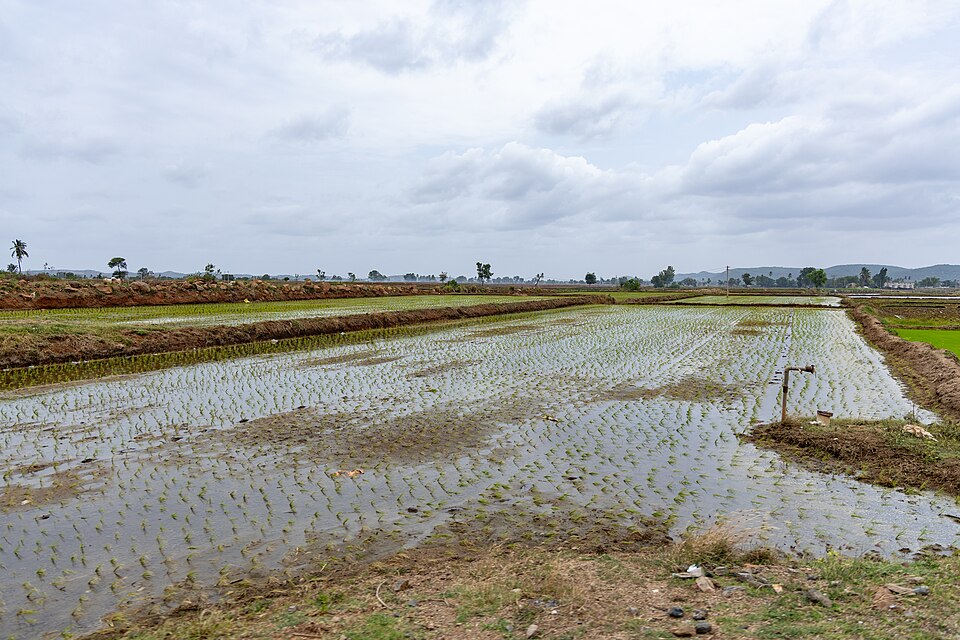
Correct — D, Methane. A transplanted paddy field is kept under standing water, and waterlogged soil quickly runs out of oxygen. In those anaerobic conditions methane-producing archaea (methanogens) decompose the organic matter in the soil and release methane (CH4). The gas escapes to the atmosphere in three ways — bubbling up through the water (ebullition), diffusing across the water surface, and, most of all, travelling up the aerenchyma, the air channels inside the rice plant itself. Methane is a potent greenhouse gas: over a hundred years one tonne of it traps roughly 28-30 times as much heat as a tonne of carbon dioxide (IPCC AR5 global warming potential). That is why flooded rice cultivation is counted among the largest agricultural sources of global warming, alongside enteric fermentation in cattle.
- (a)Nitrogen — Nitrogen gas (N2) already makes up about 78% of the atmosphere and is not a greenhouse gas at all — it is a symmetric diatomic molecule whose vibrations do not change its dipole, so it cannot absorb infrared radiation. Do not confuse it with nitrous oxide (N2O), a genuinely potent greenhouse gas released from nitrogen-fertilised soils; N2O is a different molecule and is not what this option says.
- (b)Carbon dioxide — Carbon dioxide is a greenhouse gas, but it is not what distinguishes a paddy field. The signature of a flooded, oxygen-free paddy soil is methanogenesis; the growing rice crop is in fact absorbing CO2 by photosynthesis. The question asks for the gas characteristically emitted from paddy fields, and the key marks methane.
- (c)Carbon monoxide — Carbon monoxide is a toxic pollutant from incomplete combustion (vehicles, stubble burning, cooking fires). It is not a significant direct greenhouse gas — it affects climate only indirectly, by using up hydroxyl radicals and so prolonging the life of methane — and it is not a characteristic paddy-field emission.
Methane is produced by anaerobic decomposition — the breakdown of organic matter by microbes where there is no free oxygen. Any waterlogged, organic-rich environment therefore emits it: natural wetlands and marshes, flooded rice paddies, the rumen of cattle and buffaloes, landfill sites, and the flooded reservoirs behind dams. Coal mines and oil-and-gas systems add methane of geological origin. Methane's atmospheric lifetime is only about a decade — far shorter than CO2's — but its warming punch per tonne is far greater, which makes it a 'short-lived climate pollutant' and an attractive target for quick climate action.
Read the question as two conditions joined: the gas must be (i) characteristic of paddy fields and (ii) a warming agent. Nitrogen fails the second test outright, carbon monoxide fails both, and carbon dioxide passes the second but is not what a submerged paddy soil specifically produces. Only methane satisfies both, and the mechanism to remember is the single word 'anaerobic' — standing water shuts out oxygen, and methanogens take over.
- Flooded paddy soil turns anaerobic; methanogenic archaea then produce methane, most of which escapes through the aerenchyma (air channels) of the rice plant.
- Methane's 100-year global warming potential is about 28-30 times that of CO2 (IPCC AR5), but its atmospheric lifetime is only around a decade.
- Other major methane sources: natural wetlands, enteric fermentation in ruminants, landfills, coal mining and oil-and-gas leakage — UPSC's 2008 prelims asked exactly this list.
- Alternate Wetting and Drying (AWD), the System of Rice Intensification and direct-seeded rice cut paddy methane by periodically restoring aerobic conditions in the soil, and save irrigation water too.
- Nitrogen (N2) is not a greenhouse gas; nitrous oxide (N2O), which comes mainly from nitrogen-fertiliser use, is — the two names are the exam's favourite confusion.
- Confusing nitrogen (N2 — inert, not a greenhouse gas) with nitrous oxide (N2O — a strong greenhouse gas).
- Picking carbon dioxide reflexively because it is the best-known greenhouse gas, when the question points at a specific anaerobic source.
- Thinking methane comes only from cattle — wetlands and rice paddies are comparably large sources.
- Treating carbon monoxide as a greenhouse gas; it is a pollutant with only an indirect climate effect.
UPSC asks it as a list ('which of these are sources of methane') or as reasoning ('why does extensive rice cultivation contribute to global warming'); UPPSC asks the one-line version — which gas comes from paddy fields, or which gas is not a naturally occurring greenhouse gas.
Consider the following: 1. Rice fields 2. Coal mining 3. Domestic animals 4. Wetlands Which of the above are sources of methane, a major greenhouse gas?
- (a) 1 and 4 only
- (b) 2 and 3 only
- (c) 1, 2 and 3 only
- (d) 1, 2, 3 and 4
Answer(d) 1, 2, 3 and 4
Same concept in list form — rice fields head UPSC's own list of methane sources, alongside wetlands, livestock and coal mining.
Among the following crops, which one is the most important anthropogenic source of both methane and nitrous oxide?
- (a) Cotton
- (b) Rice
- (c) Sugarcane
- (d) Wheat
Answer(b) Rice
The same crop-and-greenhouse-gas link asked from the crop side: rice is the cropland source UPSC singles out for methane (and nitrous oxide).
Which one of the following is NOT a green house gas found naturally in the atmosphere?
- (a) Nitrogen oxide
- (b) Carbon dioxide
- (c) Methane
- (d) Ozone
Answer(a) Nitrogen oxide
The mirror image of this question — UPPSC 2020 makes you separate the real greenhouse gases (methane included) from the nitrogen-family pollutant that is not one.
- practice — not a real PYQ
Which of the following practices in rice cultivation reduces methane emission from the field?
- (a)Keeping the field continuously flooded through the season
- (b)Alternate wetting and drying of the field
- (c)Increasing the dose of urea
- (d)Transplanting seedlings into deeper standing water
Answer(b) Alternate wetting and drying — periodically draining the field lets oxygen back into the soil, which suppresses the methanogens that need anaerobic conditions (it also saves irrigation water and pumping energy).
- practice — not a real PYQ
Why is methane described as a 'short-lived climate pollutant'?
- (a)It stays in the atmosphere for centuries but traps little heat
- (b)It has a much higher warming potential than CO2 but an atmospheric lifetime of only about a decade
- (c)It directly destroys the stratospheric ozone layer
- (d)It is produced only by natural, not human, activity
Answer(b) It has a much higher warming potential than CO2 but an atmospheric lifetime of only about a decade — which is why cutting methane delivers climate benefits far faster than cutting CO2.