
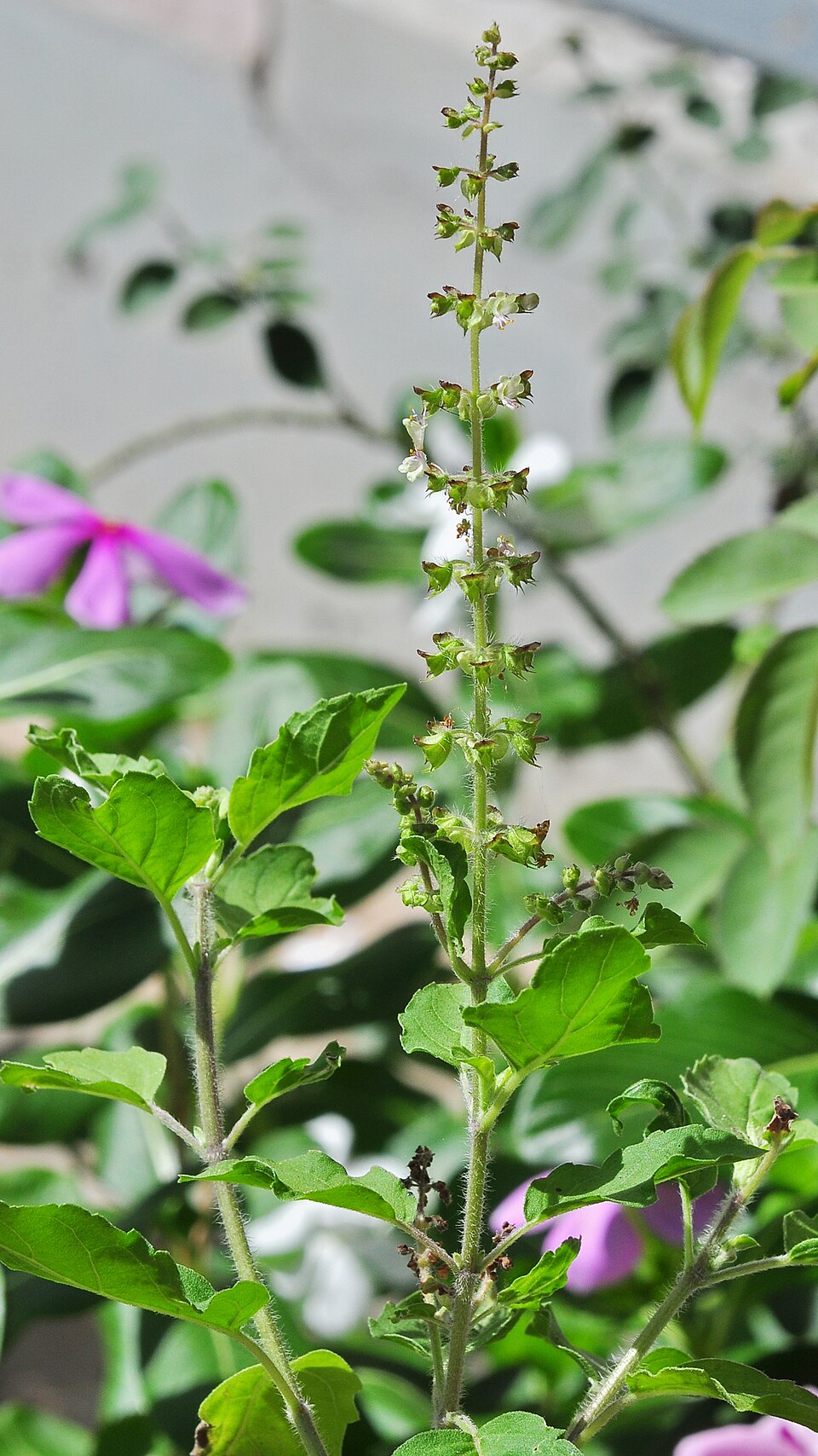
Tulsi plant has medicinal values due to the presence of the following
- (a)Inorganic Acid
- (b)Organic Acid
- (c)Phenols and Flavonoids
- (d)None of the above
Correct — C, Phenols and Flavonoids. Tulsi (Ocimum tenuiflorum, syn. Ocimum sanctum; holy basil, family Lamiaceae) owes its medicinal reputation to its secondary metabolites, and the dominant group among them is polyphenolic. Eugenol — a phenolic compound (4-allyl-2-methoxyphenol) — is the principal constituent of tulsi leaf essential oil and carries much of its antimicrobial and anti-inflammatory activity; alongside it the leaves contain phenolic acids such as rosmarinic acid and a set of flavonoids. Phenolic compounds are powerful antioxidants because the hydrogen of the phenolic –OH group is readily donated to neutralise free radicals, and that is the biochemical basis of the plant's traditional use.
- (a)Inorganic Acid — Plants do not store mineral acids such as hydrochloric or sulphuric acid in their tissues, and no inorganic acid is responsible for tulsi's medicinal properties.
- (b)Organic Acid — Too general, and it misses the active chemistry. Tulsi does contain rosmarinic acid — but that is itself a phenolic acid, and its activity comes from the phenol group, not from being an ordinary organic acid. The chief constituent, eugenol, is a phenol and not an acid at all, while the everyday plant organic acids (citric, malic, oxalic) have no such medicinal role.
- (d)None of the above — Wrong, because a specific and well-documented class of compounds — the phenolics and flavonoids — is exactly what accounts for the plant's medicinal value.
Plants make primary metabolites (sugars, amino acids, lipids) that keep them alive, and secondary metabolites that they do not strictly need for growth — alkaloids, terpenoids, glycosides and phenolics/flavonoids. Almost every medicinal plant is medicinal because of its secondary metabolites. In tulsi that role falls to the polyphenols: eugenol and other phenylpropanoids in the essential oil, phenolic acids such as rosmarinic acid, and leaf flavonoids, which together give antioxidant, anti-inflammatory and antimicrobial activity.
The option set runs from vague to specific, and in phytochemistry questions the named compound class almost always beats the generic one — 'organic acid' could describe half the contents of any leaf. Reason it out by asking which class actually has a known mechanism: phenolic –OH groups quench free radicals, which is a real, documented mode of action. Note honestly that tulsi is not purely phenolic — it also carries terpenoids such as ursolic acid — but the class the question names is the correct one.
- Tulsi = Ocimum tenuiflorum (syn. Ocimum sanctum), family Lamiaceae; commonly called holy basil
- Eugenol, a phenolic (phenylpropanoid) compound, is the chief constituent of tulsi leaf essential oil — clove oil is the other classic eugenol source
- Rosmarinic acid, a phenolic acid, and leaf flavonoids add to the antioxidant activity
- Phenolics and flavonoids are secondary metabolites: antioxidant, anti-inflammatory and antimicrobial
- Tulsi also contains terpenoids such as ursolic acid, but the compound class named in the answer is the phenolic/flavonoid group
- Choosing 'organic acid' because rosmarinic acid is an acid — it is a phenolic acid, and the named class is what the question wants
- Assuming a plant's medicinal value comes from its vitamins or minerals rather than from secondary metabolites
- Confusing tulsi (Ocimum tenuiflorum) with sweet basil (Ocimum basilicum)
Phrased either as 'plant X owes its property to which compound' or as a plant ↔ active-compound match list — neem–azadirachtin, cinchona–quinine, sarpagandha–reserpine, tulsi–eugenol. Learn the pairs both ways round.
Neem tree has acquired industrial importance as a source of
- (a) biopesticide and anti-fertility compound
- (b) anti-fertility compound, biofertilizer and anti-cancer drug
- (c) biofertilizer, biopesticide and anti-fertility compound
- (d) anti-cancer drug, biopesticide and biofertilizer
Answer(a) biopesticide and anti-fertility compound
The same idea for a different Indian medicinal plant — a plant's usefulness traces to named secondary metabolites (azadirachtin and related limonoids in neem, phenolics and flavonoids in tulsi).
- practice — not a real PYQ
Eugenol, the phenolic compound found in tulsi oil, is also the principal constituent of the essential oil of
- (a)Clove
- (b)Cardamom
- (c)Turmeric
- (d)Fenugreek
Answer(a) Clove — clove oil is the classic commercial source of eugenol.
- practice — not a real PYQ
Which one of the following pairs of a medicinal plant and its active compound is correctly matched?
- (a)Cinchona — Reserpine
- (b)Sarpagandha — Quinine
- (c)Neem — Azadirachtin
- (d)Tulsi — Nicotine
Answer(c) Neem — Azadirachtin. Cinchona gives quinine, sarpagandha (Rauvolfia serpentina) gives reserpine, and tulsi's marker compound is eugenol, not nicotine.