
Who opposed Planned Development in India ?
- (a)Mahatma Gandhi
- (b)Jawaharlal Nehru
- (c)Indira Gandhi
- (d)Rajiv Gandhi
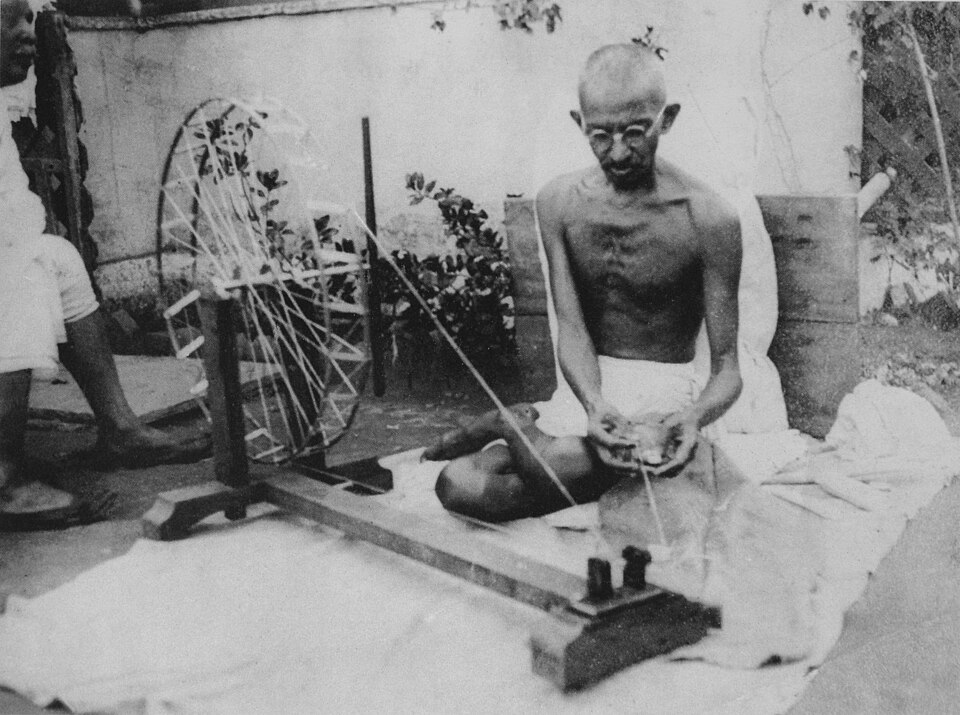
Correct — A, Mahatma Gandhi. Of the four names, three are the very people who built and ran India's planning system, and only one argued against the model it rested on. Gandhi's objection was not to forethought about the economy but to the kind of development planning implied: centrally directed, state-led, machine-intensive and city-centred growth. From Hind Swaraj (1909) onwards he attacked modern industrial civilisation itself, and his positive programme was the opposite of a central plan — gram swaraj, the self-reliant village as the unit of the political and economic order, khadi and village industries as the base of employment, and trusteeship rather than either state ownership or unrestrained private capital. He organised that programme through bodies like the All India Spinners' Association and the All India Village Industries Association rather than through a planning apparatus. When the Congress set up the National Planning Committee in 1938 under Nehru's chairmanship, its premises were industrial and Gandhi did not share them, and in a well-known exchange of letters in 1945 he told Nehru that he still stood by the village-centred order of Hind Swaraj, to which Nehru replied that the village was backward and that India would need industry. One honest qualification a student should carry: Gandhi was assassinated in January 1948, more than two years before the Planning Commission was created in March 1950, so what he opposed was the model and its assumptions, not the institution. His alternative outlived him — a 'Gandhian Plan' was drawn up on his lines in 1944 by Shriman Narayan Agarwal, and Jayaprakash Narayan's Sarvodaya Plan of 1950 continued the argument.
- (b)Jawaharlal Nehru — The exact opposite — Nehru is the architect of Indian planning. He chaired the Congress's National Planning Committee from 1938, was ex-officio chairman of the Planning Commission set up in March 1950, and drove the Second Five Year Plan's Mahalanobis strategy of building basic and capital-goods industries. He is the man who described the great dams and steel plants as the temples of modern India.
- (c)Indira Gandhi — She extended planning rather than opposing it. As Prime Minister she chaired the Planning Commission, ran the Fourth and Fifth Plans, nationalised the major banks in 1969 and fought the 1971 election on 'Garibi Hatao' — a state-led, redistributive programme that assumed a planned economy.
- (d)Rajiv Gandhi — Rajiv Gandhi was impatient with the Planning Commission's bureaucratic style and began loosening industrial controls, but that is criticism of how planning was practised, not opposition to planned development. The Seventh Five Year Plan (1985-90), with its technology missions, ran under his government.
Two rival visions of development competed in the national movement. The dominant one, associated with Nehru, M. Visvesvaraya's Planned Economy for India (1934), the Congress's National Planning Committee (1938) and the industrialists' Bombay Plan (1944), held that a poor agrarian country could only escape poverty through rapid, state-directed industrialisation. The Gandhian vision held that a machine-and-city model would concentrate wealth, destroy village crafts and deepen unemployment in a labour-surplus country, and that development should instead begin from the self-governing village, labour-intensive production for local needs, and voluntary restraint by the wealthy under trusteeship. Independent India adopted the first: the Planning Commission was created by a Cabinet resolution in March 1950 and the First Five Year Plan began in 1951. The Gandhian view survived as a strand in the Constitution's Directive Principles — Article 40 on village panchayats and Article 43 on cottage industries — and in the Sarvodaya and Bhoodan movements.
Answer this by elimination on the strength of a single organising fact: Nehru, Indira Gandhi and Rajiv Gandhi were all Prime Ministers who chaired or worked through the Planning Commission, so none of them can be the odd one out. Only Gandhi stood outside that system, and he is the standard textbook name for the critique of centralised industrial planning. Be precise about what the claim means, because UPSC-style questions punish loose phrasing: Gandhi did not oppose the idea of thinking ahead about the economy, and he was dead before the Planning Commission existed. He opposed the model — big machinery, centralisation, urban growth and state direction — and offered a decentralised, village-based alternative in its place.
- Gandhi's alternative to centralised planning was gram swaraj — the self-sufficient village as the unit of development — with khadi and village industries and the doctrine of trusteeship.
- His critique of modern industrial civilisation and machinery dates from Hind Swaraj (1909) and never changed in essentials.
- Nehru chaired the Congress's National Planning Committee from 1938 and was ex-officio chairman of the Planning Commission, created by a Cabinet resolution in March 1950; the First Five Year Plan began in 1951.
- Gandhi was assassinated in January 1948, before the Planning Commission was created — his opposition was to the model of planned development, not to that institution.
- The Gandhian strand entered the Constitution as Directive Principles: Article 40 (organisation of village panchayats) and Article 43 (promotion of cottage industries in rural areas).
- Reading the question as 'who opposed all economic planning'; Gandhi opposed the centralised, industry-led model and offered a decentralised village-based alternative.
- Forgetting the chronology — Gandhi died in January 1948, before the Planning Commission was set up in 1950, so the target of his critique was the model, not the body.
- Attributing the Gandhian Plan of 1944 to Gandhi himself; it was drawn up on Gandhian lines by Shriman Narayan Agarwal.
UPPSC asks it as a one-line odd-one-out among leaders, while UPSC prefers the doctrinal side — which Directive Principles are Gandhian, or what Gandhism shares with and where it parts from Marxism — so store Gandhi's economics as a contrast with the Nehruvian model rather than as an isolated fact.
Consider the following provisions under the Directive Principles of State Policy as enshrined in the Constitution of India : 1. Securing for citizens of India a uniform civil code 2. Organizing village Panchayats 3. Promoting cottage industries in rural areas 4. Securing for all the workers reasonable leisure and cultural opportunities Which of the above are the Gandhian Principles that are reflected in the Directive Principles of State Policy?
- (a) 1, 2 and 4 only
- (b) 2 and 3 only
- (c) 1, 3 and 4 only
- (d) 1, 2, 3 and 4
Answer(b) 2 and 3 only
The same contrast in constitutional form — village panchayats and cottage industries are exactly the decentralised, village-based development Gandhi set against centralised industrial planning.
One common agreement between Gandhism and Marxism is
- (a) the final goal of a stateless society
- (b) class struggle
- (c) abolition of private property
- (d) economic determinism
Answer(a) the final goal of a stateless society
Goes to the root of the same opposition — Gandhi's distrust of concentrated state power is precisely why he rejected a centrally directed development plan, whatever its economic merits.
- practice — not a real PYQ
The 'Gandhian Plan' of 1944, put forward as an alternative to industry-centred planning, was drawn up by
- (a)Shriman Narayan Agarwal
- (b)M. N. Roy
- (c)Jayaprakash Narayan
- (d)M. Visvesvaraya
Answer(a) Shriman Narayan Agarwal — M. N. Roy authored the People's Plan (1945), Jayaprakash Narayan the Sarvodaya Plan (1950), and Visvesvaraya the Planned Economy for India (1934).
- practice — not a real PYQ
Which of the following Directive Principles of State Policy reflect the Gandhian strand of thought? 1. Organisation of village panchayats 2. Promotion of cottage industries in rural areas 3. Securing a uniform civil code for citizens
- (a)1 and 2 only
- (b)2 and 3 only
- (c)1 and 3 only
- (d)1, 2 and 3
Answer(a) 1 and 2 only — Articles 40 and 43 are the Gandhian principles; the uniform civil code (Article 44) belongs to the liberal-intellectual group.