
Which one of the following natural regions is known as 'Land of Big Games' ?
- (a)Temperate Grassland
- (b)Tropical Monsoon Region
- (c)Hot Desert Region
- (d)Tropical Savanna Region
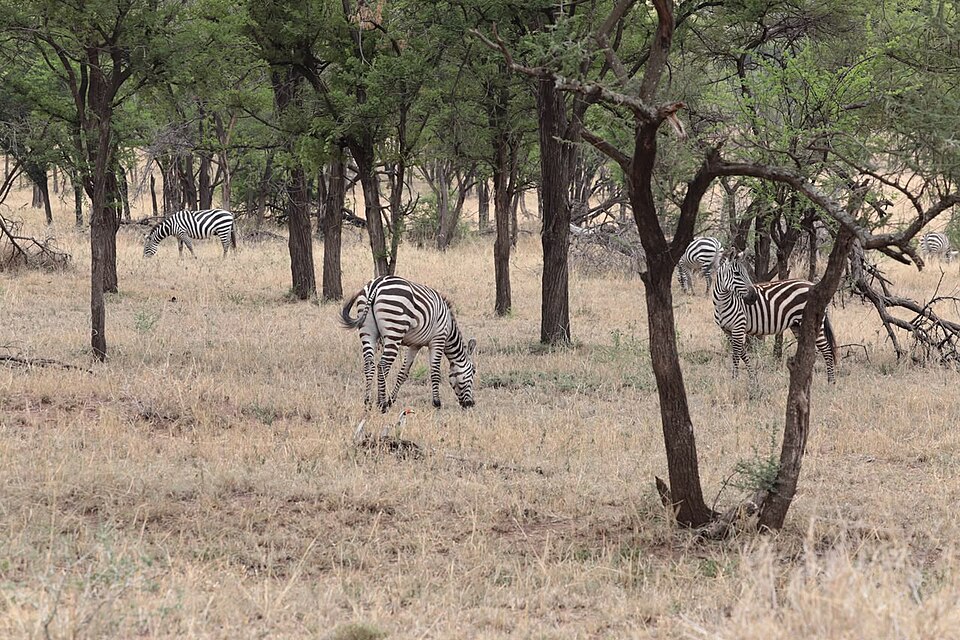
Correct — D, Tropical Savanna Region. 'Big game' is the old hunter's term for large wild animals, and the regional geography textbooks give the title 'the land of big game' to the tropical savanna, also called the Sudan type or tropical continental region, which lies between the equatorial rainforests and the hot deserts at roughly five to twenty degrees north and south. The reason is ecological, not literary. The savanna's alternation of a wet high-sun season and a long dry season produces vast expanses of tall coarse grass — elephant grass can exceed three metres — dotted with scattered, drought-resistant, deciduous trees such as acacia and baobab. Open grassland of that extent is the richest possible fodder base for large grazing and browsing animals, and there is enough tree cover for browsers without the closed canopy that would shut out the grass. The result, above all in the African savanna belt from the Sudan region eastwards into Kenya and Tanzania, is the greatest concentration and variety of large mammals on Earth: elephant, giraffe, zebra, wildebeest, buffalo, antelope, rhinoceros and hippopotamus, together with the predators that live off them — lion, leopard, cheetah and hyena. Colonial-era big-game hunting gave the region its name; today the same wildlife supports the great game reserves and national parks, and the safari tourism built on them.
- (a)Temperate Grassland — The steppes, prairies, pampas, veld and downs are treeless interiors of the mid-latitudes carrying short, nutritious, sod-forming grasses under cold winters. They are famous as the granaries of the world and as extensive ranching country for cattle, sheep and horses — domesticated stock, not big game. Their great wild herds, such as the North American bison, were reduced to remnants by the end of the nineteenth century — the great slaughter came in the 1870s and 1880s.
- (b)Tropical Monsoon Region — The monsoon lands of South and South-East Asia are defined by a seasonal reversal of winds and heavy summer rain, supporting tropical deciduous forest of teak and sal and, above all, dense agricultural populations growing rice. They do hold notable wildlife such as the tiger, but the region is classified in geography by its rainfall regime and its intensive subsistence farming, never as big-game country.
- (c)Hot Desert Region — The Sahara, Arabian, Thar, Kalahari and Atacama are the opposite case. Extreme aridity yields only sparse xerophytic scrub, which cannot feed large herds; desert animals are adapted to scarcity and are few in number, the camel being the characteristic large animal. Scarcity of forage is precisely what rules the desert out.
The world's natural regions are climate-vegetation-life units, and the tropical savanna is the transition belt between the equatorial rainforest and the hot desert. Its defining feature is a sharply seasonal rainfall regime: the sun's overhead position brings the equatorial rain belt across in the high-sun season, giving a wet summer of the order of eighty to one hundred and sixty centimetres, while in the low-sun season the trade winds bring drought, grasses wither and fires sweep the plains. That regime forbids continuous forest but favours grass, producing the parkland look of tall grass with scattered flat-topped trees. Ecologically, an open grass sward with seasonal flushes of growth supports enormous herbivore biomass and the large carnivores that depend on it, which is why the savanna is the world's big-game region. The largest expanse is African, but the llanos of the Orinoco basin, the campos of the Brazilian highlands and the grasslands of northern Australia belong to the same type.
Approach the question by asking which region can physically feed large animals in large numbers. That immediately eliminates the hot desert, where forage is negligible. The tropical monsoon region has ample food but is a forested and heavily farmed region defined by its wind regime. The temperate grassland does have grass in abundance, and this is the trap option — but the association a geography student is meant to carry for it is wheat, ranching and the granaries of the world, not wild herds. What is left is the savanna, and the confirming image is the East African plain with acacia trees, migrating wildebeest and lions. Two more savanna details are worth carrying: the tsetse fly, whose sleeping sickness in humans and nagana in cattle long obstructed livestock keeping across parts of the African savanna belt, and the classic textbook pairing of the pastoral Masai of East Africa with the cultivating Hausa of northern Nigeria.
- The tropical savanna, or Sudan type or tropical continental region, lies between the equatorial forests and the hot deserts, roughly five to twenty degrees north and south, and corresponds to Köppen's Aw type.
- Its climate has a distinct wet high-sun season and a pronounced dry season, with annual rainfall typically of the order of eighty to one hundred and sixty centimetres and frequent dry-season grass fires.
- Vegetation is tall coarse grass, including elephant grass exceeding three metres, with scattered drought-resistant deciduous trees, chiefly acacia and baobab — the characteristic parkland appearance.
- The African savanna carries the world's greatest concentration of large mammals — elephant, giraffe, zebra, wildebeest, buffalo, antelope, rhinoceros and hippopotamus, with lion, leopard, cheetah and hyena as predators — the origin of the name 'land of big game'.
- Other savanna tracts are the llanos of the Orinoco basin, the campos of the Brazilian highlands and the grasslands of northern Australia; in India, much of the interior peninsula falls in the Aw type by climate, though without the African fauna.
- Choosing temperate grassland because it is also grassland; its association is with wheat, ranching and the granaries of the world, and its great wild herds were largely destroyed.
- Assuming 'big game' refers to a sport or a hunting reserve rather than to a natural region defined by its large-mammal fauna.
- Treating the savanna as uniformly grassy; it is a parkland of grass with scattered acacia and baobab, and its rainfall varies enough to grade into thorn scrub on the desert side and into woodland on the forest side.
UPSC has approached the savanna through its climate — asking what its characteristic rainfall regime is in 2012 — and through its ecology, asking in 2021 what keeps it treeless, while UPPSC prefers the descriptive label as here, so learn the region as a package of climate, vegetation, fauna and its textbook nicknames.
Which one of the following is the characteristic climate of the Tropical Savannah Region?
- (a) Rainfall throughout the year
- (b) Rainfall in winter only
- (c) An extremely short dry season
- (d) A definite dry and wet season
Answer(d) A definite dry and wet season
The same natural region tested from the climate side — and the wet-and-dry regime it identifies is exactly what creates the vast seasonal grasslands that make the savanna the land of big game.
The vegetation of savannah consists of grassland with scattered small trees, but extensive areas have no trees. The forest development in such areas is generally kept in check by one or more or a combination of some conditions. Which of the following are such conditions? 1. Burrowing animals and termites 2. Fire 3. Grazing herbivores 4. Seasonal rainfall 5. Soil properties Select the correct answer using the code given below.
- (a) 1 and 2
- (b) 4 and 5
- (c) 2, 3 and 4
- (d) 1, 3 and 5
Answer(c) 2, 3 and 4
Closes the loop on the same region — the grazing herbivores that UPSC lists as a check on tree growth are the very big game that gives the savanna its name, so the fauna and the vegetation explain each other.
- practice — not a real PYQ
The llanos of the Orinoco basin and the campos of the Brazilian highlands belong to which one of the following natural regions?
- (a)Temperate grassland
- (b)Tropical savanna
- (c)Mediterranean scrubland
- (d)Equatorial rainforest
Answer(b) Tropical savanna — both are South American names for the tropical wet-and-dry grasslands lying between the equatorial forests and the drier interiors, the same natural region as the African savanna.
- practice — not a real PYQ
Which one of the following best describes the natural vegetation of the tropical savanna region?
- (a)Evergreen broadleaf trees forming a continuous multi-storeyed canopy
- (b)Tall coarse grasses with scattered drought-resistant trees such as acacia and baobab
- (c)Short nutritious sod-forming grasses with virtually no trees
- (d)Thorny xerophytic shrubs separated by wide stretches of bare ground
Answer(b) Tall coarse grasses with scattered drought-resistant trees such as acacia and baobab — the parkland form produced by a wet season long enough for tall grass and a dry season severe enough to prevent closed forest; (a) describes the equatorial rainforest, (c) the temperate grassland and (d) the hot desert.