Match List – I with List – II and select the correct answer using the codes given below the lists : List – I (Programme) A. National Programme for Control of Blindness B. Integrated Child Development Scheme C. National Leprosy Eradication Programme D. National Rural Health Mission List – II (Launch Year) 1. 1975 2. 1976 3. 2005 4. 1983 Codes :
- (a)A-1 B-2 C-3 D-4
- (b)A-2 B-4 C-1 D-3
- (c)A-2 B-1 C-4 D-3
- (d)A-4 B-3 C-2 D-1
Correct — C, A-2, B-1, C-4, D-3. Taken one by one: the National Programme for Control of Blindness was launched in 1976 (matching 2) and was India's first fully centrally sponsored health programme, set up to attack cataract-led blindness; it was renamed the National Programme for Control of Blindness and Visual Impairment in 2017. The Integrated Child Development Services scheme was launched on 2 October 1975 (matching 1), growing out of the National Policy for Children of 1974, and is delivered through the anganwadi. The National Leprosy Eradication Programme dates to 1983 (matching 4) — the older National Leprosy Control Programme of 1955 was re-designated as an eradication programme once multi-drug therapy made elimination a realistic goal. The National Rural Health Mission was launched on 12 April 2005 (matching 3) and was folded into the National Health Mission, alongside the National Urban Health Mission, in 2013. You do not need all four dates to answer: NRHM in 2005 is the one everyone knows, and D-3 already knocks out (a) and (d); ICDS in 1975 then settles (c) over (b).
- (a)A-1 B-2 C-3 D-4 — Swaps the first pair — it dates the blindness programme to 1975 and ICDS to 1976 — and then makes the leprosy eradication programme a 2005 initiative and the National Rural Health Mission a 1983 one. NRHM in 1983 is the giveaway: it is a twenty-first-century mission.
- (b)A-2 B-4 C-1 D-3 — Gets the two easy ends right — blindness 1976 and NRHM 2005 — but swaps the middle pair, dating ICDS to 1983 and the leprosy eradication programme to 1975. This is the near-miss option and the one most students lose the mark to; ICDS is fixed to 2 October 1975.
- (d)A-4 B-3 C-2 D-1 — Every pairing is wrong. It makes the blindness programme a 1983 launch, ICDS a 2005 launch, the leprosy eradication programme a 1976 one and the National Rural Health Mission a 1975 one — three decades before it existed.
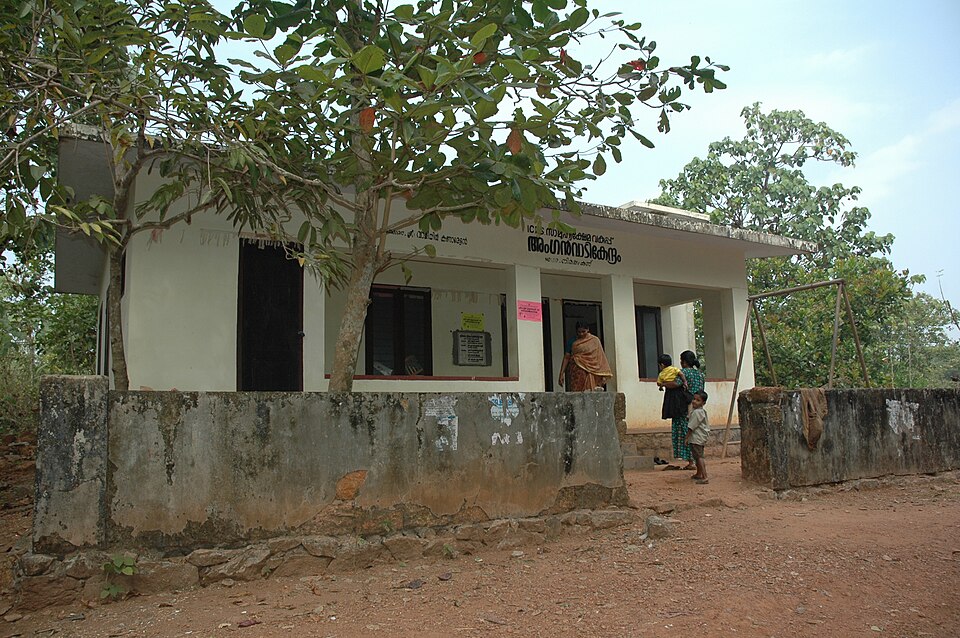
India's national health and nutrition programmes fall into recognisable waves, and dating them is really a matter of placing a programme in the right wave. The 1950s to the 1980s were the era of vertical, single-disease programmes run from the centre — malaria, leprosy, tuberculosis, blindness — each with its own directorate and its own targets. The mid-1970s added a different kind of instrument: the Integrated Child Development Services, launched on 2 October 1975, was not a disease programme at all but a permanent delivery platform in the village, bundling supplementary nutrition, immunisation, health check-ups, referral, pre-school non-formal education and nutrition-and-health education for children under six and for pregnant and nursing mothers, all through the anganwadi centre and the anganwadi worker. The 2000s brought the third wave: instead of adding another vertical programme, the National Rural Health Mission of 2005 tried to strengthen the health system itself — untied funds to facilities, Indian Public Health Standards, decentralised district planning, and a new community-level worker, the ASHA.
In a four-way match you rarely need four facts; you need the two you are surest of, applied in the right order. Start with the outlier in time. NRHM is unambiguously 2005, and only options (b) and (c) say so. Then take the fact you are next surest of — ICDS on 2 October 1975, a date tied to Gandhi Jayanti and repeated in every nutrition chapter — and (c) is the only survivor. The trap the paper actually sets is the (b)-versus-(c) choice, where the two 1970s-80s dates are shuffled, so the whole question turns on whether you know ICDS is 1975 rather than 1983.
- Integrated Child Development Services launched 2 October 1975, out of the National Policy for Children 1974; six services through the anganwadi — supplementary nutrition, immunisation, health check-up, referral, pre-school non-formal education, nutrition and health education. Now run by the Ministry of Women and Child Development and restructured as Saksham Anganwadi and Poshan 2.0
- National Programme for Control of Blindness launched 1976 — India's first 100 per cent centrally sponsored health programme, aimed chiefly at cataract blindness; renamed National Programme for Control of Blindness and Visual Impairment in 2017
- National Leprosy Eradication Programme dates to 1983; it succeeded the National Leprosy Control Programme of 1955 and was built around multi-drug therapy
- National Rural Health Mission launched 12 April 2005; subsumed into the National Health Mission in 2013 along with the National Urban Health Mission. The ASHA — Accredited Social Health Activist — is its frontline worker
- Sequence to remember: ICDS 1975, NPCB 1976, NLEP 1983, NRHM 2005
- Dating ICDS to 1974 — that is the National Policy for Children; the scheme itself was launched on 2 October 1975
- Treating the National Leprosy Eradication Programme and the National Leprosy Control Programme as one date: control 1955, eradication 1983
- Confusing NRHM (2005) with NHM (2013) — NHM is the umbrella created when the rural and urban missions were merged
UPPSC asks scheme-to-launch-year matches and 'which of the following is NOT covered under scheme X'; UPSC prefers the functional question — what an ASHA is allowed to do, what ICDS actually delivers, which ministry runs a programme.
With reference to National Rural Health Mission, which of the following are the jobs of ‘ASHA’, a trained community health worker? 1. Accompanying women to the health facility for antenatal care check-up 2. Using pregnancy test kits for early detection of pregnancy 3. Providing information on nutrition and immunization 4. Conducting the delivery of baby
- (a) 1, 2 and 3 only
- (b) 2 and 4 only
- (c) 1 and 3 only
- (d) 1, 2 and 4
Answer(a) 1, 2 and 3 only
Same programme, one level deeper. UPPSC asks when NRHM was launched (2005); UPSC asks what NRHM's signature innovation, the ASHA, actually does — escort, counsel and detect, but not conduct deliveries.
A major health mission carried in 1996 was
- (a) war against leprosy
- (b) small-pox eradication
- (c) pulse polio immunization
- (d) popularisation of oral rehydration therapy
Answer(c) pulse polio immunization
Same skill — anchoring a national health programme to the right year, with leprosy offered as a distractor. It is a useful reminder that the leprosy campaign belongs to an earlier wave (control 1955, eradication 1983) than the mass-immunisation drives of the mid-1990s.
Which one among the following is NOT covered under Integrated Child Development Programme ?
- (a) Supplementary Nutrition
- (b) Immunization
- (c) Nutrition and Health Education
- (d) Family Planning
Answer(d) Family Planning
The very next UPPSC cycle takes the same programme from the other side — 2019 asks when ICDS started (1975), 2020 asks what it delivers. Family planning is not one of the six ICDS services.
- practice — not a real PYQ
The National Rural Health Mission was merged with the National Urban Health Mission to form the National Health Mission in which year?
- (a)2005
- (b)2009
- (c)2013
- (d)2018
Answer(c) 2013 — NRHM (2005) and NUHM together became the two sub-missions of the National Health Mission.
- practice — not a real PYQ
Which of the following is described as India's first 100 per cent centrally sponsored health programme?
- (a)National Leprosy Eradication Programme
- (b)National Programme for Control of Blindness
- (c)National Rural Health Mission
- (d)Integrated Child Development Services
Answer(b) National Programme for Control of Blindness, launched in 1976 and funded fully by the Centre, with cataract-led blindness as its main target.