
Which of the following is correct? (i) √7 + √2 > √6 + √3 (ii) √7 + √2 < √6 + √3 (iii) √7 + √2 = √6 + √3
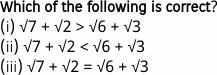
- (a)(i)
- (b)(ii)
- (c)(iii)
- (d)(i), (ii) and (iii)
Answer
Why
Correct — B.
Both sides are positive, so compare their squares.
Square the left: (√7 + √2)² = 7 + 2 + 2√14 = 9 + 2√14
Square the right: (√6 + √3)² = 6 + 3 + 2√18 = 9 + 2√18
Compare the surds: √14 < √18, so the left square is smaller
So √7 + √2 < √6 + √3, which is statement (ii) → option (b)
Why the others are wrong
- (a)(i) — (i) says the left side is larger. After squaring, both sides are 9 plus a surd, and 2√14 is less than 2√18, so the left side is the smaller one.
- (c)(iii) — (iii) needs 2√14 = 2√18, that is 14 = 18. In decimals the sides are about 4.060 and 4.182, so they are not equal.
- (d)(i), (ii) and (iii) — Two numbers satisfy exactly one of >, < and =. The three statements exclude each other, so they cannot all be true at once.
Concept
To compare sums of square roots, square both sides. Squaring keeps the order of positive numbers, and (√a + √b)² = a + b + 2√(ab).
When the two pairs have the same sum (7 + 2 = 6 + 3 = 9), only the cross terms differ, so compare the products: 7 × 2 = 14 against 6 × 3 = 18.
With equal sums, the pair whose numbers sit closer together has the larger product, and so the larger total.
Decimals confirm it, to three places: √7 + √2 ≈ 4.060 and √6 + √3 ≈ 4.182.
Key facts
- For positive x and y, x < y exactly when x² < y²
- (√a + √b)² = a + b + 2√(ab)
- If a + b = c + d, then √a + √b < √c + √d exactly when ab < cd
Study next
Common traps
- Adding under the root, as if √7 + √2 were √9 = 3
- Dropping the cross term 2√(ab) when squaring, which makes both sides 9 and suggests equality
18 Sep 2025, 12:30, Quant Q.3 sets √6 + √2 against √5 + √3 (both pairs sum to 8) and asks for the incorrect relationships, keyed (i) and (iii).
Related PYQs
No directly related past PYQ was found.