
Simplify: √98 − √32 + √50
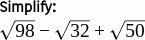
- (a)7√2
- (b)6√2
- (c)5√2
- (d)8√2
Answer
Why
Correct — D. Take the largest perfect-square factor out of each root.
√98 = √(49 × 2) = 7√2
√32 = √(16 × 2) = 4√2
√50 = √(25 × 2) = 5√2
All three are multiples of √2, so combine the coefficients:
7√2 − 4√2 + 5√2 = (7 − 4 + 5)√2 = 8√2
The value is 8√2 → option (d)
Why the others are wrong
- (a)7√2 — 7√2 is √98 alone. The last two terms do not cancel: −4√2 + 5√2 = +√2, which lifts the total to 8√2.
- (b)6√2 — 6√2 would need 7 + 4 − 5, with the minus sign on √50. The question subtracts √32 = 4√2 and adds √50 = 5√2: 7 − 4 + 5 = 8.
- (c)5√2 — 5√2 is √50 alone. It drops the 7√2 − 4√2 = 3√2 that the first two terms leave, and 3√2 + 5√2 = 8√2.
Concept
Surds combine only when the number under the root is the same — like surds, just as 3a + 5a = 8a.
98, 32 and 50 look unrelated, but each is 2 × a perfect square: 49 × 2, 16 × 2 and 25 × 2. Taking the square root of that factor outside turns every term into a multiple of √2.
After that the question is plain arithmetic on 7, 4 and 5.
A decimal check agrees: √98 ≈ 9.90, √32 ≈ 5.66 and √50 ≈ 7.07, and 9.90 − 5.66 + 7.07 = 11.31 ≈ 8 × 1.414.
Key facts
- √(ab) = √a × √b for non-negative a and b, so √(49 × 2) = 7√2.
- Only like surds add or subtract: p√2 + q√2 = (p + q)√2.
- √a + √b is not √(a + b): √9 + √16 = 7, but √25 = 5.
Study next
Common traps
- Combining under one root: √(98 − 32 + 50) = √116 ≈ 10.8, while the true value 8√2 ≈ 11.3.
- Taking out a square that is not the largest, such as √32 = 2√8, and stopping before reaching 4√2.
15 Sep 2025, 12:30, Quant Q.2 also turns on like surds: (√7 + √3)² − 2√21 expands to 10 + 2√21 − 2√21, and the like terms cancel to leave 10.
Unlike surds are compared by squaring at 18 Sep 2025, 12:30, Quant Q.3 and 19 Sep 2025, 09:00, Quant Q.3.
Related PYQs
No directly related past PYQ was found.