
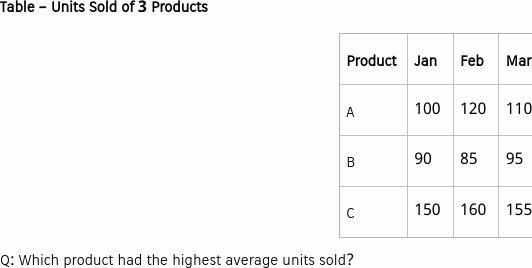
Table – Units Sold of 3 Products Product | Jan | Feb | Mar A | 100 | 120 | 110 B | 90 | 85 | 95 C | 150 | 160 | 155 Q: Which product had the highest average units sold?
- (a)A & C both
- (b)B
- (c)A
- (d)C
Answer
Why
Correct — D. For each product, add the three months and divide by 3.
A: (100 + 120 + 110) ÷ 3 = 330 ÷ 3 = 110
B: (90 + 85 + 95) ÷ 3 = 270 ÷ 3 = 90
C: (150 + 160 + 155) ÷ 3 = 465 ÷ 3 = 155
Compare: 155 > 110 > 90, so the highest average is C → option (d)
Why the others are wrong
- (a)A & C both — A averages 110 and C averages 155, so the two do not tie. An answer naming both would need their averages to be equal.
- (b)B — B has the lowest average, 90. All of B's months (90, 85, 95) sit below A's lowest month, 100.
- (c)A — A's 110 comes second. C's lowest month, 150, is already above A's highest, 120, so C must average more.
Concept
When every row covers the same number of periods, the highest average belongs to the highest total. Dividing each total by 3 cannot change the order.
Here you need not even add. C's smallest month (150) is larger than A's largest (120), and B stays below 100 throughout, so C wins on sight. When the rows overlap, compare the totals instead.
Key facts
- Average = sum of the values ÷ number of values.
- With equal counts, ranking by average and ranking by total give the same order.
- The totals here are A 330, B 270 and C 465.
Study next
Common traps
- Picking the row with the single highest month: here both point to C, but a row with one spike can have the lower average.
- Treating an option that names two products as a safe hedge: it is right only if their averages tie exactly.
A highest-average question over a table also comes at 9 Sep 2024, 16:00, Quant Q.11, where C2 (total 967) edges C1 (total 965) over four years, so there the totals must actually be added.
Related PYQs
No directly related past PYQ was found.